The Dynamic Duo that Completed Race to Alaska on a Hobie 16 is Back for 2026 with Another Hull and a New Teammate
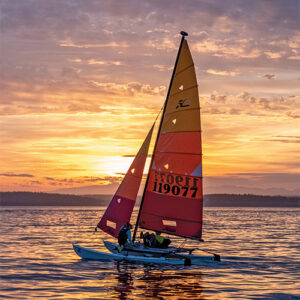
I’d rank John Ped and Kaila Pfrang’s successful R2AK on a Hobie 16 catamaran high among the epic race’s most impressive feats. Just arriving in Ketchikan leaves them in a class of one (no one else has made it on a Hobie 16), but the WAY they did it—smoothly (relatively), quickly, adeptly, positively… I’m a fan. And I guess the good feelings go both ways: I captioned my cover shot of them on the August 2024 issue of 48° North with a description of the pair as “scrappy and well sailed,” which John told me is “one of the kindest compliments we’ve ever gotten.” They’re back for R2AK 2026 on a Diam 24 trimaran, and they’ve added Kaila’s dad Chris to the crew. I recently got to interview them for the R2AK Podcast.
Tell us about your decision to come back and do R2AK again?
John: Kaila and I finished the last R2AK in about 9 days. The last two days were really a joy, and we stepped off the boat knowing we wanted to do it again. We didn’t know necessarily what it was going to look like, or who was going to be on the team; and we were lucky to have the three of us come together and the right boat present itself. Really, we just had such an incredible time and a great adventure in the last race.
John and Kaila, you’re a sailing power couple. Why screw that up by adding a third person to the boat?
Kaila: It comes down to sailing through the night. I hadn’t expected to do much of that and was pretty nervous about sailing through the night on our first R2AK. After Bella Bella, we ended up having the opportunity to essentially go straight through. It was so magical and so fun, and really not what I would have thought. So by adding a third, it means we may get to sail straight through and experience the race in a whole different way.
I do want to ask you about the plan to sail all the way through but first, Chris, how are you feeling about joining these skilled multihull maniacs?
Chris: Well, a little intimidated. They’ve set a really high bar, but I’m really happy that I’m able to join them and be part of the team. It’s already been so much fun planning this out, trying equipment, putting things together, splitting up duties, and everybody’s taken on particular aspects of preparation they feel they could contribute to most. All of that together makes this a real adventure and also a real challenge, and something to really look forward to.
Was there anything about John and Kaila’s 2024 R2AK that specifically made you want to join the team?
Chris: Definitely. I was at the start in Port Townsend helping them out with the boat and putting the last things together. Then, I was in Victoria taking apart a pedal drive in the middle of the night and putting that back together, and being part of the cheerleading team. At that point, a part of me was saying, “Hey, I want to do this.”
John and Kaila, remind me about your sailing backgrounds?
Kaila: My sailing background is primarily high school and college sailing. My dad and I sailed 505s together for a while, so I think that’s kind of what got me into more high-performance sailing. We sail Vipers all together. And then up into the Diam, basically adding a hull every year for the past three years of my life.
John: My background’s similar, definitely focused on dinghies. I grew up in catamarans, high school sailing, college sailing, some skiff sailing. And I was super fortunate in high school to join a Transpac campaign. I did two Transpacs with a team and got to see behind the scenes all the work that goes into putting together a program like that. That got me some offshore experience.
How about your sailing history, Chris?
Chris: I don’t want to say too much, I might not be able to join the team any longer if I tell them how little I actually know. But I’ve really gotten into sailing since Kaila started, and developed ever since. I became a sailing instructor and have been doing junior sailing with kids throughout the school years for Kaila and her siblings.
You guys say that the origin of your team is a bar in Germany between karaoke songs. The really important question is: What were your song choices?
Kaila: I believe my sister and I sang “Dancing Queen.” It was definitely a Mamma Mia song.
John: I was there to cheer on Kaila and her sister; and to talk Race to Alaska plans with her dad. I showed him pictures of the Diam 24 that I wanted us to buy.
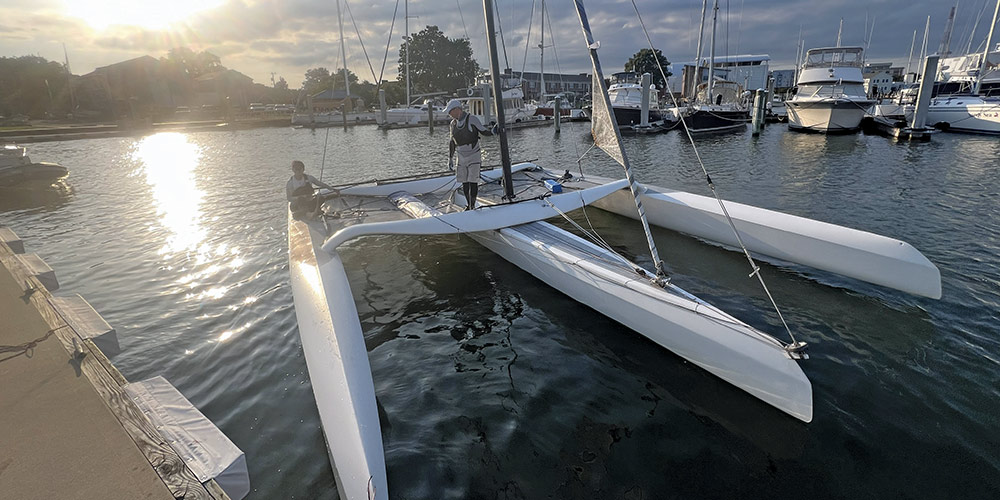
Speaking of the Diam 24, share a bit about the arc to landing on that boat. What made it the choice for you for R2AK 2026?
John: We were initially looking at boats more similar to the Hobie 16—like F18s—and Kaila and I doing another doublehanded attempt. But we really couldn’t piece together being doublehanded and being able to sail through the night. So we started expanding the scope and landed on boats that were big enough for three. We looked at taking the Viper, which is a 22-foot keelboat that’s really more geared towards inshore buoy racing.
Then we stumbled upon the Diam 24 while we were doing a test sail of an F18 in San Francisco. We saw this boat—it looked powerful, well-built—and as we started researching, it turns out it comes from a really reputable designer and builder in France. These boats have been raced on a professional circuit there, so they’re well-proven and get pushed super hard. We liked a lot of its features: it was compact, easy to push with a pedal drive, but also had a lot of power. It’s super stable, has full-length amas and twin rudders, and really robust construction. So we felt like it was a good balance of fun and sporty, cost-effective, and also safe and stable.
I’ve picked up noise from some internet opinionistas—not necessarily reliable sources—about the Diam 24’s narrow entries and concerns about buoyancy in seas, like the boat specializes more in flat water. Has that been something you’ve noticed in training, or do you have other information that suggests sailing it in seas is going to be just fine?
Chris: John and I doublehanded the boat in pretty big seas—4 to 5 feet? The boat handled really well upwind. We had to throttle it back a little bit because it wanted to go faster and faster and, given the sea state, we wanted to keep the boat safe. Downwind was similar—we had to throttle it, but it was sailable and maneuverable and responded well. With the sail choices we’ve made and the reefs we’ve added, I think the boat will be able to perform in almost all but the most extreme conditions. We’re really happy with the setup, how it handled, and how easy it was to sail in those conditions.
Kaila: I’d add that coming from monohulls and then the Hobie 16—which is a very tippy boat—especially around Cape Caution where every wave we were jumping forward to keep the boat down, I’ve been very impressed with how the Diam 24 handles. It feels shockingly stable. In big puffs, we’re able to turn that into speed instead of flying over quickly.
Chris: One of the things that really surprised me early on, coming from monohulls, sailing the Diam 24 in flat water—we’re sailing along and then see the actual speed of the boat and we could barely believe it. We’re going 16, 17 knots, and it felt like going fast in a 420. It was so stable and impressive how slow you felt, even though you were going really fast for a sailboat.
In what ways does the boat decision influence your planning?
John: The biggest thing is weight management. We’re tracking every ounce we bring. Any weight we add is a detriment to performance. We’re focused on keeping weight down and systems simple, but not skimping where we need to make the boat survivable, fast under the pedal drive, and warm enough when sleeping.
Kaila: I want to say we only have about 140 pounds for everything—food, gear, water, sleep system, pedal drive—all of that within the boat’s limits.
Can you dig into what round-the-clock sailing will look like on the 24?
Kaila: We’ll be more strict on a shift schedule. Last time, John and I were roughly on shifts, but if we were both tired, we’d dock and sleep. When we sailed through the night, one person would take the bulk of it, then switch near sunrise. This time, a bit more structure.
We’re being a lot more particular about our nutrition—that was a big lesson learned—we didn’t eat enough last time, and that hurt the first half of the race. Eating is your job and we will know the exact calories we need to eat in a day. Sailing’s your job too, but eating has to come first if you want to perform.
There are other things too, like making sure at least one person is sleeping the whole time, and building systems so you can steer from the pedal drive position.
John: Having a third person opens up a lot of options. We’ll emphasize staying ahead of what’s coming—temperature drops, wind increases—making sure we’re layered properly and have the right sail plan before changes happen.
Say more about your sleep system.
Kaila: On the Hobie, it was simple—closed-cell foam pad, blow-up mattress, emergency-blanket-style bivy, sleeping bag. Underway, it was a drysuit and full gear in the bivy sack. Not warm enough for high performance. I’m excited about this year.
Chris: I’ve been operating a sewing machine in my garage. We sewed a hammock that installs in the center hull, off the bottom, because water comes through the middle when you take waves. Then a mat, blow-up pad, and likely a double bivy—a bivy inside a bivy. I tried it in my living room and overheated in five minutes, so that’s a good sign. If necessary, we can move a person to the high side, but we’re hoping to sleep mostly in the center.
Speaking of systems, I understand there’s some team turmoil about how you’ll be pooing on the boat?
John: It’s a sore subject. I’ll be standing on the transom of the center hull and making gifts to Mother Nature during calm times (always 3+ miles from shore and in compliance with regulations), like we did on the Hobie. Others might have heavier plans.
Kaila: That is similarly my vote—keep the system simple by not bringing one.
Chris: I was the instigator of the bucket idea. In calm conditions, direct deposit off the transom works. In rough conditions, stepping over the tiller and holding on gets tricky. So I’m in the design process for a carbon fiber sh*t bucket. We’ll see if it comes along.
What section of the course are you most looking forward to revisiting?
John: I’m excited for another crack at the Gulf Islands. Last year we decided to go past Active Pass and then missed a tide gate at Porlier and had to stop for a few hours. We’ve done a lot of analysis of tide gates and required speeds, so I’m hoping to get that right this year.
Kaila: I’m really looking forward to Banks Island just southwest of Prince Rupert. That’s where we first saw orcas. The geography is amazing—you feel in the middle of nowhere and then mountains pop out of the water. And I’m excited, and a little nervous, about Cape Caution. Last time, we took this awkward straight-across approach from the tip of Vancouver Island and ended up hitting Cape Caution when it was windiest and the waves were the biggest. Hoping to approach it more confidently and better prepared this time.
Chris: I’m curious about the tide gates—whether pedaling against current is ever an option.
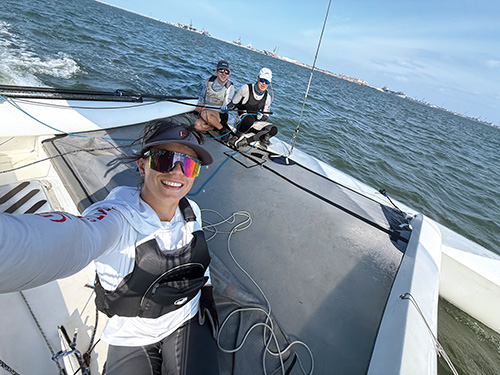
A three-strikes policy was part of your team video from 2024. What are the details and will the policy be in effect for the upcoming race?
Kaila: It was a big part of our first race. Three strikes—someone too cold, something breaks, weather shifts—and we’d stop and reassess. That day in the video, the pedal drive master link broke, the main halyard snapped, and it rained. We decided to stop before Johnstone Strait and fix things properly. We’ll likely take a similar approach—monitor the boat, the weather, ourselves.
What good or bad advice would you give first-time R2AKers?
Kaila: We based some tide gates on how much current we thought we could handle instead of just waiting for slack. That was pretty fun. The good part of that advice is to know your boat—what speeds and handling you’re capable of—and don’t just blindly follow the typical advice of always waiting for slack tide.
John: I don’t know if it’s good or bad advice, but race hard. Sail hard and push. We’ve learned a lot by pushing hard.
Why do you adventure race, and why should others?
Chris: For the challenge. Seeing if you’re able to do it, knowing you may not be. You prepare and find out if you’re prepared enough. That’s what makes it fun, what makes the adventure.
Kaila: I enjoy embracing The Suck. You learn a lot about yourself and the environment. It expands who you are. And it changes how you understand the world. John and I hiked the Appalachian Trail traditionally—backpacks, 20 miles per day for a few months—then later ran the Long Trail supported by family. Same mountains, completely different experience. Adventure racing gives you that different lens.
John: I’m aligned with that. It’s a privilege to see these waters and lands this way. Going fast, you see things differently. And building the whole program—the team dynamics, everything before Port Townsend—that’s most of the race. It’s a super fun process, and there are so many ways to do it.
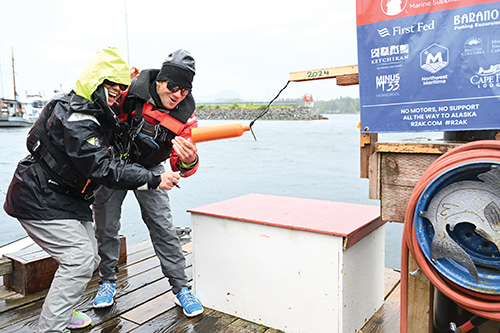
Joe Cline has been Managing Editor of 48° North since 2014.