 In some ways, boats are like books—they can provide a great adventure, an escape, or merely a few hours of relaxation. They can be an invitation to view the world differently, challenge the user to learn and grow, or even help them to overcome adversity.
Extending the metaphor, if boats were kept in a “boat library,” you could check them out with your “marina card.” You might select one simply based on its appearance, a rigorous comparison to dozens of alternatives, or a friend’s recommendation. Maybe you could keep one for a few days; or simply opt for a quick trial on a long, lazy afternoon before returning it to the lender, allowing someone else to enjoy it soon thereafter.
Despite those similarities, it took me a while to think of boats as books, choosing ownership as my first foray over chartering or renting. Even though we were new to Puget Sound and boating in general, regular 48° North readers will recall that my wife Laura and I bought a modest sailboat about four years ago. We may have gotten lucky with our half-century old Columbia 28, Ariel. She was affordable, forgiving, and easy to sail. Sure, her engine was fickle, she lacked systems like a roller furler for the jib, the head was tiny, and she hated going upwind. But for first-time boat owners, she was just what we needed and was within our capabilities.
Like reading a great book, we were indeed challenged, entertained, and engaged. But after recently selling Ariel, Laura and I have reassessed boat ownership in favor of leasing and borrowing club boats, much like the library model. Financially, the cost is about the same, but the benefits are different, with education and new opportunities finding their way into the mix.
Two aspects of our new approach are so ideal that we’re not sure why we didn’t think of them before. Although our lack of experience and knowledge of sailing probably had something to do with it—reminding me of the adage of “wishing I knew then what I know now.”
One of the options is to check out a small sailboat from our yacht club’s inventory. While we knew that the use of their Cal 20s was part of the association’s monthly membership dues, we never had the occasion to check out any of them—until now. With Ariel in the hands of new owners, our club’s feature is a great way to continue sailing in the summer months.
An on-the-water training session was required prior to checking out one of the four vessels in their fleet. Initially, I found the requirement unnecessary, given my time aboard our sturdy 28-foot sloop. But after completing the practice session, I found myself grateful for the additional training.
As if on cue to support our frustration with the lack of consistent sailing conditions in the Pacific Northwest, gusty winds up to 25 knots canceled our originally scheduled training session with Dave, one of our former dockmates. The follow-up date was nearly scrapped for the opposite reason, with the wind at a mild 4 knots. But since the small, swift craft responds well to light winds, we proceeded.
Dave and his wife, Patty, own an Erickson 38, Wavewalker, along with their own Cal 20, Sunseeker. I found Dave’s experience, complemented by patient and thorough instruction, a valuable asset as we adapted the skills and knowledge of sailing techniques, terminology, and safety we’d developed on Ariel to the Cal 20 Iris. Iris and the three other Cal 20s spend summers at the marina guest dock, ready for check-out by any club member seeking an afternoon adventure on Commencement Bay.
In addition to providing instruction to new users, Dave races his Cal 20 in our club’s summer series. His vast experience proved to be practical for pleasure sailing as well. For example, though not actually sailing (nor even allowed in racing) the practice of “sculling” a boat’s rudder to provide forward motion was new to us. Sitting “in irons” as Dave referred to the dead air conditions, Ariel would bob, sway, and drift aimlessly, until we fired up her engine or awaited the faintest breeze to fill her listless sails. But Iris seemed ready to propel onward, whether by wind, motor, or rudder oscillation.
While I’m not sure that our 6,000 pound Columbia sloop would have responded to the practice of sculling had I known about it during our time with her, I was amazed that I was able to achieve a speed of nearly 1.5 knots during a windless spell of our Cal 20 training session.
But when forward motion wasn’t desirable, say, when having a snack or just needing a moment to rest, regroup, or reef, Dave taught us another sailing trick—heaving-to. This technique will be old hat to more experienced sailors, but was a revelation to us. The technique nearly stalls momentum, limits progress in any direction, and reduces the heeling angle of the vessel. Accomplished by backwinding the jib with the clew to windward and the sheet tightened, the main is positioned on the opposite side as the jib with the the tiller lashed over. The results: a fairly stable pause point in most conditions. Again, I wish I knew that a few years ago.
Sailing the Cal 20 was exciting and enjoyable, but is still a summer event for fair weather sailors like Laura and me. On winter days when the chill cuts through to our bones—or alternately, when the wind is but a whisper—a powerboat with an enclosed cabin is the perfect vessel to help us enjoy being on the water, which brings me to the second option for boat-less sailors.
We recently discovered another organization that has a fleet of powerboats for us to check out for a monthly premium. When you consider moorage fees, yearly maintenance, repairs, and upgrades, the rental cost for us is actually less than the price of owning a vessel that remains in the water year round.
Once again, the learning curve was steep. Piloting a boat with a cruising speed of 25 knots required quite an adjustment of focus for me as captain and helmsman. Aboard Ariel, I was able to take in the sights of Commencement Bay without much vigilance, knowing that in traveling at a speed of three or four knots, I would have plenty of time to avoid any obstacle. Additionally, the lumbering sloop was the stand-on vessel in an encounter with a powerboat, giving me added confidence in my navigation.
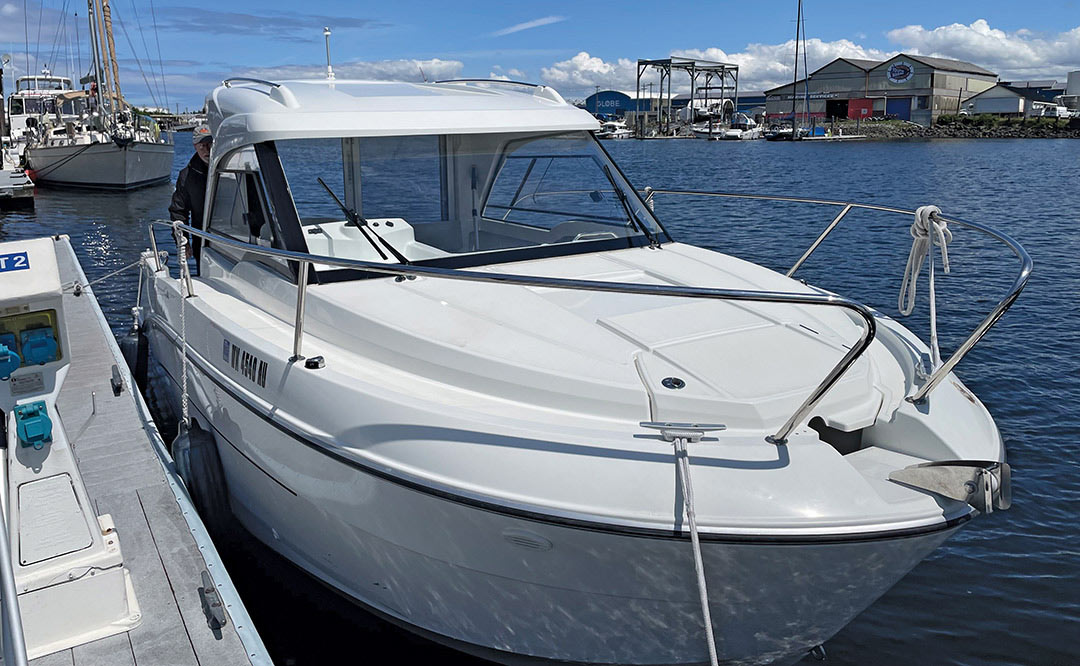
In contrast was our early outing in a Parker Poland Scamander, necessitating a watchful eye on a swiveling head, looking for approaching boats or “timber whales” bobbing in the swells. At nearly six times the speed of our sailboat, the zippy pilothouse boat required a focus on the destination and journey at the same time—offering new appreciation for the value of a navigation system. As we headed rapidly toward Gig Harbor one afternoon, I relied on the display long before being able to sight the narrow opening of the picturesque bay with my naked eye.
A week later, when trying out a Beneteau 22 during a light rain with overcast skies, I again relied on the electronic navigation system since visibility was limited, a situation that I never encountered because we only sailed Ariel in ideal conditions.
Since powerboating does indeed demand a set of skills different from sailing, the company leasing the powerboats requires an on-the-water training similar to the one we received for the Cal 20. Furthering my knowledge of boating was their two-hour course on safety, regulations, and marine knowledge. The online course, while mostly a refresher for me, provided clarification on buoys, charts, and marina rules, which increased my confidence as well as enjoyment on the water.
When reviewing our recent experiences with “library boats,” Laura and I feel pleased with our decision to temporarily eschew boat ownership. We still remain open to finding an “edition” that is so perfect for us that we may again purchase a vessel of our own.
For now, the variety of vessels and the absence of maintenance provide benefits that outweigh those of ownership. Walking away from a boat without worry or guilt about projects left unaddressed feels convenient and incredibly decadent. On the other hand, we need to plan our outings with the availability of boats in mind, knowing that other folks like us may also be seeking to check out the same popular model on a given day. When that happens, we’ll have to settle for either a used copy or maybe one that didn’t quite make it to the best-seller list—but who knows, our favorite adventure story might just be the one we didn’t appreciate until we got a few pages in.
David Casey is a retired math teacher, and woodworker. After relocating from California, he and his wife Laura enjoy exploring the vistas of Puget Sound from the deck of a boat or a promenade along its shores.