Island Packet Yachts is building toward a nearly 50-year legacy. Founded by naval architect Bob Johnson in 1979 and growing to notoriety as one of the prominent American sailboat builders, Island Packet has ushered in a new era since longtime San Diego-area Island Packet dealer, Darrell Allen, and his wife, Leslie, assumed ownership in 2017. In this recent chapter, they’re honing the niche as one of the last remaining manufacturers of full-size, semi-custom sailing yachts in the United States.
 Yes, this is a boat test article, yet both the company’s history and Darrell and Leslie’s specific influence are important to the story of Island Packet’s new 42-foot Motor Sailer. This boat is, in a variety of ways, indicative of the Florida-based builder’s evolution, and is aligned with their philosophies and priorities from design to construction process, and as well as the finishing and outfitting details. Darrell’s fingerprints are all over the Motor Sailer project, but so is his priority to adapt and execute the design to clients’ specific desires thoughtfully as a part of the build. Let me put it this way: I’ve never crawled around an engine room with the president of a sailboat company before, let alone heard their informed description of the decision calculus of which components should go where and why, and what slight alterations and upgrades they’re already eying for future builds. That is, until I had that experience with Darrell on the Motor Sailer 42.
I recently had the good fortune to go sailing on hull #1 of Island Packet’s Motor Sailer 42, which is happily homeported on Bainbridge Island. Of course, all types of boats have all types of fans in these waters, but there are certain categories with similarities—one such significant category is the stout weather-ready vessel that provides unique comfort for year-round enjoyment and thrives logging long miles in the Inside Passage’s fickle conditions. Since our cruising grounds can be seldom-summery or less windy than sailors would hope (or both) the sturdy trawler has been the default choice in this category. The Motor Sailer 42 should definitely draw the eye of boaters to whom this approach appeals.
Of course, its superpower is that it’s also a sailboat, and a solid one at that. Over the years, other motorsailer designs have done well in the Pacific Northwest, but I don’t think any offer the new Island Packet’s combination of space and modern creature comforts. This is a well-considered design whose greatest strength is that it doesn’t try to do everything, no matter how contradictory that might sound in light of its dual-purpose name. I’m actually relieved that Darrell and the Island Packet team didn’t try to load this thing up on power to make it a souped-up speedboat (which would require a lighter build). I’m glad they didn’t chase top-end sailing performance at the expense of this Motor Sailer’s gentle motion in waves. The Island Packet Motor Sailer 42 is steady, stable, comfortably livable, and ready to do some distance—we could have motored from Bainbridge to Ketchikan without refueling!
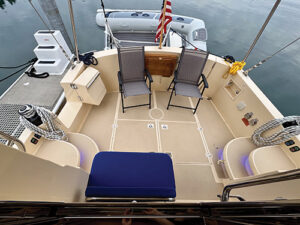
This is a big boat in pretty much every dimension, but it doesn’t have the top-heavy look of many trawlers of similar length. It won’t be mistaken for a low-freeboard thoroughbred either, but its styling reads clearly as a sailboat. Its length overall, including the sprit and swimstep, stretches to 44 feet, while keeping some slightly more classic lines with its 34.75-foot waterline. The beam of 13 feet feels luxurious when moving around the boat, but was noticeable when leveraged at steeper heeling angles sailing upwind. Perhaps the Motor Sailer 42’s most noteworthy dimension is its heft, displacing 33,000 pounds. Darrell is the first to promote that they doubled(!) the ballast from Island Packet’s closest design cousin (a motorsailer of similar length debuted in 2007), which only had 5,000 pounds of ballast to the Motor Sailer 42’s 10,000 pounds in the keel.
The boat feels incredibly stiff and sturdy as a result of these choices. It has a predictable, settled way through the water. It was noticeable the moment we turned into Puget Sound chop with a northerly pumping in the mid-to-high teens.
Inside the house with the heater on, everything was warm, comfy, and smooth. I normally leave interior discussions to the end of an on-the-water article, but the interior liveability is so paramount to this design, it deserves top billing.
Stepping aboard the Motor Sailer 42 is most easily done through the cockpit due to the boat’s massive freeboard. For a boat of this size, the cockpit is fairly compact and utilitarian. Hull #1’s owners opted to forego built furniture in the cockpit other than one fold-down seat on the forward bulkhead and a small, varnished fold-up table aft. They brought out the ergonomic folding chairs they use instead from the gigantic storage lockers under the sole. Stowable chairs are a sensible choice in a rainy climate. Though fairly small, I’m certain the cockpit is still where the happiest hours of a cruise will be wiled away.
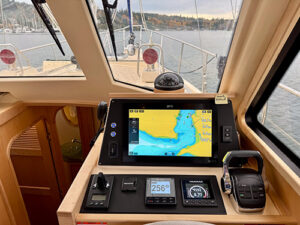
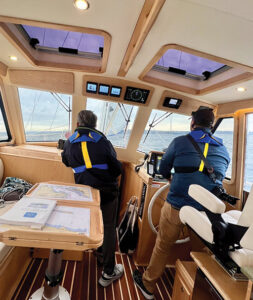
Island Packet’s new Motor Sailer boasts single-level living between the cockpit and the main pilothouse salon, and the door separating the two is high-end and strong. Heading into the salon, there’s a slightly-raised U-shaped settee to port with the thoughtfully-constructed electrical panel aft. The primary helm station is to starboard, forward of the linear galley. Engine controls and navigation displays are arranged around the helm station, and the sail controls—including the electric three-speed primary winch—extend just to the port side of the gently-angled companionway stairs that go down to the living quarters. Visibility to the mainsail is excellent, through an overhead pair of matched athwartships hatches in the forward portion of the salon. Headroom is an impressive 6’6” and combined with brilliant 360-degree views through the large windows—the salon experience is all space, comfort, and luxury.
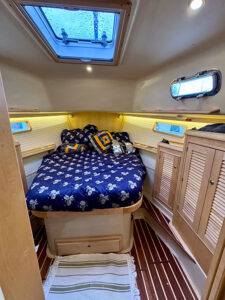 Stepping forward down the stairs using the nicely placed handrail, there’s a midship double berth (my personal favorite) to port where the washer/dryer is also kept. A head with separate shower is to starboard before you arrive in the owner’s V-berth cabin with a centered queen bed and its own private head. All of this interior functionality made this boat feel move-in ready, for living aboard or long distance cruising. It’s elegant but not overdone. To me, it begs to be used and is sure to be appreciated by owners and guests alike.
We were ready to put the boat through its paces under sail. Like a lot of sailing purists, I neither expected, nor expected to like, the single push-button system in the pilothouse that unfurled the main. Pretty slick! On days when you’re traveling through a lot of pockets of intermittent geographic-influenced winds, I doubt there’s an easier system for furling and unfurling.
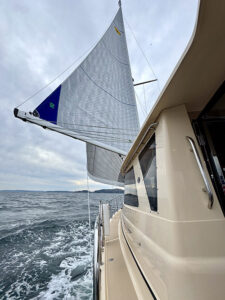 The Motor Sailer 42 employs a solent-style rig with a self-tacking jib on the inner forestay and a 170% reacher on the forward masthead forestay that tacks to the end of the boat’s minimalist sprit. Unfurling and sheeting the reacher are the only sail handling operations that would require you to leave the comfort of the pilothouse, and even then it’s out into the boat’s completely covered aft cockpit. Your foulies might only get their workout in the dinghy to shore!
We started sailing upwind. I’m glad we sailed upwind first, because there was a bit of expectation adjustment. Flashy upwind performance was never going to be this stout full-keel design’s goal, but still we chugged along making 3.5-5 knots pushing apparent wind angles to the high 30s. Even with its freeboard, some spray found its way to the forward-facing house windows, but wipers restored visibility with ease.
Sail tweaker that I am, I wanted to play with many elements of the set-up, but I didn’t find a lot of gold to mine in the fullest upwind mode. Moreover, sail adjustments producing heel of more than 15 degrees was a quality of life reduction in the cabin that spans nearly the boat’s full 13-foot beam.
Cracking off to a close reach with full main and jib, however, the boat came to life—speeds topped 6 knots, the heel moderated, and I saw firsthand what may have been predictable all along… If your course is dead into the wind on a motorsailer, there’s a good chance you’re going to use the motor. If the course breaks away from close-hauled, the sailing becomes both more effective and more enjoyable.
We happily threw in some tacks, which required no more action from us than turning the wheel. Soon we beared away farther and tried out the reacher. It’s a huge, powerful sail, and scooted us effortlessly along just off a beam reach with speed pushing above 7 knots and motion smooth enough to set your coffee cup down without worrying.
I was eager to test out what the boat could do under power with its 110 horsepower Yanmar. There were no big surprises here, just solid, reliable performance. The cruising speed is likely to be in the neighborhood of 7 knots—a knot or two slower than many trawlers—but the Motor Sailer 42 will sip fuel by comparison and use even less diesel if you sail some of the time. Recommended cruising RPM were between 2,200 and 2,400 and, pushing just above that range, we were chugging along pleasantly at 6.6 knots upwind into 20 knots, windwaves, and a waning flood. In this mode, we were consuming about 2.5 gallons per hour, and I measured the cabin noise level at 74 decibels of what I found to be a pleasing engine hum. Given its fuel capacity of 233 gallons, the Motor Sailer 42’s realistic range is around 700 miles. That’s a lot of miles!
As someone who is pretty captivated by sailing performance, and has even dabbled with engineless sailing, it’s probably not surprising that I’m not the market for the Motor Sailer 42, at least not right now. But sometimes testing a boat like this, which isn’t quite right for my sailing dreams, is actually the richest experience; because it illuminates all the things I still appreciate about a design I might not personally choose.
I think Island Packet’s Motor Sailer 42 will be perfect for a lot of folks in this region, especially those who want to explore the remote corners of the Inside Passage and Alaska with all the creature comforts and the ability to go sailing when conditions allow. It’s spacious, livable, and high quality—all in all, an exciting prospect indeed.
Joe Cline has been Managing Editor of 48° North since 2014. Special thanks to Darrell Allen of Island Packet Yachts and the owners of hull #1 for taking me sailing.