It had been days since my routine AIS checks turned up a new target on the multifunction display, now caked with minute nodules of salt spray from the rambunctious sail south out of Sea Otter Cove on the northwest tip of Vancouver Island. We’d come across boats, dozens of them in fact, but all were small sportfishing outfits that were not transmitting their positions. And so, it came as a bit of a shock when a new triangle with a vaguely familiar boat name suddenly popped up. Bangarang. That’s fun to say, I remember thinking. Whimsical, playful, and oh so familiar. I called down to Gio, who was elbow-deep in processing a chunky albacore tuna we’d caught just a few hours earlier; “don’t we know this boat?” We stared at each other blankly for a few moments, recounting the dozens of boats we’d been on that year for any recollection of this curious vessel. Our brains were pretty much connected after nine months of full-time cruising with just the two of us onboard, and it was no surprise that we realized who it was at practically the same instant.
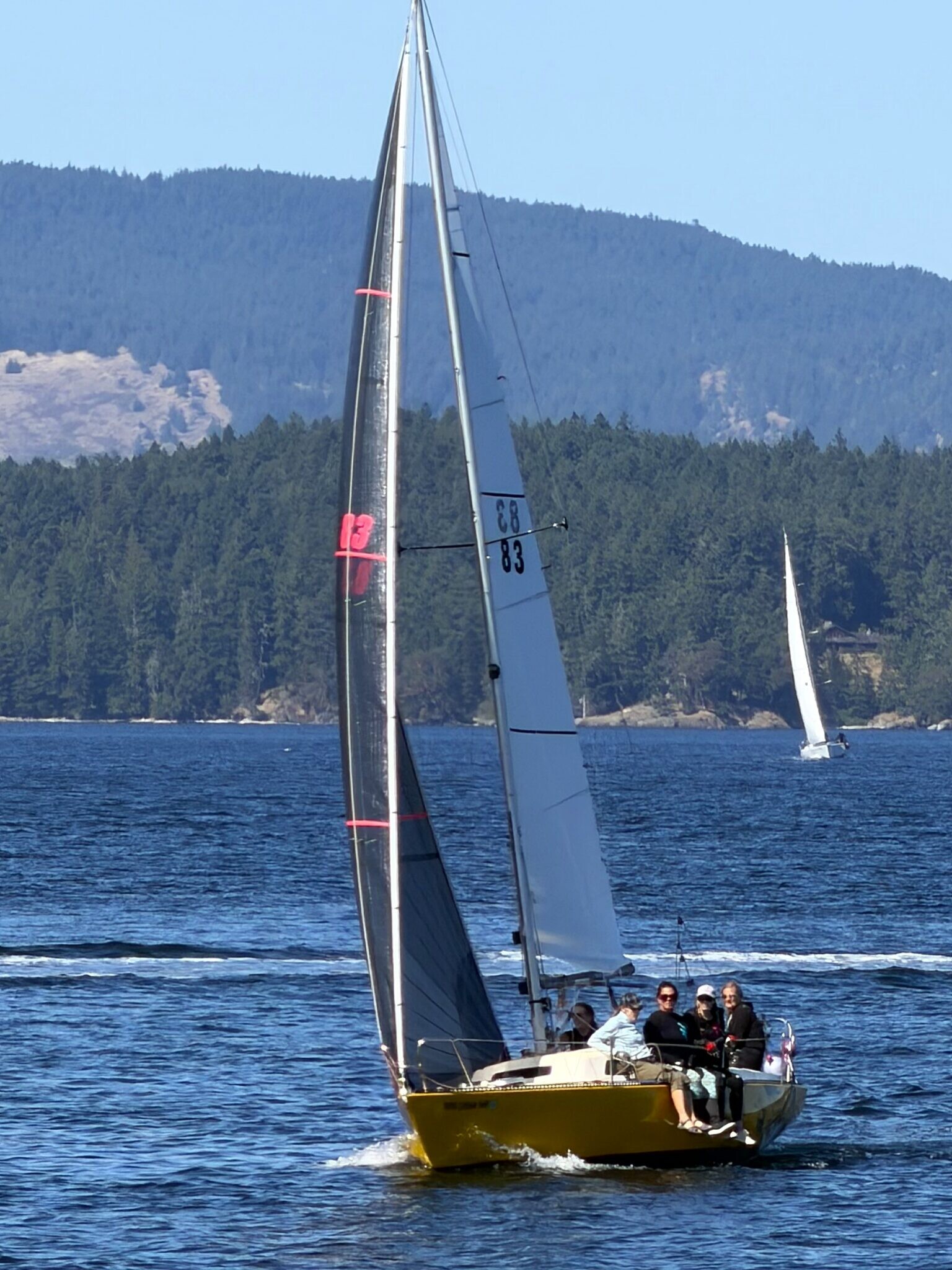
We’d met Jacob and Hailey on Bangarang several years ago during an open boat event at the Marine Technology Center in Anacortes, our alma mater and later Jacob’s as well. Shortly after our chance meeting, they purchased a simply-outfitted cruising boat and after a season of shakedown sails, set out around Vancouver Island for the summer. Never ones to take the easy route, we had purchased our own boat, Sea Fox, in San Diego and were on the tail end of a 10,000 mile voyage to sail her back to Anacortes via Mexico, Hawai’i, southeast Alaska, and now down the west coast of Vancouver Island. It was completely by chance that we happened to see them, well over a year later, smack dab in the middle of our intended anchorage for the night. Knowing this would be a total surprise for them, we couldn’t help but sail in as quietly as possible, waiting until we were nearly abeam before hollering “Bangarannnnnnnnnng!” at the tops of our lungs. Our plan worked perfectly, and a slightly dazed but gleeful Jacob, Hailey, and Echo the Husky popped up out of the companionway to see who was causing all the ruckus.
It wasn’t until much later after the obligatory boat tours and rapid-fire life updates that we got to the juicy talk that so many cruiser reunions are comprised of: laundry, food, good crabbing spots, ground tackle, battery banks and, of course, water. There’s a work around for just about all of the factors that could potentially curtail a cruise, except for sweet, fresh water, which is precisely where the conversation got interesting.
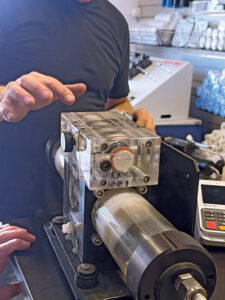
On Sea Fox we’re fortunate to have a capable watermaker that permits us to be somewhat casual with both our water consumption and cruising itineraries. And while we always err on the conservative side by minimizing our usage, keeping tanks topped up offshore, maintaining several onboard emergency caches, and utilizing saltwater whenever possible, we also aim to stay fully hydrated and periodically indulge in onboard showers without guilt. We were tangentially aware of ports with potable water options in case we had any issues, but never needed to exercise or entertain a routing deviation for the sake of water. And we could exist comfortably at anchor for over a month without the need to make water, sometimes longer with a bit of preparation and the occasional generous downpour.
Our experience over the past nine months of largely trouble-free watermaker operation and bottomless water tanks contrasted sharply with many cruisers we met along the way who were sailing sans infinity water. On the desert coastline of Baja California Sur we overheard VHF conversations between boats exchanging vital information about water availability, cleanliness, taste, and cost. In La Paz the daily migration from the anchorage to the single freshwater spigot at the dinghy dock was both predictable and relentless. In Hawai’i the one other cruising boat we shared an anchorage with suffered a watermaker failure on the way back to Seattle from New Zealand and spent over a week slowly refilling their tanks a few jerry jugs at a time from a dock spigot that was nearly a two-mile dinghy ride away. And now, on the west coast of Vancouver Island, our friends were weighing their options for prolonging their glorious summer cruise while keeping their primary tanks, added bladders, and all available vessels full of the fresh water that would allow them to do just that.
This experience, of course, begs the question of whether you need a watermaker or if it’s just nice to have. Given that fresh water is the lifeblood of any cruise, be it for drinking, cooking, showering, or cleaning, many long-distance ocean cruisers consider having the ability to generate unlimited fresh water essential. But here in the Pacific Northwest, where fresh water is relatively abundant and cheap or free, the value proposition becomes more nuanced.
Watermakers, also called desalinators or reverse-osmosis (RO) systems, are machines that take saltwater and turn it into potable fresh water by removing salt and impurities. The most common type on cruising boats is a reverse-osmosis system, which forces seawater through a semi-permeable membrane under high pressure, leaving salt and contaminants behind. It sounds simple enough, but each step requires precision to optimize performance. First, seawater must be drawn from outside the hull. Then pre-filtration removes particulates, silt, and organisms. Water is then pressurized, usually to about 800-1200 psi depending on the salinity. Then it’s on to the reverse osmosis process whereby high-pressure forces water through a sensitive membrane through which salt molecules are unable to pass. Product water (that’s the stuff you drink) is collected and transported to your tanks, while the resulting concentrated seawater (also called brine water), is discharged overboard. The result is fresh water you can drink and use straight from the ocean.
The biggest advantage: you can produce fresh water anywhere you have seawater, so long as your system is functional. For long offshore passages or cruising remote areas without options to top up tanks, the ability to make your own water is a real game changer that frees up options on the charts and the calendar as far as where you can go and how long you can stay there. Cruisers without watermakers often must plan fuel stops alongside water stops. With a watermaker, showers, laundry, equipment flushing, engine room chores, and dishwashing become less of a rationed luxury. This can greatly improve quality of life aboard, and for some people is quite high on their list of “must haves” in outfitting their cruising boat. On long bluewater passages, buying water in remote marinas and hauling jerry cans can become expensive, costing time, money or, in many cases, both. A watermaker reduces that ongoing cost, and though it doesn’t always fully offset the initial investment, many cruisers find the non-monetary benefits (freedom, flexibility, comfort) are the real value, not the cost savings.
But it’s not all infinity showers and bottomless water tanks. Good watermakers are expensive. Small units start in the low thousands, but quality systems can range from
$5,000–$15,000+, depending on capacity. By the time you factor in the installation, which involves plumbing in a dedicated seawater intake system, hauling out and installing a new through-hull or two, mounting the high-pressure pump and membrane, wiring, and adding structural backing, you’ll need to budget for about double the cost of the unit itself. Watermakers are power hungry too, especially if you choose a high output unit. Performance drops significantly if the unit is run at low voltage, such as from partially discharged lead-acid batteries. As a result, when used in solar-only or limited alternator systems, they must be carefully balanced with onboard power generation capacity and other loads.
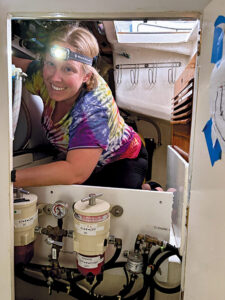
For a simple cruising boat, choosing an energy efficient watermaker can dramatically reduce daily power burden and system complexity. High efficiency watermakers have energy recovering devices built in and produce several times more water per watt than conventional systems, making them an ideal choice for boats that rely heavily on solar and battery power. However, this energy recovering technology is well reflected in the price tag of these efficient machines. Portable watermakers provide a simple option without the need for an invasive expensive installation. But there is no free lunch. These units typically have their own onboard generator powered by gasoline, which requires cruisers to carry a plentiful supply of this volatile liquid aboard, they cannot be used underway, are far from quiet, and represent the lowest efficiency watt per gallon conversion of any available option.
Owning a watermaker means being comfortable adding one more item to your boat’s already long maintenance list and several to your spares list. Watermakers perform best when they run regularly and biological fouling of the membrane occurs when they sit idle. To keep this fouling at bay, manufacturers recommend a regular (weekly) freshwater flush while some require periodic chemical flushing. The osmotic membranes are expensive, and they are extremely sensitive to chlorine as well. Flushing them with chlorinated water will destroy the membrane so flush water requires filtration through activated charcoal to neutralize chlorine. Pre-filters need regular changing and the entire system needs to be properly winterized in the offseason. Ignore maintenance and you risk a system failure that can easily become a safety issue without prudent water conservation practices in place. Breakdowns are possible, if not probable, and things like pumps, membranes, valves can be equally as difficult to troubleshoot as a novice as they are hard to source in remote cruising grounds. Lastly (although we could go on), RO systems produce brine wastewater that needs to be safely discharged overboard. While it’s usually fine to dump overboard offshore, in some environmentally sensitive areas this may be discouraged or prohibited.
If the cost and maintenance of owning a watermaker are barriers, there are alternatives many cruisers use effectively, especially in the Pacific Northwest. Fresh water is relatively easy to find. Most marinas and even some anchorages have potable water, often inexpensive or included in dock fees. Traditional cruisers keep the adventures exciting by hauling water in jugs. Creativity points are earned here since potable water sources are so varied and abundant in a temperate rainforest. Simple, cheap, and reliable with zero onboard power usage needed. On the flipside, though, jugs can be heavy, it can take hours or days to fill your tanks and the question of “where are we planning to store these things again?” must be answered. Hand-crank or small portable watermaker units are becoming another popular option these days. Though they are generally slower with a lower output, they can be a great backup option in a pinch. Rainwater catchment systems can also be a successful strategy. Using canopy or deck catchment, funneling into tanks, with a first-flush diverter. The Pacific Northwest’s frequent rains make this surprisingly effective.
Or you can take the road less traveled and exercise an option that requires precise planning and some luck. Make friends with some people who will buy a boat that already has a high output, high efficiency watermaker installed on it. Have them sail from San Diego to the north end of Vancouver Island and meet you at a remote anchorage to top your tanks off for you, which is precisely what we were able to do for our friends on Bangarang. After listening to Jacob and Hailey describe their options and attempt to quantify how dire their need to take on fresh water might become, we sent them home that night with full water jugs to top up their tanks and auxiliary water bladders before we parted ways the next morning.
We are lucky here in the Salish Sea that watermakers are a luxury, not a lifeline. And while they are certainly nice to have, especially for those seeking maximum self-sufficiency, they are totally not necessary for most cruisers here. If ocean crossings or long passages with no shoreside water access are in your future, a watermaker can be liberating. You make water every day, reduce tank planning, and don’t need as many extra jerry cans. In places like Alaska’s outer coast, or the central Pacific, where water stops are rare, adding a watermaker can give you freedom to roam farther afield. But if your typical cruise itinerary keeps you close to shore, with regular marina visits, cheap water fills and rainwater can be more than sufficient while still leaving you with a nice cruising kitty with which to explore our endless glacial fjords and archipelagos. If you love the idea of producing your own water and have the electrical capacity to support it, the comfort gains can be significant. But if your goal is simplicity, reliability, and minimal maintenance, you can absolutely cruise the Pacific Northwest and beyond comfortably without one.
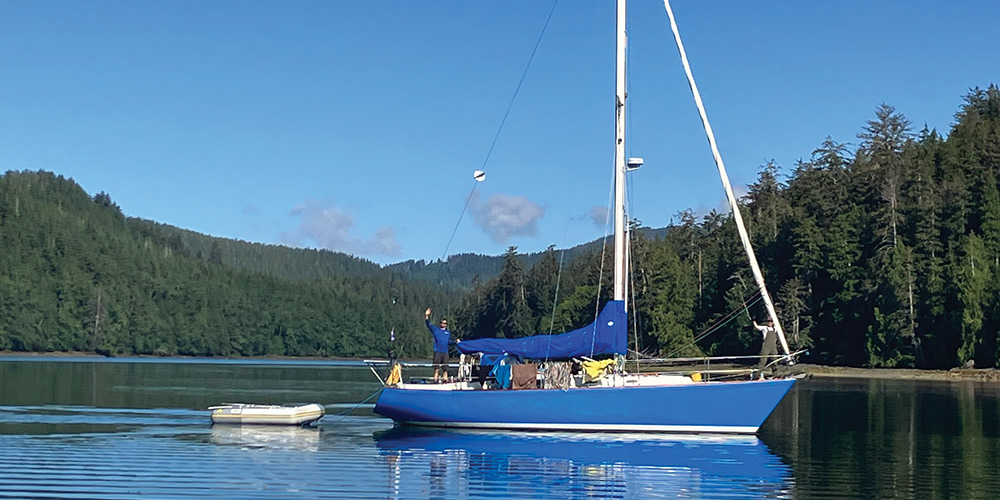
out from the chance reunion near Winter Harbour.
Gio and Julie of Pelagic Blue lead offshore sail training expeditions and teach cruising skills classes focused on preparing aspiring cruisers for safe, self-sufficient world cruising on their own boats. Details and sailing schedule at
www.pelagicbluecruising.com.