Happily, we pulled our C-Dory 22 Cruiser Sea Lab out of our Fair Harbor slip and onto her trailer for a good cleanup and a few repairs before our three weeks of late summer cruising. I really wanted the windlass to work before we left, the trim tabs were being wonky, and the bottom was a bit furry.
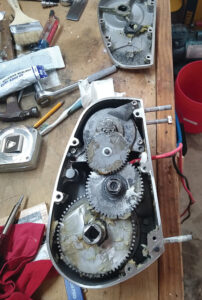
For some reason, the windlass stopped working last summer. Once you’ve had a taste of that system’s convenience, it’s really hard to go without it. Electrical power was getting to the unit, but it seemed somehow frozen up; so once Sea Lab was out of the water, I was determined to pull it off the boat, take it apart, and see what the problem was. As it goes, the modern way to initiate this kind of procedure is to watch YouTube videos. It’s a plan that has gotten me into trouble before, but I’m too stubborn and frugal to immediately recruit the assistance of a professional shop. So, on the bench it goes.
As I pulled out the housing screws, I kept thinking to myself, “A new one is $1,400, don’t screw it up.” In the video, the housing halves separate easily, and nothing flies out of the inside on springs. In reality, one of the drive gears is pressed into a fitting on one half of the housing, and it’s tight and doesn’t just slide off. There’s probably a special tool for pulling this off, but I didn’t have one, so two long screwdrivers would have to suffice—and they did. I was pleased to see I apparently avoided damaging anything except the irreplaceable gasket between the housing halves, but boy are there a lot of gears in there.
Not finding anything visibly out of place, I pondered the next question… does the motor work? I found and stripped the ends of some trailer wire for test leads and carefully carried the half of the windlass, with all the stuff in it, out to the boat battery. After removing the first drive gear, I touched the wires to their terminals and the motor jumped to life. Great, it’s not burned out. Next, I put the drive gear back in and re-tested it with power and, sure enough, the whole thing drives and appears to be working. The thing itself is not the problem.
Back at the bench, I cleaned up the inside of the housings, redistributed the grease, and made a nice new gasket seal with 3M 4000. After aligning, pressing, and bolting the halves back together, I rebedded the assembly onto the bow of the boat. To my disappointment, I pushed the button and all I got was a click. I already checked power from the relay to the connection and the spade connections looked clean and shiny, but there was nothing else it could be. So following another trip to town to buy some terminals and replace all four…Voila! It worked.
These are the kinds of things I love, and hate. Climbing through the self-doubt and worry when learning to do something that might ultimately misfire and cost a lot of money or cause me grief; but if I manage to succeed, the feelings of triumph and self-reliance make it worthwhile. With that task accomplished, the rest of it seemed easy and almost fun.
Once Sea Lab was ready in the driveway, we loaded on all our gear and supplies for three weeks—not having to cart everything down the dock seemed like a bonus. We pulled out of the driveway, boat in tow, and drove the mile and a half back to the marina and ramp launched before motoring around to our slip. We waited for the next morning to begin our summer journey.
Our plan was to rendezvous with our friends, Rob and Tracy on their Sea Ray 23 Blue Pearl at Blake Island and formulate a plan to head north into the Gulf Islands. The Blue Pearl crew had not boated across the border into Canada before, and there were a couple of places we really wanted to take them. They had 10 days, we had 21, so we raced up to the border and checked in without too much difficulty. Both boats called into Canadian Customs on the snazzy app, and they cleared Blue Pearl but told Sea Lab we had to check in at the dock at the South Pender station. We radioed BP and agreed to meet at the Poet’s Cove fuel dock.
After clearing in and topping up on fuel, we motored up the channel and through Pender Pass to head north to Winter Cove on the edge of the Strait of Georgia. We found it uncrowded and beautiful, and when I pushed the anchor down button, the windlass did its job without complaint. Anchor set, the Blue Pearl sidled up, and we rafted for the night in calm weather and stunning surroundings.
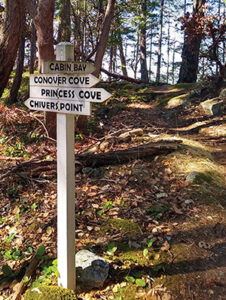
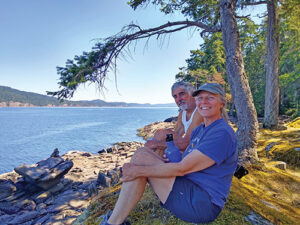
The next morning’s plans were to push farther north to Conover Cove on Wallace Island, a place we had been to a few years ago, and wanted Rob and Tracy to see. We made the easy transit, and managed to get space on the float across the dock from each other with a picnic table in between—perfect for communal meal prep. Tied up and settled in, we hit the hiking trails to the south end for some great views and maritime forest scenery.
All four of us are connected to garden and tree work, and are tuned-in to the landscapes surrounding us, and we all found this particular forest very interesting. One tree that was especially fascinating to us was the western yew, Taxus brevifolia, which I had seen on a previous visit to the island. It is an uncommon tree and, in 1962, it was discovered to have a chemical compound in its bark that is highly suppressive to cancerous cells, and the compound was given the name Taxol, which is used in many types of cancer treatments and is on the World Health Organization’s list of Essential Medicines. We sighted numerous examples of this tree, and all of them were very old and large for their type. Western yew is a small tree that blends in with the forest making it difficult to spot, so what people generally think of as “large trees” does not fit with this species. The large specimens we found were of 18-20 inch trunk diameter but were probably in the neighborhood of 200 years old.
We hiked and enjoyed Wallace Island for two days, and covered nearly all the trails on the island. The time slipped away and, before we knew it, it was time for the Blue Pearl to head home. We said our goodbyes, and Rob and Tracy headed south and we continued north.
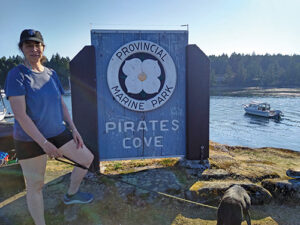
Our next destination was Pirates Cove on DeCourcy Island, an anchorage we had chickened out on entering at low tide years ago in our Cal 27 Moondance. We almost chickened out again as it was low tide when we arrived and there were three boats ahead of us waiting to enter through the narrow channel. Plus, from the outside, the inside looked quite crowded. We discussed going somewhere else for the night but decided that was silly as this was one of the places we wanted to see, and many people have told us how great it was. So we waited our turn.
Once in, we saw that there were three unoccupied stern tie chains just inside the entrance, and being in a very small and shallow draft boat we thought that would be fine for us. We had a 400-foot roll of poly rope aboard just for this occasion, and we knew it would be another learning experience for us. In 25 years of boating, we had never stern tied before. I dropped and set the anchor with our trusty windlass, then we got one of the kayaks in the water and set the stern-tie spool on a stick in Sea Lab’s rod holder. I hopped into the kayak and took the rope end to the chain, through a ring, and back to a stern cleat with an overhand loop knot. We tightened things up and were high-fiving each other on how easily and smoothly we accomplished the whole procedure, then settled in for a leisurely lunch and anchor watch. After a couple hours, we decided it was well-set—time for hiking. The trails were great, and Tim Tim the sailor dog was happy to be on dry land, so we explored for several hours
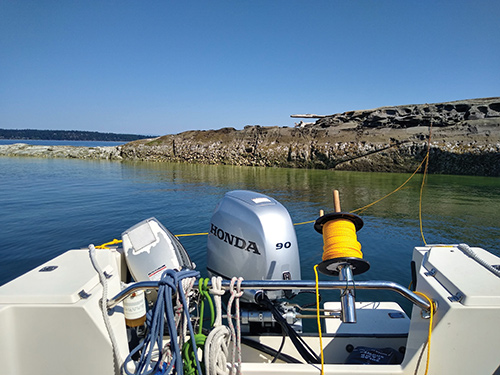
It was getting to be time for dinner, so we got back to the kayaks and loaded Tim in, and began to paddle back to Sea Lab. As we approached, something about the boat looked odd and it dawned on me that it was not in the same place as when we left. Sea Lab was parallel to the reef rocks and very close. We both shifted into high paddling gear, and arrived to find that Sea Lab had pulled her anchor with the rising tide. Swinging on the stern line, the boat had drifted back toward the rocks and was almost aground.
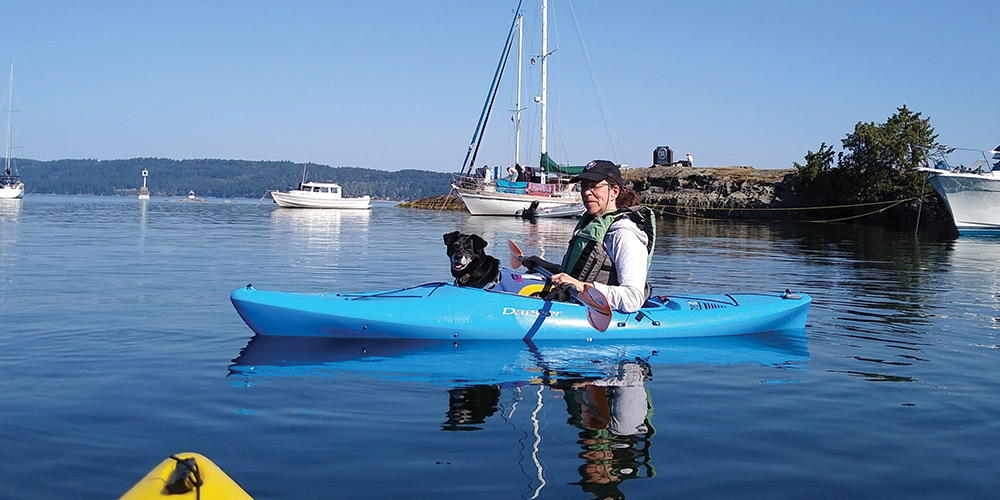
We climbed aboard, looped the kayak painters onto an empty rod holder, and I started the motor, asking Tekla to keep all the lines out of the propeller. Looking over the transom in the crystal-clear water, I could see we were moments away from being stuck in the rocks. Then I was in gear, moving away from the reef and raising the anchor at the same time. We had to get the stern line off the chain, so Tekla unhitched the end from the cleat and pulled it in from the other end, which was great until the knot from the overhand loop hit the chain… and stuck.
Meanwhile, during the rope shuffle the yellow kayak had somehow dismounted its hold and was 50 yards out the entrance and heading for the channel, but that had to be dealt with later. Around this time, we heard a shout asking if we needed help and we turned to see a man in his inflatable dinghy. “Yes, thank you! Will you free the knot from the stern tie chain?” And he did so quickly.
We felt back in control. With the line aboard, we moved up the bay a little, farther away from the reef, and in two tries reset the anchor. That accomplished, I jumped into the blue kayak to reset the stern line while the nice man in his dinghy went out and rescued the yellow kayak. Whew! We got everything tied back together and the adrenaline began to fade, and we were both frazzled.
We settled down with mugs of boxed wine and talked about what would have happened if we had come back 10 minutes later. Well, we didn’t. We worked it out, and nothing broke and nobody got hurt. Indeed, after all of these years, we’re still learning.
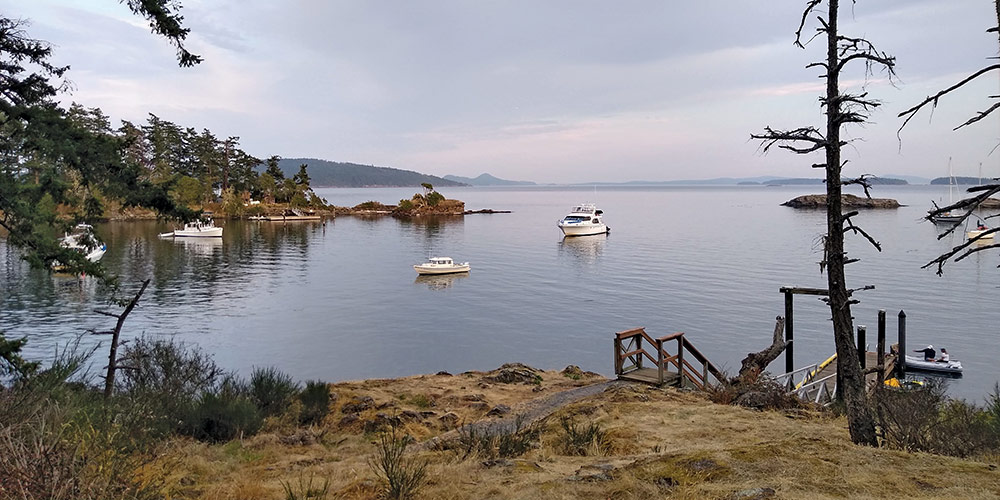
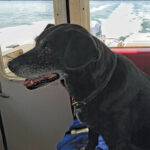 Dennis, Tekla, and Tim Tim the sailor dog recently changed their home cruising waters from Tacoma to Case Inlet.