After a lot of hard work, money, and diligence, you finally have a new or freshly rebuilt engine installed in your boat. Congratulations! Speaking from personal experience, it feels so good to have an engine that starts easily and runs well, especially when travelling outside of your home turf.
Now that the engine swap is over with, how do you get off on the right foot with maintenance and operation practices that will help avoid having to pull it again after only a few years? You may recall from past articles that I see too many low-hour engines in my shop with copious amounts of blowby, hard starting issues, and other problems. Many of these complications are related to an improper break-in procedure. Such trouble starts early and can be attributed, in part, to incomplete or outright incorrect information from some in the industry. I want to set the record straight and share my advice—based on my training and experience—so your engine can last as long as possible!
An all-too-common phrase I hear with new engines is, “You don’t need to break-in your engine because it’s already done at the factory.” False. This is so far from true, and it guarantees you will have consistent compression problems from the beginning. Having worked for an engine manufacturer, it is true that we would put the new and rebuilt engines on the dyno for initial testing (a dynamometer or “dyno” is a diagnostic tool with the ability to measure an engine’s power and performance under simulated conditions). However, this testing was nowhere near enough to properly seat piston rings against the cylinder wall. The break-in procedure is the responsibility of the new owner and is typically around 100 hours (according to most manufacturers).
The first 100 hours are the most critical for an engine that is new or freshly rebuilt. A lot happens between Hour 1 and Hour 100 that can affect the performance for the lifetime of the engine, and neglecting these procedures will ensure more premature wear-and-tear than normal. During the engine break-in period, there will be some excess metal-to-metal wear as new parts seat against one another. And while that is normal, we don’t want that process to harm components over the long run. Here are some steps to take to ensure that your engine is broken-in properly.
1: Change the oil early and often.

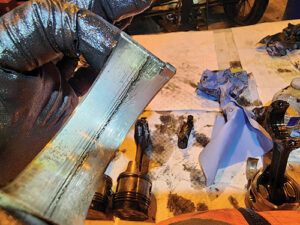
hours of use. Note the light, even crosshatch wear pattern.
After the very first start and run, as new parts are seating, there will be some metal in the oil. This is normal, but you want to get this metal out as soon as possible to prevent scratching or damage to precise surfaces.
Whenever I rebuild an engine or install a new engine for a customer, after taking it out on its first run under load, we change the oil and sometimes it’s fairly dirty after a single use, which is good. That means that the detergents in the oil have done their job to capture any debris. We want that to be flushed out by changing the oil.
While you can use a break-in specific oil, it typically is not required as most modern oils will do the job just fine; break-in oil is typically used at the manufacturer for the very first start on the dyno. After the first hour and first oil change, I typically advise people run the engine for 5 or 10 more hours before another oil change. During this period, the owner is instructed to vary RPM ranges and avoid excessive idling at all costs. After that, doing one more oil change prior to the 100 hour mark is a smart idea. After the initial 100 hours, then it is generally safe to adhere to the manufacturer’s specifications for regular oil change intervals.
2: Avoid idling or low speed operation as much as possible.
During the first 100 hours or so, most manufacturers advise running the engine harder under load while varying RPMs periodically during cruising. While I don’t encourage you to run full speed through a marina, get out of your slip, clear any obstacles, and then get the engine up to speed as quickly as you can and keep it up there. It is good practice to continue this type of use for the remainder of the engine’s life, as running the engine within its designed range is good for keeping its internals clean and clear of soot and carbon.
A lot of boatowners are afraid to run their new engines “hard” for fear of damaging them. While doing the initial seatrial, it is required to run the engine up to 100% under load for a short period to verify the vessel is propped correctly and that the engine is sized correctly. Failure of a yard or mechanic to do this will void any warranty if there is a failure, so make sure the engine is able to utilize all of its operating range without problems before leaving the yard.
3: Vary your RPMs while cruising.
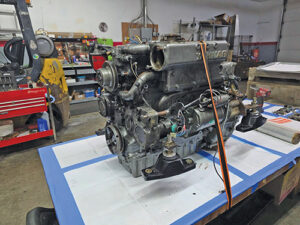
Yanmar, Kubota, Cummins, Beta, and many others encourage you to run your engine at varying RPMs during the first 100 hours, typically calling for changes in speed every hour or two. Mix it up, you don’t have to change speed much, just change it 100 RPM or so. If you are going to run it at 100%, avoid running at this speed for more than 5 or 10 minutes, but any other speeds are safe except idling (limit any excess idling, since this does the most damage). Check your temps, oil pressures, etc., with a mechanic during the initial hour to verify the install was correct and all systems are happy.
It really is that crucial!
Breaking-in your engine is one of the most important things you can do to ensure good performance and longevity. While an engine that wasn’t broken-in will still run, it will quickly develop cylinder glazing and stuck pistons rings, which will harm compression numbers, limit performance, prematurely damage parts and cause the engine to run rather uneconomically for the remainder of its life.
I see many engines with fewer than 400 hours on my workbench for a rebuild because owners were too afraid to break them in properly. Your engine will perform for thousands of hours without issue if you follow these tips. Now get out there and enjoy your new engine.
Meredith Anderson is the owner of Madame Diesel, LLC, where she operates a mobile mechanic service and teaches hands-on marine diesel classes to groups and in private classes aboard clients’ own vessels.