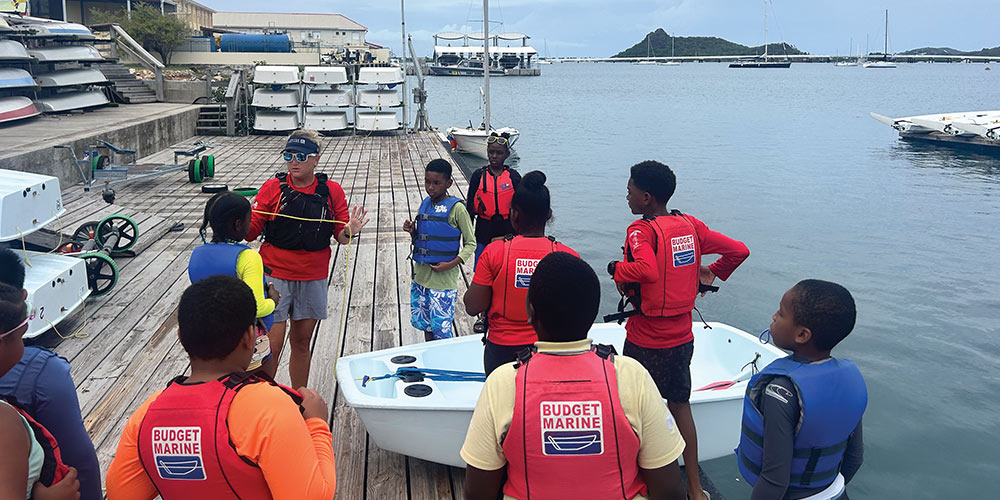
Sitting in a 15-foot RIB at the pin end of the start line, my arms are crossed over my life jacket and an orange whistle is clasped in the side of my mouth. I’m watching closely while Optimist sailors jostle to get up on the line. With sails luffing, then filling, then luffing again, some are on time, several are early, and others are late. From my vantage point, I pick out the sail numbers and life jacket colors of those I think are going to be early and intently watch what they’re doing to identify tips I can give them afterwards.

“5, 4, 3, 2, 1, BLAST!” The race is on… sort of. It’s a practice start, one of many we’re doing in this training session, so I blow the whistle several times to call the fleet back for a restart. In choreographed fashion, they ease their sails and bear away or tack to come back down to the line.
As I’d expected, three boats were over early, but several others absolutely nailed the start. I motor over to one of the students who was over early, hold on to the side of his boat, and offer a drink of water with my compliment sandwich: “I love how much speed you had coming off the line, unfortunately you were over early. The boat below you wasn’t very close, so in that situation I’d like to see you use some of that space to burn time—come down a bit, then back up, luff the sail, and hold your lane. Also, your body position in the boat was much better than the first start, so keep that up.”
In a Caribbean islander accent, he replied, “Yes, coach.”
“Good, go have fun!” I respond while motoring to the next boat.
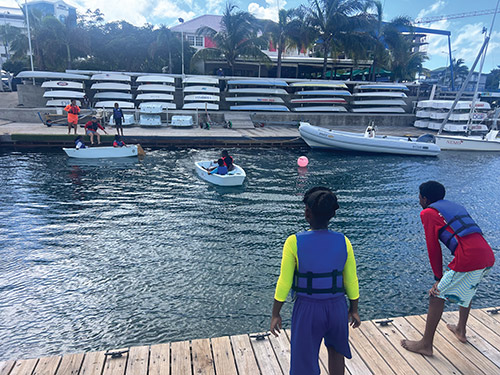
Later, in the debrief session at the yacht club, our group of coaches talked to the kids about starting strategy and how to put themselves in a good position to succeed on the start line. In my mind, there is a lot to that sentiment of getting yourself into positive spots, not just in sailboats. Sailing is the medium that teaches that lesson, but it can be applied to other aspects of life, too.
The idea of getting yourself into scenarios for success is something that has been filed in my teacher-brain for quite a while. I’ve employed it as an instructional tool when teaching lots of different types of sailors; from coaching kids and adults in racing, to leading cruising and offshore sailing classes in a variety of locales. I have a broad memory bank of tidbits like this, which have come over many years of spending time on the water, especially in the teaching capacity. This past summer marked the twentieth year that I’ve been instructing sailing, and my passion for getting people excited about the sport and lifestyle has only strengthened. That passion also extends into my writing, which I hope inspires and informs.
In that vein, the intent of this article is not to give readers my resume, but rather to provide some insight into what my varied experiences have taught me about sailing, teaching, and learning. After all, every good teacher is also a continuous learner, and the same is true of sailors. No matter how much time I spend on the water, I’m always learning from other coaches and instructors, from my students, and even from the ocean. Here are some reflections and takeaways from my twenty years as a teacher.

YOUTH SAILING
When I was 21 and fresh out of college, I started teaching sailing at a summer camp in Florida working with 8- to 16-year-olds. I really enjoyed and connected with that age group because I could see firsthand how much progress they could make in a short amount of time. Also, I appreciated how their innocence and trust could lead to pure learning and joy in the sailing environment.
Not only did that first teaching experience create a deep connection to the kids, it showed me how close sailing coaches are when working together towards a common goal. There aren’t that many jobs where your coworkers become such fast friends, with little to no competition between one another, and a level of information sharing that is admirably high-level. We all wanted our kids to succeed and, by focusing on that, we all wanted each other to be successful as coaches.
Fast forward to 2025 and I find myself at the Sint Maarten Yacht Club in the Eastern Caribbean coaching kids this age for the first time since that summer. Jumping back into this type of teaching after two decades of other pursuits in sailing education—now in another country—I was struck by how the themes and rewards remain the same. I was immediately eager to go through the learning process with these kids and also to join a group of impressively knowledgeable instructors. It’s refreshing to teach youth sailing again and, when I asked one of our youngsters recently how her school day was, she said with all honesty, “It’s much better now that I’m about to go sailing.” That right there is what it’s all about.
Takeaway: Be patient. To best achieve all of those positive and joyful learning experiences for young sailors and instructors alike, I learned quickly that it is important to exercise patience, and to keep a few things in mind about how we take instruction. Children have different learning styles and capabilities than adults, and that’s very evident in the sailing environment. By having patience with individual kids and even in group settings, everyone benefits.
KEELBOAT, COASTAL AND OFFSHORE
From teaching youth sailing, I got hired as a keelboat instructor at an international sailing school that was based in Florida. Now working full-time and year-round, the amount of information and on-the-job training was initially like drinking through a fire hose. But once I settled it and completed the instructor certification process, it all slowed down and the teaching part came natural to me.
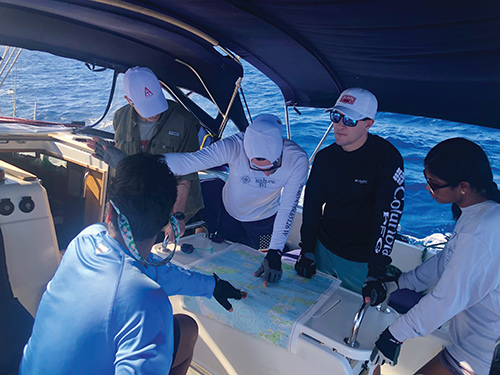
No longer coaching from a RIB, I was now on the boat with the students conveying the finer points of sail trim, points of sail, docking, anchoring, yacht systems, and much more. I loved it. The biggest change with this new endeavor was that I was primarily teaching adults who were using their vacation time to come learn how to sail and cruise on 26-foot keelboats and then 40- to 50-foot cruising boats. This meant I had to adapt my teaching style. And, still in my early twenties, I was usually quite a bit younger than my students and I’m sure more than a few were skeptical of my overall level of experience.
Undeterred, I worked my way up the ladder and soon found myself traveling to the Bahamas and Caribbean to teach, and then got navigation and passagemaking instructor certifications that allowed me to go deeper into the sailing curriculum and across bigger stretches of water. It was a blast, but it was a lot. After six mostly wonderful years of living that lifestyle, it was time to take a break. All teaching is hard work, but this style of education is particularly time intensive—I was spending over 250 days a year on the water and needed a change. Also, my burgeoning writing career was providing new opportunities, and I wanted to focus more on that and on possibly starting a family.
It was the decision to step away from this teaching environment that turned me towards Seattle. I got hired at Windworks Sailing School, where I taught on the weekends, and went to the University of Washington during the week to get my Certificate in Editing. Also in that time span, my wife Jill and I bought our beloved Grand Soleil 39, named her Yahtzee, and moved to Shilshole Bay Marina. Soon after, we welcomed our first son, Porter, then our second, Magnus, and took off cruising. I feel like our family’s adventures started the day I taught that first keelboat class all those years prior.
Takeaway: Get immersed. Knowledge comes from experience, and expertise comes from long-term immersive experiences. When I first started teaching on keelboats and cruising boats, I was all in. Being in my early twenties, a rigorous schedule was ok with me and I was up early, home late, and sometimes gone for a week or more at a time. I knew that all the time and hard work that I was putting in would be worth it in the long run. The effort I expended was almost as valuable as the experience I gained, and in the end, it all led me to a lifestyle that I get to share with others… especially my family.
RACING
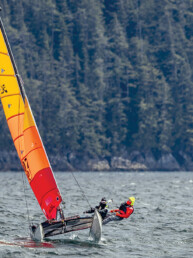
Along with teaching broader sailing and cruising skills, I was also coaching racing and honing my craft on the race course. I grew up racing dinghies and then went on to keelboats, but when I was first pressed into service as a racing coach, it was a bit intimidating. Being young, it didn’t quite feel like I was ready for that step and yet, I would jump at every opportunity that came my way.
As with most things, the more I got into it, the more I learned from those around me and the results followed. I came to understand and enjoy the nuances of my role as a coach of a race team and how to teach starting, tactics and strategy, upwind and downwind trim, mark roundings, and so much more. Again, it was one of those parts of sailing that the more you do it, the more you get comfortable with a variety of racing situations, student and crew dynamics, wind and sea states, and modes in which the boat needs to be sailing in order to be successful.
I still take almost every coaching opportunity that I am able to, and even though it was the hardest and most intimidating thing to teach at first, I’ve found that I love it the most because it’s incredibly rewarding to watch students put their skills into practice on the race course and succeed.
Takeaway: Lean in to what is uncomfortable. My initial nerves around teaching race crews stemmed from a lack of experience in that environment. Yes, I knew how to race sailboats, but doing and teaching are not the same. And it’s a different thing entirely to step on a boat with a full crew and coach them through a day or a week of racing. I was fortunate to have mentors who helped me along the way and, even when it seemed like I was in over my head, I pushed through and came out more confident on the other side.

UNITED STATES NAVAL ACADEMY

One of my latest part-time endeavors has been teaching recently-graduated officers of the United States Naval Academy how to sail, and then how they could teach the incoming freshman class. If there’s one thing about the Naval Academy, it’s how they build conformity and continuity into teaching sailing.
At Navy, teaching the Standard Operating Procedures (SOP) is the only way. End of discussion. No wiggle room. I knew right away that my freewheeling Caribbean attitude of having fun most of the time while teaching wasn’t going to cut it. While we did have fun sailing at Navy, it was structured in a way where I was having nearly as much of a learning experience as the young officers.
The other civilian instructors were incredibly well versed in the culture of the SOP world and I was a quick study in how to follow the step-by-step organization of this style of teaching on a sailboat. We taught the officers on Navy 26 keelboats and the days were long and hot, but rewarding. We put them through all the normal keelboat skills and it was incredible how fast they could complete skills checklists. There was a reason why they’d graduated from the Naval Academy.
By the end of the three weeks, the core group of instructors had moved from onboard teaching to coaching from Navy RIBs. We put the sailors through tacking and jibing drills, and even had them racing each other during the final few days of their certification. Navy was a different world, but boy was it gratifying to walk away with a smile on my face after completing that gig.
Takeaway: Be open to new experiences. I’ll admit, when I accepted the job at Navy and walked into the Academy in Annapolis, I didn’t know what to expect—not unlike so many of my students over the years. I had absolutely zero experience in the military world and it probably showed when I came in wearing flip flops and an untucked shirt. Fortunately, I was eager to teach and learn, and in doing so I connected with my fellow instructors and students. And by being willing to try something new and different, I can now count that experience as one of my favorites in all my time teaching sailing.
ON THE HORIZON
Looking back on the past two decades of being a sailing instructor brings up a lot of fond memories of fun people I’ve met, sailed and worked with, and amazing places where jobs have taken me. I’ve watched kids go from zero sailing experience to being able to take boats out on their own. Race crews have gone from completely green to being competitive and even winning on the race course. And learn to sail students have blossomed into cruisers who then went on to charter or own their own boats.
I’m proud to have been part of moments like those and continue to push myself to be a better coach and teacher to help new sailors or those who want to grow their skills. Now, looking towards the horizon, I feel more open than ever to what lies ahead. Like I tell my students, just keep working hard and putting yourself in a position to succeed… and you will.
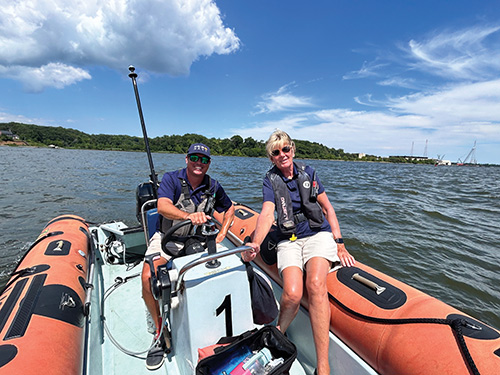
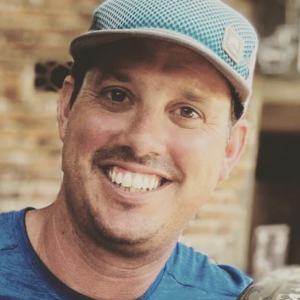
Andy Cross is the editor of 48° North. After years cruising the Pacific Northwest and Alaska with his family aboard their Grand Soleil 39, Yahtzee, they sailed south and are currently in the islands of the Eastern Caribbean.