Think about the people you’ve sailed with for years—thousands and thousands of miles. You know what makes them tick. You know their strengths, their weaknesses, and how they act when they’re frustrated, nervous, or upset. More importantly, you know how to help them get out of that funk.
I’ve sailed with people who talk more and more as they get frustrated. Others go completely silent. Some yell. And some you would never know are frustrated until they admit it after the race. Each of these situations requires a different approach from a teammate. Over time, you learn what to do to help each person return to their best competitive self.
But what happens when you don’t have years or thousands of miles to gather that knowledge?
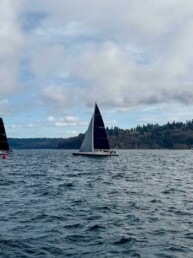
Our Cascadia Sailing Team has to do exactly that: become a cohesive team in a short period of time. We are a group of 11 women from the Pacific Northwest who have joined forces to train and compete at the New York Yacht Club Women’s International Championship in September. Led by Chris Wolfe, Joy Dahlgren, and Jen Glass, our team was selected as one of 20 teams out of 48 applicants to compete in the inaugural championship.
I had my eyes on this event from the moment it was announced—women’s sailing on a global stage, the opportunity to compete against the best women sailors in the world, and the chance for young girls to see what’s possible in a sport still largely dominated by men. I am incredibly honored and excited to be part of this team.
Once selected, the countdown began: we have 15 months to finalize our lineup, build trust, strengthen teamwork, learn a new boat, and prepare to compete at our highest level.
Luckily for our team, Jen Glass, our tactician, brings a career background steeped in team building. During our most recent training block, she led a team-building session on Friday night before our weekend of sailing.
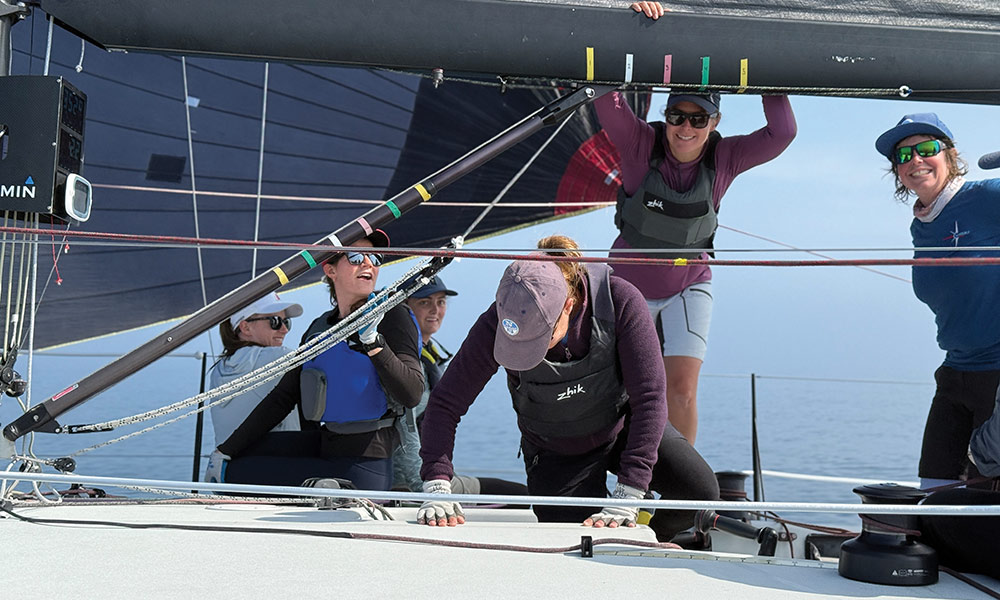
We had already sailed together a handful of times. That gave us a baseline level of comfort and understanding. But Jen wanted us to go deeper. We gathered in the conference room at North Sails Victoria after a delicious team dinner. In front of each of us was a sheet of paper filled with prompts and blanks. A Mad Lib!
We spent a few minutes filling it out, identifying our own responses to prompts including how we react to difficulty and what our respective “superpowers” are. And then we paired off with teammates—roles we closely interact with, and people we didn’t know as well—rotating through three “speed-date” conversations.
Each of us shared our Mad Lib and talked through our answers. What struck me most was how much their answers made sense, even though I had only sailed with these teammates a few times. I could think back to moments when their superpower had helped our team, or when I had noticed they were frustrated or withdrawn.
The exercise gave us space not only to get to know one another better, but to build trust and better understand our team dynamic.
As jib trimmer, I was paired with our offside jib/kite trimmer, our main trimmer, and our bow person. These are all roles that I work with closely and rely on constantly on the boat, but happen to be teammates I hadn’t spent much one-on-one time with yet. Understanding how they show up when they’re stressed or frustrated, and what I can do to help, was both eye-opening and incredibly valuable.
There were plenty of laughs, especially during the “what I do that might be annoying” section. It was a moment of self-reflection. Even if you’re actively working on improving certain behaviors, there’s something powerful about acknowledging them openly—and knowing your teammates understand you.
When we regrouped as a full team, two key takeaways stood out. First, many of us tend to shut down or get quiet when we’re upset, stressed, disappointed, or annoyed, but each person wants support in a slightly different way. Some want direct feedback. Some want space. Some want reassurance.
Second, each person’s superpower truly was just that, a superpower. Maybe it’s why they were chosen for their role. Maybe it’s why they thrive in it. But hearing people articulate what they bring to the boat, and recognizing how much that strengthens the team, was powerful.
The impact was evident immediately in the practice that followed. People seemed more confident in their strengths, more aware of those around them, and noticeably more cohesive as a group.
Jen’s superpower—pushing people to be their best—showed up as she encouraged teammates to step into new roles. Chris’s focus showed up when we practiced the same starting maneuver twenty times in a row, refining details each time. Adaptability showed up after a messy spinnaker set when, instead of frustration taking over, someone offered, “No worries! The line got stuck on that one. Let’s talk through how to prevent that in the debrief.” Calmness surfaced in high-pressure moments. Awareness was on display when someone noticed a teammate getting quiet and offered the kind of encouragement that person had said helps them most.
As for me, I’m loud. I always have been.
“Everyone needs to work on their volume, except maybe Ana,” Chris said good-naturedly during one of our first practices.
On our long drive home from Victoria, fellow teammate and vastly experienced corinthian sailor, Jaimie Mack, and I talked about how often people, especially women, label something about themselves as a weakness or an annoyance while those around them may see it as a superpower. “Bossy” was a word I heard more than once growing up. Luckily, I come from a long line of loud, confident women (and men who support loud, confident women) so I’ve always tried to see my voice as a strength.
I also recognize that strengths can become overwhelming if not balanced. I’ve worked hard, and continue to work, on creating space for others, because my instinct is to raise my hand first and fill the silence. What this activity with our Cascadia team gave me was clarity: I can lean into my superpower, while trusting that my teammates will call me out if I’m taking up too much airspace. That mutual understanding creates accountability without tension.
This activity encouraged each of us to take ownership of our strengths, which is something we’re not often asked, or allowed, to do. It created comfort, trust, and a deeper respect for one another. It moved us meaningfully closer to our goals.
With 11 people onboard, cohesion isn’t optional, it’s essential. Whether you’re working side-by-side every set or simply climbing over each other during a full-on downwind, understanding one another matters.
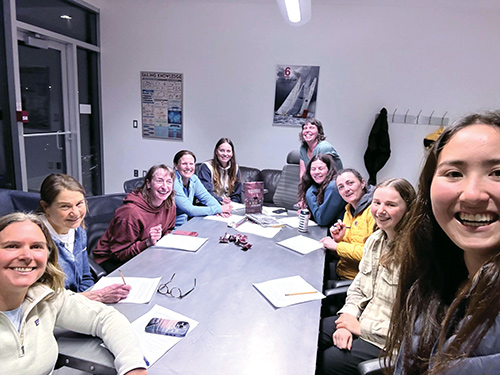
Even if you don’t run a formal team-building session like this with your crew, I challenge every sailor reading this to reflect: How do your teammates act when they’re frustrated? Do you know how to help them get out of their funk? And most importantly—what are their superpowers? And how can you lean into those strengths more intentionally?
Because building a team isn’t just about time sailed together. It’s about understanding, trust, and choosing to show up for one another—on and off the water. For our Cascadia team, that foundation of trust and teamwork is what allows us to chase big goals with confidence.
AnaLucia Clarkson grew up sailing in Seattle, which is still her home port. She is an accomplished dinghy and keelboat racer with multiple finishes in the top 10 at World Championship regattas.
48° North is thrilled and honored to be sharing stories from Cascadia Sailing Team over the coming months.
To learn more about Team Cascadia, visit cascadiasailing.org. The team is actively fundraising to support their campaign, and they are incredibly grateful to those who have already contributed. As you read about in this article, coaching and time together (which requires travel for much of the team) are some of the most valuable parts of their preparation; and they’re also some of the team’s biggest recurring expenses. Support from the Pacific Northwest sailing community makes the team’s activities possible, and is very meaningful to every member of the team.