Wonderful, Fussy, Mostly Unnecessary

in remarkably light airs.
I distinctly remember the only day, or rather night, that I appreciated having a code zero onboard Sea Fox. We were late leaving the Magote just off La Paz where we’d been anchored for the past week provisioning for an anticipated three-week passage to the Hawaiian Islands. The sun had just started to set as we motored out the long channel along the Malecon that we’d come to enjoy walking each day as we set out on our various shopping and exit paperwork adventures. It’s unusual for us to depart so late, but with all the boxes checked and more familiar boats rolling into the anchorage each day, we knew we had to make moves or we’d be dancing the La Paz waltz for at least another week.
The overnight sailing forecast was dismal at best; 5-8 knots, mostly on our nose. In apparent winds over 10 knots, our Malö 39 Sea Fox, can point to an impressive 30 degrees, but at these low wind speeds we weren’t going to hold our breaths for big miles or easy sailing. As we rounded the final channel marker and surveyed the serene Bahia de La Paz, now completely placid and calm compared to the whirlwind of boats and gusty winds that greeted us upon our arrival all those days ago, the puffs of wind we’d hoped to find vanished almost in unison with the setting sun. The wind speed, and boat speed, dropped precipitously just in time for our watch change. I lamented leaving poor Gio to figure out how best to catch the patchy, pathetic puffs while I hopefully caught some sleep. I half-expected the next sound I heard to be the rumble of the engine. Instead it was the muffled cursing and sharp report of metal on wood that woke me up. Just one snap shackle glancing off the mahogany bulkhead led me to the same solution Gio had come to: the code zero.
Shoved into the forward head we use primarily as a sail locker and overflow stowage staging area, our code zero was practically brand new and came with the boat when we bought her in San Diego just six months prior. It served us well in the light airs of San Diego Bay, but the more we used it the more we wondered how it would fare under the pressures of rigorous offshore cruising and our eventual return to Pacific Northwest waters in coming months. Dacron sails, such as our mainsail and 125% furling genoa, are remarkably forgiving when it comes to withstanding the punishments of passagemaking. Layers of thick, robust fabric coupled with robust stitching, a healthy dose of chafe protection, and UV protection can keep these white wonders full for years, sometimes decades. Our sailing mentor and partner John Neal regularly cruised 50,000+ miles with his suits of white sails built by Port Townsend Sails. But code zeros are different.
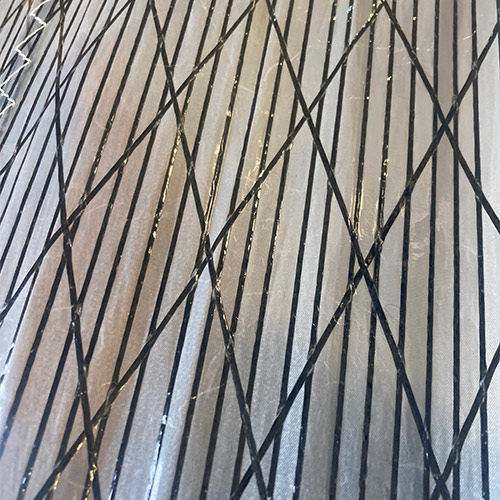
Initially introduced in the racing world, code zeros are a breed of awesome and awful that has taken the sailing world by storm. They are those sneaky in-betweeners that fill the sweet spot between a genoa and an asymmetrical spinnaker. They’re built light and cut flat, with a luff designed to work around a torsion cable so they can furl cleanly, often on a removable, stowable pancake furler such as ours. In the right conditions they can feel magical, giving you that much sought-after lift in the lightest of zephyrs, extra pace on tight reaches, and a potentially forgiving option for coastal cruising. In our experience they (rarely) behave nicely, they (occasionally) roll up tidy, and they sure do turn those marginal puffs into honest boat speed, which is why cruisers and racers alike treat them like a coveted secret weapon. And when morale is taking a nose dive or the engine hours are already piling up, having a sail that keeps the boat moving instead of wallowing can make a watch feel less like drudgery and more like you’re actually sailing again.
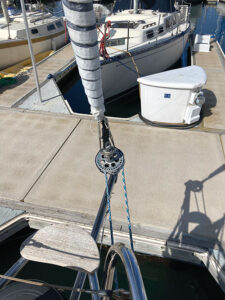
But for all that charm, code zeros aren’t pure upside. Some sailmakers will tell you that a “code zero” isn’t even one thing anymore. Cruisers, racers, and racer-cruisers all get different fabrics, different load paths, and different crossover angles. The laminates that make them powerful in drifter conditions are remarkably easy to overstress if you tend to get overeager in a building breeze. Because they sit in that awkward gray zone between a headsail and spinnaker, they can feel fussy, even sluggish, to trim and they’re not much use deep downwind. We’ve read that the upwind performance is dismal too, but ours pointed pretty well; sometimes as high as 45 degrees in 5 knots.
Then there’s the lifestyle tax: the dedicated continuous furler and control line, the heroically long two-part purchase halyard required to haul the thing up to the masthead to create enough tension for proper sailshape and furl-ability, the storage footprint, and the reality that laminate fabric ages much faster than your trusty Dacron. Most sailmakers will tell you to expect something like three to five seasons of healthy use if you’re flying it regularly, a little longer if only use it in the truly light airs and furl it immediately as the wind picks up.
While a code zero promises to fill that delicious middle ground between motoring in a limp breeze and wrestling a full kite, the question that matters is whether it solves a problem most cruisers really have. In light air reaches, it can be a showstopper; shaving hours off coastal hops or offshore passages. Shorthanded crews in particular tend to appreciate that while the sail flies easily, the sheer size, weight, and sensitivity in changing conditions means it still demands a respectable amount of respect when in use, particularly during hoists and drops and in shifting wind conditions.
Having it on a furler certainly simplifies the situation, but it demands judgment, space, and a willingness to swap sails when the angle shifts (and typically a second person). It can absolutely be a quiet champion for sailors who spend real time reaching in light air. For everyone else, it risks becoming one more expensive, delicate embellishment that mostly snoozes in the sail locker, waiting for that perfect but rare day. And this is the heart of it: a code zero usually doesn’t save your passage, it just makes a handful of hours happier, faster, or less demoralizing. If that’s a pain point in your sailing life, the sail earns its keep. If not, it probably won’t. Plus, because the design and materials used for these sails evolve quickly, they historically hold resale value poorly—so buying one “just to try it” is rarely a financially graceful experiment.
A code zero can feel tailor-made for the Pacific Northwest’s moody summer wind patterns, where you spend half the day in a teasing 6-10 knots of wind and the other half wondering if the forecast forgot you wanted to sail that day. In the Strait of Georgia, or crawling up Johnstone Strait on a glassy morning, it might keep you sailing instead of firing up the iron genoa. But the flip side here is sharper than elsewhere: the breeze can spike fast when thermals kick up or you round a headland, which can make flying a light laminate sail a real liability. And before you get seduced by visions of ghosting out the Strait of Juan de Fuca on the light air reach of your sailing dreams, it’s worth evaluating whether your bowsprit or anchor roller assembly can actually handle the load a code zero will add to it. These sails pull hard, and any marginal hardware will be found out quickly.
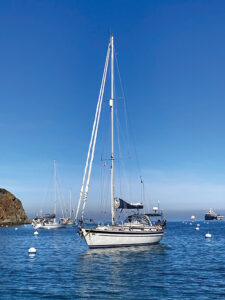
Even with clear decks and simple rigging, ours took at least an hour, sometimes longer, to set-up and deploy; and about the same at the end of its deployment. That alone might give you pause. If you rarely pull the code zero out, that hesitation turns its use into a negative feedback loop. The less you use it, the clunkier the set-up feels, and the more likely it is to turn into that “maybe later” sail that never leaves the locker. You’re most likely to use it on those rare dreamy summer afternoons when the wind is gentle, steady, predictable. That’s the local calculus: is a sail that’s magic for maybe twenty days a year still worth the space, cost, and care? A good code zero thrives on steadiness of wind angles and pressure, neither of which the Salish Sea reliably delivers. That doesn’t make it useless, just very conditional.
In the end, a code zero is classic Pacific Northwest temptation. It’s undeniably fun, occasionally brilliant, and absolutely not essential for most cruisers. It won’t replace your genoa, it won’t rescue you from the region’s moody gusts and dead zones, and it won’t see enough use to justify itself if you’re chasing practicality. But on those rare, golden afternoons when the breeze is soft and steady, it can make the boat feel lighter, happier, and maybe even a little magical. If you delight in dialing in your sail inventory and savor the art of coaxing speed from whispery winds, it might be a lovely indulgence for you. But if you’re looking for something that transforms everyday cruising here in the PNW or in the warmer waters of the Pacific, this one stays squarely on our Nice list.
Speaking of warmer waters. It’s a little ironic that I’m writing this article at anchor in Baja California Sur, the code zero long gone from our inventory, and somehow I don’t miss it even a little. Our passage to the Hawaiian Islands was rolly and fast; the code zero never saw the light of day. Same for the couple of months of cruising we did there. And the passage from Hawai’i to Ketchikan. And the next three months of cruising the west coast of Vancouver Island. And several more laps around Vancouver Island with sail training expedition crews. So, it should come as no surprise that before departing on our current anticipated 15,000-mile cruise we evicted lonely code zero. Hopefully it is enjoying a home where it will see more miles and bring more smiles.
Gio and Julie of Pelagic Blue lead offshore sail training expeditions and teach cruising skills classes aimed at preparing aspiring cruisers for safe, self-sufficient cruising on their own boats. Details and sailing schedule at www.pelagicbluecruising.com