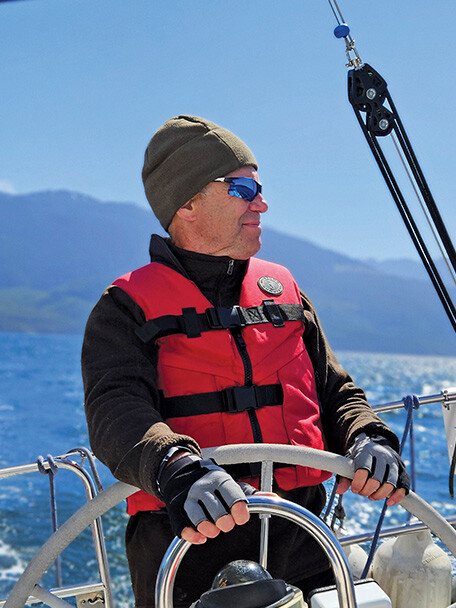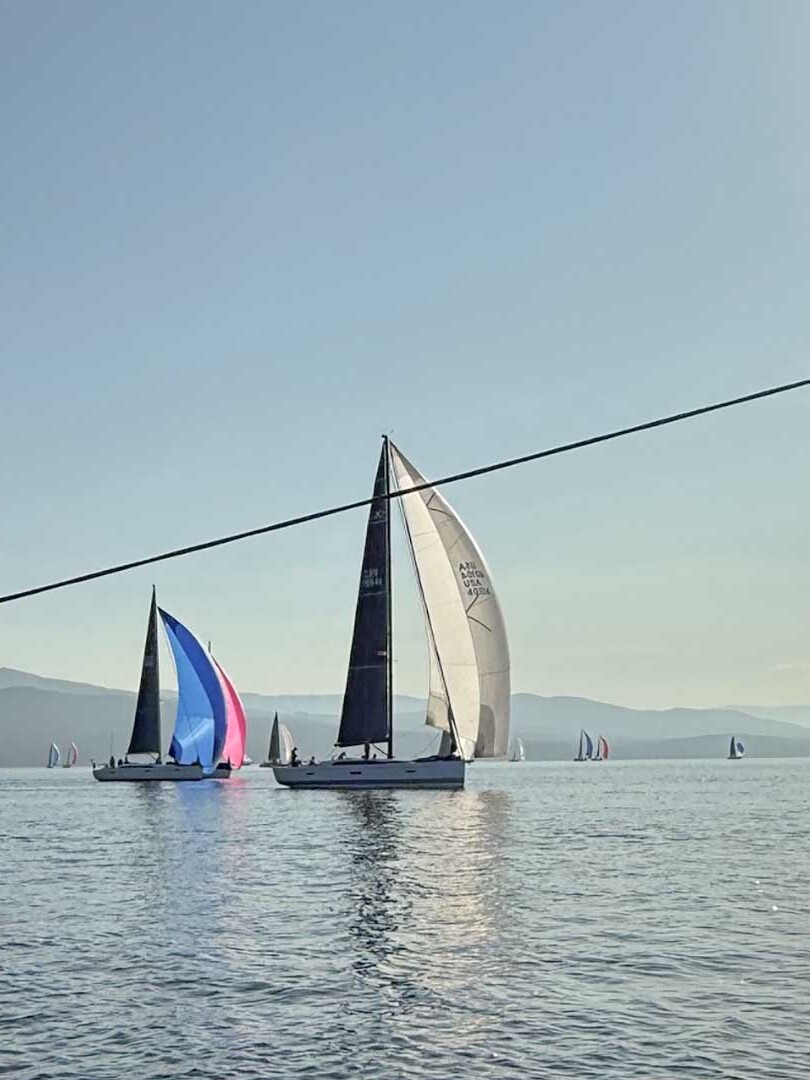
I love a boat test, whether older designs or brand new. This month, I had the chance to get out on one of the freshest offerings, the Hanse 460. Though the design made its debut elsewhere as early as 2022, I had the good fortune to be out for the maiden sail on the first 460 in the Pacific Northwest. Setting sails for their very first use is an experience I never tire of, and to do so on a design with so much to discover—and the 460 has that in spades—was a real pleasure.
The Hanse 460 is the initial launch of an entirely new line from the German manufacturer. In a departure from previous models, the 460 tapped the French design firm Berret-Racoupeau. While the hull is consistent from boat to boat, lots of other elements may be chosen and customized as a part of the build process. Two keel options, deck layout variations, a dodger, headsail rigging configurations, and literally scores of choices on the interior—the 460 is a bold move for Hanse into the “individualization” of their production designs.
Approaching from the dock, the 460’s reverse bow and raised chine certainly caught the eye, but my main impression was of a profile that’s quite sleek and elegant, given the size and use-case. Climbing aboard, I found the 460’s freeboard significant, something the sexy and low-profile topside design hides a bit. More freeboard doesn’t only mean interior volume, but combined with the chine the decks should stay nice and dry. Viewed on the water, I find the 460 an attractive, modern looking yacht.
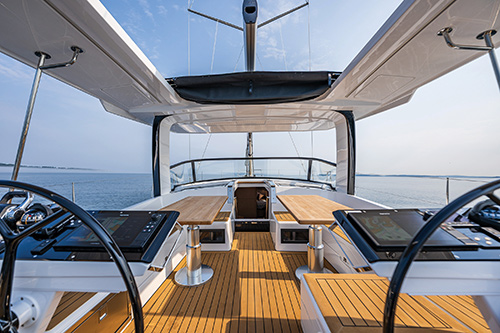
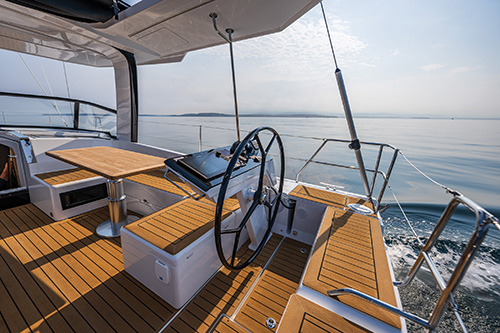
The 460’s cockpit is versatile and pleasing to the eye; focused on simple, modern sailing tools with flexible set-ups for traveling, relaxing, or entertaining. It would be tough to call the cockpit design anything but dazzlingly clean. Forward of the twin helm stations are mirrored seating areas, each with their own table. The tables raise and lower electronically, allowing each table to come down to settee height and make a huge sun lounge area. In this application, bravo, and the same for seating and eating on deck. The layers of things to like about the 460’s design were revealing themselves, but there were a couple head-scratchers for me, too; and the cockpit table choice was one of them. The main cockpit lockers are located under the settees outboard of the table, and the only latch access is under the table. That means a sailor’s ability to reach and open those lazarettes goes from challenging when the table is in the “up/dining” position to non-existent when the table is in the “down/lounge” orientation. Luckily there are additional lockers in the aft portion of the cockpit and a large sail locker in the bow. Still, that’s valuable stowage that most 460 users may only want to use for infrequently needed gear.
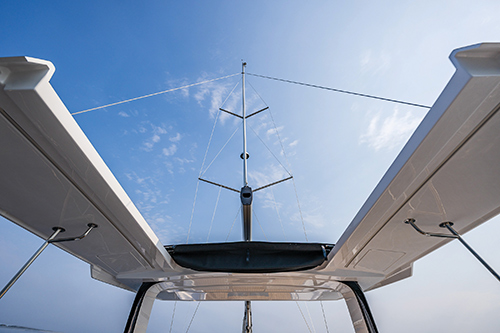
Fitting for our region, this 460 came equipped with the optional hard-top dodger with glass wind screen and a collapsing canvas top cover—providing a flexible, comfortable covering while maintaining the airy aesthetic. The whole dodger system slopes upward as it goes aft, giving more sense of space above the helmsperson’s head than in many covered cockpits. Pacific Northwest owners may want to order a connection between the fixed windscreen and the forward edge of the dodger to keep rain from running off into the companionway hatch area. Since it was a lovely fall evening with no precipitation, we slid the canvas center-section fully forward, and had excellent sightlines to the mainsail to pair with the already clear sightlines forward and down the side-decks from the helms.
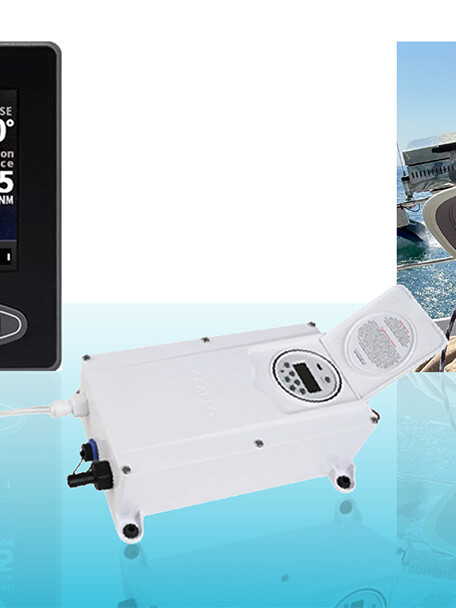
From a sailing perspective, the twin helm stations are the center of the 460’s universe, and are genuinely comprehensive, each side with one of the only two winches to be found anywhere on the highly efficient deck. Obviously, these winches will do all the heavy lifting, and are thus electric, but they’re also the first I’d seen that can be controlled from either helm station—so if one sail is trimmed to the port winch while you’re driving from starboard, you can still trim the port winch in from your starboard position with the push of a button. Cool! Aside from the winches and the array of clutches just forward of them, the heart of each station is the large Raymarine touch screen display, with engine controls for the upgraded 80hp diesel on each station (switchable from side to side). One particularly clever element of the helm stations was the autopilot control and smaller electronic display on the outboard face of each helm pedestal, visible and adjustable when driving while seated on the outboard deck or accessing the winches.
In keeping with the theme of varied choice, the boat can be ordered with several headsail rigging options, from a second forestay to a variety of flying sails. The 460 I sailed had the self-tacking jib to pair with the in-mast furling main, making sailing legitimately effortless. In any configuration, the sailplan is a step more powerful than previous generation Hanse designs, an attribute I was about to appreciate.
As we set our sails, we scanned hopefully for breeze without seeing a lot of promise. Honestly, I thought our test might be a bust. Soon, almost as a surprise, the boat began to move, and move nicely, with just the main and jib. We cut the engine, trimmed the sails, and instantly were visited by a pod of harbor porpoises. We sailed for two hours on every point of sail with this configuration, and we kept moving the entire time in winds primarily between 0 and 4 knots. Maybe we saw a 5 or 6 knot puff, and the boat speed climbed to 4 knots. All of our maneuvers were a piece of cake with the self-tacking jib and other sail-handling controls right at the helms. Sailing the 460 was fun, facile, and fulfilling without requiring much from anybody. And impressively, it was all in breeze so light most folks wouldn’t bother turning the engine off, and without the optional genoa or flying sails. Coming ashore to find that the boat’s displacement is on par with some of the heavier offerings in its class at more than 27,000 pounds—and this deeper-draft version is even a bit lighter than the shoal keel option—it left me applauding the accomplishment. Part of this performance success is certainly the use of the chine, which allows for a narrower waterline without sacrificing interior livability. That’s important too, because the boat has added a lot of beam—at least a foot-and-a-half more width compared to the fairly recent Hanse 458 design. The 460 is also almost two feet longer overall and on the waterline than this elder sibling, though the fixed sprit and reverse bow account for the majority of those increases, respectively.
Adding to our enjoyment as we glided zephyr-to-zephyr, the 460 design elects for a single rudder, something that’s becoming less common in modern production boat design. I still prize it, especially in a larger boat, because the helm feel remains helpful and rewarding especially in light air sailing, and that was certainly true on the day we had this 460 out for her first sail.
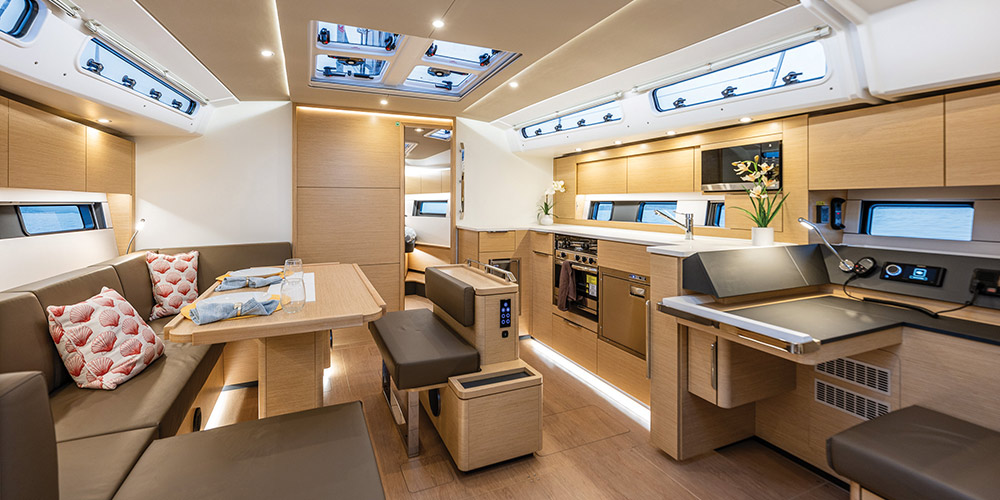
With so many configuration possibilities, no two 460 interiors are likely to be identical, but a number of highlights provide a common experience. There are a lot, I mean a lot, of hatches and windows. The central saloon hatch is actually four distinct hatches with the ability to open in different directions to direct airflow. The primary berth is forward, with two private aft quarter berths. The 460’s three heads make it one-per-berth, with two being en-suite. The saloon feels massive—the natural light and 6-foot-7-inch standing headroom contribute to that sense. The saloon table and settee to port is the primary feature, and the mostly-longitudinal galley is to starboard with small counter extensions fore and aft. The galley has more elbow-room than many bluewater sailors prefer, but this is clearly ideal for day-to-day liveability at anchor or a guest dock since a person can be cooking and there’s still room for someone else to pass through the galley. There is a bench-back brace with hand-hold near the galley when cooking in choppy seas.
I liked the stand-alone bench as a seating component across from the saloon table’s C-shaped settee—it allows much more ergonomic access to the seating area. I also appreciated this 460’s choice of a true navigation station, always good for actual navigation, but in my experience, it’s also the most frequently used seat on any cruising boat, period. In all, I found the interior to be luxuriously spacious and inviting for a boat of this size, with modern styling and thoughtful details to go with user-friendly technology employed throughout—from layout, to lighting, to appliances.
With all of this space, its extraordinary convenience above and below deck, and its sailing performance impressing even in underwhelming conditions, there is an awful lot to like about the Hanse 460. My kids are little and this might be more boat than we require today, but fast forward 10 years… Would there be an easier boat to choose than this one if setting out to explore the Inside Passage? My (then-teenage) daughter and son would get their own berths, we’d have more space than I’d ever envision needing, and the sail- and boat-handling would be dead easy for any one of us. Plus we’d be gladly setting sail in a range of conditions including those light and sunny summer days on the Salish Sea. Sign me up.
Joe Cline has been the Managing Editor of 48° North since 2014. He and his family live in Edmonds, Washington. Thanks to Ken Monaghan and Seattle Yachts for taking me sailing. And thanks to Jeff Eaton and Walker Valley Media for the photos.