As we make our return to fall, the Southern Resident orcas are coming back to forage for salmon in Puget Sound. Accordingly, the Orcas Network is reminding boaters to steer clear. Here’s their latest report.
Members of the endangered Southern Resident orca population remained in Puget Sound foraging for salmon on Friday morning amid commercial and recreational vessel traffic. Orca Network’s Whale Sighting Network confirmed that whale sightings reported on September 3 were members of J pod, visiting inland Puget Sound for the first time since February 24 of this year. Members of L pod entered Puget Sound behind J pod on September 3, but left later in the morning.
After frequent visits and extended stays by groups of marine mammal-eating Bigg’s orcas throughout the summer, the return of the salmon-eating Southern Resident orcas may not seem significant. But Puget Sound is a key foraging area for Southern Residents in the fall. They regularly travel into this region pursuing Chinook and Chum salmon, which make up a large majority of their diet during the fall and early winter. Declining salmon runs over past decades are a key factor in the population’s endangered status, corresponding with the whales spending less time in Puget Sound than they have historically.
To the untrained eye, it is hard to tell Southern Resident orcas from the mammal-eating Bigg’s orcas. The populations are completely separate, however, and their diets aren’t the only difference. Experienced researchers and naturalists can tell the two ecotypes apart based on variations in the shapes of the whales’ dorsal fins and white eye and ‘saddle patch’ markings.
While the Bigg’s orca population is estimated to be 500 or more individuals, there are currently fewer than 77 Southern Residents. Noise and disturbance from vessel traffic can interfere with the whales’ ability to find food, a serious survival challenge when there is less food available for them overall. Research has shown that when boats approach Southern Resident orcas too closely, they stop foraging. For pregnant females or nursing mothers, those interruptions combined with fewer available salmon can have devastating consequences.
Recreational watercraft are asked to avoid Southern Residents whenever possible. Current regulations require all recreational watercraft to maintain a minimum distance of 1000 yards from Southern Residents, and to disengage transmission if navigationally safe to do so should whales surface within 400 yards.
“All recreational watercraft users are subject to the same rules about how far to stay away from orcas,” said Stephanie Raymond with Orca Network’s Share the Water boater education program, which offers free workshops to recreational watercraft groups. “If you encounter orcas on the water and you aren’t familiar with the differences between Residents and Bigg’s, it is best to assume they are Residents, and keep your distance.”
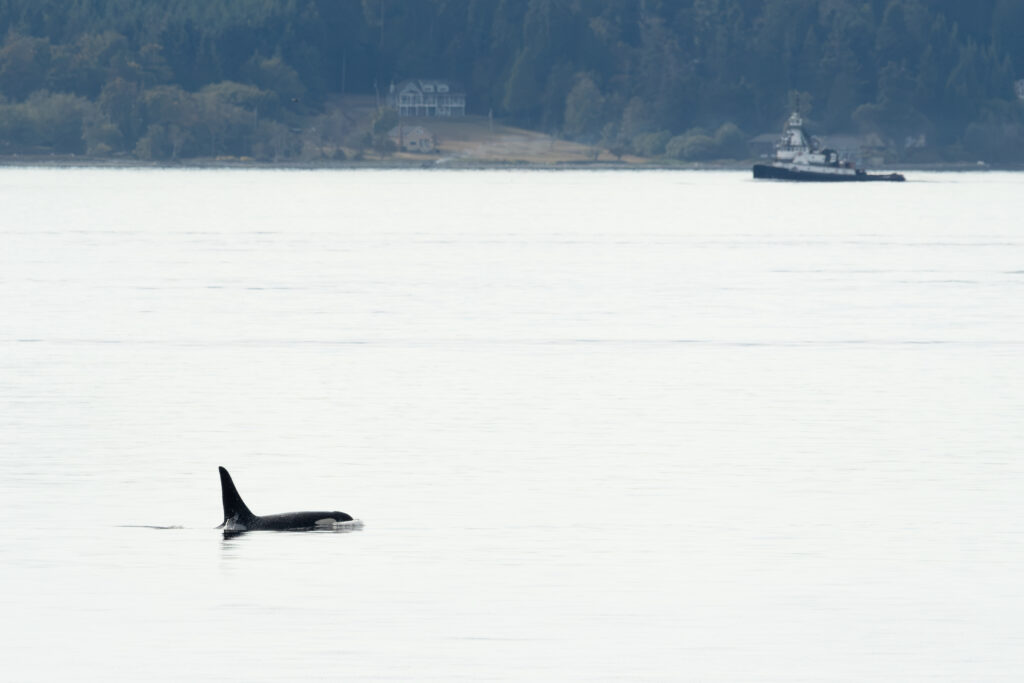 Orca Network’s Whale Sighting Network shares Southern Resident orca sightings with commercial vessel traffic, like the Washington State Ferries. Sighting reports let large vessels know to slow down to reduce noise, and to keep a careful lookout for the whales when they are nearby. Sighting reports are also available to the public in the Orca Network Community Group on Facebook or via text alert subscription[1] , so that shore-based watchers know where and when to watch the water for approaching whales. Anyone who sees a whale, from shore or from a boat, is encouraged to send a report to Orca Network via sightings@orcanetwork.org or https://orcanetwork.org/our-programs/whale-sighting-network/report-whale-sightings/.
“Real time sightings enable Orca Network to keep commercial shipping traffic up to date on the location of the Southern Resident orcas at all times,” said Rachel Haight, Co-Coordinator of Orca Network’s Whale Sighting Network. “They also provide people the opportunity to view the orcas from shore as they travel through Puget Sound, and serve as a means of data collection that is shared with various agencies and researchers. This invaluable information can then be utilized in creating policies for the recovery and protection of Southern Resident orcas.”
When the Southern Residents are in Puget Sound, shore-based watchers may spot permitted research vessels near them. Permitted researchers will be flying yellow pennants with their federal permit numbers on them, making it easy to distinguish between boats who are allowed a little closer and those who aren’t.
“Orca Network celebrates October as “Orca Salmon Month” to raise awareness of the importance of the connection between the return of the salmon and the health of our endangered Southern Resident orcas,” said Orca Network President Howard Garrett. The organization’s Founding Director Susan Berta added, “J pod’s return is also a reminder that this is the beginning of the season when we who live near the inland waters of the greater Puget Sound region are blessed with visits from our beloved Southern Resident orcas. It’s time to keep watch for them and hope for the thrill of catching a glimpse as they pass along our shores.”
To learn more about Southern Resident orcas, visit Orca Network’s website, www.orcanetwork.org.