Seattle to San Francisco
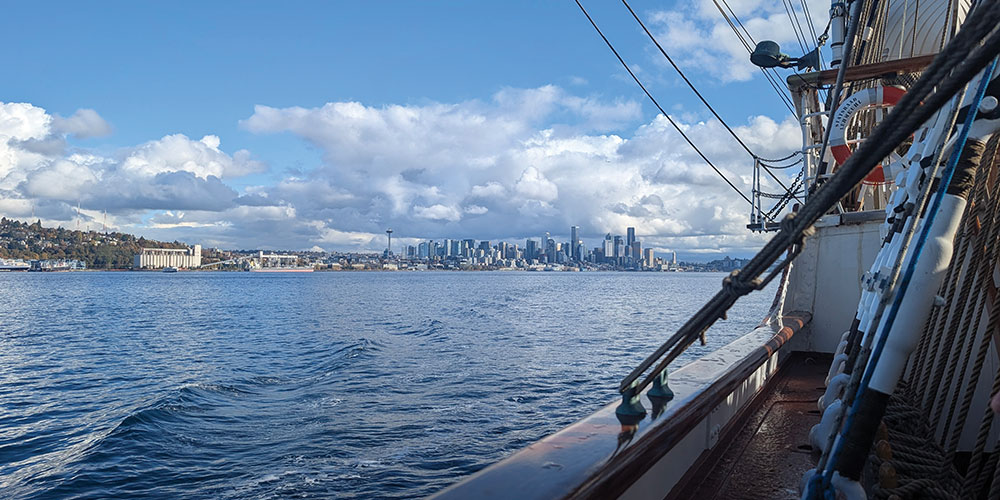
“SÅ SMÅTT!” The person at the front of the line calls to eight behind them, who echo back the command. They take one step forward in unison to ease the line without releasing it, as it is unwound from the belaying pin and all prepare to share the load. There’s shouting in Norwegian, a whistle blows, and all begin to haul hand-over-hand with their full body weight. “ONE-TWO-HEAVE! ONE-TWO-HEAVE!”
For a week, Sean and I are trainees on Norway’s century-old, three-masted barque, Statsraad Lehmkuhl of Bergen, joining a leg of the One Ocean Expedition from Seattle to San Francisco with Maritime Blue and a group of oceanographers from the University of Washington. We’re both avid sailors—boat owners who live aboard in Seattle, we’ve cruised the West Coast as far south as the Sea of Cortez and as far north as Glacier Bay, and we’re R2AK finishers—but this is a very different experience. We’re both eager to learn tall ship sailing. I work on a smaller expedition sailboat in the Southern Ocean, and this is my idea of a vacation. Sean is a member of Maritime Blue’s partnership network, and he’s excited for conversations on coastal stewardship.

We’re sailing with a lean crew for the experience to be comfortable—about 25 people awake at a time, in three watches of four hours: Red, White, Blue. All this muscle is required for sailing, as several maneuvers require a minimum of 15 hands. In charge of the White Watch (4-8 a.m. and p.m.) trainees is our drill sergeant, Nanna, who trains us in tasks, teaches us Norwegian sailing commands (with a Danish accent), and reminds us of the many rules we must follow. Anyone who is late to muster will be holding up about 40 other people. “HOY!” We report our attendance.
During each watch, every trainee takes one hour at a physical post. Lookout on bow; buoy watch on stern; fire watch safety rounds; and helm. A bell is used to communicate anything sighted from lookout to helm, to the officer navigating in the charthouse. Fire watch must ring in the time each 30 minutes on the half-deck bell. The ship operates like clockwork—-shift and post changes; when meals are served and finished. Throughout the week, one learns more of the quiet routines, peeking into some of the hidden labyrinths of the ship, though the engine room remains a mystery and the engineers work overtime.
We have lessons by blackboard, learning each square sail, their parts and lines. None are labeled, and all the synthetic hemp lines look identical criss-crossing high up into the rigging, but there is logic to locating them. The farther aft, the higher up the mast. Course; Lower Topsail; Upper Topsail; Topgallant; Royal. With very little daylight during our watch hours, we learn the coiling techniques appropriate for working versus lazy lines in the dark (if we can identify them, that is).
Before dawn most mornings, we work together to swab the deck, from fo’c’sle to main deck to half deck, requiring a hosing team, soap team, scrubbing team, and squeegee team. Nanna tries to teach us how to swab efficiently in unison as it’s key to teambuilding, but we lose the glue as soon as she steps away.
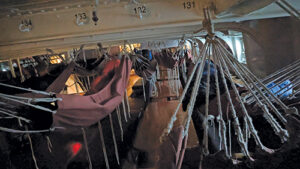
Off watch, when not eating, socializing, attending talks, doing science, working out in the sail locker (which mustn’t be called a gym), or being recruited to polish bronze, we rest in our hammocks. Forty trainees share the aft banjer, and twenty the fore banjer which is also our mess hall where we dine. A hammock with a camping mat in it is surprisingly comfortable because it gimbals in the waves. I read Elif Shafak’s “There Are Rivers in the Sky” which takes on the perspective of water, chronicling three lives entangled by the Thames and the Tigris rivers, exploring themes of climate change and displacement.
Of our group, there is a broad range of experience in sailing and at sea. It’s fascinating to talk with the undergraduate oceanography students who have a strong understanding of how the ocean and weather systems work, but are just starting to find their sea-legs for the first time, and have many questions about how decision-making happens in sailing and how all of the theory is used in practice. They are enthralled with the ever-changing ocean and get to experience all its moods throughout the week.
We have relatively calm, sunny conditions through Puget Sound. The pilot disembarks off Port Angeles and we circle at the exit of the Strait of Juan de Fuca waiting for a low to pass and the sea state to improve. As we turn out past Neah Bay, I’m standing lookout in sideways rain. By the time we’re back up at 4 a.m., we have 15 foot swells on the beam and most people are feeling quite nauseous. I too must offer back my dinner to the sea. The gutters are cleansed as waves wash back and forth over the main deck and we all huddle on the half-deck bracing ourselves. Staysails try to steady the ride.
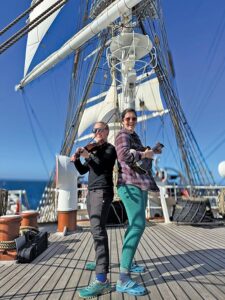
Eventually good sailing conditions come. Flying square sails, we enjoy the vibrant contrast to the earlier horrors. We assemble a motley band of guitars, mandolin, and violin. Molly (on mandolin) and I had met in college on the East Coast 15 years ago and, running into each other here by coincidence, now found ourselves playing Bach and the Pirates of the Caribbean theme song somewhere in the North Pacific. I picked up the violin only a few months ago, as a former cellist who needed to adapt to boat life, and this was my first time playing in public.
We brace aback, pointing the rigs towards each other to make a science stop and drop the rosette 1,000 meters down to collect samples from the water column. The Lehmkuhl is also collecting continuous data as we sail (that will later be made publicly available) from hull and mast sensors.
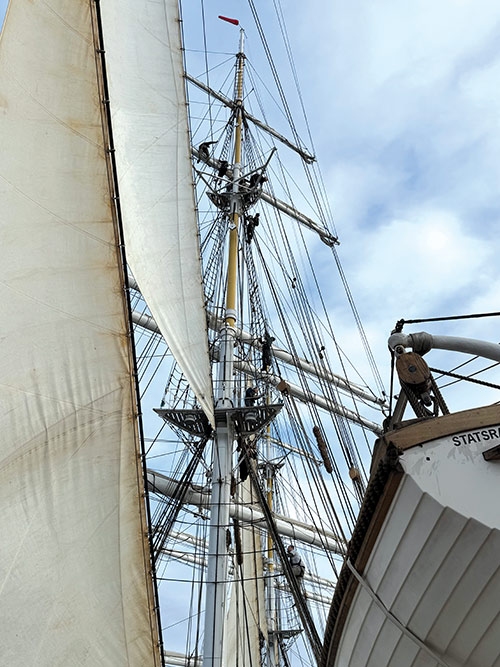
Photo by Devon Thorsell.
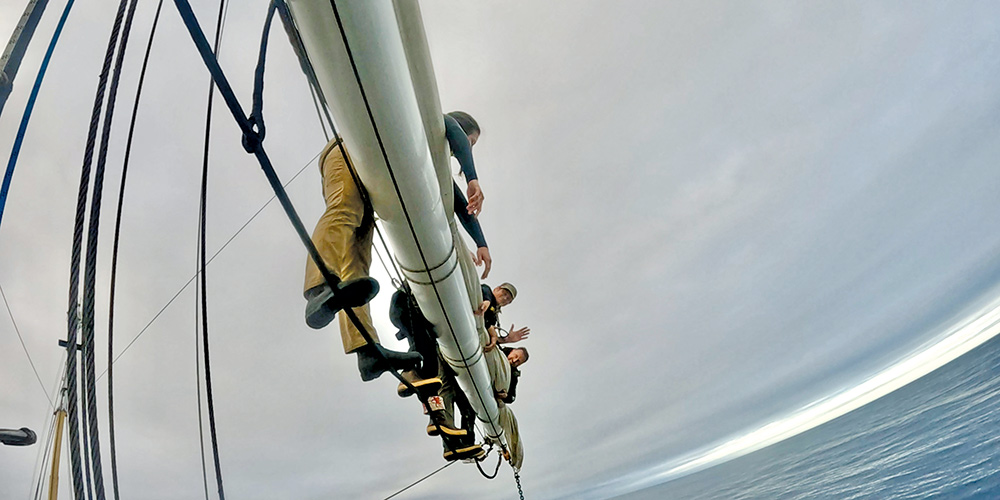
If we manage to pass the Pull Up Test (one pull up plus a 10 second body weight hang) we earn the option to go aloft. I’m grateful my recent bench press training has paid off. We learn how to enter the rig (calling it “climbing” is verboten). We follow rat-lines out to the yards, and by the end of the week have learned how to furl and unfurl the square sails each time one must come in or out. Tight-rope walking with a safety line behind the calves, with stomach over the yard; coordinating rolls of the huge sails with a small team. One member of White Watch sailed on the Lehmkuhl 53 years ago as a teen, and he reported that no one used safety harnesses in the 1970s. No sailors were injured, however a crew member who daringly balanced on the top of the mast was reprimanded for the stunt.
We descend the rig into a sea shanty chorus, led by Captain Marcus Seidl. The journey closes with “Leave Her, Johnny” the night before we arrive in San Francisco.
Farallones and their telltale whale spouts are now in the distance. One final jibe for White Watch, which takes a couple of hours. Center the main yards (five of them) to help the turn. Brace main yards starboard to port. Douse mizzen staysail. Douse fore course. Brace fore yards starboard to port. Set fore course. Now coil every line.
The last time Sean and I sailed under the Golden Gate Bridge was in 2021, as we hooked a left down the California coast to Mexico with our Catalina 36, Petrichor. Since we’d shipped Petrichor up to the Salish Sea on a cargo ship in 2023, we finally got a chance to complete our missing leg of the Pacific, albeit in a bit more comfort, despite it being November in the North Pacific.
We step ashore on the Embarcadero, and back into 2025.

Kate Schnippering and Sean Kolk live aboard their Catalina 36 Petrichor in Seattle. Half the year, Kate is a crew member with Pelagic Expeditions on the 77-foot schooner Amundsen. Sean is co-founder of Astraeus Ocean Systems, a maritime environmental intelligence company that helps communities effectively steward local waters.