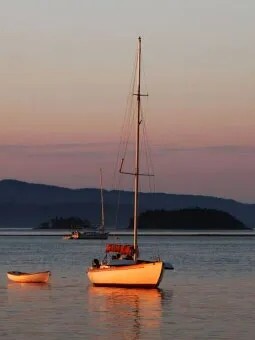
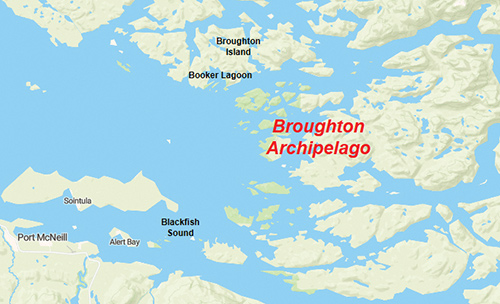
Alone in a world of silence and stillness we sit patiently this morning, marooned in a blanket of fog and smoke. There is no breeze, no movement, no indication of life. We are locked in time lying at anchor aboard our sailboat in Booker Lagoon on Broughton Island, about 200 miles north of Vancouver, B.C. on the Inside Passage.
We’re surrounded by water, forest, and some of the oldest granite on earth. Yet, while feeling unambiguously remote, we are only a half-day’s sail east of Port McNeill and Cormorant Island, where civilization and all manner of help and supplies can still be found. We ask ourselves if we might have forgotten something, as we think we could stay a long time.
The morning begins with the sun’s warming rays slowly piercing the smoke, dispersing the fog to admit patches of blue. Impatient clouds gather to make their appearance on stage also, but are kept at bay. As if on cue, nature lifts its baton, and a lone raven claims ownership to this domain with his deep-throated croak. From the forest’s edge, a branch sways and a great blue heron lifts elegantly from its perch. He flaps away leaving a trail of raucous obscenities in his wake. This marine wilderness—as we have come to know and appreciate it—comes alive.
“Sunrise” from the famous Grand Canyon Suite by Aaron Copland could well have been inspired on a morning such as this, and would have made a fitting soundtrack to complement the aleatoric music of our natural surroundings. And we, with coffee mugs in hand, salute the coming day and peer with wonder beneath the curtains now lifting for our next surprise.
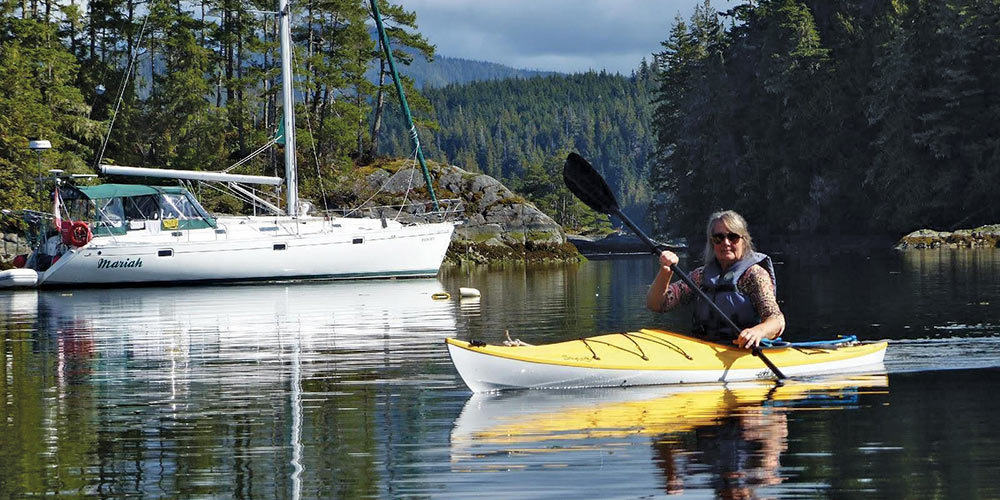
The weather this early October has been surprisingly idyllic, and forecasts for next week are even better. Considering we are cruising the Broughton Islands Archipelago off Blackfish Sound this late in the year, we know that this wonderful weather cannot last much longer. But for now, with most of the cruisers having gone home and most of the marinas and resorts being closed, we are thankful to have such incredible anchorages to ourselves; and the fair weather makes it that much more special.
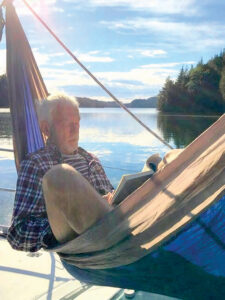
Swinging in my hammock with a cold cider and book in hand, I ruminate about the evolution of life on this earth, starting with fire, water, and fishy creatures, and culminating in a species called “sailors” playing about in their boats. I consider myself fortunate—not only because I belong to this community, but also for my chance to own a comfortable, capable cruising sloop big and well-equipped enough to both carry our water toys and cool our cider. Having a companion, a muse, who also loves to play on the water completes the team and fulfills me all the more.
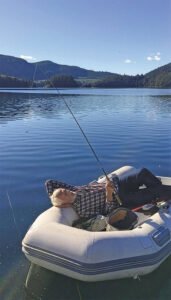
Today’s jobs are to kayak around the lagoon, to drop our crab trap, and to do some serious fishing. Catching a flounder or even a Dungeness crab while under the scrutinizing eyes of a heron loitering nearby will be a daunting challenge. From watching this stoic bird’s antics, I have developed my very own “still-fishing” technique from an inflatable which affords me great satisfaction, if not fish. My partner, Sue, who is hoping for a fish supper, flips me a copy of Charlie White’s book describing how to catch these elusive critters. I pretend to be offended but leaf through this book when she is not looking.
We are attracted to hideaways such as Booker Lagoon because of their natural beauty and serenity. Without realizing, one soon begins to hear the smallest of sounds as if equipped with the latest hearing aid. We even catch ourselves whispering to each other so as not to disturb the neighbors. For us, this is a brief moment to slow down, and a luxuriously long time to reminisce and to dream. Being retired and in a fog helps.
We revel in the thought that many places like Booker Lagoon along our coast are returning to the wild again, despite the massive clear cuts in the hills surrounding them. There is hope that these lands will continue to offer escape and solitude not only for mariners, but for those who wish to hoist a pack on their shoulder and hike inland to seek a differently remote refuge. Had we wanted to anchor here 100 years ago, there would have been scant room: log booms, tugs, and rafts housing loggers would have crowded these waters and the forests would have been wasted. And not long ago, the better anchorages would have been taken over by fish farms.
I take advantage of yet another foggy morning to trim my beard and read about my hero, Leonardo Da Vinci, the original “Renaissance Man.’’ I find a soft cushion on which to consider his many innovative and clever ideas. Had Leonardo been introduced to sailing in the 1400s, I am sure this genius could have conceived of racing foils before their time, and perhaps even beaten Columbus to the New World in a boat drawn to his sensibilities. Or being Leonardo, maybe he would have run out of patience and gone on to design a better glider or catapult?
Comfortably ensconced within our sheltered cockpit, Sue chooses not to discuss Leonardo, but instead pulls out her book: “Totem Poles and Tea,” a story of a young school teacher from the city charged with educating native and white children while having to adapt to her challenging new life on nearby Village Island and surrounding Broughtons. This was during the early years of the 1900s when times were especially tough, and indigenous people were little understood and even less respected. As she reads contentedly, two soft helium balloons flutter dejectedly at half-mast. These were a present given to Sue upon retirement only two months ago when we started this trip. She is still basking in her newfound freedom and glows in her happiness like our new LED lights.
There is a lot to read, ponder, and do while anchored in such an idyllic and protected place, which many consider to be the largest, if not safest “hurricane hole” in the Broughtons—a tidal lagoon with good holding ground, still surrounded by mountains and forest capable of protecting an armada of boats from wind and waves. Surprisingly, we do not see any other cruiser venture into the lagoon the whole time we are here, nor the whole week before when cruising the many islands in the vicinity. For once, we do not miss this company.
Reluctantly, the day of departure from this “Eden” of ours approaches only too quickly. Our decision is hastened by an infection on Sue’s leg from a suspected spider bite that requires urgent medical attention. We decide to head for the hospital at Alert Bay, but we need to get there by nightfall and before the strong winds predicted for Queen Charlotte Sound start to blow.
As the fog lifts on the morning of our planned departure, the receding tide reveals a widening slope of the beach and moss-covered rocks, a reminder that, if we linger, low water will soon be upon us, trapping us in this lagoon for another day. Checking our tide tables, we note that our window of escape on this tidal river, the only way out of this otherwise land-locked lagoon, is less than an hour.
While we dislike being rushed on our holidays, we have to appreciate the magical ebb and flow of nature’s tides, which makes cruising more interesting and challenging. The possibility of going aground, even when following a previous track, makes you especially attentive to the wheel and depth sounder. But where receding waters and shorelines make beach combing on our West Coast beaches great fun, they can also trap or tarnish the unwary. We have no time to be trapped today.
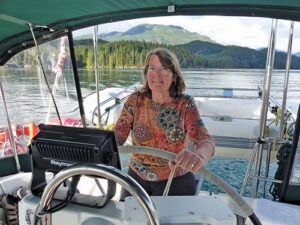
has to be done at just the right time.
Motoring this narrow and winding tidal river for the first time, even at slack (do not try sailing) can be unnerving because, once committed, there is little chance of going back, especially if you should meet another boat. And forget it if the current is in full force at 8 knots. The two doglegs one must negotiate for this transit add to the anxiety as they can hide the rapids but not their sound. Unless you use your radio and skippers are listening, you never know who you will meet when you commit your boat to this tricky channel.
Today we are surprised by a young black bear swimming across this very channel. He is trying to pass in front of us, our right-of-way and constraints of size and draft notwithstanding. Not coincidentally, he chooses slack water to cross also. With a spurt of energy to avoid our bow, this furry fellow quickly reaches the opposite shore, scampers up the rocky bank, and shakes himself off smartly. With a sneer on his snout and nary a look back at us, he slowly shuffles off into the dense forest adjacent. Could he be tired of all this tourist traffic, especially when he must dodge loitering boaters on his morning shortcut to work so late in the season? Too much!
Our trip across Blackfish Sound is the highlight of our cruise. It starts with us motoring at a business-like 7 knots across the Sound until suddenly we spot puffs of white “smoke” on the horizon ahead of us. And closing. Then we hear the “whoosh” of deep breathing. Whales! We quickly kill our engine and hoist sail in anticipation of an encounter. We are soon surrounded.
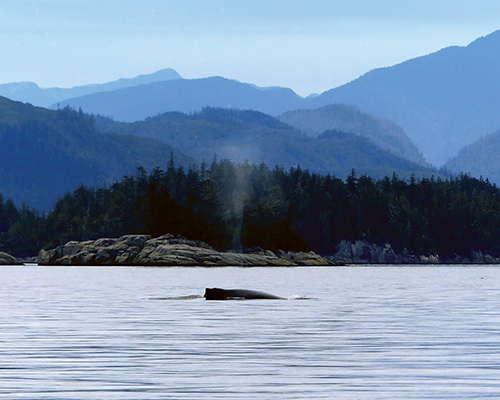
Possibly some of these cetaceans have confused us with another of their species, for why would they allow us to come so near? Or is this a major feeding ground, and we are the treats? Seeing their huge bodies erupting out of the water with jaws open in pursuit of their prey has us transfixed, if not fearful, for our boat and lives. But the impact we braced for does not come, and we continue watching and photographing in awe. Of course, at times like this my camera is out of reach.
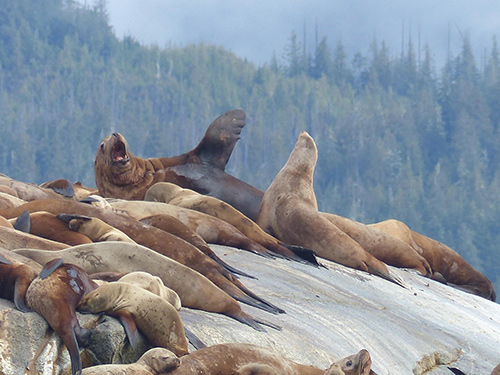
So engrossed are we with these giants that we do not realize that our boat is drifting dangerously towards a small island guarded by shallows and a bevy of bickering sea lions lazing atop their rocks.
In checking our position, we are surprised to see what appears to be a large black navigational buoy in the distance. But we are perplexed when the chart does not show such a buoy existing. And if there was such a buoy, why would it be located in the middle of the Sound away from all dangerous rocks and islands? Binoculars quickly show that this is no buoy, but a humpback whale. It is standing upright on its tail with his large head sticking out of the water, much like an oversized periscope in some war movie! Is this creature looking in our direction and, if so, for what purpose? And how can he hold his head so still and for so long?
This is the first time we have witnessed “spy-hopping”—a practice by which whales such as humpbacks check out their surroundings, presumably looking for other whales who have found feed, to seek out familiar landmarks which guide them in their annual migrations, or perhaps to look out for boats that might threaten? Perhaps this spy-hopping whale is watching us in amusement to see if we will go aground?
We see more than a dozen of these huge humpbacks during our sail over to Alert Bay, more proof that these whales are now returning to our waters in numbers never anticipated even ten years ago. What a remarkable sight and comeback for their species. We cannot think of a nicer send-off from Blackfish Sound and the Broughtons.
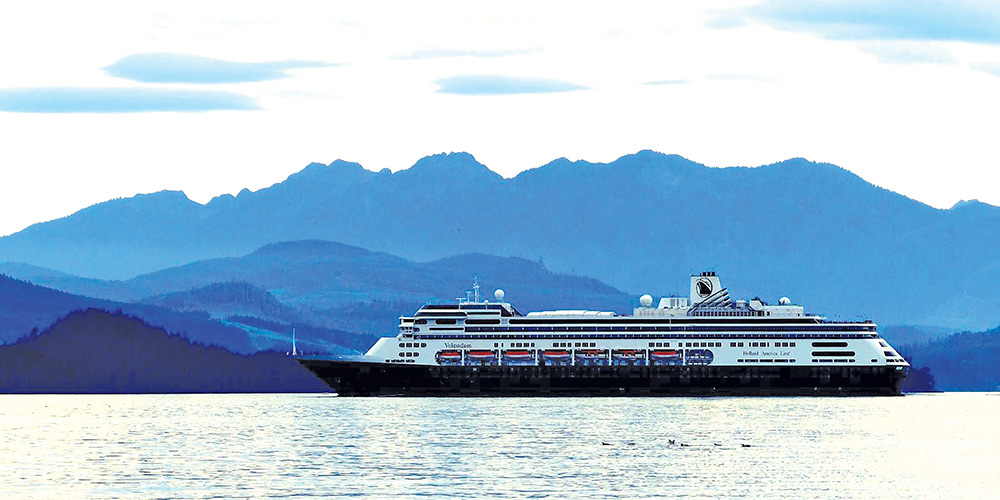
In the evening, after crossing the Sound, we intercept a cruise ship. This stately giant is in a rush, moving at a speed of around 20 knots, and on its last scheduled journey south from Alaska. Hopefully its tourists are also enjoying the whale show presented just off their port side. Sue and I might not be as comfortable nor as well-fed as these passengers on their luxury liner but, on this day, our small boat is providing us front row seats to witness one of the best wildlife shows on earth.
Despite these unexpected whale sightings en route, we are still able to fetch Cormorant Island before nightfall, and before the wind and sea conditions deteriorate as predicted. Fortunately, the subsequent care and treatment provided by the Alert Bay Hospital staff and Dr. Cutfeet is a success.
My patient and partner, cured and rested, continues to cruise with passion. Both of us now hold an even greater respect for spiders, whales, and navigational buoys. Mainly, we share a strong desire to spend more time in the remote waters of this coastline, particularly in the quiet of the offseason when our solitude is shared by so much wondrous wildlife.
After crossing over to Canada in 1949 on the last voyage of the Aquitania, Al Lubkowski acquired his “sea fever” early and never lost it. Seafaring adventures include a marine charter business in the Caribbean and in recent times around Victoria and the Islands (Blackfish). He used one of the boats he built – a 49 foot cedar strip replica of a Nuu Chah Nulth sailing canoe for boat and kayak charters and for cruising with his partner Sue. He also completed the Race to Alaska in 2015 with his F27 trimaran.