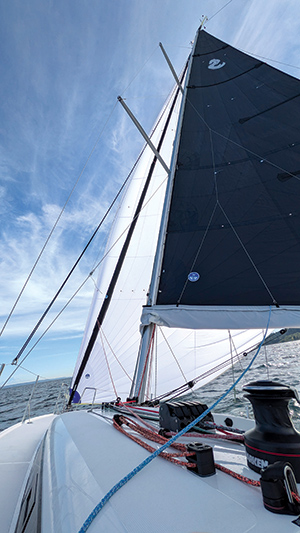
 Few design debuts can boast the amount of buzz that Beneteau’s new First 30 has garnered since its release in early 2025. I’ve been anxious to sail it since I saw the boat in person in Annapolis, Maryland last fall, and I’m happy to say I recently got out on one on a perfect October day in 10-15 knots of wind and golden autumn sunshine. It was a great sail on a boat that definitely wooed me (we woohoo-ed a bit as well, giving the asymmetrical kite a run). But I’m getting ahead of myself…
I think it’s fair to say that part of the hype around the First 30 was brought on by all the claims of what the boat could (and honestly can) be. The initial design brief was for a high performance cruiser with a price-point goal of €100,000. Add to that value proposition performance attributes and anecdotes of its planing capabilities in barely any breeze. Plus, you can cruise it with your family! That’s a lot of cake to have and eat it too.
For once, let me share my conclusion up front. That noise had me excited, and the boat is genuinely awesome to sail. But some of that marketing noise is… well, still noise. Beneteau has brought something amazing to market with the First 30. Even if it’s not quite the superpowered sailing unicorn the prophets foretold, its enormous success is well-earned, its brilliant design nails a broadly-appealing equilibrium between ease and speed, and the boat is capable of things most other production “do it all” boats could only dream of. In short, it’s a boat that suited me and my sailing style exceptionally well, and I loved it.
More than its individual appeal, the design philosophy resonates. What naval architect Samuel Manuard (of IMOCA and Class 40 fame) and the Beneteau First team were aiming for with this design appears to be a chance for more people to experience fast, exhilarating performance sailing without the technicality of a dedicated race boat or the trappings of a top team or extraordinary skills. They call it a “planing cruiser.”
You can gather some context by exploring how its measurables fit the market. The First 30 has few very direct competitors, but its 6,700-pound displacement is a couple thousand pounds heavier than thoroughbred race boats in this size range, while being proportionately lighter for its size than the slightly bigger J/99 (2 feet longer and 1,700 pounds heavier); and quite a bit lighter than the preceding Beneteau First 30 released in the mid-aughts which displaced 8,267 pounds. Weight is a factor, but so is where it’s placed. The new First 30’s ballast-to-displacement ratio moves it much farther toward performance than its predecessor, with more of its overall weight in the 2,358-pound cast iron keel.
In three-dimensional life, the boat looks sleek and modern, without appearing experimental. For a boat with 6-foot standing headroom in the main salon, it retains a low-slung profile, with narrow coachroof window aesthetics reinforcing its zippy appearance. The package is well-proportioned and, while interior volume was certainly a priority, the boat also looks properly fast.
But seriously, how does it sail? I’d say beautifully, with a few unique characteristics befitting its goals. The sailplan is built around a double spreader rig supporting a powerful mainsail and a fractional high-aspect jib. The mast has a single adjustable backstay. Downwind, the spinnaker sets off a bowsprit just over three feet in length, supported by a bobstay that makes it Code Zero ready.
Upwind with breeze in the low-to-mid teens and wind waves of two to three feet, I quickly found the First 30 to feel like it was at the high end of the range for our sail set-up while also being completely in control. The boat seemed to be happiest sailing upwind at a fairly significant heel angle. The broad hull shape with chines aft and the twin rudder design support that idea offering stability, control, and speed when heeled.
The First 30s tiller-driven twin rudders are kind of a superpower, enabling a remarkably responsive driving experience even when rocked up. The helm has terrific feel and virtually unlimited control regardless of heel. This could be true for any twin rudder boat, but I’ve sailed a number of them, and I thought the First 30 executed the best combination of feel and control of any twin rudder set-up I’ve used. The rudders made it easy to drive the waves, which felt required because the hull’s relatively flat and planing-oriented shape under the waterline risks a bit of slapping in chop if not driven attentively. A rounder, deeper bottom would handle a sea state more smoothly at the expense of planing facility. As I say in every one of these articles, all boat design is compromise. The driving experience was just plain fun, and we hadn’t even gotten to the boat’s specialties yet.
These upwind observations helped solidify my understanding of the First 30’s sailing priorities. It is a boat that can be happily sailed by a crew, but it’s more optimized for shorthanded sailing. Upwind sailing shorthanded is always going to be a challenge, and the First 30’s responses are to sail well with more heel and to manage power more through adjustments to sail area than in the nuances of trim and tune. Additionally, as we’ll get to, the boat absolutely shined off the wind, and its upwind performance to me was admirable considering what I perceived to be some compromises on upwind prowess for the quality of the experience reaching and running.
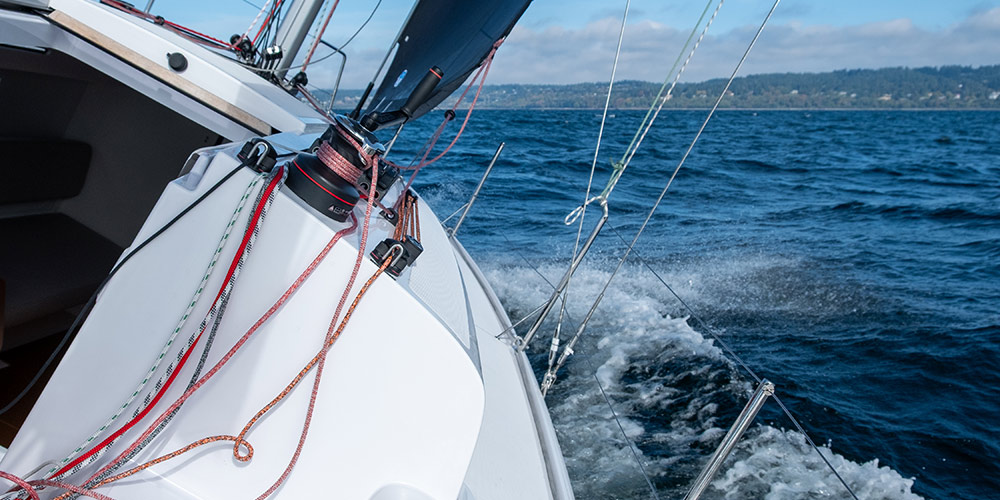
Another signifier of its balanced focuses—shorthanded, off the breeze—is that the rigging clearly suggests First 30 sailors will only use the primary winches near the helm station for flying sails. The jib is rigged to the cabintop self-tailing winches and has a cleverly simple lead system with a floating up-down adjustment, allowing the lead to naturally move outboard as it is let up (both things you’d want in windier conditions), and conversely inboard and down for better shape in lighter air. The cabintop winches do a lot of heavy lifting, managing not only the jib sheets which do not have a cleat, but also the array of five clutches per side for halyards, reef lines, and other controls. I attempted some cross-sheeting adjustments, but some of the rigging there seemed to suggest a sailor would most likely be flying a Code Zero or spinnaker trimmed to the primaries more often than than the jib.
The deck layout is another point of praise. The increasingly popular set-up of an open cockpit aft of the traveler and bench seating ahead of it is my preference, and elegantly implemented here. The deck is generally free of clutter. The primary winches are roughly abeam of the traveler bar, thus easily trimmed by a helmsperson or a crew. There’s a pair of robust and well-placed port and starboard foot-pushes on the cockpit sole near the helm, something you definitely want if sailing at high angles of heel.
After getting to know the boat upwind, we beared away in the northerly and headed over on a beam reach toward Point Jefferson. Sure enough, reaching at 8 knots with a much more moderate heel angle was an “ah-ha” moment. This was what this boat was built for, or at least part of it. Control and feel in the helm, the trim of both sails, the ride, and the speed. We were more comfortable, and more importantly it felt like the boat was more comfortable with what was being asked of it. Such an easy 8 knots on a 30-footer is noteworthy in itself. That’s efficient speed for a comparatively small package with just main and jib in moderate conditions.
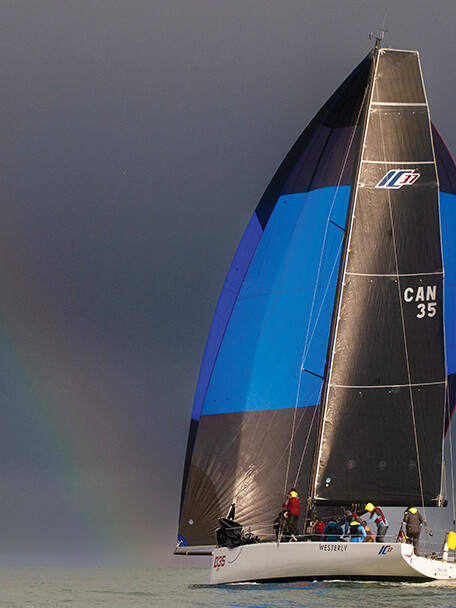
Ducking into the lee near Indianola to prep the kite in a little less breeze, we soon hoisted the masthead asymmetrical and the boat continued to excel. Broad reaching, we were so curious to see what it would be like. Would it plane in 10 knots like I’d heard? Our experience was no, not quite; it needed a little more than that. With wind in the 10-14 knot range, we reached hot and soaked lower and caught some great waves. We hit 10 knots and cheered. In the puffs, we were probably doing what J/70 sailors call “lazy planing”, but I’d hesitate to say we were fully on the step. Still, it felt great, and again the rudders were brilliant. We felt absolutely free to push the boat hot and drive it down in a puff or on a wave with zero signs of compromised control. In all, the downwind experience was fabulous, and there’s without a doubt more in the tank with another few knots of breeze.
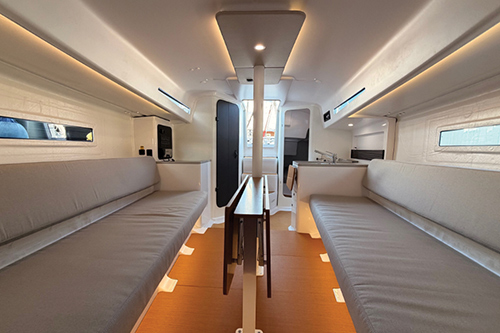
The First 30 is all about the sailing experience, but remember that it is marketed as a planing cruiser. Indeed, all this analysis of the sailing experience needs to be balanced by the fact that the boat has a real cruising interior. In 30 feet, it’s not expansive, but there’s room for a couple both in the V-berth and in the aft cabin. There’s a real marine head, a galley, and the salon is as cozy as it is functional. Tankage and stowage will likely keep the itineraries condensed for most owners, but the possibility is there. I’ve always wanted a boat on which I could sail Van Isle 360 with a self-contained crew staying aboard for the two-week adventure. The First 30 would be ideal in that application.
Now, I should say, for all this incredible design consideration and execution on a boat that I’m a huge fan of, I was aware of some less-than-perfect cost-saving efforts. These things—small and sticky mainsail slugs, removable line bags that didn’t stay attached very well—would be easy to adapt, but remind the user this is a boat for which affordability influenced some of the decisions.
In the end, the fact that everyone seems to be talking about the First 30 has its pros and its cons. Overall, it delivers, and it exceeded some of my expectations while showing a few others to be inflated by marine media ballyhoo. And it should be noted that while I still consider the boat to be an excellent value for a new boat of these capabilities, the initial budget goal proved impossible; asking prices are now roughly twice the original intent.
My advice to anyone interested in the First 30 is to quiet the noise and just think about all this boat can do, all it accomplishes, and how well it does those things. And then go sail it. After all the build-up, I was ready to love the First 30. And I did.
Joe Cline has been the Managing Editor of 48° North since 2014.
Special thanks to Sam Airhart and Signature Yachts for taking us sailing.