There were some surprising moments of windlessess, but what made the 2026 edition of the Round the County—an event enduringly beloved not only for its competition but for its community connection—one for the ages were the stretches when the wind turned on. And when it did, it absolutely howled.
The night before Round the County, the Brown Lantern in Anacortes was filled with sailors sharing drinks, swapping sea stories, and speculating about what the weekend might bring. There was plenty to talk about. Outside, strong winds had already begun sweeping through the San Juan Islands, with gusts reaching into the high 30s. Inside, the forecast seemed to be a topic at every table.
The afternoon before, Scott Kanlyn, First Light’s captain and owner, and I had delivered the Beneteau First 47.7 from Friday Harbor, alongside our buddy boat, Sláinte, with her captain and owner, Dave Ferguson, and his daughter, Cameron, aboard. We crossed the ferry channels as the sun began to set, listening to music and enjoying what we suspected might be the last bit of calm weather for the weekend.
Something special takes place among the sailing community during an event like Round the County. Sailors who gather away from home for two days competing against one another in the beautiful San Juan Islands, also spend a lot of time in community ashore making connections with friends new and old. Whether you’ve raced for decades or are relatively new to the sport, so much is shared and strengthened and there’s no shortage of fun.
While all of the race-eve carousers were buzzing with anticipation, those who had delivered that day already had some fresh epics to regale. Wind gusts had reached the 40-knot range around Anacortes on Friday, and several boats had already withdrawn from the race. Forecasts continued to change, with heavy winds expected to build throughout the weekend. Yet, looking at the Marine Traffic app, boats were still arriving from Seattle—white-knuckling their way north through the wind, but appearing like a trail of Anacortes-bound ants on the screen.
Watching the arriving boats attempt to maneuver into its designated slip was nothing short of nerve-racking. Groups of sailors gathered along the docks, ready to catch lines and help guide the incoming boats. With the wind pushing boats around as they attempted to maintain a straight course, you could see masts leaning as they made their way down the fairways. Some boats had as many as eight people helping them dock. Despite the conditions, sailors continued checking gear, rigging jacklines, and hauling jibs onto the deck in preparation for the next morning, as if 40-knot gusts were nothing more than a light breeze.
Aboard First Light, our crew of ten had joined our compatriots in preparation for two days of racing around the San Juan Islands, and helped on the dock when we could. One aspect of our team that’s particularly memorable to me was that six of our crew members are women. Being part of a racing crew with such strong female representation is exciting and something I was proud to be a part of throughout the weekend. This was my first year participating in some of the bigger sailboat races. After racing Swiftsure earlier in the year, I was now taking on Round the County, with the goal of racing around Vancouver Island next year. Each race has been another opportunity to learn, gain experience, and become more involved in a sailing community I’ve grown to love.
Saturday: Chasing the Wind
By 6 a.m. Saturday, Cap Sante Marina was already coming to life. Sailors walked the docks carrying gear, checking rigging, and making last-minute preparations. Coffee in hand, we climbed aboard First Light and headed out beneath a brilliant red sunrise. The water was calm, almost deceptively so.
As we approached the starting area off of Lydia Shoal in Rosario Strait, a sea lion swam curiously around the committee boat while the fleet gathered for the sequences. With boats maneuvering for position, crews preparing sails, and everyone watching the breeze, there’s always electric energy before a start; and that’s really true at Round the County where the already-large classes are combined to make a very crowded starting area.
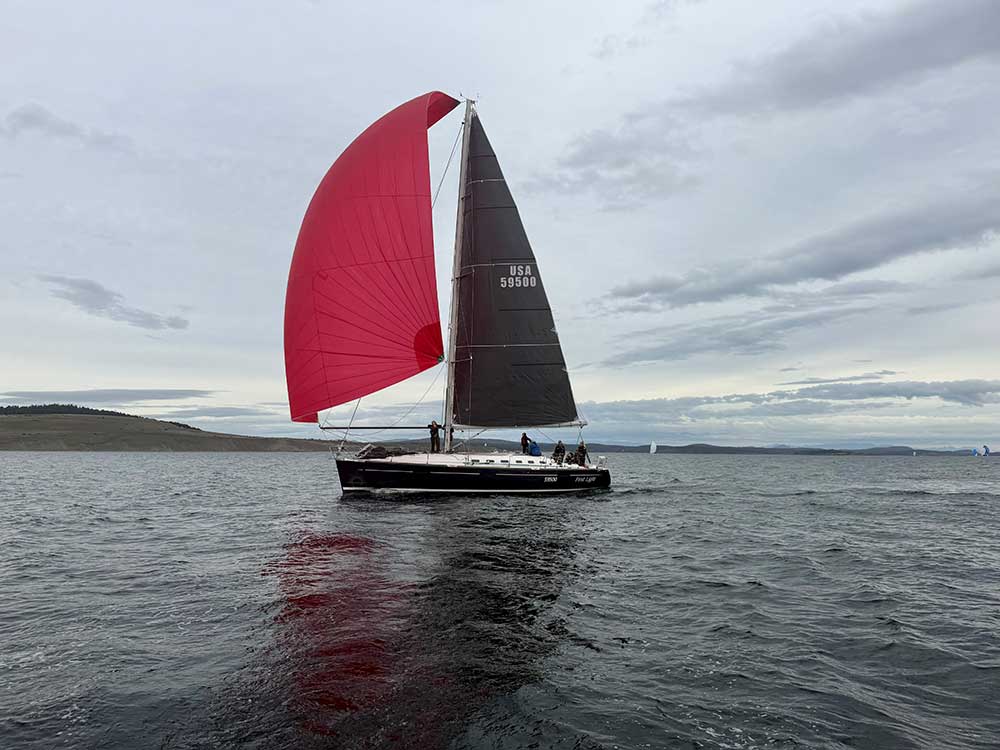
As our division approached the starting line to begin our clockwise circumnavigation of the San Juan Islands, there was little wind to work with. But within five minutes of crossing the line, the breeze quickly built from the north, approaching 25 knots. With our spinnaker flying, we suddenly found ourselves scrambling to adjust to the stronger conditions. The short-lived northerly shifted east, and the crew hustled to douse the spinnaker onto the deck while hoisting our #1 jib, with others brought the smaller #3 headsail on deck to rig in variable building breeze. The morning’s calm rapidly gave way to a flurry of sail changes as we worked to get First Light under control and properly trimmed for the conditions. Round the County 2026 was officially underway.
The fleet continued south around the islands, with many spinnakers flying beneath a cloudy sky. Turning east at Davidson Rock and skirting the southern side of Lopez Island, boats spread out across the water. We found ourselves sailing alongside Beauty, alternately gaining and losing wind in our spinnakers while keeping a watch out for deadheads in the water. The tantalizing draw to be farther from the Lopez shore generally paid-off less than the near-shore route.
For a while, it seemed the wind would give us plenty to work with. But as we rounded toward San Juan Island and made our way toward the finish at the entrance to Mosiquito Pass, the breeze began to fade. Within a few miles of the line, the wind died almost entirely.
The fleet that had been spread out across the course consolidated, with boats drifting back and forth as crews searched for whatever breeze they could find. The lighter boats seemed better able to take advantage of the occasional puffs, while heavier boats like First Light relied on what little momentum we could maintain. At one point, we watched the bowman aboard the Davidson 30 GBH hang off the bow, pushing aside thick beds of bull kelp to clear a path forward. Fortunately, the current was in our favor. Without it, crossing the finish line would have been an entirely different challenge.
Then, almost as if a switch had been flipped, the wind returned. Shortly after we crossed the line, the breeze was back above 20. It was a fitting end to a day that reinforced just how unpredictable racing around the San Juan Islands can be.
Our division, ORC 3, was quite diverse, ranging from 30-foot Narwhal, a C&C 30 One Design racing sled, a number of J/111s, several others, and some larger racer-cruisers like First Light. By the end of day one, it was a pair of Bellingham-based boats, who rate differently but incredibly wound up in a tie atop the standings: Narwhal and the J/120 Margaret II.
Roche Harbor: A Fleet Reunited
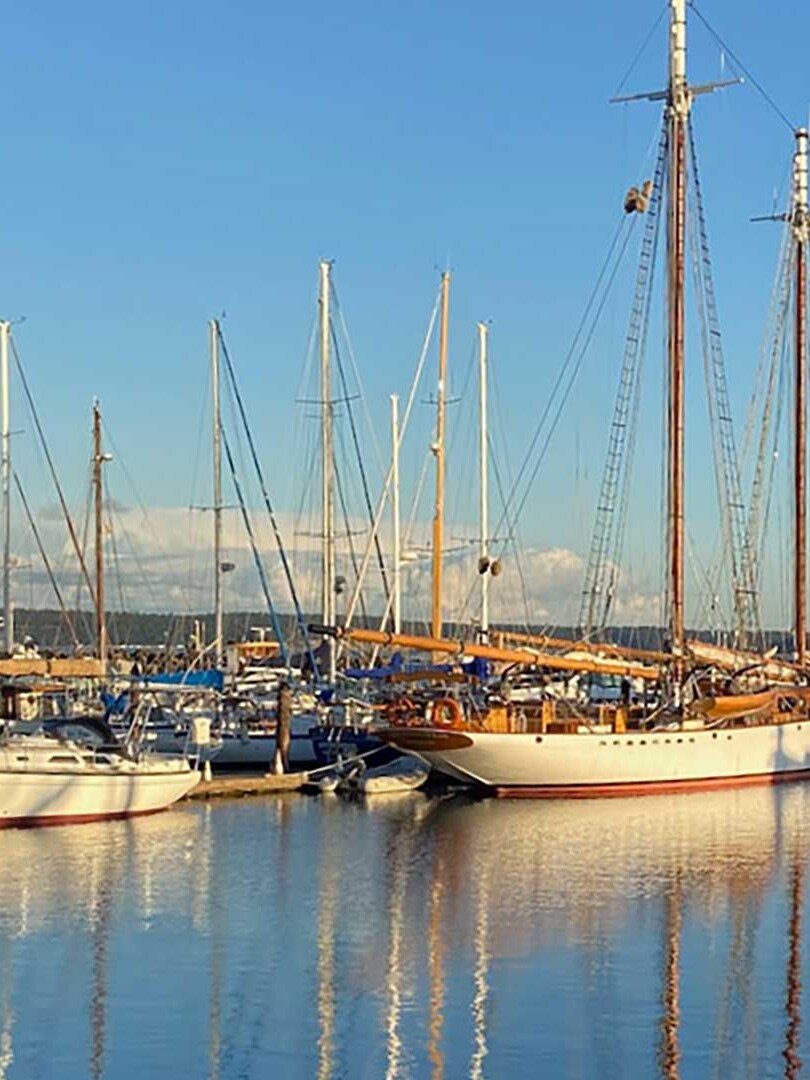
Pulling into Roche Harbor, we were fortunate to find a slip along the main center dock, next to a large powerboat. The marina was bustling with sailors, dock lines, sails, and conversations about the day’s racing. With another day of racing ahead, there was plenty to do before settling into the evening and we set about organizing and folding sails on the dock .
That night, the gathering tent came alive with a live band, pizza, refreshments, and sailors exchanging stories from the day—some while cutting a rug on the dance floor. It was another reminder of what makes Round the County such a unique event. After spending the day sailing halfway around the San Juans, the community connections took center stage; even more meaningfully than in Anacortes the night before.
By 9 p.m., the rain and wind had begun to strengthen, and our crew made its way back to First Light.
The original forecast suggested Saturday would be the breezier of the two days, yet in reality, we spent much of it chasing wind around the islands. Sunday, on the other hand, had been forecast to be nearly dead calm. Little did we know, the San Juans had a very different Sunday in store for us.
Sunday: The San Juans Deliver
By 7:45 a.m. Sunday, we were off the dock and ready to go again. There were fewer nerves among the crew than the morning before, but just as much anticipation. Most of the crew had managed to get a good night’s sleep, and we were eager for another day on the water.
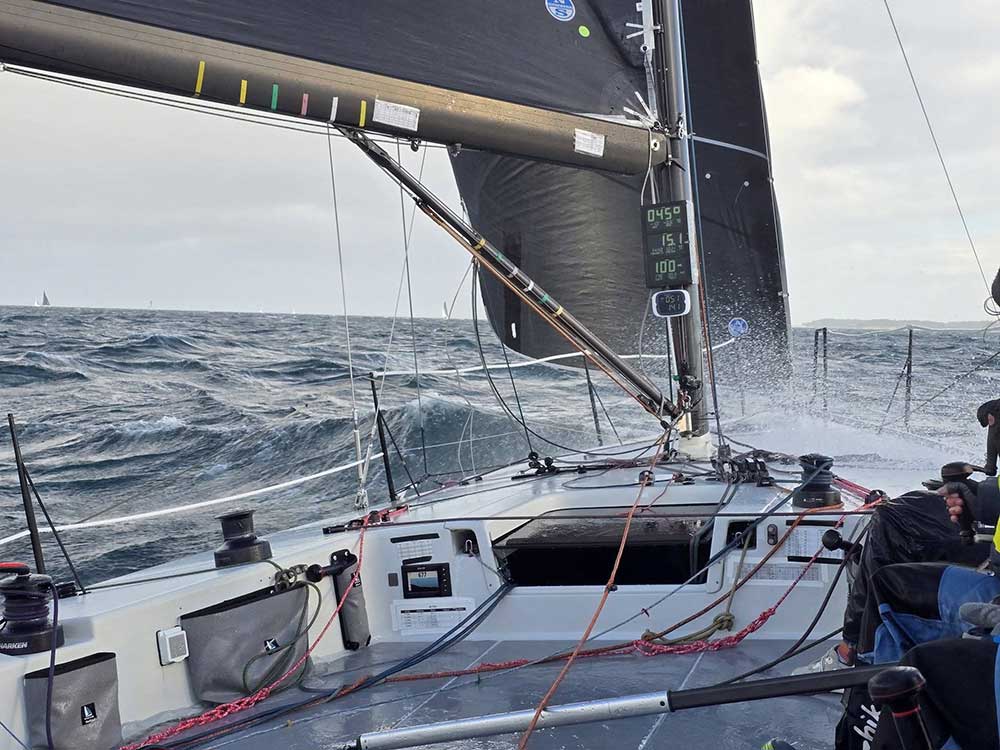
As we made our way toward the starting area near Henry Island, the fleet of roughly 100 boats assembled for the second leg. The day’s pre-start excitement had an especially beautiful backdrop with the surrounding islands and open water washed in the golden morning haze. The southerly was already building, with sustained speeds in the high teens and gusts above. At 8:45 a.m., our race began. Since it was a downwind start, we all jockeyed for position with our jibs up, while some boats tried to time early spinnaker hoists.
Stronger puffs and exposure in Haro Strait quickly made things challenging for several crews, with boats struggling to control their kites on angles that were a bit too hot for the breeze as the fleet made its way northwest toward Stuart Island’s Turn Point. Meanwhile, the Dash 750 multihull Hyperion came flying past us, prompting cheers and hollers from our crew as we sat perched on the rail, calling out to the skipper as they sped by. It was one of those moments when, despite the competitive atmosphere, you couldn’t help but appreciate the sight of another boat absolutely flying through the conditions.
Once we rounded Turn Point and changed course toward Patos Island, spinnakers were flying again. The wind was blowing around 30 knots, and a large container ship approached Boundary Pass, right down the middle of the fleet. Our boat stayed farther south, avoiding the ship’s path as we continued racing.
Around us, boats struggled with sail handling, headsails were tearing, and crews were fighting to keep their boats under control in the growlers. While some boats were rounding up as they became overpowered, even without spinnakers, our sail combination of a reefed main and No. 3 jib combined with First Light’s inherent heft kept us ably charging ahead through gusts and chop.
Critical to our control, we had a crew actively trimming our sails—Haley on jib and Gaby on main, both easing when a gust came through and grinding to catch the wind at the right angle. Scott, our captain, mentioned this saved the boat from rounding up several times in these conditions.
Then, as we approached Patos, we heard a call over the radio. Our divisionmates on the J/111 Flash had run aground on the reef near the lighthouse. We heard the boat had become overpowered, rounded up on starboard tack, and struck the reef. The crew was unable to get free, and the boat was being pushed against the rocks.
We immediately dropped our sails and started our engine in idle, standing-by in case we could provide assistance. Other boats nearby also slowed or stopped to respond. Fortunately, Flash was eventually able to get free and make its way back toward Bellingham with the crew shaken but ultimately safe, although the boat was taking on water along the way. It was a sobering moment seeing waves crashing all the way up their sails as the crew were still sitting on the rail.
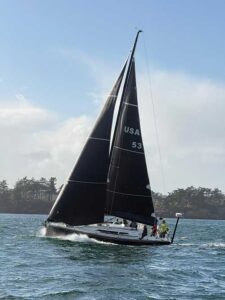
For all the competition and excitement that comes with sailboat racing, the safety of everyone on the water remains everyone’s first priority. Witnessing boats responding to another crew in distress highlighted the seamanship and community that connects and unites us as sailors, far outweighing our relationship as competitors. Once the situation had stabilized, we raised our sails again and continued racing.
With a reefed mainsail and our No. 3 jib, First Light powered through three-foot waves and the southerly still pumping around 30 knots. The conditions were exhilarating. We passed boats on our starboard side, pushing through the rough water as the fleet continued around the islands. After Saturday’s frustrating stretches of light air, Sunday was delivering all the wind we could have asked for, and then some.
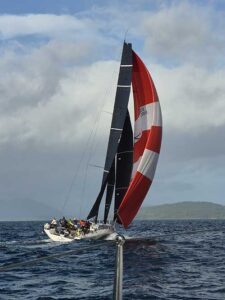
The final leg after turning south at Orcas Island’s Lawrence Point was an upwind battle through Rosario Strait, with the age-old question of whether to skirt inside the Peapods or outside to the east—First Light chose the east side. I believe we overtook a few boats on the inside of the Peapods, but the farther east you were, the better—and our pals on Sláinte managed to overtake us. This final stretch saw the breeze decrease to around 15 knots, and some of the lighter boats recovered some gains after the wind and waves on the north side of the islands rendered some a little less efficient. Our crew worked together through the gusts and waves as we made our way toward the end of two unforgettable days.
And then, just as the weekend was coming to a close, we were given one final surprise. Looking back toward the finish line on our way to Anacortes, I saw a humpback whale surface, its blow rising into the air like a goodbye to the epic weekend of racing. After two days of unpredictable winds, challenging conditions, and memorable moments both on and off the water, it was a beautiful way to end Round the County 2026.
The sailing was riveting and, whatever your mindset or result, this will be remembered as a very zippy edition of this beloved event. Shoutout to a number of the ORC 1 boats and to the F-32SR trimaran, who logged the full two-day 66-mile circumnavigation of the islands in under 7 hours total! With the racing wrapped up, it’s time to give some flowers to the victors. Our class podium for the weekend included J/111 Hooligan in first, Margaret II in second, and J/111 Lodos in third.
More Than a Race
Round the County brings together sailors of all different backgrounds and experience levels, united by a shared love for the sport and this beautiful place we’re lucky enough to sail. For me, being aboard First Light with a crew that works hard, supports one another, and knows how to have fun has shaped my love for sailing just as much as the sailing itself. As someone still relatively new to racing, there’s something pretty special about being surrounded by people who encourage you to learn, challenge yourself, and become a better sailor. Getting to share that experience with so many other women made it even more meaningful.
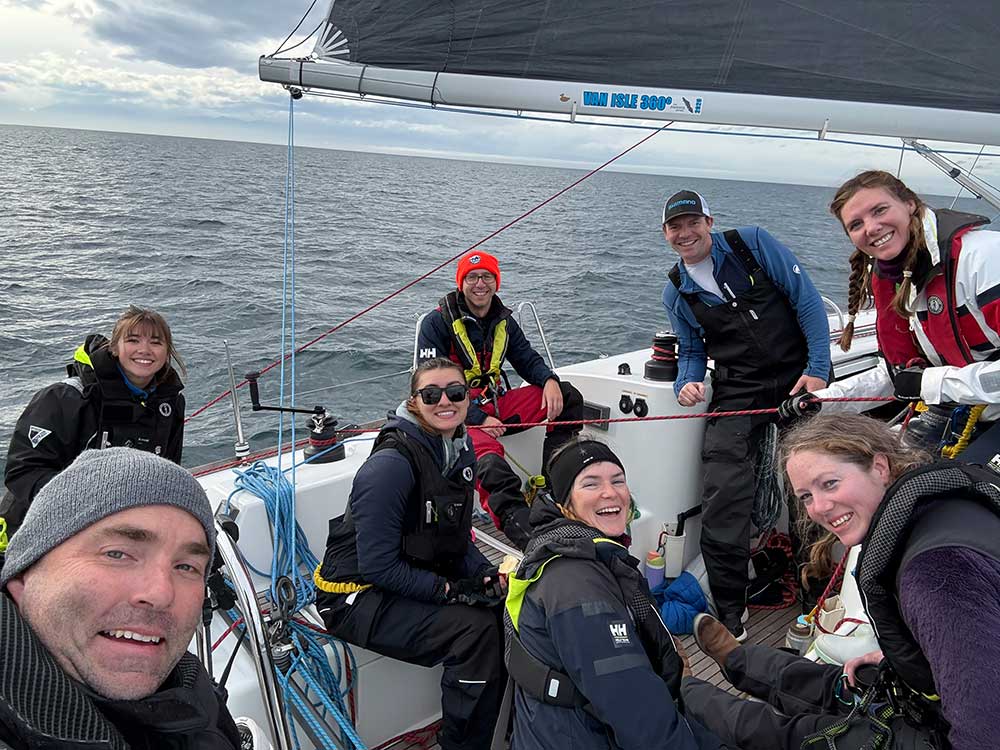
The weekend’s adventures gave us plenty of sea stories to take home. And no doubt the Pacific Northwest sailing community will be talking about this one for a long time.
I came into the weekend excited for two days of racing and left with a little more experience, a lot more inspiration, and an even greater appreciation for the people I’ve met along the way.
Full results at: roundthecounty.com