Having sailed a variety of boats from 10 to 100 feet, my default preference is a small-to-midsize monohull keelboat with performance chops. Cruising catamarans are seldom at the front of my mind, though I know they intrigue many fellow sailors. So when Tre, an old pal and new owner of an Excess 11 catamaran, invited me to go sailing, obviously I said yes; but my excitement was driven by the opportunity to discover something outside my comfort zone.
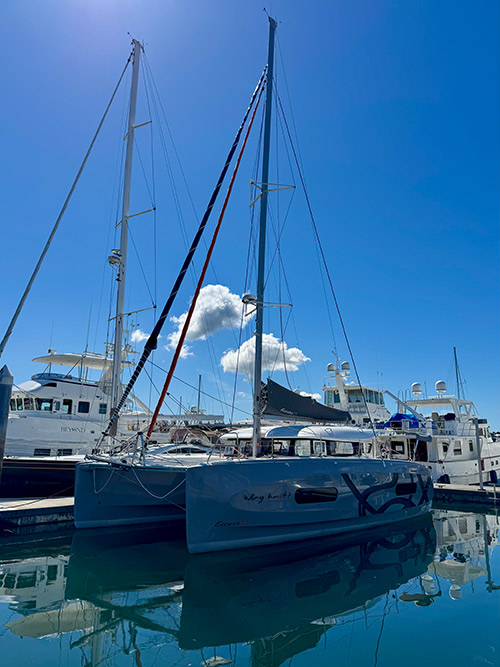
I’m late to the party on the Excess 11. My first real exposure to the impressive line of Excess catamarans came at the Annapolis Sailboat Show. For those who aren’t steeped in cruising cat trends and evolutions, the Excess 11 debuted in 2020; and Tre’s boat is the first example in the Pacific Northwest. Displaying speed and offshore prowess, an Excess 11 won its class in the 2021 ARC Rally. Such a prominent result, paired with a couple big-name Boat of the Year honors, make it a darling of multihull cruisers and media alike. Tre described the Excess 11 as “a sailor’s cruising cat.” There’s more to it, obviously, but after sailing the boat, I find that characterization as apt as it is succinct.
The Excess 11 is ostensibly 11 meters in length, with length overall just over 37 feet. With a dry displacement of 19,845 pounds, that positions the Excess 11 a couple thousand pounds lighter than its heaviest competitors, while making it 1,000 pounds or more heavier than some of the more performance-oriented options in that size range. The Excess has two different rig options, and the one I sailed had the taller “Pulse Line” rig that increases mast height by three feet from standard and adds a flattop main, pushing the sail-area-to-displacement ratio from the high teens (a typical range for production cruising cats) to just above 20 (near higher performance designs).
Much of what wowed me through my test sail aligns with the accolades the design has enjoyed, and centers around this idea: This sub-40-foot catamaran, which is competitively priced, both sails and lives as well as larger, more expensive competitors.
The Excess has stylishly sporty exterior aesthetics, with attributes like the narrow entries at the near-plumb bows and molded bump-outs in the hull sides that boost interior volume without increasing wetted surface.
Stepping aboard from the swim-step, it was only a single step to the starboard helm station which is situated at deck level, bucking the cruising cat trend of the raised helm station. Especially for a mainly-monohull sailor, I appreciated this familiarity—moving from one helm to the other provided the different perspective I always value with twin helms, both when looking forward and when checking the sails. For entertaining under sail or more time with the family, the proximity of the helmstations to the cockpit will be a major advantage over the raised-helm alternative.
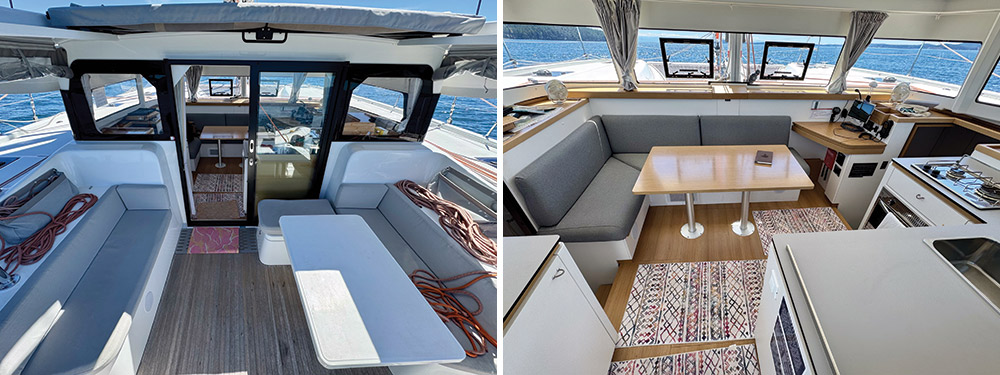
The cockpit seating area has a settee and table to starboard, and a settee positioned to port across the walkway to the cabin. Adding seats on two sides comfortably seats four (the boat comes with soft upholstered modular seats), and adding another table connects the two settees and creates a single dining area for a larger group.
The cockpit’s living area is covered by a retractable awning between the two rigid aft-running extensions on either side of the coachroof. This awning’s stowability is a sail-friendly attribute, increasing visibility to the rig and sails. Each helm station also had a canvas bimini—the perfect array for our sunny June sail—but the helm biminis’ 270° Isinglass panels would be a welcome addition in cold and wet conditions.
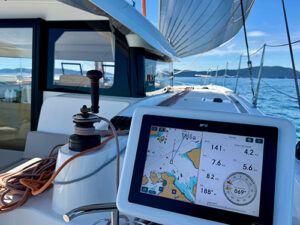 As we motored out, I became aware of the placement of twin Yanmar 30hp diesels under each helm station. At the helm, there’s a bit of vibration and more engine noise than I’m used to while driving; but having them well aft of the main cabin is an enormous quality of life improvement for anyone in the salon–including someone driving by autopilot remote from the navigation station.
Soon, we were head-to-wind, and I was jumping the 2-to-1 main halyard at the mast. The factory configuration for Tre’s boat has a self-tacking jib, and Tre had rigged up the Code Zero which tacks to the aluminum bowsprit extending from the bow beam. The mast is positioned quite far forward, so it’s a fairly small triangle for the jib on the fractional rig. The newest Excess 11s are now delivered with a traditionally-sheeted overlapping genoa. Not only does the genoa increase upwind sail area, but it also should appeal to the sailor this boat targets—someone eager for a more fun, hands-on sailing experience.
The Pulse Line rig’s extra height helps the smaller jib, and the square-top main is clearly the workhorse in the sail plan. The boom is positioned as low to the coachroof as possible without a vang, thus maximizing sail area. The mainsheet system is similar to one I’ve seen on many new boats recently, with a dedicated mainsheet to port and another to starboard. Functionally, this set-up increases trimming adjustability with neither a mainsheet traveler nor a boom vang. The windward sheet acts like the primary mainsheet and also enables you to position the boom to weather for twist, while trimming the leeward sheet acts more like a vang.
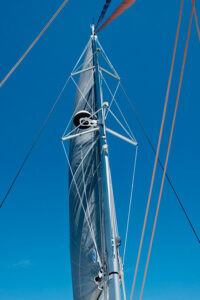 With the main and jib set, sailing upwind in 4-7 knots, we were moving nicely against a waning flood in Guemes Channel. I’ve witnessed conventional cats’ notoriously underwhelming light-air performance; and thus I was pleased to find the Excess 11 a facile sailor even in gentle breeze. I braced to be in irons through the first few tacks, but we were easily through on every maneuver. Though the now-standard genoa would have been an upgrade in this day’s conditions, the jib had a nice shape and was easy to set-up. In breeze this light, the boat’s ability to point has a ceiling—it was happy around 40° apparent, but tipping into the 30s felt too thin and slow. As the breeze builds, Tre assured me that sailing close-hauled at 30° apparent is the norm.
Given that the boat felt decently powered-up in less than 10 knots, I was curious if it was a reef-early kind of ride. The factory recommendation is to reef at 23 knots apparent. In other words, there’s a great deal more sailing excitement to be found on the Excess 11 than I saw, but my stoke meter was still high.
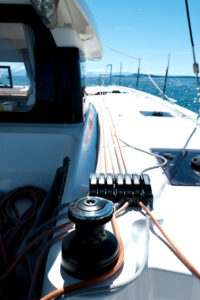 As with almost any production design today, ease is a clear priority. The sails were up, down, in, and out without anything that felt strenuous. The array of control line clutches and a primary winch near the starboard helm station is the hub for actual sailing. In this case, the primary winches are dual-speed electric.
With the boat trimmed for the conditions and the diesels off, we got into a rhythm. Hand on the helm, I was struck by the responsiveness. And by responsiveness, I mean I was oversteering… a lot. I always (wrongly) look for more helm feel than there is on a cat. Still, the steering system is definitely tuned for a light touch. The system uses textile lines and is entirely mechanical (not hydraulic), well-suited to the spirit of the design. That I found the groove fairly narrow was more about my tuning as a driver than the boat’s tuning in the system.
One of any cruising catamaran’s main virtues is interior space, and this is another area where the Excess 11 shines. The main salon is enticing and the views are as good as any cat competitor. The forward L-shaped settee and table to port are balanced with the aft-facing L-shaped galley to starboard. While multihull marketing often displays tropical scenes, I maintain that this mostly covered indoor/outdoor living experience with 360° of expansive windows can also be considered tailor-made for enjoying coffee on a misty morning when stern-tied next to an Inside Passage waterfall. Palm trees not required.
Underway, this visibility through the salon windows is also important, since the deck-level helms require looking through salon glass some of the time. I wager this is a useful but imperfect solution, and not nearly as important or preferable as the ability to switch control from one helm to another easily for a better view.
Tre’s Excess 11 is the three-cabin layout, with one hull dedicated to the private luxuries of the owners’ suite, including a desk as well as a head with walk-in shower that’s approximately as spacious as one in my house. Fitting two private double-berth cabins into the other hull, with a head (also with separate shower) between them feels anything but cramped. A few aspects of interior build quality signal efficiency over extravagance—there was a bit more cabin sole creak than ideal for me, for example. But the overwhelming impression of the interior is one of comfortable quality, well-appointed layout, and functional spaciousness. All in a 37-foot package, and one with rewarding sailing manners. Impressive.
Under each berth and throughout the cabins as well as in the bow’s lazarettes and garages, the storage capacity boggles the mind. It borders on problematic. The Excess 11 is thoughtfully drawn and constructed to keep the boat’s weight in check—extremely important to multihull performance. With so much space for storage and living, it would be incredibly easy to fill the available spaces with thousands of pounds of gear and provisions and risk reducing its capability for good performance. Thoughtful packing will keep the boat as sailor-friendly as intended.
Now plying the waters of Rosario Strait, we got to bear away and unfurl the Code Zero. It wasn’t a surprise, but cracking off and adding a much bigger sail took this from a “nice” sailing experience to a legitimately fun one. An apparent wind angle of 60° was no problem at all, meaning there’s only a 20° course/wind deviation between close-hauled with the jib to rolling out the Code and turning the “yahoo!” dial up a few notches. With the versatile sail, deeper reaching angles are also on offer. There can be precious little reaching for many PNW cruisers, but I’d plan itineraries to maximize time in this mode.
Zooming out and considering what enthralls me most about the Excess 11, some of its PNW appeal might apply to any cruising cat—huge windows to take in the exquisite surroundings and bring in daylight even on gray days; built-in cockpit covering for better outdoor living in damp conditions; given our generally flat sea states, you don’t have to stow every last belonging before weighing anchor; the factory-option dinghy davits can accommodate a 12-foot rib; and there’s great maneuverability and reassuring redundancy afforded by having twin diesels.
Then, there are a host of things I appreciate specifically about the Excess 11. I love the position of the mast forward of all living spaces—the bilges were bone dry, and they have a better chance of staying that way with fewer holes in the deck above the cabin. I really appreciated the interior layout; I honestly wouldn’t change a thing. But most of all, I loved its focus on a great sailing experience. All boat design is a compromise, and I think the Excess 11’s compromises fit neatly with my own preferences.
 In sum, I’m in on the Excess 11. The sailing experience isn’t hype, it’s actually good; the interior is the picture of boaty comfort; and the design choices align with the ways that I would want to use a boat like this for cruising the Salish Sea.
Thanks to Tre Nabstedt for taking me sailing. For your own experience aboard the Excess 11, it is the vessel used for multihull sail training through Seattle Yachts Sailing Academy in Anacortes.