Over the last eight years, my wife Jenny and I sailed thousands of miles aboard our Alberg 37, Maya. We’ve circumnavigated Vancouver Island, sailed to Alaska, and spent several winters cruising Pacific Mexico. We’ve made offshore passages, weathered storms, and spent countless nights at anchor in remote places. And this year presented maybe our greatest challenge to date: cruising with a toddler.
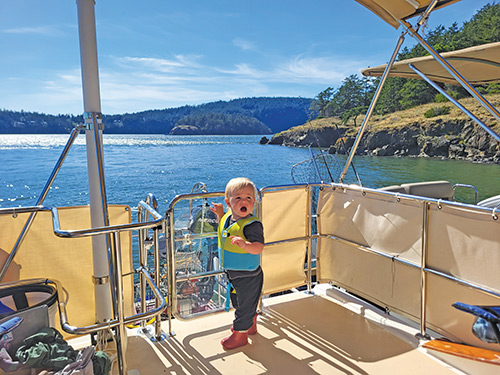
After many adventures aboard Maya, we sold her in Mexico and have since purchased Restless, a 1980 Universal Marine 36 trawler here in Puget Sound. This past spring, we set off on a three-week cruise through British Columbia with our 20-month-old son, Jameson, for our first extended cruise as a family.
Jameson is not a stranger to cruising. He had his first overnight on the boat when he was 2 months old and, at the time, cruising with him was actually straightforward. He couldn’t crawl yet so we were either holding him or he was asleep. Even when he was a year old, cruising was more or less the same; although he had just begun to crawl, which was still easy to manage on the boat.
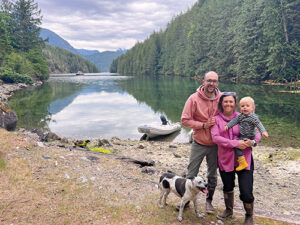
Fast forward another year to the spring of 2026 and he had recently become confident walking and climbing things—perfect timing for our three-week cruise in Canada. Thankfully, this trip had been in the works for over six months so we could prepare the boat for the challenges that lay ahead. As with any boat, there were regular projects and upgrades to be done. We installed a lithium battery bank, solar panels, and a watermaker.
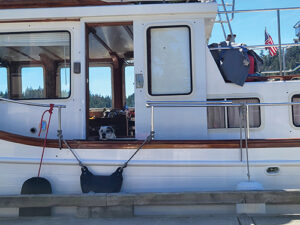
Then there was a whole category of “toddler proofing” the boat. To be fair, we had a good foundation to work from. Our boat is a three-cabin layout, which is separated nicely into different areas. Cabins fore and aft gives Jameson his own room up forward. The V-berth has a door that we could close when he is sleeping. The salon is very comfortable and has doors on all sides that can be closed and locked in place. Additionally, our flybridge is very spacious with a big table in the center with lots of open space around it. The flybridge was mostly enclosed with the exception of the entrance. To address this, we purchased a prefabricated stainless steel “lift-to-unlock” door that we found from an online retailer and then adapted that to work on our boat. This was a huge time and money saver. The prefabbed door had been mass produced for some other variety of boat on the market and was purchased at the cost of about 2 hours of a metal fabricator’s time. Even better, it basically dropped into the entrance of our flybridge with only a small amount of creative engineering to get the “lift-to-open” operation in place. We added a transparent acrylic panel to the door which increased safety and added some aesthetic.
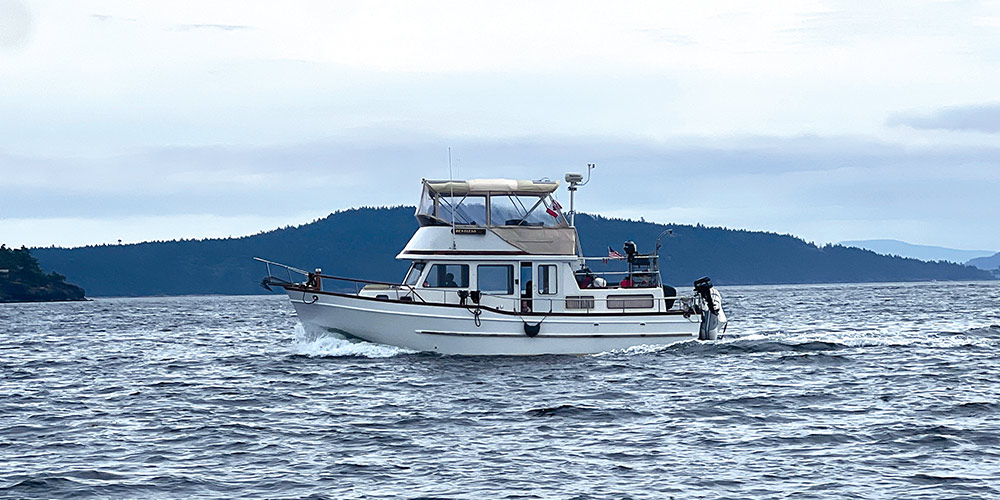
The last modification needed for the flybridge was to fill in the gaps between the existing stainless steel railing. We sewed up some additional canvas panels with grommets and zip tied them in place, effectively closing the perimeter to the point where we felt comfortable having Jameson roam around the flybridge. It’s worth noting that the most likely place for a toddler to escape the perimeter was at the bottom of these canvas covers so having a bunch of small grommets at the bottom of the canvas to anchor it to the floor increased both the safety factor and our trust in the enclosure.
After many hours spent working on the boat through the winter, it was finally time for our big cruise. In a perfect world, we would have a sea trial to test all the new systems and upgrades put in place over the winter. As it would happen, life, work, and obligations got in the way, which kept us dockside until launch day. In the wise words of Captain Ron, “If anything is gonna happen, it’s gonna happen out there.”
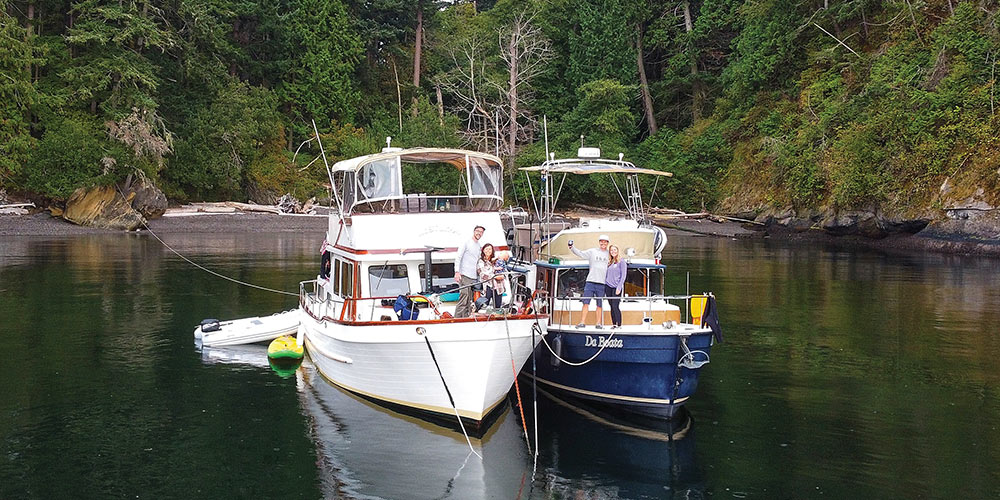
We launched from our homeport of Anacortes on May 7 under beautiful spring weather conditions. Our destination was Desolation Sound and we spent our first night at the dock in Prevost Harbor on Stuart Island where we met up with our buddy boat for the trip, Da Boata—a Ranger Tug 31, captained by Jameson’s aunt and uncle.
The next morning we set off to Canada to check in at Van Isle Marina in Sidney’s Tsehum Harbour. Clearing in was very straightforward, only taking about 10 minutes and done over the dedicated Customs landline phone at the marina. After that, we made our way to Ganges on Saltspring Island, opting to stay at the marina there so we could more easily provision the boat for the next three weeks. We like to reprovision in Ganges because there are several grocery stores within walking distance of the marina. The big grocery store is a 10-15 minutes walk uphill from the marina so it was really handy to use the compact stroller we had stashed on the boat. This was the only time we used a stroller on the trip, but we were very happy to have it.
With our boat full of fresh food and a burning desire to get to Desolation Sound as fast as possible, we set off north from Ganges, easily navigating Dodd Narrows before stopping at the public docks on Newcastle Island in Nanaimo. Newcastle Island is one of our favorite parks and even better with a toddler—there’s a playground, a great combination of open green fields, forestland, wildlife, and amazing views all around. Also, there’s a constant stream of seaplanes landing and taking off, which Jameson absolutely loved.
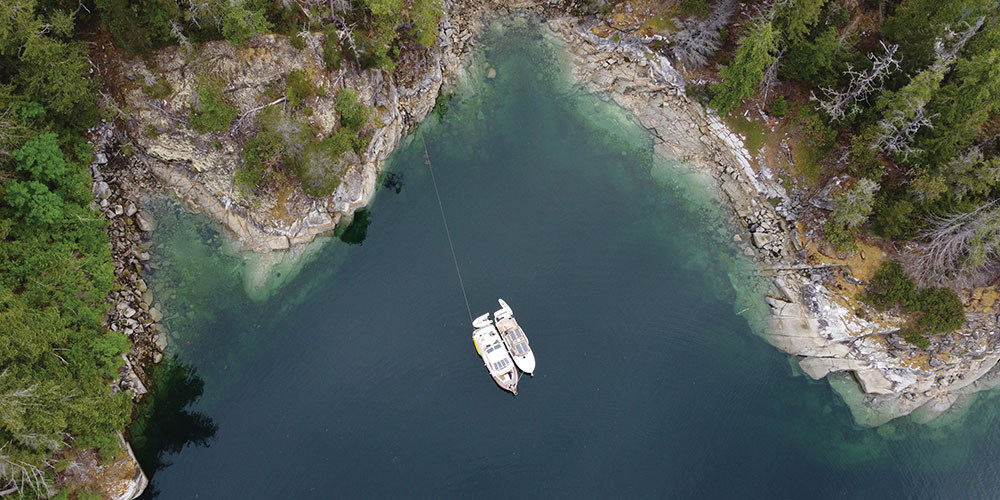
After a nice night at Newcastle Island and a mandatory stop at the Dinghy Dock Pub, we set out to leave the protected waters of the Gulf Islands and venture into the Strait of Georgia. The weather and sea state cooperated and we made what would be the longest passage of the trip, completing the 60 nautical miles to the marina at Lund in great time.
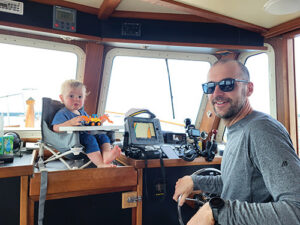
At this point, we were four days into the trip and we had begun to figure out life with a toddler aboard. First and foremost, while underway everyone stayed in the salon with all the doors closed. One parent drove, the other managed Jameson. For moments where we needed to maneuver the boat in a marina, or drop anchor, we would strap Jameson into a carseat on the settee and distract him with a bottle of milk or a video playing on a phone. For the hours spent underway, the salon turned into a big playpen—toys and pillows everywhere. Jameson could stand on the settee and look out the windows at the constantly changing environment. When it was nap time, he slept in his pack-and-play up in the V-berth, which we anchored to the wall so we could be absolutely sure it wouldn’t slide when we encountered any sort of sea state.
Arriving in Lund, we were feeling great. Our toddler was not only alive, but thriving, and we were all having fun. We were at the doorstep of Desolation Sound and it had only taken us four days—we had two-and-a-half weeks before we had to be back home.
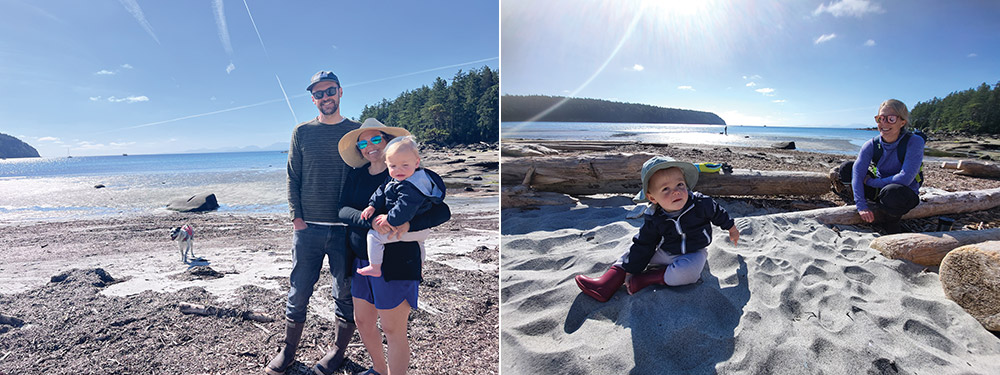
We spent the next 11 days touring through Desolation, stopping in Prideaux Haven, Roscoe Bay, Von Donop Inlet, Gorge Harbour, to name a few. After the longer travel days to get up north, we really appreciated the short jumps between anchorages in Desolation.
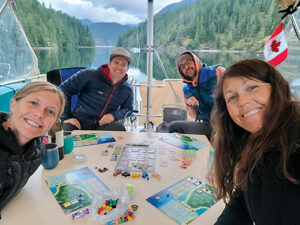
It was at this point we really found our rhythm. Days started promptly at 6:30 a.m. with Jameson ready to take on the world. There is no snooze alarm with a toddler. Mornings were coffee and family time and Jameson would play with his toys at the salon table or run laps around the boat with a parent trailing close behind. Each day, we made time to take Jameson ashore to explore and get a change of scenery from the boat. If we were traveling, we would try to time his nap while we were underway. Coincidentally, we found the best way to keep a toddler asleep is to have them listen to the soothing hum of a diesel engine. On layover days, Jameson’s nap time allowed one parent to go do an activity—usually some SUPing or fishing. Happy hour would eventually roll around where we would all congregate on the flybridge to relax and enjoy food and drink before his bedtime. After that, it was drinks and cards for the adults.
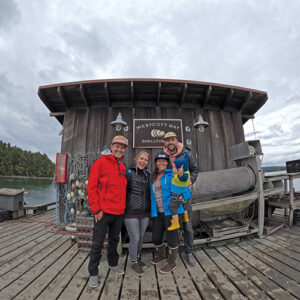
As it always does when cruising, time flew by and, all too soon, we had to say goodbye to Desolation Sound and start heading south. While we were very lucky with the weather on our way up north, the conditions were not as ideal for us on our southward journey. There were no major gales predicted, but there was a north-northwest wind forecast that showed up here and there over the coming days. Fully aware of the predicted wind, we snuck across the northern part of the Strait of Georgia to Tribune Bay on Hornby Island. After a peaceful night at anchor we set off south to Nanaimo. This passage would prove to be one of our wildest days at sea in a long time.
We started the day with only a slight breeze at our backs. Slowly, the wind and sea state built to the point where the autopilot became useless and we were hand steering somewhat aggressively to account for the following seas. While all of this was going on, there was a Canadian military exercise going on in the Whiskey Gulf section of the Strait. Huge planes were swooping low, helicopters were flying around with giant nets carrying what appeared to be torpedoes, military ships were zooming all over the place, and there was a bunch of commotion over a large recreational boat accidentally traversing the closed area making for some incredible VHF conversations. Absolute cinema.
After several hours of this and an ever worsening sea state, we rounded the point into the safety of Departure Bay. We could breathe a sigh of relief to be in the protection of Newcastle Island. While collectively catching our breath we made our way through the narrow channel between Newcastle and Vancouver Island. This sigh of relief was short lived because, in one moment we were travelling the channel at about 4 knots, the next was a huge CRACK and BAM. A moment of bewilderment. Then the realization that we had struck a rock. I immediately threw the boat into neutral and we waited. Several seconds went by and we were still moving forward. Not stuck. That’s good! Do we have steerage? Yes. Also good! Do we have propulsion? Oh, it’s a scary thing to put the boat back into gear after a collision. Big sigh of relief—in forward gear we had propulsion and no weird vibrations! OK, time to check the bilges… no leaks!
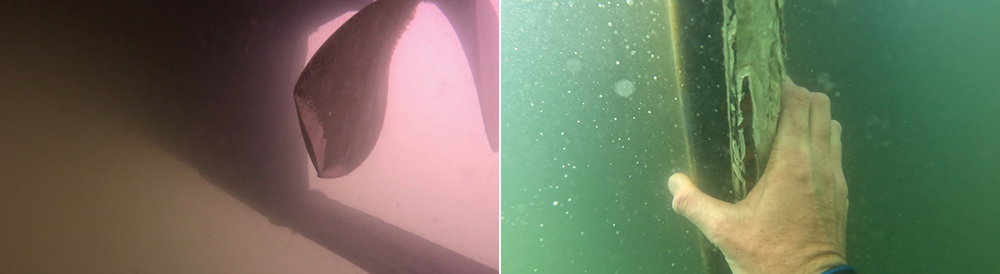
All of this chaos happened in about the span of a minute. Jenny and I in what could be described as a frenzy, with Jameson laughing through the whole thing. Good crew, this one. We motored cautiously through the rest of the channel and tied up to the Newcastle Island park docks. I dove on the boat and found some missing fiberglass on the centerline and the propeller with small dog ears, but no other damage. We escaped a major disaster and the trip could continue on as scheduled. That night, extra happy hour drinks were poured as we recounted the crazy day.
We spent the last few days in Canada making leisurely miles south. We enjoyed several nights anchored at DeCoursy Island and a shift in the wind unexpectedly brought us to Lyall Harbor where we got to taste the very laid back vibe that is Saturna Island. It was a perfect ending to another wonderful trip to Canada. We crossed the border and took several more days to get back to our slip in Anacortes.
We arrived home a little dinged-up and tired but, more than anything, triumphant. The family was safe and overflowing with lifelong memories made. Another proper adventure in the books and Jameson was the best part of it. I really feel like I watched my son grow up before my eyes. He started the trip as a baby and by the time we got home he was a little boy. Crazy. It happened so fast, and if we all hadn’t had the last three weeks of concentrated family time on the boat I would have missed some of that.
Looking back, it’s funny how nervous we were about bringing a toddler on an extended cruise—turns out it was easier than we expected. Our preparations paid off; and the challenges that did show up, we adapted to. This trip was a good reminder that any proper boat adventure is really about heading out and seeing what happens. You prepare as best you can, but eventually you need to cast off the dock lines and go, because if anything is going to happen, it’s going to happen out there.
Mac and Jenny are based out of Anacortes, Washington. Mac owns and operates Boat Doctor NW, a marine services business specializing in boat electrical systems. They also share updates via social media under
“Cruising Maya” (Instagram, Facebook, YouTube).