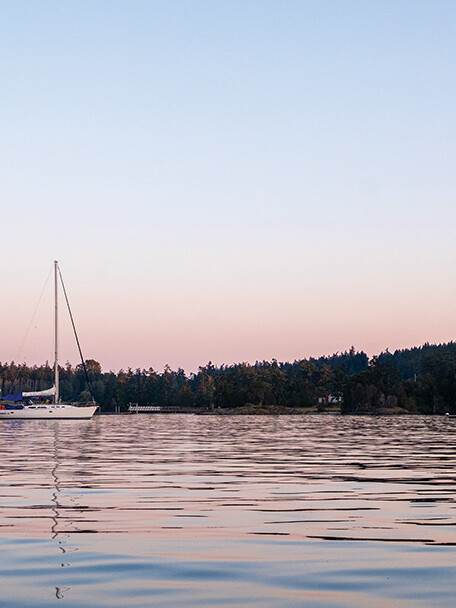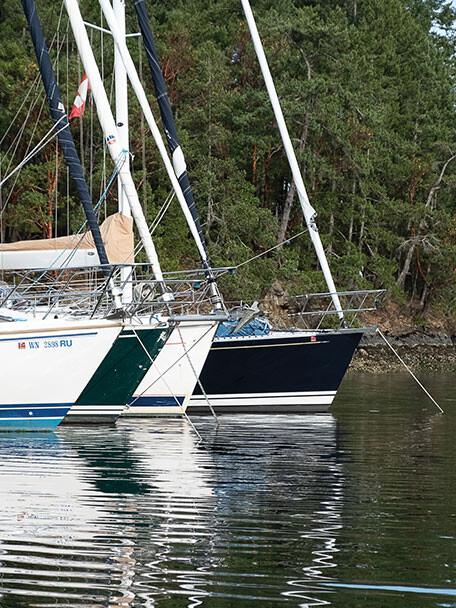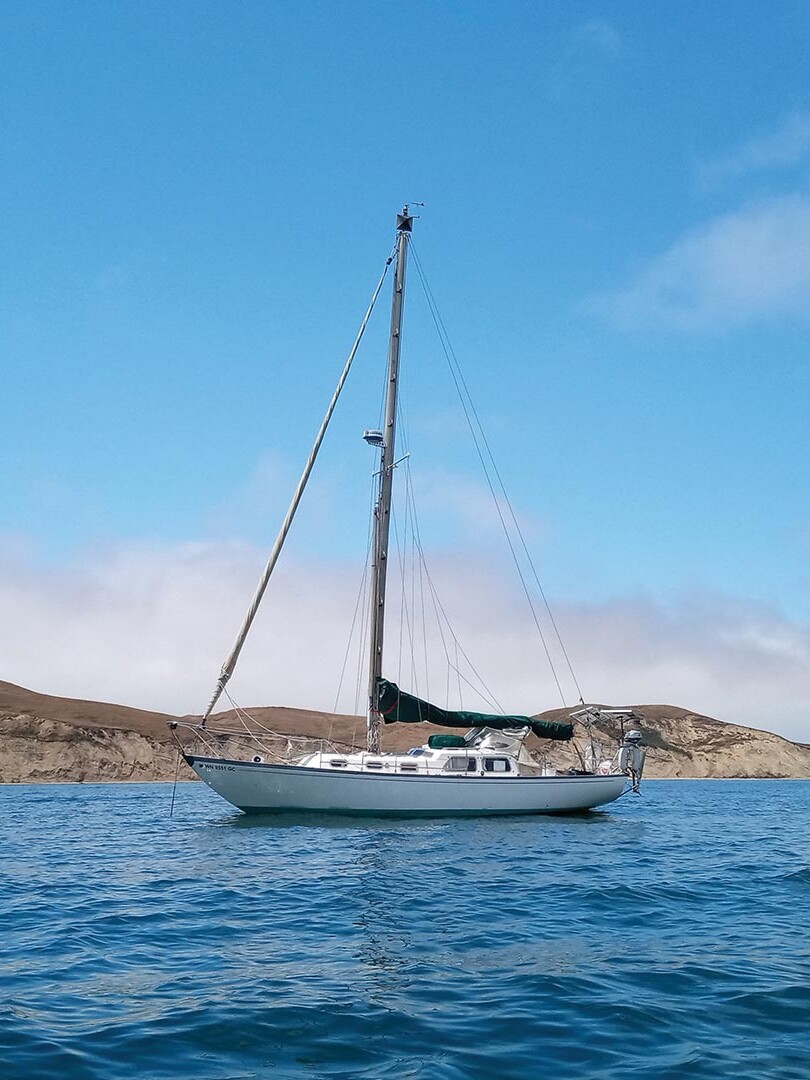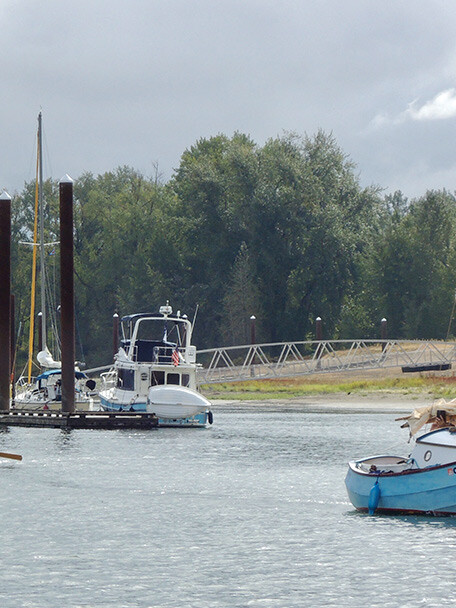
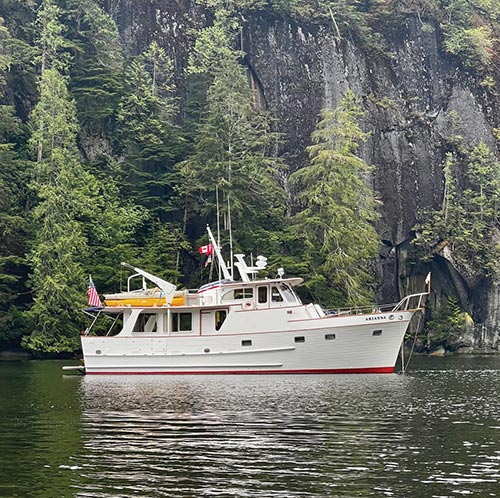
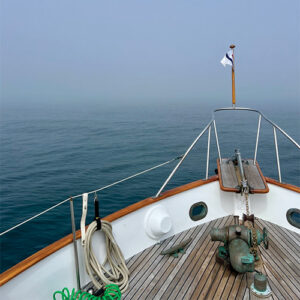
As the early morning light filtered through the mist hovering over Lagoon Cove, a welcoming marina near the eastern entrance to British Columbia’s Broughton Archipelago, I stood in the pilothouse of Arianna, my sturdy wooden 1970 Grand Banks Alaskan 46, and admired the quiet harbor. It was day seven of the first leg of my voyage to Alaska; a trip that had lived in my imagination for decades.
 It wasn’t simply about reaching Alaska, though. Along the way, I hoped to explore places I had read about for years—small communities, secluded anchorages, historic passages, and natural landmarks that had quietly become destinations in my mind long before the voyage began.
Our destination that day was Sullivan Bay, but first we planned to stop at Watson Cove at the north end of Tribune Channel. Beyond the cove stood an ancient western red cedar I had read about in several guidebooks. Estimated to be more than three thousand years old, the tree was hidden in the forest beyond the shoreline. For days, I had wondered what it would feel like to stand beneath a living thing that had quietly endured for so many centuries. As I thought about the tree that morning, my mind drifted back to the dream that had brought me to this point.
More than fifty years earlier, while growing up in Maryland, I had begun telling anyone who would listen that someday I was going to take a boat to Alaska. It was an ambitious dream for a teenager who had never ventured much beyond the Chesapeake Bay, and most people probably dismissed it as youthful imagination. As the years passed, life filled with career, family, and responsibilities, but the dream never completely disappeared. Owning Arianna made the dream feel attainable for the first time.
When I finally began planning the voyage, I found myself thinking back to those school days—not only to the dream itself, but to the people who had first heard me talk about it. I hoped I might reconnect with a few of those classmates and, if they were willing, invite them to become part of the journey itself.
I searched for crew among people who had known me then—friends and classmates I remembered as dependable, thoughtful people. Mark and I had reconnected through Facebook a year or so earlier, and another classmate suggested I contact Mike. We hadn’t kept in touch over the decades, but I felt I knew them well enough to ask. To my delight, they both accepted the invitation to join me for the first leg of the voyage.
Becoming a Crew
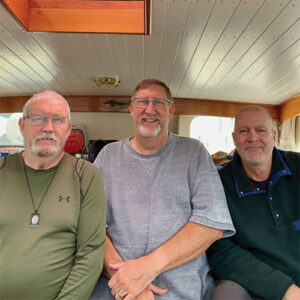
Mark had spent time sailing in past years, so life on the water wasn’t entirely unfamiliar, though cruising aboard a 46-foot trawler through the Inside Passage was altogether different. Mike had less boating experience than either Mark or me. Quiet by nature, he revealed little about what he was thinking, and I often wondered what he was making of this adventure.
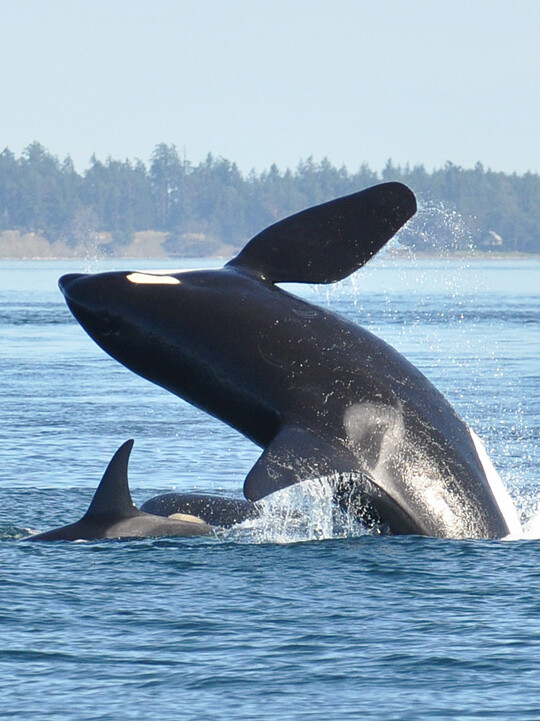
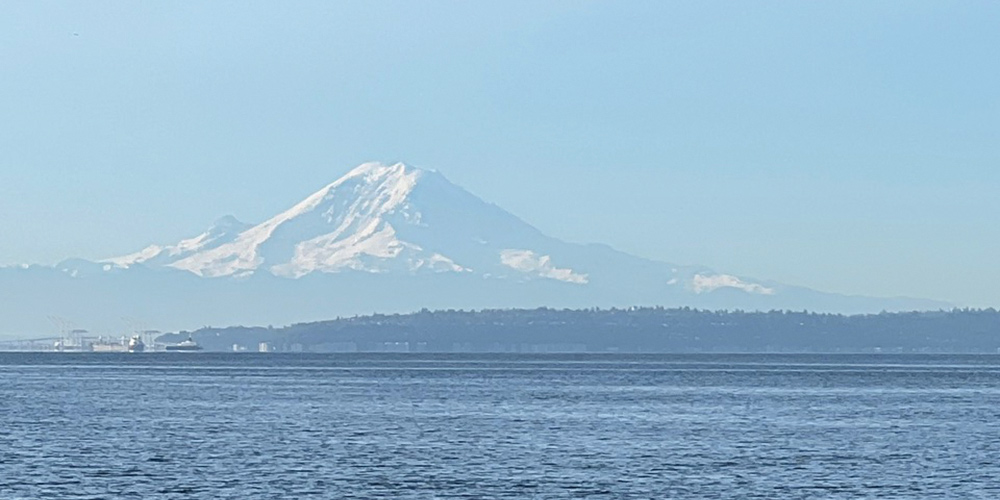
The past six days had already provided an unforgettable introduction to the Inside Passage. We watched killer whales surface alongside Arianna, admired spectacular waterfalls, and timed several narrow passages to coincide with slack water. On our first morning leaving the Seattle area, a clear blue sky and the magnificent mountains around us made it feel as though the voyage had begun under ideal conditions. Then, as we rounded Marrowstone Point, we were met by a wall of dense fog. Within half an hour, visibility had dropped to less than 50 yards. I asked Mike to take on lookout duties and showed Mark how to watch the AIS display, while I monitored the radar and chartplotter. Even so, our attention was mostly outside the pilothouse.
The electronics helped us understand what lay beyond the fog, but our eyes rarely stayed on them for long. Just as we were settling into those new roles, the Coast Guard called, directing us to alter course west from our planned northerly route. With no explanation for the sudden change, I quickly replotted our course while the others remained focused on their responsibilities. Only later did we learn we had been making way for a U.S. submarine. We eventually received the all-clear notice and resumed our northerly progress. Two hours later, we emerged into the sunshine again. Experiences like that quickly turned three travelers into a crew.
During that first week together, Mark and Mike quickly found their sea legs and settled into the rhythm of life aboard. As captain, I remained responsible for navigation, weather, tides, and the countless decisions required to safely lead the boat through remote waters. Mark and Mike gradually took on more of the daily routines, accepting each new responsibility with little hesitation. Just as encouraging, we settled into an easy companionship that made life aboard genuinely enjoyable. By the end of that first week, I found myself quietly believing that inviting Mark and Mike had been the right decision. More than that, I was beginning to believe this voyage was going to work.
Sometimes the weight of responsibility for this trip intruded on my thoughts. Leading my friends through these remote waters filled me with both eagerness and apprehension. The familiar “what ifs” occupied my mind. What if I miscalculated the tides? What if something went wrong with the engine? What if I struck a hidden rock? Despite those concerns, Mark and Mike’s willingness and enthusiasm were infectious. I was grateful they had chosen to join me. Their easygoing confidence helped me keep my thoughts in perspective.
Onward to a Tree
in the Broughtons.
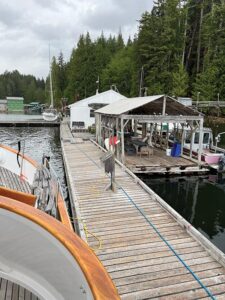
Lagoon Cove’s marina was deserted and peaceful as Arianna’s crew came to life early that drizzly morning. Without much discussion, we slipped into the routines we had developed over the past week. Mike performed the basic engine checks; Mark organized the salon and galley and managed the stores. I settled into the pilothouse to review the day’s route, tides, and weather. By the time the engines warmed and the lines were cast off, everyone knew the day’s plan.
Gliding out onto the calm morning waters, Lagoon Cove gradually disappeared into the mist as Mike and Mark coiled the dock lines and stowed the fenders. As we departed the cove, the drizzle faded, the mist began to lift, and shafts of early-morning sunlight spilled across the coastline. I felt a quiet surge of anticipation as I pictured the ancient cedar standing silently in the forest, patiently awaiting our arrival.
With the boat underway, Mark returned to the galley to start breakfast. I don’t know whether he had ever considered a career as a short-order cook, but he seemed to enjoy the role and was certainly better at it than I was. Although we all took turns preparing meals, Mark usually claimed the morning shift, and Mike and I always looked forward to hearing his familiar breakfast call. By then, the steady rhythm of our daily routines had become part of the voyage itself, offering a reassuring sense of normalcy amid the excitement of exploring new waters each day.
As we set off, I reviewed my earlier navigation calculations and set the autopilot to our first heading of the day. With a new moon approaching, the morning would bring the day’s larger tidal exchange—more than 16 feet. The afternoon cycle, however, would be much smaller, which is a common feature of the mixed semidiurnal tides along the British Columbia coast. The larger morning tidal exchange allowed us to take advantage of the strong flood current up Tribune Channel, reaching Watson Cove by late morning—an hour before slack tide. The timing couldn’t have been better. During the several hours we expected to spend ashore, the tide would rise only another two feet before turning and falling about three feet—little change in water level and therefore little current in the cove. Beyond Watson Cove, the afternoon ebb would fall only another five feet, creating a small and manageable amount of adverse current for the remainder of our passage to Sullivan Bay.
Tribune Channel was given its name by Captain George Vancouver during his 1792 exploration of the Pacific Northwest, though I have never found a definitive explanation for why he selected it. Watson Cove itself appears only briefly in the historical record, yet it has undoubtedly sheltered Indigenous peoples, fishermen, loggers, and passing boaters for generations. Beyond Watson Cove lies Sullivan Bay, a floating community whose history dates to a small post office established on nearby Kinnaird Island in 1924. The post office later relocated to its present site in the 1950s.
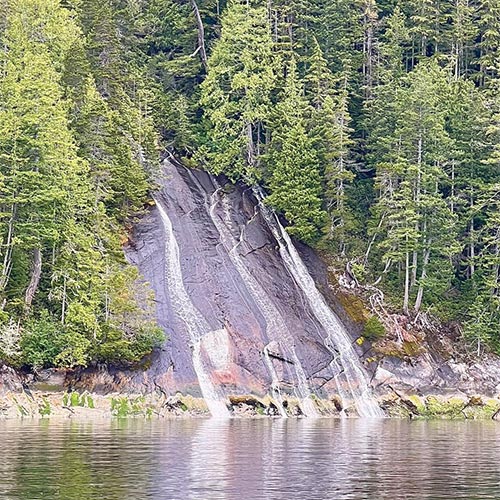
Once we were underway, the rhythm of the day settled in. We shared pilothouse duties to keep two people on watch, allowing the third crew member to rest, read, or enjoy the views. The autopilot handled steering, but only to a compass heading that I selected. Using the chartplotter, I continually compared our course with the planned route, adjusting the heading as wind, current, and tides gradually pushed us off track. The person at the helm monitored the boat’s progress while watching for the few vessels that ventured through these waters and for the countless logs drifting along the channel. The second person in the pilothouse served as an additional lookout, scanning for debris and boats while calling out any wildlife sightings. As captain, I rarely left the pilothouse while we were underway. Even during my off-duty hours, I kept busy with log entries, instrument checks, weather forecasts, and navigation updates. However, as time permitted, I was continually drawn to the scenery around us. Mike and Mark were on duty in the pilothouse as we approached a waterfall just before Irvine Point. As I gazed out at the rugged coastline, my thoughts began to wander.
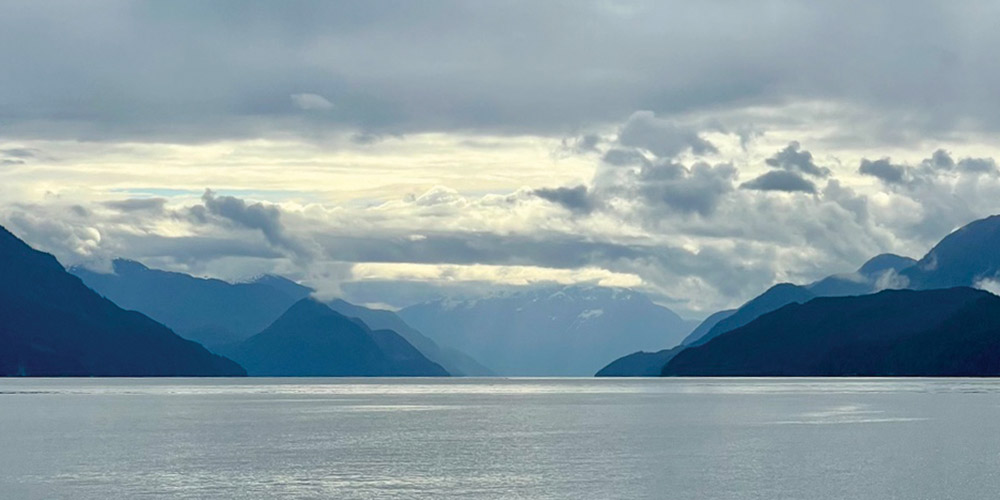
The Broughtons are a remote, ancient landscape that seems untouched by time. While humans have undoubtedly passed through here over the centuries, their marks feel faint, as if the land has resisted change. Traveling through the Broughtons isn’t just a journey from one place to another; it feels like stepping into a different era, one in which the natural world remains in its natural state.
As the still-low sun broke through clouds in the eastern sky, its light raked across the mountainsides, revealing details I hadn’t noticed before. Forested ridges that had seemed flat suddenly showed depth. Waterfalls emerged from the shadows, and the gray rock faces along the shoreline took on texture and shape.
At that moment, the boat’s motion, the engine’s hum, and even my responsibilities faded into the background, leaving only a profound sense of traveling through space and time. The greens of the dense forest, the cascading whites of countless waterfalls, and the grays of the endless rocky shoreline stood out with an intensity that revealed their intricate details. For a few moments, I forgot everything except what lay beyond the windows. The wilderness didn’t seem indifferent. It simply existed on its own timescale. Something about the changing light held me. I never found the right words for it then, and I’m not sure I can now.
The excited calls of “Look at that waterfall!” or “Did you see that?” gradually grew less frequent—not because there was less to see, but because we had stopped announcing every wonder around the next bend. Before long, the pilothouse fell quiet. Whether the changing light affected Mark and Mike as it did me, I never asked. Each of us seemed lost in our own thoughts. As we approached Watson Cove, I reluctantly pulled myself away from the windows and turned to the day’s next task—working out an anchoring plan.
First Real Test
Anchoring in these waters is always a challenge. Arianna’s ground tackle consists of a 60-pound Bruce anchor, a swivel, and 450 feet of chain. A general rule is to deploy about five feet of anchor rode for every foot of water depth in calm conditions. But applying that rule while accounting for tides, wind, current, bottom conditions and swing radius involves more than simple calculations. Like many aspects of boating, it is a skill that develops with practice. Over the years, each successful anchorage had gradually built the confidence I would rely on that morning.
From the charts, the cove appeared small and surprisingly deep, nearly 80 feet. During our visit ashore, the tide was expected to rise another two feet before falling about three. A textbook 5-to-1 scope would have required almost all of Arianna’s anchor rode. Complicating matters, the tight cove offered little room for the boat to swing safely without grounding on the rocky shoreline. With little wind or current expected, my goal was to set the anchor securely while keeping Arianna’s swing radius as small as possible. As I sketched potential solutions in the logbook, my gaze drifted back to the scenery outside the pilothouse windows. The rugged terrain and vivid contrasts refused to be ignored.
We arrived at Watson Cove as planned and prepared to anchor in the center of the deep, narrow inlet. I managed the helm while Mark and Mike operated the anchor windlass on the foredeck. They glanced at one another—this was only the second time we’d anchored on the trip. Although they were new to anchoring in deep water, they listened carefully and followed directions without hesitation. With a curious look, Mark called back to me, “How much chain should I let out?” With high tide just two hours away, the sounder read 92 feet. I replied, “Let out 350 feet, signal me at 100 feet (when the anchor touches the bottom), and I’ll back up as the remaining 250 feet is released.”
The faded paint markings on the chain showed the length as it unspooled. Mark released the anchor and signaled at 100 feet; I then slowly reversed Arianna toward the mouth of the cove, allowing the chain to lie nicely on the ocean floor. When Mark signaled at 350 feet, I shifted into neutral while he secured the chain, then eased Arianna into reverse to set the anchor firmly into the bottom.
Once I was satisfied the anchor was set, I shifted to neutral and let the boat drift forward as Mark operated the windlass, retrieving the chain to our planned length of 300 feet before securing it with the anchor snubber. I shut down the engines, and the sudden silence of the secluded cove settled around us.
The small cove stretched east to west, enclosed by forest on three sides. Hidden waterfalls echoed from the cliffs along the northern shore, while the southern shoreline rose from a rocky bank. At the eastern end, where we hoped to begin our hike, the land appeared flatter, but a dense wall of trees and undergrowth concealed any obvious way into the forest.
This was our first time leaving Arianna alone in such a deep, isolated cove. Although I trusted the anchor, walking away from the boat still felt like crossing a psychological threshold. Setting the anchor in those conditions had been our first real test as a crew, and that success gave us the confidence to step ashore. More difficult anchorages undoubtedly lay ahead, but this first one began to build our trust—in the boat, in one another, and in ourselves.
Finding the Cedar
With Arianna securely anchored in the cove, Mark, Mike, and I focused on the next task: launching the dinghy. This was new to us as a team, since all our previous stops had been at marinas with docks. Mark took on the role of davit operator; I managed the dinghy lines from the upper deck, giving instructions, then passed them to Mike on the lower deck as the tender was lowered into the water. By the end of the trip, each of us could perform every step of the launch. Like many tasks aboard Arianna, it had begun with instruction but quickly became teamwork.
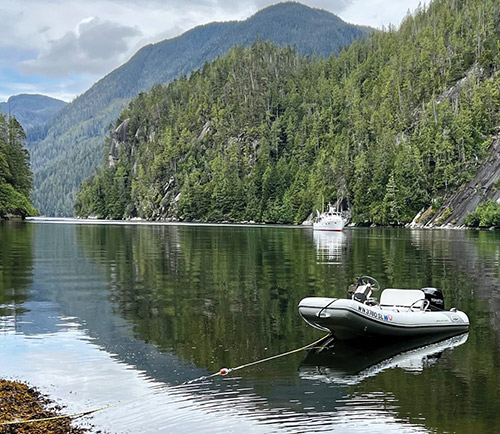
As the dinghy floated alongside, we gathered our daypacks for our first excursion ashore. Venturing into the wilderness required far more preparation than a stroll along a marina dock. Our daypacks held a first-aid kit, extra clothing, plenty of water, a satellite emergency radio, and cameras. Just before leaving, we tucked bear spray into each pack. We weren’t expecting any encounters, but bears were common in the area, so we intended to be prepared. Dressed in rain gear and life jackets, we boarded the dinghy, started the outboard, and cast off the lines. As Arianna slowly receded behind us, the anticipation I had felt all morning quietly returned. Somewhere beyond the shoreline stood the ancient cedar I had been thinking about for days.
Approaching the coastline, the air was crisp and invigorating, yet heavy with the dampness of the lush flora around us. According to our research, somewhere on the southwest shore, a large rock outcrop marked a creek outlet that would lead us to the ancient site we were seeking. However, as we neared the beach, many large rocks looked similar. “How about that one over there?” Mike suggested, so I pointed the dinghy in that direction. The bow slid gently onto a broad rock ledge, and we climbed out, unloading our gear. With the tide receding, anchoring the dinghy was challenging, as we knew the water would drop a good three feet while we ventured into the woods in search of the ancient tree.
I couldn’t help but chuckle at the mental image of a local newspaper headline: “Adventurers Stranded for Hours, Awaiting the Rising Tide to Refloat Their Dinghy.” Determined to avoid that fate, we carefully secured the dinghy, ensuring it was well-fastened to shore with a long line, and let it drift back into deeper water with an anchor bungee system as the tide ebbed. Before turning toward the forest, I looked back. Arianna rode quietly at anchor beyond the dinghy, now looking much farther away than she really was.
Mike had guessed correctly, and this seemed the best place to find an entrance into the forest. The thick vegetation at the forest’s edge obstructed our path with brambles, small trees, dense brush, and exposed roots, yet we persevered. Beyond the dense edge of the forest, the world felt different. Towering trees surrounded us, their gnarled roots twisting over and around one another as though they had been slowly reshaping the forest floor for centuries.
The ground was slick with moisture, and the earthy scent enveloped us—a blend of mud, thick mosses, and decaying logs from the fallen trees. Above, the canopy formed a dense shield, filtering sunlight and creating a dark, damp atmosphere. A small creek, nearly hidden beneath moss and fallen branches, offered the clearest path into the forest, so we followed its winding course.
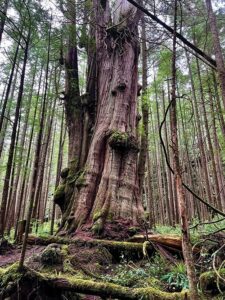
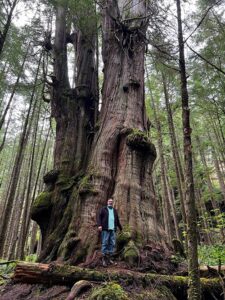
Although the walk was short, it felt much longer as we picked our way through brush, mud, tangled roots, and fallen trees. We followed the narrow creek bed, single file, through the forest. As the trees began to thin, we climbed out of the creek bed and naturally spread out, each choosing a slightly different path through the forest. I don’t remember who first spotted the cedar or whether we all noticed it at about the same time. Surrounded by the other trees, it blended into the forest more than I expected, and its true size wasn’t immediately obvious. I had imagined finding one enormous trunk rising above everything else. Instead, I wasn’t even sure I was looking at the tree we had come to see. As I walked closer, its true scale slowly revealed itself. With every step, it seemed to grow.
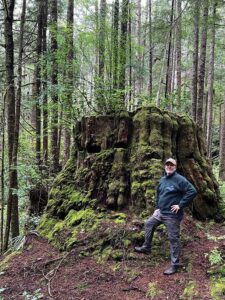
The tree’s massive base, said to be nearly thirteen feet in diameter, anchored it to a small knoll, where it split into two enormous trunks before dividing again into four that rose skyward, creating a silhouette unlike any tree I had ever seen. Wordlessly, the three of us drifted apart, each approaching from a different direction. None of us seemed inclined to disturb the silence.
A Story of Time
Standing beneath it, I tried to grasp what three thousand years truly meant. Throughout the Pacific Northwest, cedar has long been known as the Tree of Life. For the Kwakwaka’wakw people and many other Indigenous cultures, it provided shelter, clothing, tools, and ceremonial objects. Standing there, those words no longer felt like historical facts. This tree had survived wind, disease, logging, and the passage of time.
Numbers alone couldn’t capture what three millennia meant. I searched for something familiar to measure it against. The cedar had already stood for centuries before the Roman Republic existed. Yet even that comparison felt inadequate.
The questions kept coming, yet no answer seemed big enough. Who had stood beneath these branches long before written history reached this coast? How many generations had passed through this forest as the cedar quietly thrived? Had children played here? Who had sought refuge beneath its branches during a winter storm? How many hunters and travelers had paused where I now stood? Had its boughs been home to nesting eagles?
Looking around, another realization slowly emerged. I had come expecting to find one remarkable survivor. Instead, I found myself standing within a process that never stopped. These forests had never been still. When this cedar was young, it had almost certainly grown beneath older trees that had lived and died before it. Perhaps one had fallen in a great windstorm, opening the canopy and giving this young cedar its chance.
None of this could be seen. It had to be imagined. Yet once my mind began tracing those unseen generations, I found it impossible to stop. One forest gave way to another, century after century, until I could no longer tell where the story had begun.
The farther my imagination reached into that unseen past, the less meaningful my ordinary measures of time became. The forest around me was no longer simply a collection of individual trees but a story unfolding over thousands of years, each generation growing from the one before. As I stood beneath the cedar, my attention drifted beyond the tree itself. The forest around me seemed remarkably alive. It was early June, and everything was growing.
The moss-covered stumps scattered through the woods suddenly took on a different meaning. Some had fallen naturally, becoming nurse logs blanketed in moss and supporting young cedars and hemlocks reaching toward the light. Fallen trees had nourished the next forest for millennia. The forest knew how to begin again.
Others told a different story. Their springboard notches showed they had not fallen to wind or fire. They had been cut by people. Their wood had almost certainly continued on its own journey—perhaps into a canoe or a longhouse, perhaps into a fishing boat or a ship, perhaps into someone’s home. Their lives had not truly ended. They had simply become part of another story.
Standing there, I found myself holding two thoughts at once. I felt a quiet sadness for the ancient cedars that no longer stood. At the same time, I couldn’t ignore that the wooden boat anchored in the cove, the one that had carried us here, owed its existence to trees like these. The contradiction wasn’t something to solve. It seemed simply part of the long relationship between people and forests.
I found it hard to explain exactly why this place affected me so deeply. I have walked through many forests over the years, yet this one felt different. Whatever the reason, I lingered longer than expected. It was one of those rare places that quietly invites you to stop thinking about where you’re going next and simply pay attention to where you are.
I had come to see one ancient tree. Instead, I found myself contemplating a forest that had been renewing itself for thousands of years.
 Eventually we turned back toward the dinghy, leaving the cedar standing quietly behind us. It would remain there long after we disappeared around the bend in the trail, continuing a story that had begun centuries before our visit and would, I hoped, continue long after it.
As we left, I hoped others who found their way there—perhaps like me, fulfilling a lifelong dream of waterborne adventure—would experience the same quiet sense of wonder and tread lightly enough that the forest could continue telling its story.
Leroy Lewis is a retired engineer and wooden boat owner who has become increasingly interested in the layers hidden beneath ordinary experiences. Aboard Arianna, his 1970 Grand Banks Alaskan 46, he explores the waters of the Pacific Northwest and has begun writing short stories as a way to reflect on and find words for the people, places, experiences, and unexpected moments he encounters along the way.