A huge fleet (including many PNW teams), lots of breeze, and friendly competition made the 50th anniversary Moore 24 Nationals in Santa Cruz one for the books.
When the 50th anniversary Moore 24 Nationals were announced, Moore stalwart, international pro sailor, and Santa Cruz native, Morgan Larson said, “Let’s get 50 boats!” Until this year, the biggest assembly of the 156 hulls that were built was at the 30th anniversary in Santa Cruz, where there were 41 boats.
Work began to wrangle every boat and rattle every cage. This event was going to be “the” event of 2026. The Moore class board members made calls, boat owners guilted their compatriots, and Moore 24s started emerging from sheds and backyards that had not been seen in years. Boats travelled from as far as Charleston, South Carolina, to attend. As the event grew closer, it became increasingly possible that having 50 boats was achievable, and maybe more.
By the time Royal Vic’s Swiftsure race took place Memorial Day Weekend, I was sailing aboard the Santa Cruz 52, Rosebud, with my good friend Mackenzie Cook. Mackenzie was one of the organizers for Moore Nationals and would be sailing hull #84. Somewhere on the Strait of Juan de Fuca, he mentioned that we were on track to have 75 boats. I could not believe it. This was shaping up to be more than a championship regatta. It would be a spectacle, a reunion, and the fodder for incredible, lifelong memories.
If you have ever been to Santa Cruz Harbor, you will remember that it is very small and has only one crane. The Moore 24 volunteers and Santa Cruz Yacht Club set out to figure out how to deal with 75 boats and, equally complicated, 75 trailers. This was no small feat. Somehow, they were able to work with the harbor to move all of the boats out of the Santa Cruz dry storage yard and into every nook and cranny that could absorb a boat on a trailer. Every single Moore that arrived from out of town had a place in dry storage to rig their boats, and store their trailers. Awesome community support!
Along with all of the boats and trailers, the shoreside events included dinners, drinks, parties for over 350 people—the organization and coordination of it all was as impressive as any sailing event I’ve attended. One of the clear highlights was having a “Moore 24 History and Lore” session led by the man himself, Ron Moore.
But of course, the real magic happened on the water. Held from September 24-27, 2026, the Nationals started off with the exhibition on Thursday evening. The exhibition race called for a 75-boat triangle-type race with a “rabbit start” where hull #0, Summertime—the Moore 24 prototype—was the rabbit. Helmed by Moore legend David Hodges, Summertime sailed across the line on port, opening the gate for all boats to cross the line in numerical order. For the most part, this went off without a hitch except for one boat tapping the rabbit.
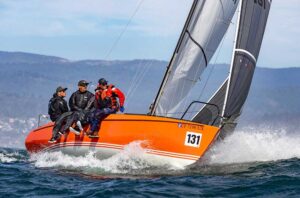
Sailing aboard our boat, hull #131 Safety Third, we were a late starter. This allowed us to get right early, and round the top mark off of Steamer Lane in third place just behind Summertime and overlapped with hull #127 Bruzer. As we sailed the next leg of the exhibition race. It was so hard to concentrate, as all you could see behind us was colorful Moore 24s with bright spinnakers—reaching fast with poles on the headstays—down to Mile Buoy.
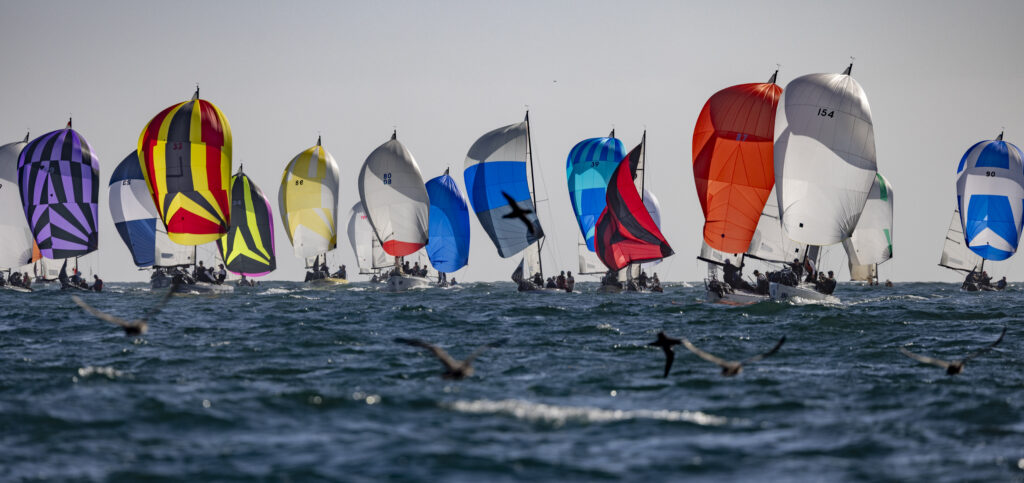
The next leg was a harbor finish, where we stayed right there in third place just behind Bruzer and Summertime, who ended up winning the exhibition race as the rabbit!
Day one of the regatta promised to be a classic windy and wavy Santa Cruz day. Having won the 2025 Nationals on our boat down in Long Beach last year, I could not help but feel a bit nervous about trying to defend our title as we sailed out of the harbor in a light easterly. We waited an hour or so for the forecasted 20-25 knot northwesterly to fill and, once it did, it was there to stay.
The race committee ran two practice starts on day one for the fleet and committee to make sure the Vakaros Race Sense system was all tuned up. On start three in 20-plus knots of breeze, race one was officially off.
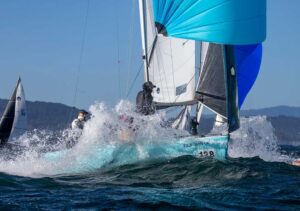
This was a notable race for me, as we rounded the first top mark in fifth or sixth place, and we set off down the first run. The waves were big, and it was easy to pump the main and catch the next wave. About half way down the first run, I pumped the main hard, and everything went dead light as the boat took off down a big wave. As she started to nose into the wave in front of us, I lost a bit of balance, grabbed the mainsheet to sit back upright, and since there was no load, I started to do the slow-motion round up. With no lifelines on the boat, there is little to grab onto. Sitting to leeward down the run, I slowly rounded the boat up and fell into the water. I was able to hang on to the tiller and mainsheet with the boat laying on its side. I threw my sunglasses into the cockpit, swam around the back of the boat, and quickly climbed into the open transom. The spinnaker was still up, we pulled the pole back, and continued down the run, only losing a few spots. I spent the remainder of the day’s additional two windy races, soaked. I think the adrenalin kept me relatively warm.
After we cleared the first bottom mark, all I could hear on the radio was calls about people who had fallen overboard. I was not the only one. In fact, over the event there were 20+ people on the “Swim Team.” The lack of lifelines is a unique characteristic of the class, but not without compromises!
Day two came with similar conditions. We sailed the first beat of the first race in the top end of the #1 genoa, switching to the #2 on the next beat, and then it was fully depowered #3 for the rest of the day.
The Moore 24 class always does a distance race for nationals and Saturday was the day. The committee fired off a course race, followed by a roughly 15 mile race up to a soft weather mark, then an epic run down to the Cement Ship mark off Capitola. Every wave was one to surf, and boats were regularly hitting 12-14 knots of boat speed. We rounded the bottom mark feeling good in the top 10, and began the beat back for the harbor finish. While in a great tacking dual up the kelp beds with hull #64, we noticed that we were the two boats farther right than the fleet. The finish was not off of the harbor as described in the course description sheet, but it was in fact back where we had started, nearly two miles west of the harbor. Many boats, including us, ended up severely overstanding the finish—it ended up being a very windy and wet reach into the finish, with our tails lightly between our legs. It was a bit of a loss for our team. There were multiple protests for the finishing procedure on this race and the committee ended up giving the whole fleet redress, and an average of scores for the distance race. This was the only slight bobble by the RC.
Day three was just like the previous two days. The breeze filled in, and it was on for another two full races. The final run of the last race was worth the price of admission. With big wind and waves, you could make big gains on the run. We were able to pick three boats off on the final run. We linked five or six waves together and nailed a big breeze jibe to avoid, and nip, a starboard tacker right at the finish.
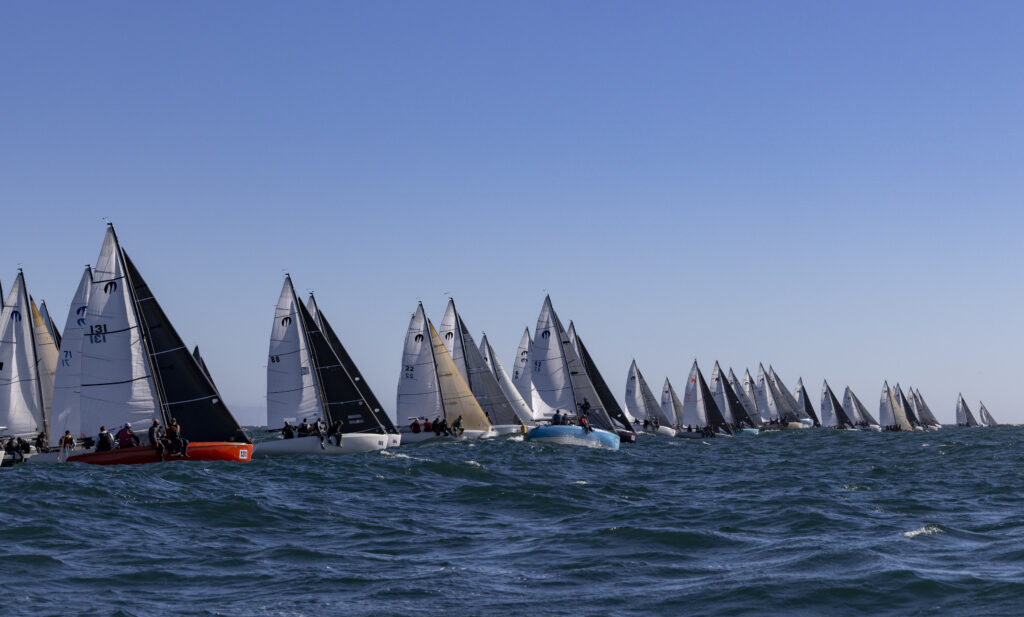
We finished the event with two reasonable results on day three. This resulted in a tenth place finish overall, which I feel massively proud of, especially with the exceptional depth of talent present. On a normal year in the Moore 24 Nationals, getting a good result is extremely difficult, as a large portion of this fleet has raced the boats for 20+ years. There are even a few original owners in the fleet, still racing very competitively. One to note is the team on hull #51, Wet Spot—they’ve been racing together since Mike O’Callaghan bought the boat new in the 70s.
I have been extremely fortunate to race in this fleet for about 20 years. Getting to show up to a Moore event is like coming to a family reunion. We all picked up right where we left off and there was lots of cheering for each other, high fives, and a great tradition of putting the winners—this year, hull #125 Pegasus skippered by Mark Christensen—in the water.
I am truly hopeful that this event boosts the fleet up even more, and it gets this fabulous class even more notoriety as the ULDB that can sail in anything. But wherever things goes from here with the Moore 24, all participants will surely look back on the 50th anniversary Nationals as an all-timer in every possible facet—racing and community, on the water and ashore—befitting of the remarkable history of this boat and its sailors.
I want to extend a massive thanks to all that made this event happen. Also, a shout out to the intrepid crew aboard our boat, Safety Third. The crew includes my wife, Elishia Van Luven, my business and boat partner Joe Grieser, and our other boat partner, Kurt Lahr. We all had an absolute ball, and look forward to the next epic event!
Full results: moore24nationals.scyc.org
Photos by Sharon Green. More images are available at ultimatesailing.photoshelter.com.