 It all began with a logistical challenge: how could my partner Leigh and I return from the Gulf Islands to the San Juans without my boat, and still have fun doing it?
I had loaned my Maple Leaf 42, Cambria, to my Canadian Race to Alaska teammates for the summer. Getting the boat across the border to them was straightforward, but returning to the U.S. side after the drop-off was another story. With the ferry route between Sidney and Anacortes no longer available, what used to be a simple hop had become much more complicated.
Colin, our skipper for Team Fashionably Late in the 2022 Race to Alaska, planned to take Cambria up to the Broughtons for the summer. Other teammates and their families would join him for different legs of the journey, using Port McNeill as the crew transfer point. Leigh and I just needed to get Cambria across the border, pick up Colin, and then figure out our own way home. That’s where the real puzzle emerged.
Our decision to give up Cambria for the summer of 2025 was influenced by two factors: both of us have aging parents, which kept us close to home, and Team Fashionably Late was between boats. One of the wonderful byproducts of R2AK is the friendships that blossom from the race. Most of the team had known each other for years, some since before high school. I was a newcomer, but was warmly welcomed into the ‘family’—something I remain deeply grateful for. Lending my boat to them for the summer was an easy decision.
After thinking through various ideas, Leigh and I devised a plan: we’d bring our 21-foot Pygmy tandem kayak to the Gulf Islands on Cambria and then paddle back to the U.S. over five days. We’d camp along the way, covering nearly 50 nautical miles and crossing Haro Strait. Each of us are in our late sixties, and we knew it would be an adventure, but we were up for it. What could go wrong?
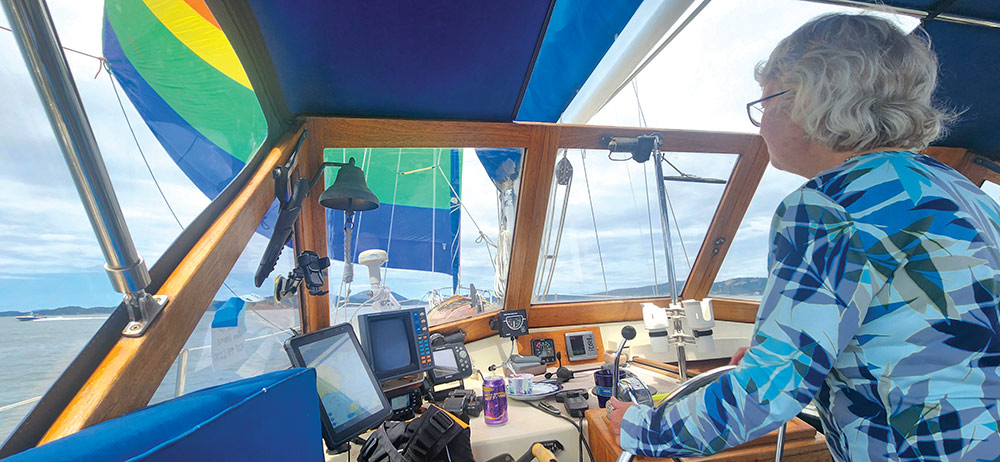
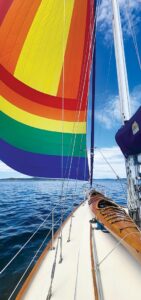
On a mid-July day, we hoisted our kayak onto Cambria’s foredeck, where it sat awkwardly for the trip across the Strait. After picking up Colin in Sidney, we headed north. True to form, Colin suggested we sail, and we enjoyed a lovely afternoon run up to Ganges Harbour on Saltspring Island. The large kayak on the foredeck only slightly hampered our sailhandling ability.
The next morning, we assembled our kayak and five days’ worth of gear on the dock in Ganges. Packing a kayak, even a station wagon like the Osprey Tandem, isn’t easy. Fortunately, Leigh and I are experienced backpackers and there are strong parallels between that pursuit and kayaking camping.
There’s a saying in backpacking that, “we pack to our fears.” We might need (insert item here). Or “this” could come in handy. “This” could refer to a variety of things we have either occasionally but rarely found useful or something we read about where in just the right circumstance might be helpful. The weight and space of these items rapidly adds up, though. Everyone needs to come to their own conclusions on the right balance of comfort, risk mitigation, and the corresponding weight and space constraints. What we’ve found works is after each outing, backpacking or kayak camping, we do a debrief. What worked and what didn’t. What did we use, what didn’t we use? What do we wish we had brought?
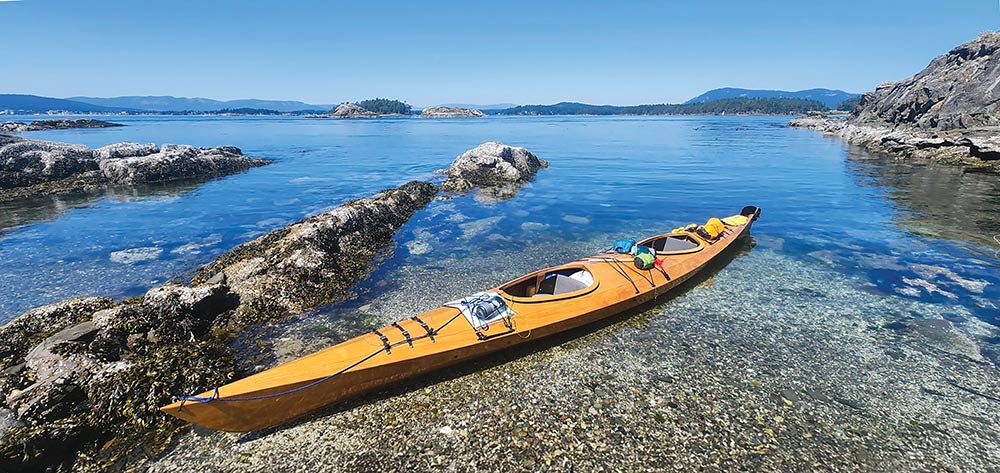
Over the years it has become a reductive exercise, but we’re not minimalists. We take out unused things and at times add back either comfort or safety items. Then there’s the process of putting gear in dry bags, remembering which bag has what (we number ours, and occasionally that seems to work), then distributing the bags into the kayak to get the weight lower with lighter weight things towards the two pointy ends. We also bring our not so secret weapon, one that we plagiarized on our first kayak trip from a group of women kayakers from the Comox Valley—Ikea bags. Ikea bags are light, durable, and greatly ease the transfer of multiple dry bags to the campsite.
Our food for this trip consisted of Leigh’s dehydrated chilis and soups. She’s become quite good at preparing dehydrated food and did most of the meals for our 2018 R2AK on Team Wild Card. Along with powerbars, snacks, and hot cereal for breakfasts, we eat simply but more than adequately. Leigh’s ethic is to put the work into the food prior to the trip, with little or no preparation immediately prior to the meal. Simply open a bag, mix with hot water and bam! Mealtime. That approach may not work for everyone, but it simplifies things during the trip.
Of particular importance was our water supply, or lack thereof. British Columbia’s provincial parks are excellent, but none of our planned campsites had a fresh water source. The combination of gear and water made our load embarrassingly heavy. We could have trimmed it all down a bit, but by the time we launched, our load and set-up was what it was and we were eager to get started.
Once the food and gear were loaded, we lowered our aging bodies into the kayak and bid Colin farewell. It was a mixture of anticipation for our short trip and some level of envy of where Colin was headed and the people he was going to be with. He was headed north on a comfortable boat and we were headed south in a far more primitive fashion. Considering the nature of our relationship and the crew, we felt fortunate to keep some of the R2AK ethic going a few years after our race—still connected and pursuing adventures and fun on the Salish Sea.
That first stroke of the paddle revealed just how heavy we were. Once the kayak was moving, our momentum helped, but breaking free from a dead stop was a challenge. For all our debriefs and ‘reductions,’ we were still a work in progress.
I love kayaking in familiar waters and, having boated all my life, our intended route was well-known to me. In larger boats like Cambria, I typically tend to stick to mid-channel, moving at 6 or 7 knots. In a kayak, we’d need to stay near shore, rock-hopping at 3 to 4 knots. This closer and slower approach transforms the familiar into something new. You notice details you’d missed before, chat with people on shore, and see more wildlife. Kayaking adds texture, nuance, and depth to places I’ve seen and passed by for years. In many ways, it’s more fun than being on a larger boat—though admittedly less comfortable.
Along with the change of pace and added scenery, kayaking presents a special joy in using your muscles—or what’s left of them at our age—to propel the boat. Carrying provisions on a human-powered craft also connects you to the traditional ways in which people before us plied these waters for thousands of years and awakens the senses.
Our first stop was Portland Island, where we easily found a beautiful campsite even in mid-July. Other campers included a former kayak guide with his young family, hoping to give his kids an alternative to the societal pressures of ‘ball sports.’ We hiked the perimeter of the island and enjoyed a stunning sunset. One advantage of kayak camping is the ability to bring lightweight chairs and a portable table. With a nice wine and Leigh’s well-planned snacks, it was a joy to simply sit and take in the scenery.
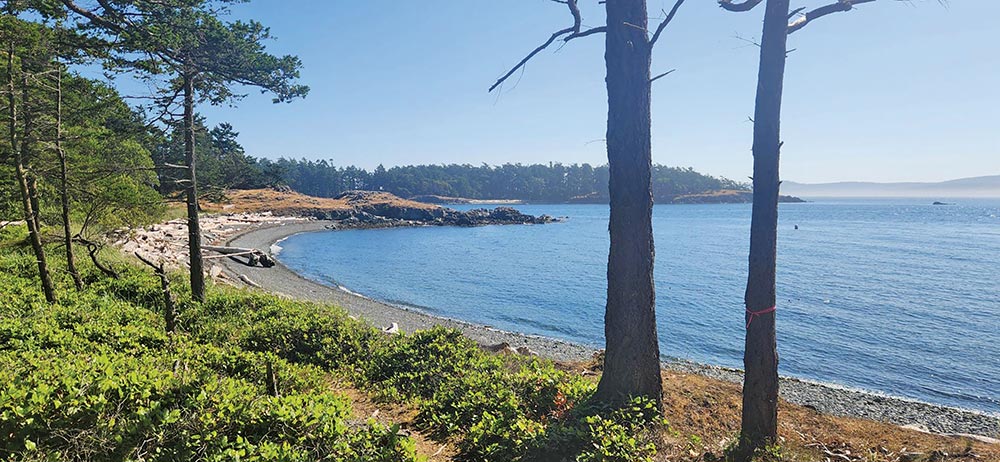
The next morning brought a lovely paddle roughly 12 miles from Portland Island to D’Arcy Island. We crossed Canadian ferry routes only a couple of times, but by monitoring VHF channel 11 and using the AIS app on my phone, we stayed safely out of harm’s way.
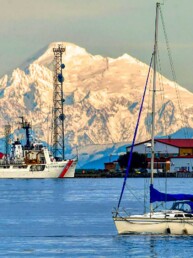
As we paddled toward D’Arcy, the angles of Mt. Baker and Spieden Island on the U.S. side slowly shifted—a benefit of always being outside, immersed in, and working for the changing scenery.
I’d wanted to visit D’Arcy for some time, and it didn’t disappoint. Now a provincial park, it was once home to Victoria’s leper colony for Chinese workers. The remains of the colony and the caretaker’s house are still visible. Hiking was rugged; trails were mapped but infrequently used, with colored tape marking the way. We navigated by looking up for the next marker, then down to avoid tripping, repeating the process and occasionally checking our trail app. The two weren’t always aligned, perhaps the mapping was more aspirational than based on the actual trail.
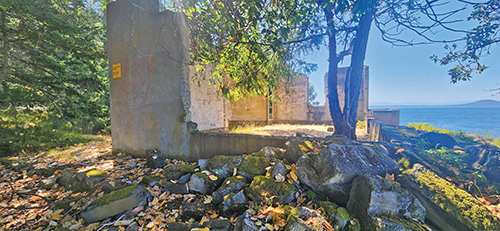
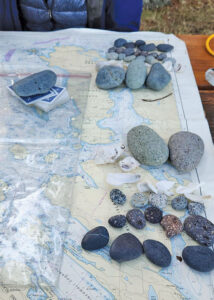
Our first night, we were the only campers on the island and on the second night, a lone Canadian kayaker joined us. Transient orcas put on a show, and once again, with chairs, a table, wine, and Leigh’s thoughtfully pre-prepared provisions, life was pretty good. We even played a few hands of poker, using various rocks and shells from the beach as currency.
After time well spent on D’Arcy Island, we turned our attention eastward towards the San Juan Islands and what would be the final stretches of our adventure. As you’d expect, we had some trepidation about crossing Haro Strait. At about three nautical miles, it’s not far and, from the deck of a 42-foot sailboat, it’s not intimidating when the weather is cooperative. I’d crossed it several times, even in pedal-powered sailboats, but from the cockpit of a kayak, that stretch of water looks much bigger.
We always wear our PFDs when kayaking, but for the crossing, we added immersion suits and carried two VHF radios—one for each of us. The weather was calm, and the marine traffic app showed no ships to worry about. It looked good.
When we reached the middle of the Strait the tidal action and residual waves from the previous evening made things a bit sloppy. I didn’t think it was too bad, but Leigh was quietly worrying about what she’d do if I had a sudden medical event and became a dead weight in the stern. We had to ‘tack’ to avoid beam-on waves, which prolonged the ordeal, but eventually, we entered the calm waters of Mosquito Pass, and the sight of dozens of small recreational fishing boats offered comfort in the increasingly unlikely event anything would go wrong.
That night we camped near Roche Harbor, and the chance to grab a cold beer and a burger was too good to pass up. We felt a bit out of place with our wooden kayak among the big white fiberglass yachts and several boat owners looked at us—at our age and our vessel—and shook their heads. Some may have admired the effort, but I suspect bemusement was the prevailing emotion. The question, “Why would anyone want to do that?” seemed half-formed on their lips.
There’s a place for boats with all the amenities—hot and cold running water, heat, refrigeration, ice makers, ovens, coffee makers, and comfortable beds. I’ve enjoyed those comforts afloat, but I’d argue there’s also a time to live more simply and enjoy our great cruising areas in a more intimate way: slower, closer, and from a different perspective.
Prior to the trip, we had left our truck at our family property near the Ruben Tarte County Park on the northeast side of San Juan Island. While it’s a simple walk from the park to the house, there’s a steep hill, and it had been a long trip. Fortunately, there was another kayaker and his girlfriend loading up. He happened to be a guide, owned his own kayak guiding company, and mercifully gave me a lift up the hill and then to the house. I smiled as I clambered into the back of his small truck and realized it had probably been 50 years since my last ride in the bed of a pickup. Though unexpected, it was a fun way to conclude the logistics of the trip!
With time being at a premium this summer, a long trip to distant anchorages wasn’t in the cards for us. What was in scope was visiting familiar waters in an unfamiliar way. In the end, getting to know these places more intimately and at a moderate pace was worth the logistical challenges, offering us a unique view of our great local cruising grounds. Though I’ve spent my whole life boating here, I’m still learning that there are new ways to discover what makes it so special.
Mark Aberle grew up spending his summers plying the waters of the San Juan Islands. A lifelong sailor, he holds the obscure yet to be broken record of finishing the Race to Alaska in 3rd place twice.