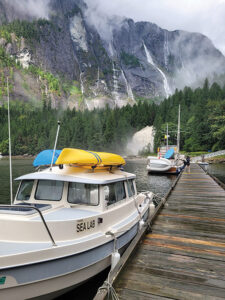
region’s most beloved docks…
But is it the Broughtons?
Tekla and I had been planning this trip for a couple of years. Originally we thought we could get all the way to Alaska on Sea Lab, our 22-foot C-Dory cruiser, and friends assured us we could. But when looking at charts and figuring out mileage, Alaska seemed daunting in the one-month sabbatical Tekla had from work. Plus, the thought of a crossing like Dixon Entrance in our tiny boat scared me a little. So we scaled the plan back to the Broughton Archipelago in the south end of Queen Charlotte Sound. Given our limited timeline, that seemed more reasonable and less like a marathon run. After all, it’s supposed to be fun. And no doubt, this would still be a big adventure.
Though we had chosen to reduce our range from the initial ambitions, our intent was to run fast to our farthest northern point and slowly work our way back south exploring all the areas we had not yet been to. Our previous northern limit had been Nanaimo, British Columbia, on our Cal 27 Moondance. On our visit to Nanaimo, we waited for the weather to break so we could cross the Strait of Georgia and get into Desolation Sound. After three days of waiting, we began to see our time to explore Desolation dwindle and concerns of another weather-influenced delay on the return trip increased—we’d be racing home before our vacation time was up. All that seemed like more stress and less fun, so we nosed back through Dodd Narrows and had a great time in the Gulf Islands. As it happened, there would be similarities during our trip north in 2026.
We got a great start from Grapeview to Coronet Bay and on to Wallace Island, Nanaimo, and Cortes Bay. We made it to the Desolation Sound area in four days from home. Then things began to get a little trickier. The tides and currents got more complicated, and there were rapids to transit that required careful timing. Sometimes, it was difficult to figure out with the tables which way the rapids were running.
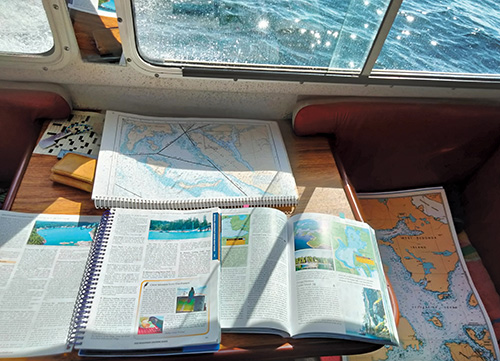
Two more days and we made it to Blind Channel Resort, the corner where we would turn into the infamous Johnstone Strait for 30 miles before taking our “exit-ramp” leading to the Broughtons and our destination. On the dock, we wound up talking with a couple who had just come back from there; as well as another couple headed the same direction we were, but who were vacillating about whether to go or not. Both couples had Starlink internet to access weather information and it appeared there would be a short window where the Strait might be passable the following morning and then the weather would deteriorate to high wind warnings through most of the following week.
Tekla and I discussed the situation until bedtime, and then neither of us slept very well. Sometime during the night, I heard the rain begin. In the morning, we awoke to a dark steady rain and watched the previously Broughtons-bound couple we had been talking to depart on a southbound course.
After clearing our heads with fresh perked coffee from the alcohol stove, we deliberated a little more and made the same decision we had on Moondance in Nanaimo: let’s head south and enjoy our time instead of spending our time venturing farther north, worrying all the while about the return trip. I guess that’s how these decisions are made—assess the situation with the time frame and information you have, and then commit.
It didn’t feel very good to bail out on our goal, but we have heard a lot of stories about Johnstone Strait and didn’t feel very sure of our ability to handle what it could dish out. As it was, we got our fair share of abuse later in the trip.
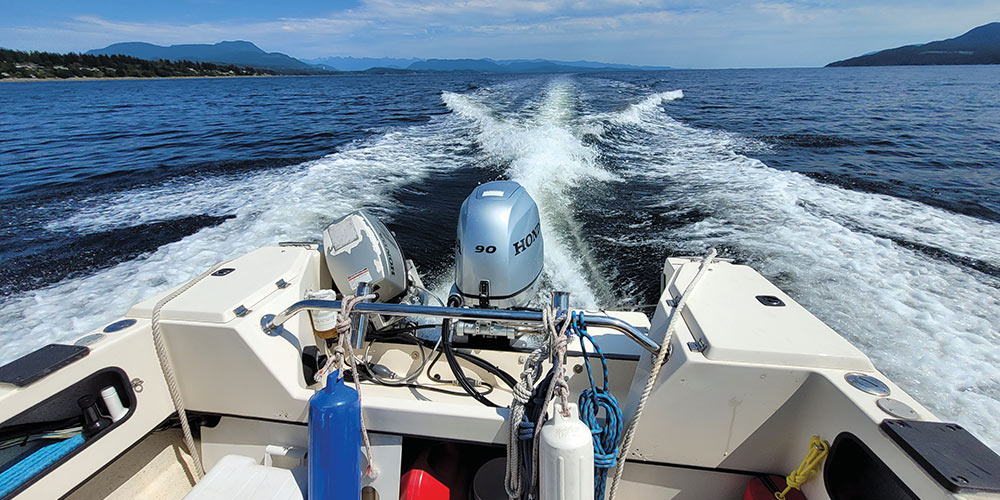
The weather and our spirits were dampened as we turned south out of the marina and back into the Discovery Islands. We didn’t go far that day. After six days of hard driving and not much sleep the night before, we decided we would find a spot to anchor and wait out the rain. Handfield Bay fit the bill for the day. We dropped anchor and made some breakfast, and took a nap. This was a rather large bay and there were no other boats in the entire place, only a family of Mergansers, four chicks toddling through the water behind mom and two riding on her back. This was what we needed. We stayed two nights.
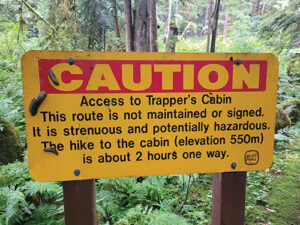
told the author the hike to the cabin would be suicide in that weather, but the local fauna didn’t seem afraid of heights.
The weather cleared and, feeling refreshed from our rest, we continued on to Small Inlet in Kamish Bay, another marvelously empty bay until a 30-foot sailboat came in to anchor in the late afternoon. It was just two boats for the night.
For ten days, we crisscrossed the waterways and islands, stopping for fuel and ice occasionally. Along the way, we found some of the best anchorages and scenery we’ve had in our nearly 30 years of boating. We navigated seven different rapids, and managed to explore Bute and Toba inlets. This area had such a different feel from our home waters—bigger, wilder, and closely surrounded by mountains.
At the beginning of the trip, Tekla had begun reading Passage to Juneau by Jonathan Raban, his account of sailing from Seattle up the Inside Passage; and we had been relating to his descriptions of the places and names as we went. Also, we were intrigued by his descriptions of Captain Vancouver’s time in this area and many times felt that not so much had changed since he was here in 1792. There are still endless miles of dense forest down to the water’s edge and mountains rising to snow level in every direction you look. There’s very little sign of human activity, so it was easy to imagine the Midshipmen on the Discovery marveling at the “sublime” landscape they were surrounded by, as well as the dark mood of Captain Vancouver who so often referenced his disdain for the “depressing and useless” landscape of the very same surroundings. As soon as Tekla finished Raban’s book, I picked it up and began my third reading of it. It was a superb companion book for this trip.
Of course, a main priority of our trip was to see Princess Louisa Inlet. We have been talking about going there for many years and, with Sea Lab’s speed, we were not going to let this opportunity pass. After many beautiful anchorages and some warm water swimming at Roscoe Bay, we declared it time to head for Jervis Inlet.
We made the four-hour run from Roscoe Bay to the Powell River Marina as soon as the tide was high enough to get out of there. We refueled and planned the ride up to Princess Lousia. The weather was turning again, with wind rising in the afternoon and rain coming; but it was not supposed to really get going until around noon the next day. As such, we left the marina the next morning at 7 a.m. to get through the north end of Malaspina Strait and around the corner to Jervis before the weather started acting up. We made coffee and filled our cups as we started the motor and pulled out onto the strait’s smooth water.
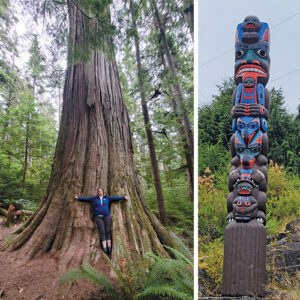
Right) A beautiful Totem at the store in Egmont, BC, while they waited for the rain to clear.
Within 15 minutes, we were getting bounced around in 3 foot chop making it difficult to drink the coffee; and in another 15 minutes, Tekla was cradling the percolator in her arms to keep it from bouncing around to the pilothouse deck. I was wrestling the steering to keep us from going straight into the waves so we wouldn’t slam into each trough while also trying to keep us from getting rolled taking them on the beam. It was nearly impossible to operate the manual windshield wiper—a simple analog feature regular readers know I love—while I was driving, so Tekla took over that responsibility while still holding the coffee pot. After the juggling act became too complex, we finally realized that she should put the coffee in the sink and put the sink cover back on.
I was trying to judge the wave size and struggling not to let adrenaline cloud my judgement. I estimated that they were mostly 6 to 8 feet peak to trough. It didn’t take much more of this before we decided we’d better get out the life jackets and put them on, even in the pilothouse.
Throughout our trip, Sea Lab had been great, everything had been working well. As we were tossed about, I was praying nothing would break and hoping that the kayaks would not come loose. We hit one trough hard enough it slammed the cabin door open, and Tekla had to abandon her wiper duty to get it closed again. We understood how the name Grief Point on the chart had come into being.
We were doing 8-9 knots over the ground and it was the longest 15 miles we’ve ever done. After two hours of keeping away from the rock-scattered shoreline and tacking to angle the waves, we finally reached Scotch Fir Point where we could turn north into Jervis and get off the strait. The turn itself was gut wrenching and suddenly the waves were behind us and we were surfing the face of the waves at 17 knots trying to keep from digging the bow into a broach. I adapted to this motion quickly enough and, in another 10 minutes, the waves began to fade and we slowly unclenched as the violence ended. We made it. And then the rain came.
Back in our canoe adventuring days we had a saying; “It’s not really a vacation unless there’s a possibility of dying.” That saying came back to me several times during those two hours.
After another few miles, we made it to Backeddy Marina and they put us on the dock, where we made another pot of coffee and something to eat while we regained our wits. It rained solid for two days, so we stayed put for two nights to wait it out.
Speaking with one of the tour boat drivers, I learned that the waterfalls in Princess Louisa were best in the rain, so we left the following morning and had a calm but rainy ride up Prince of Wales Reach, Jervis Inlet, and Queens Reach. We arrived just an hour before slack at Malibu Rapids. We had gotten lots of practice with rapids farther north and, after seeing a couple other boats go through, Tekla radioed our intent. With no objection, we started through.
As soon as we rounded the corner into the strong ebbing current, we saw two ski boats, a big inflatable with a pile of rope, and a small fishing boat. The guy on the fishing boat, radio in hand, was yelling at us that one of the ski boats was dead in the water and we should turn around. I had to get ahead of the fishing boat to maintain steerage and, only about 10 feet in front of him, I whipped a U-turn right in the middle of the rapid. In this instance, I sure was glad our boat is small and nimble. We hovered outside the rapid for a short time, and all the boats came out so we re-radioed and went through with no further trouble.
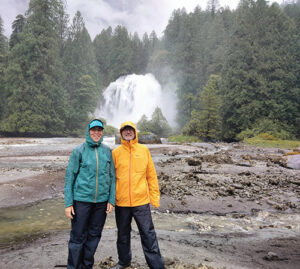
We motored to an open space on the dock at Chatterbox Falls and couldn’t believe our eyes at the majesty of this place. Friends had been telling us for years how great it is, and I feared that it would be disappointing—how could it possibly live up to their praise? It was not disappointing!
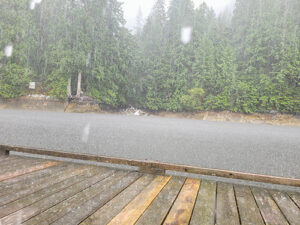
During the heaviest rains, we were surrounded by at least 14 waterfalls and Chatterbox was raging. In the short rain breaks, everyone would hurry out onto the dock to meet and take in the surrounding wonders then scurry back inside when the downpours resumed. It rained many inches in our two nights, everything was wet. My Jonathan Raban book swelled up. Summer though it was, the temperature was a chilly 60 degrees, so we wore more clothes. A candle lantern and a battery powered fan is all the heat we had for keeping some of the condensation off the windows.
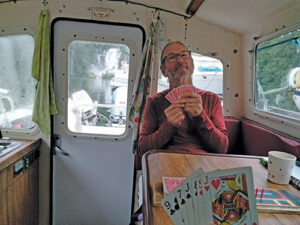
But don’t let the weather fool you—it was a blast. Box wine, cribbage games, hiking between storms, reading. In the end, I was thankful we got to see Princess Lousia in these conditions.
Our plan was to leave the inlet on the 5:30 a.m. ebb at Malibu. We set our alarm and got underway a few minutes behind a beautiful Westsail 43 with the same idea and, apparently, radar. We got about a mile away from the dock before the fog shut right down onto the water. We blindly followed our GPS track back to stumble onto an open buoy and wait for the next slack and some visibility. The rain had stopped and eventually the fog burned off and the day was clean and bright. All but two of the waterfalls were gone, and Chatterbox was much subdued from the previous two days. We bid adieu to Princess Louisa, and it was time to turn south and make our way back to our home waters.
We learned so much during the four weeks of this cruise and the time was unforgettable. These northern waters are big and not as easy as the San Juan or Gulf islands, and we really shifted to a higher gear of navigation as well as route and weather planning. I’m ready to go again! Maybe we’ll make the Broughtons next time…
Dennis, Tekla, and Tim Tim the salty old sailor dog can mostly be found floating around on Case Inlet waiting for orcas to swim by.