The sun is shining and you are in your happy place, out on the boat. Friends and family are happily chatting onboard as you set your course for the next destination and you sit back in your seat behind the helm. You know your boat inside and out, and feel good about the maintenance and repairs you have completed to get to this point…when suddenly you feel a minor lurch followed by the engine struggling to run.
The moment sends a shockwave through you and you jump out of your seat wondering what just happened. Before you can react, the engine returns to its normal operation as if nothing happened and you are left wondering if you should turn around or pretend you didn’t notice the momentary RPM fluctuation. The rest of the trip goes as planned, but the entire time you are in fear the engine will fail in some way.
Your confidence is shaken, and you realize maybe you don’t know everything you thought you did. After all, you have no idea where to even start with diagnosing what happened in that moment. Beyond praying it doesn’t happen again, how do you prepare for the odd events that may take place? Learning to diagnose problems with your engine is not an easy task and will take years of learning. However, it is absolutely possible for the committed DIYer who wants to pursue that path.
When I started on the path of becoming a diesel mechanic, I was overwhelmed by all I didn’t know, and sometimes I still am with all of the new technologies coming out each year. As a boat owner myself, I want to understand every aspect of what my engine needs to run well and, if it doesn’t, I need to know how to find the problem quickly and efficiently. While I do this professionally and am expected to identify problems on clients’ boats, I can commiserate with them because I have certainly panicked and blanked-out when something has gone wrong on my own boat.

Learning to slow down and process the situation is one of the most valuable critical thinking skills, it’s the foundation to a positive outcome, and I want to break it down for you as you learn to diagnose a problem. Note, if some of this rings a faint bell and you read my September column about addressing a dead diesel… that’s not a coincidence. The situations and symptoms may change, but the fundamental practice of working through the essential elements that make a marine diesel function are quite consistent, and represent the foundation of diagnostic analysis. Let’s take the example from above and work through it in a diagnostic fashion.
- Give yourself a moment to process what just happened: You’re motoring along and the engine RPM changed or the engine is about to die. What does that mean? Whether normal functionality returns or the engine does in fact die, when something happens, I often need a solid minute to just calm myself down and think. Then, my mind can gather important information to move forward. Get yourself and the boat into a safe place and pause.
- Process what is actually happening: The engine RPM changed. Did the engine die? Did it go right back to normal like nothing had happened? Did the symptoms return, and with what frequency? Resuming normal operation tells me whether something is minor and is currently developing, but not critical yet. If RPM is fluctuating, one of the most obvious systems that could be the culprit could be fuel, but how do I know that?
- Mentally divide the engine into systems: Raw water, fresh water, fuel, air, exhaust, etc. Which of these systems could cause a fluctuation in RPM? Which is the most obvious to start with? My mind goes to fuel in this example, but don’t forget to think about what systems could overlap? By having a basic understanding of all these systems, you’ll know that a clogged exhaust could also cause the engine to struggle. Or maybe even a clogged air cleaner or failing turbo.
- Note the full array of symptoms during the time of the event, I recommend writing them down: Is there any smoke when the engine is struggling? If so, what color is it? Is there an oily sheen in the water? Even if you’re pretty sure you know what to do with the information at the moment, try to remember the details of what occurred and what made it worse or better. Think like another type of diagnostician, a doctor: when you come in with an emergency, they try to get as much information surrounding the actual event as possible to establish timelines and a solid time frame of when things were normal versus when things weren’t. In our example, let’s say the engine had some notable puffs of grayish/black smoke during the RPM fluctuations. Once the engine recovered, the smoke went away.
- Start with the basics first: Check your records for work done previously that could’ve caused the issue at hand and could point you in the right direction. Were you working on the fuel system prior to the trip? Changing filters perhaps? Replacing a turbo charger yourself the month prior? Decided to throw on a new air cleaner while you were at it? Checking the basics like fuel filters are the best starting point but, if it’s not that, where do you go next? Trace your steps if work has been done, and double check those things. In this hypothetical, you had changed your filters the week prior with no issues.
- Do your best to isolate the problem: If you are suspecting something in the fuel system, fill a remote fuel tank and run the engine off of that to see if it helps. Let’s say it does, what does that tell you? If it tells you everything prior to your “remote tank” is now part of the problem. Time to work backwards towards your boat’s fuel tank. Start checking fuel lines, filter housings, the tank pickup tube(s), 12v or mechanical lift pumps, etc. You find excessive algae buildup in the tank’s pickup tube. Fuel filters were clean, but maybe you’d never had the tank serviced in your time onboard the boat. You found the problem!
Diagnostics aren’t an easy thing to master, but teaching yourself about engine systems will allow you to break down a problem into manageable pieces and reverse engineer the problem until a solution is found. Medical professionals must have a deep understanding of the human body to be able to diagnose what’s happening—you can’t just throw parts at a patient most of the time.
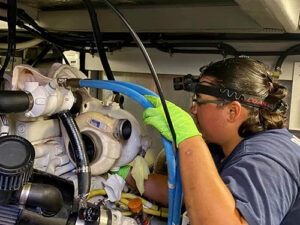
Think of an engine in the same manner. Try to break each system up into separate pieces that you can investigate or isolate. If you make some progress, dig deeper and before you know it, the problem may be right in front of you. While I can’t teach you the entire art of diagnosing engines in one article, I hope I can help build a good diagnostic foundation for those of you who want to tackle problems on your own. After all, the mechanic can’t always be there to magically fix the problem. Good luck diagnosing and happy boating!
Meredith Anderson is the owner of Madame Diesel, LLC, where she operates a mobile mechanic service and teaches hands-on marine diesel classes.