 I don’t remember when it started, but Tekla and I, along with our friends Al and Sue, have been talking about taking a canal boat trip in Europe for several years. What an adventure it would be. Somewhat suddenly, it came up again this spring when Alan mentioned that he’d been looking at tour companies and places online. One night, he called saying he found a canal boat experience in France that looked interesting and that the company’s booking schedules were filling fast.
We wondered aloud in our group phone call, “Should we book it?” Yes, was the answer, “Go ahead and book it.” Then came finding flights, hotels to stay in before we made it to the south of France where the canal began, hotels before our return, train reservations, and all the other travel logistics that I dislike doing. It turns out Alan doesn’t like that stuff either but, thankfully, he found the resolve to take care of most of it. He said, “If I don’t do it, we’ll never go!” I’m sure he’s right.
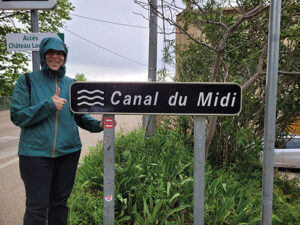
On May 1, 2026, Tekla and I took a nine-hour flight to Paris on our way toward a seven-day trip up the Canal du Midi beginning near the Mediterranean Sea. As is often the case, a big transit like this changes more than just one’s location; and a particularly big shift was the crossing of time zones that made us all a bit loopy for a day or two before we caught our train for the small village of Agde near our put-in on the canal. Just before we reached our station, the train was traveling through a marshy tidal area and I spotted flamingos out the window. Wow, I’ve never seen flamingos in the wild!
We hiked with our luggage to the hotel where we struggled with language a little bit at the front desk, checked in, dumped our bags and went looking for a beer, which we found in a beautiful setting along the river Herault. Our boat check-in was at 9:00 the next morning, so we had a little time to explore the very old town of Agde in the pleasant light of a spring evening.
In the morning, we hailed a cab to get us all to the Le Boat office and marina about 20 minutes away, where we went through a whirlwind check-in process of signing papers and agreeing to instructions we mostly understood. We dragged our stuff onto the 40-foot boat, where our liaison Claire led us through a tour of the vessel, a check of systems, and a run-down of how to operate everything.
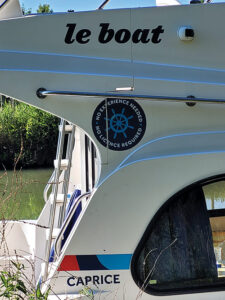
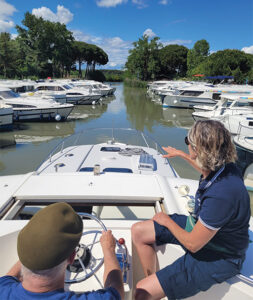
As primary captain, Alan’s turn was first for the sea trial, and the five-cylinder diesel engine sounded strong and throaty as we rounded out of the marina and onto the canal. Claire coached him through the boat’s paces and then a turnaround with the single prop and tiny rudder, throttling forward and reverse to get the big boat turned around in a tight space. Then, it was my turn. Running back up the canal at top speed of 5 knots, my exercise was to back the boat into a narrow space for our first attempt at a “Med Moor”. This was an exciting maneuver and ultimately successful. Minutes later, Claire said, “You’re all checked out and ready to go, bon voyage!”
Though we didn’t really feel ready to go, it was nonetheless time to go. Off we went, and the first half hour or so felt surreal. I had the feeling that we were on some kind of Disneyland ride through the beautiful French countryside with millions of red poppies blooming along the banks below the endless and meticulously cared-for vineyards. I kept expecting an animatronic hippopotamus to pop up alongside and roar before receding into the water.
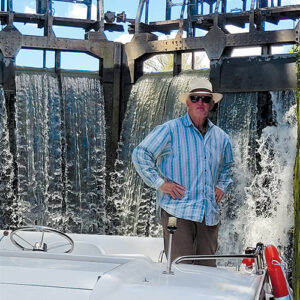
This fantasy ended as we approached our first of many locks. The light was red, conveying the universal signal to stop: do not proceed. We side-tied to bollards that were clearly placed there for waiting traffic and sat wondering what to do. Tekla got off the boat and walked up to the lock. Soon, the light turned green and the big gates slowly opened. We started the engine and moved forward into the basin, where Tekla caught the lines we threw fore and aft and wrapped a bollard; she then threw them back for us to tend on deck. The gates closed behind us and the sluice gates in front started to open with an oncoming rush of water under great pressure churning the big boat around in the basin.
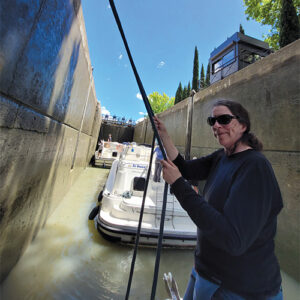
One of the first thoughts we had about this recreational locking was that it could never happen in our country. Inexperienced boaters from abroad running big boats in locks with no railings or safety equipment, and the crew is unable to understand much of the language the lock master was throwing at us. How many things could go wrong? You could get killed doing this! Nobody died, the lock gate opened in front of us, and we went merrily on our way once again through a spectacular landscape. Amazing!
After transiting several underpass bridges barely large enough to fit the boat through and one more lock without incident, we decided it was time to stop for the night and enjoy some of the wine and cheese with our fresh baguettes we had provisioned with before boarding.
Earlier, Claire had informed us that the anchor on the bow was just for decoration and tripping over, and never to use it. Instead, she showed us two big spikes and a small sledgehammer and suggested we should pull up on the bank and pound stakes into the ground and tie our 40-foot 10,000-pound boat to them. I thought, “sure that sounds rational,” so when the time came I jumped down (I know, no jumping) into the tall grass and pounded the stakes. There are no tides and barely discernable current so it worked out just fine, and we had our first thoroughly enjoyable evening on board and fell asleep knowing the anchor would not drag.
The Canal du Midi was built over a period of 14 years beginning in 1666, and was completed in 1680 to speed shipping commerce and avoid pirates through the Strait of Gibraltar. It was an idea that long predated the principal architect Pierre-Paul Riquet’s concept, but he was the one to solve the problem of supplying water at the high point of elevation to get continuous water from the mountains to the canal. The marvel of engineering that it is was recognized in 1996 as being worthy of designation as a World Heritage site by the United Nations Educational, Scientific and Cultural Organization (UNESCO). In travels up to this point in my life so far, places with this designation have been well worth seeing.
This is one of the oldest canals in Europe still in operation and is now only used as a recreational and tourism pathway. Its commercial potential peaked in 1856 with 110 million tons of shipping and 100,000 passengers, before its use saw a steep decline with the advent of railway shipping and travel. Today, approximately 10,000 pleasure boats pass through the canal annually, with the majority of tourists being from the UK, Germany, and Switzerland. In 1787 Thomas Jefferson, as an ambassador from the United States, went to study the Canal du Midi envisioning a similar canal to connect the Potomac River to Lake Erie.
A highlight of the trip for us—among many but truly a pinnacle for me—was brought on by a poster that Tekla saw for a show that was happening the night that we were in the village of Capastang. The group was a band called Velo Swing and they happened to have a free show that night. It sounded very interesting, but we really didn’t know anything about them, the venue, or their music. We showed up a half-hour before at a venue for exposition of literary types, poetry, readings, music, and exchange of ideas and art: La Maison Romane.
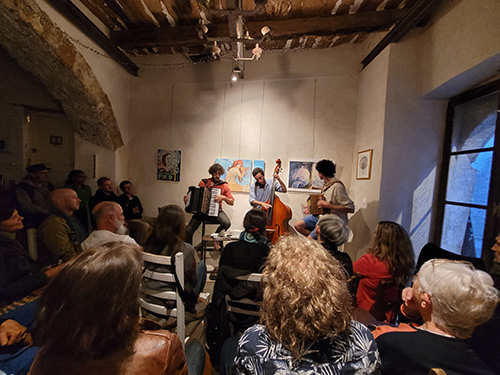
The setting was something I couldn’t have imagined. It was a house built in the 12th century on a tiny medieval street with a small front. Inside, there were 30 chairs set up in a small room with floor space against the front wall for the three-piece band consisting of a chromatic accordion, a pushbutton accordion, and an upright bass. The members of Velo Swing were touring on their bicycles from Barcelona, Spain, to Italy for a Critical Mass bicycle rally. They were good humored, telling jokes and stories and playing heartfelt songs of folk and swingy gypsy jazz with joy that was evident in every face. It was one of the most engaging concerts I have seen, even though I couldn’t understand a word of the French they were speaking. We left the show feeling ebullient and walked on clouds all the way back to the boat for the night.
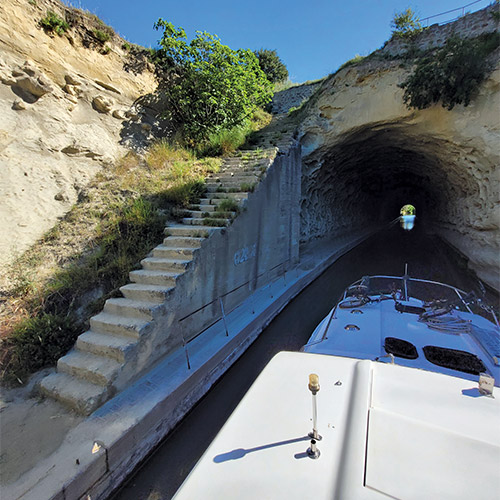
The adventure continued with two features of the canal that felt bizarre and very surreal to us. The first was boating through a tunnel. I have never experienced the feeling of driving a boat into a blind tunnel almost two football fields long. The Malpus Tunnel was the first canal tunnel ever built. At the beginning of the trip, Claire told us to honk the horn before we entered. We did, but it wasn’t reassuring.
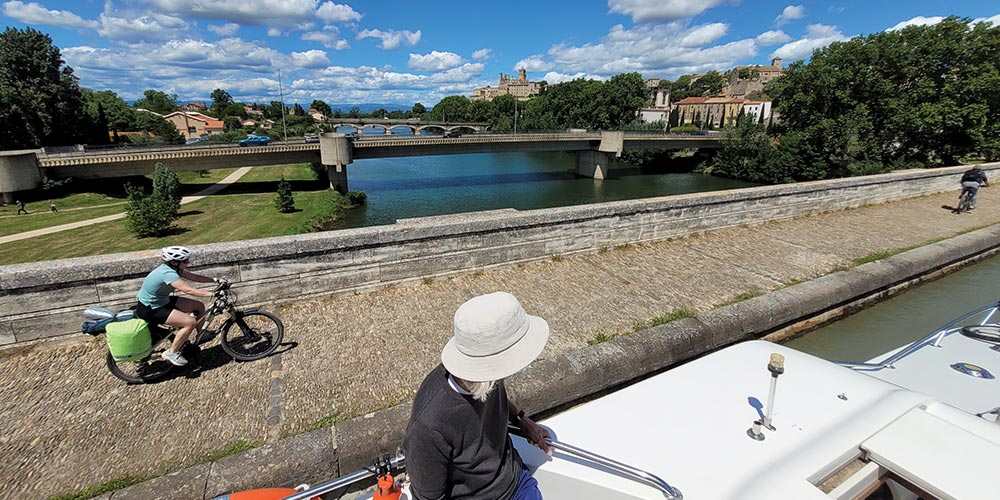
The next feature was less alarming but still unsettling; floating over an aqueduct high above roads and a river below. We had the feeling of being on a freeway overpass but on water and cruising slowly along as if all were normal.
Re-crossing both of these features on our return trip was even more fascinating as the initial astonishment was gone, allowing for deeper realization of what a remarkable feat of engineering this canal represents. It was all dug and built without the advantage of the big machines we possess in our modern age.
We returned to the homeport marina after our sightseeing adventure on the canal for another whirlwind procedure with the LeBoat staff. We said our “Au revoirs” and dragged our luggage and memories to the train station. Reflecting along the train ride, I thought: ‘What a spectacular boating experience surrounded by history and human achievement, scenery, culture, good food, flora and fauna, and great friends.’ In my mind during the ride, I closed my eyes and recited “There’s no place like home,” clicked my heels three times, and I was back home planning our next trip on the Salish Sea. This time, I want to see giant cedar trees and whales and bears! The canal was fun but I think my spirit is more in tune with natural history than human achievement.
Dennis, Tekla,and Tim Tim the salty old sailor dog can mostly be found floating around on Case Inlet waiting for orcas to swim by.