We were supposed to be sailing west: due west, in fact. Yet when I popped up into the cockpit for the pending watch change at the top of the hour, somehow, we were sailing… north? It didn’t make any sense. We’d been sailing west for days turned weeks. A quick glance through our hourly log entries showed consistent wind direction for the last ten days straight. My brain, sluggish thanks to a busy day of sail changes and a paucity of naps to make up for it, took its time processing this observation. I could tell everyone was eager to head down for some well-deserved sleep as the ceremonial serenade of snap shackles and harnesses being removed commenced before my feet left the top companionway step. I didn’t pester the soon-to-be off-watch crew with too many questions, knowing I’d have ample time and solitude during my own night watch to figure out this fun new puzzle. As each crew member rustled past me, still removing foulies as I donned my harness and tether, they tossed me some breadcrumbs; sails are set perfectly, haven’t touched the trim all watch, and we’re making great time.
“Fabulous,” I remember thinking. “But guys, why are we sailing in the wrong direction?” I scanned the logbook again, this time with the intention of someone who had time to stop and scrutinize rather than nonchalantly contemplate on the fly. The scribbled coordinates clearly showed we were making more northing than westing. And that the wind speed had remained consistent for the last several watch rotations. But the hastily scribed wind angle was what made me do a double take. During the past six hours, the wind had veered… significantly. Curious though, that the sail trim didn’t need any adjustments through that large of a wind shift. The plot thickened. Oops, there’s the alarm, time for my hourly log entry. Mildly annoyed and decidedly distracted by the pending mystery I’d yet to solve, I quickly scooted over to the helm and started my usual top-of-the-hour checks. Tootling through menus and scribbling figures as fast as I could, a slightly askew key stroke on the port sidebar left the answer to my quandary staring me right in the face.
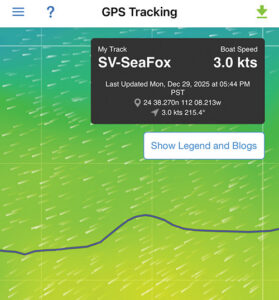
direction in a shifting breeze, until noticed and corrected.
It was the autopilot’s fault. Actually, that’s not true, it was just the easiest “brain” to lay blame on. The autopilot was doing a fantastic job of sailing us to the ever evolving wind angle, better than any of us could do ourselves, rather than the agreed-upon heading that put us in line with our next waypoint several hundred miles ahead. Somehow this slight slip-up must have either gone unnoticed or been part of a curious experiment during a quiet watch period.
Smiling to myself, I couldn’t help but wonder how the compounding clues that something was amiss had gone unnoticed until now. It might have been the busy day, the missed naps, or a bit of cautious complacency creeping in as we neared two weeks at sea. Regardless of circumstance, I was grateful for the clear task of getting us back on course and trimming sails to keep me occupied for the first part of my watch. “This certainly will make for a great laugh once we make landfall!” I giggled to myself.
You might be expecting a deluge of sharp criticisms aimed squarely at the dangers of self-steering, and electric autopilots in particular. There will be none of that here. The ability for the boat to steer while you do something else—reef, navigate, brew a hot cuppa, or simply bask in the glorious sunshine peeking through hope holes—is one of the biggest upgrades in safety and quality of life aboard. Gone are the tireless days and nights of hand steering in all weathers or of jury-rigging lines, bungies, and cords to create a mechanical crew member that never needs to sleep, eat, or take a break. But is it necessary or merely nice to have? To answer that, we have to break down what self-steering accomplishes.
Steering a sailboat for hours is surprisingly tiring, particularly in the changeable conditions that define the Salish Sea and dendritic fjords of the Inside Passage. Even the most attentive helmsperson drifts, loses concentration, or gets distracted by log dodging, crab pot spotting, bubble netting whales, or navigating tight channels. A system that can hold course consistently and predictably reduces fatigue, sharpens navigation, and frees the crew to handle the dozens of small tasks that make for a smooth passage. For shorthanded crews, self-steering is often the difference between arriving relaxed and arriving exhausted.
Even on the most responsive cruising boat in mild conditions, few things drain a crew faster than hand steering without pause. Thirty minutes is about all most people can comfortably bear while performing optimally. Sometimes less in storm conditions. After that, control and finesse at the helm get a bit sloppy and thus inefficiency begins to compound. Amplified over the course of several days or weeks on an ocean passage and you’re looking at significantly extended time at sea and tremendous potential for fatigue and lapse of judgment. It’s something you must experience firsthand to truly understand, and why we largely eschew self-steering on our sail training expeditions in favor of giving our crews a taste of the strength and focus required day after day. This practice also adds a healthy respect and curiosity for the systems that, with a pinch of component consideration and a dab of prudent planning, can reduce the burden of steering to a mere afterthought.

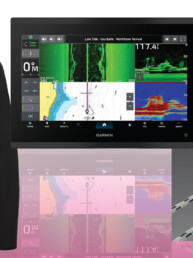
The most familiar self-steering tool for sail and power boaters alike is the autopilot. Electric autopilots are power-driven systems that use sensors, a control computer, and some form of mechanical drive to hold a course selected by the operator. They excel here in the Pacific Northwest where wind direction can change dramatically over even a few boat lengths, and speeds often rise and fall without warning. An autopilot doesn’t care. It will hold a compass heading or GPS track through fluky puffs, narrow channels, and tide rips and, if installed and tuned correctly, it will work equally well under power as it does while sailing. Steering across the Strait of Georgia in sloppy chop or dealing with the confused mess at the mouth of the Strait of Juan de Fuca all become significantly less taxing when an autopilot handles the helm for you.
Still, autopilots have limits. They rely on electricity, which means they rely on your batteries, alternator, solar, and wiring all being functional. The larger the boat and the heavier the steering loads, the more power they consume and the more robust—and expensive—the drive system needs to be. Coastal sailors discover this the hard way on their first week-long cruise: run the fridge, instruments, lights, and autopilot at the same time, and the battery monitor drops faster than expected. Autopilots also introduce electronic complexity. Sensors can fail; and computers require periodic software updates and calibration, and can behave unpredictably at times if these needs are not met. It’s also not uncommon for components to burn out quicker than anticipated if they’re undersized, sail trim is poor, or conditions are consistently challenging. For example, autopilots can’t see or anticipate tidal gates and a slow course correction could cause it to overwork correcting against the current or allow the boat to spin around if it can’t overcome the current. Most issues are fixable with spares and some comfort with troubleshooting, but they are still issues—and when they appear underway, they are rarely convenient.
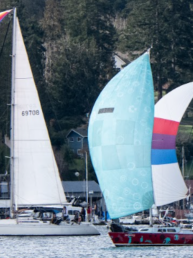
Windvanes, on the other hand, seem like a contradiction to the realities of sailing in the Pacific Northwest. They steer using the wind itself as the reference, requiring no electricity whatsoever. With a keen installation and savvy sailor to control the vane, it can hold a constant apparent wind angle for days at a time, even in heavy seas, and it does so with a remarkable blend of simplicity and reliability. Offshore sailors love them because they remove power consumption from the equation entirely. For passages from Cape Flattery to Hawai’i or down the West Coast to Mexico, a windvane becomes something close to magic: a silent, endlessly patient helmsman that never gets tired and never asks for more batteries, snacks, or sleep. But that strength is precisely what limits their performance in the PNW. Windvanes depend on stable breeze, and stable breeze is something the inside waters simply do not consistently offer. Anyone who has tried to sail north up the Inside Passage knows how shifty the winds can be, and waiting for the right conditions to sail north could take weeks or months; a luxury we can’t always afford. A boat that spends half its time motoring, fighting contrary currents, or tacking in narrow channels simply will not benefit from a wind-only steering system.
That’s why for most PNW cruisers, windvanes fall into the “nice” category. They’re an elegant solution, but they become truly necessary only if you intend to spend more time offshore where the wind stabilizes, the swell organizes, and apparent wind becomes far more consistent. Under those conditions a vane can steer more smoothly than most electronic pilots and do it without consuming a single amp. For cruisers with plans to sail the west coast of Vancouver Island, take the outside route back from Alaska, or continue southbound for Mexico, the South Pacific, or Hawai’i, a windvane becomes far more than a nicety. It becomes a second steering system and a major source of fatigue reduction.
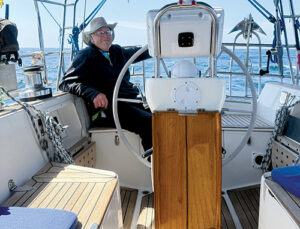
Boat design plays a role in this decision, too. Some hull shapes and steering systems work beautifully with windvanes, while others make them harder to integrate. Boats with moderate displacement, well-balanced rudders, and clean transoms tend to pair well with vanes, particularly if they are designed with passagemaking in mind. Very light displacement boats, wide-stern modern cruisers, and twin-rudder designs may not perform as naturally without some customization. Autopilots, meanwhile, can be fitted to nearly anything, but boats with heavy helm loads or hydraulic steering require more powerful—and thus more expensive—drives to perform reliably, particularly on longer passages or in confused seas.
Power management is another deciding factor. The PNW has many days where wind is light enough that sailors end up motoring significant distances, burning diesel and running alternators. Autopilot power draw becomes less of a concern when the engine is already running. Offshore, the equation changes. Many sailors rely on a combination of solar, hydro-generators, and occasional engine charging, and they quickly discover that an autopilot steering in big seas is often the single largest power consumer on board. A windvane eliminates that load entirely. As the miles stack up, the energy savings add up to meaningful safety: more reserve power for communications, lighting, and navigation, and less dependence on starting the engine at awkward times.
The question, then, is how a PNW cruiser decides what they actually need. For most cruisers who stay inside the Strait of Juan de Fuca, an autopilot is truly necessary. It makes coastal sailing dramatically easier and is often the enabling factor for comfortable shorthanded cruising. Even a modest tiller or wheel pilot can change the entire experience of a weekend cruise. Once you reach Cape Caution or head down the west coast of Vancouver Island, a more capable pilot becomes necessary simply because conditions demand more torque and better course-keeping. A windvane becomes necessary only when your cruising ambitions extend beyond the regional coastline. If your long-term plans include sailing to Alaska via the outside, crossing an ocean, or heading down the coast toward warmer waters, the value of a vane becomes clearer. It reduces workload during multi-day passages, provides redundancy in case of autopilot failure, and can often steer better than a human helmsperson in heavy weather.
Although the conversation is often framed as “autopilot versus windvane,” that’s a misleading comparison because the two systems excel in fundamentally different conditions. Autopilots shine in the PNW because they can follow a precise course through inconsistent wind, strong currents, and narrow geography. Windvanes shine offshore where wind direction stabilizes, energy generation becomes more precious, and sea state rewards a steering system that responds fluidly to the rhythm of the boat. Many experienced ocean cruisers, ourselves included, choose to carry both systems, not as redundancy but because each does its best work in a different environment.
Ultimately, the distinction between necessary and nice in your self-steering selection comes down to where you sail and what kind of cruising you aspire to. For daysailing, island-hopping, or making your way north toward Desolation Sound, an autopilot belongs firmly in the necessary column. A windvane, however, sits in the nice-to-have category until the horizon line grows longer. When it does, it shifts quickly into the realm of essential safety gear—something that protects the crew as much as the rig or the hull. Self-steering might seem like high-end gear, but at its core it’s an investment in rest, safety, and the ability to stand back from the wheel and actually enjoy the cruise. The right system makes the boat feel steadier, the days feel shorter, and the miles feel easier. For PNW sailors who dream beyond the next anchorage, that’s what makes self-steering not just a luxury but an important part of choosing the kind of cruising life you want to live.
Regardless of which you choose, it is vitally important to remember that hand-steering skills are still unequivocally necessary. Equipment failures can and do happen, and no self-steering can see or anticipate waves the way a living, breathing helmsperson can. When transiting a tidal rip area or against strong tidal currents, proactive steering can mean the difference between keeping the bow pointed on course and getting spun around into a potentially dangerous orientation. Don’t let the perception of serenity on the autopilot’s part fool you; human attentiveness is still of utmost necessity.
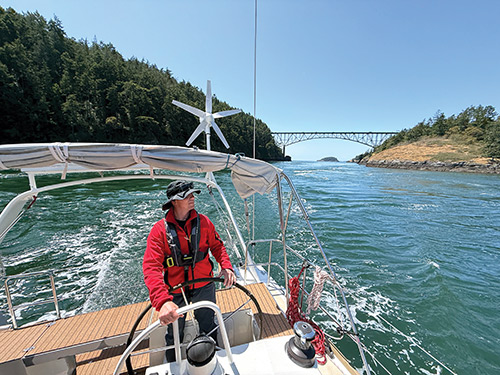
Gio and Julie of Pelagic Blue lead offshore sail training expeditions and teach cruising skills classes focused on preparing aspiring cruisers for safe, self-sufficient cruising on their own boats. Details and sailing schedule at www.pelagicbluecruising.com.