Some days, shopping for the simplest piece of boating gear becomes a research project as you delve into comparisons between every available option, price, warranty, and “objective” review—all in search of the elusive best product. Type “8-foot dinghy” into your favorite search engine and you’re likely to be overwhelmed at the barrage of options that the AI bot generates. Each of which, by the manufacturer’s decree, is most certainly the right one for you. So if a dinghy is the target of your search, how do you see through the cyber-smokescreen and narrow down the options that are the best fit for you?
If you haven’t guessed already, a tender of some flavor sits squarely on the “Necessary” list when it comes to outfitting your boat for cruising our beautiful Pacific Northwest waters—or anywhere you may venture from here.
Much like cruising boats, dinghy designs are a compilation of compromises that must be carefully considered in the context of your cruising goals. Features that make one dinghy ideal for diving atolls in the Tuamotus might make it a terrible choice for gunkholing around the Pacific Northwest. Choosing the right one for you depends on where you plan to cruise, the size of your crew (both number of people and their physical proportions), your budget, your available storage space, and what your cruising lifestyle priorities will be.
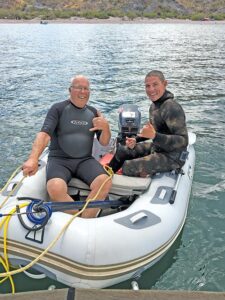
Our philosophy has always been to keep it simple; the less-is-more ideal that is the basis for this column, Necessary or Nice. We’ve cruised with a dinghy but no outboard (who doesn’t love a nice row on a sunny day?), hard kayaks instead of a dinghy, and even an inflatable paddleboard as a temporary dinghy. Just about anything that floats and has some sort of human, mechanical, electrical, or sail propulsion can serve as a fine tender. For many cruisers, the dinghy doubles or triples as the family car, day fishing platform, social shuttle, and grocery getter—it can even serve as an emergency life raft or source of aerobic exercise. You may even use your dinghy more than your cruising boat. But the biggest consideration when it comes to tender selection isn’t the build material, the hull form, or even the price tag; it’s where are you going to put the thing when you’re not actively using it? For most cruising boats there are four realistic options, none of which are mutually exclusive: davits, inverted on deck, rolled up, or towed behind.
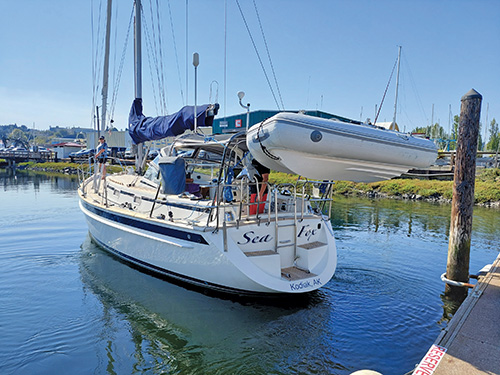
A well-designed and adequately robust set of dinghy davits is a convenient way to carry a tender. Though never an inexpensive or non-invasive installation, they keep the dinghy out of the water, protect it from biological fouling, and allow launching and retrieving in minutes. Their safe working load must account for the fully equipped wet weight of the tender including the outboard, fuel tank, battery, and any gear that will be left in the dinghy when hoisted. If the davits aren’t designed for that load, you’ll find yourself removing the outboard to hoist onto the stern rail every time the dinghy comes aboard, adding time and effort to what was supposed to be a simple operation. Forget to pull the drain plug and a torrential downpour can quickly fill the suspended dinghy with water at 8.3lbs per gallon. Similarly, the mechanical purchase needed to make hoisting and lowering effortless and safe varies greatly with the physical constraints of the potential operators. You want to ensure that it is safe for all members of the crew to hoist and lower the dinghy. If you can, test this out with various block and tackle configurations and see what works best for you and your crew.
Tender width is another important davit design consideration. A dinghy that is too wide for the davit arm length will interfere with solar panels, antennas, LifeSling deployment, and other transom mounted equipment. It will also significantly reduce the helmsman’s visibility aft and, on many boats, occupies the same real estate needed for a self-steering wind vane. Finally, a dinghy hanging from davits must be secured for more than just its own weight. In rough conditions it will swing, bounce, and twist, placing enormous dynamic loads on both the davits and the dinghy itself. Proper tie-downs are essential to prevent movement that can chafe inflatable tubes, damage the hull, or overstress the davit structure.
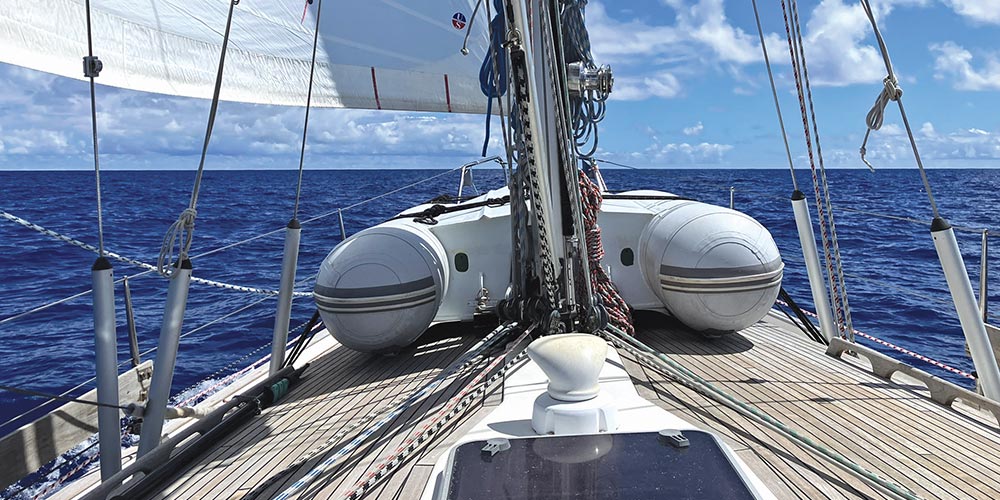
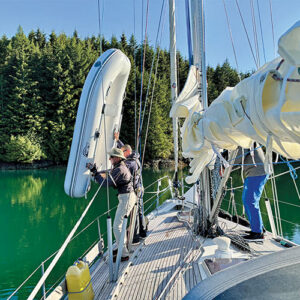
Storing the tender inverted on deck is the safest option for those sailors planning to make offshore passages or anticipating rough seas. But will it fit up there? Dimensional constraints of an inner forestay are the reason our cruising boat, Sea Fox, has one of the shortest dinghies available at a mere 7 feet 10 inches. If you are a cutter rig, this might apply to you, too. We find that hoisting the dinghy on deck using the spinnaker halyard and winch on the mast for mechanical advantage takes just as long as putting it in the davits and keeps us ready to depart at a moment’s notice if needed. Storing on deck however, does come with its own challenges.
For most crews, getting the dinghy on the foredeck is a two-person job unless you’ve engineered a dedicated hoisting system. In calm conditions it’s a pretty straightforward operation, but once the dinghy is in the air, losing control of it in a fresh breeze or rolling swell can result in expensive lessons involving strained backs, broken hatches, crushed dorades, or bent whisker poles. Once on deck, the dinghy needs to be lashed down securely to strong attachment points so it can’t shift underway, while still allowing the crew to move safely around the foredeck. A dinghy that’s secure but promises a tripping hazard on every excursion to the windlass or to check the rigging is simply trading one problem for another.
Here in the Pacific Northwest, where day sails between anchorages are the norm, many cruisers simply tow the dinghy rather than stow it. This can be a great option so long as your towing setup is properly designed for the job. Your tow line should incorporate some sort of shock absorption to reduce shock loading and ideally a bridle to distribute loading. Using a floating tow line is highly recommended to prevent it from sinking and fouling the prop during anchoring or docking maneuvers. Not all dinghies are equally suited to towing and one that does not track well can quickly become a nuisance. Prolonged towing in rough conditions can load these fittings in excess of their design limits and literally rip off the adhesive patch that holds on the D-ring on many inflatable bladders. Some inflatable models have towing attachment points intended only for low-speed use or short distances.
The most popular tenders by far are inflatables, and for good reason. They’re fairly lightweight, almost impossible to flip, and can be an affordable choice depending on the flavor you choose. A RIB (Rigid Inflatable Boat) combines inflatable tubes with a rigid hull. The hulls are generally available in two materials: fiberglass or aluminum. The rigid hull allows the boat to plane with a suitably sized outboard, making it dramatically faster and more efficient than a displacement dinghy. If your cruising style involves covering longer distances, diving, ferrying lots of gear, or carrying several people, a RIB is tough to beat.
Fiberglass is typically the more affordable rigid-hull option but it is more susceptible to damage. Repeated meetings with reefs, barnacle-covered rocks, and rough beach landings will quickly mar the bottom of a composite RIB. The addition of a rugged keel guard paired with a properly installed set of transom-mount dinghy wheels can significantly reduce wear and extend the life of a well-used fiberglass RIB. Aluminum hulls, by comparison, have become increasingly popular because they’re lightweight, exceptionally tough, and well suited to the frequent beach landings that are part of cruising in this area. But aluminum has its own drawbacks. Most aluminum RIB hulls are painted, and in a saltwater environment that paint will eventually bubble, peel, and fail. The inflatable tubes of aluminum RIBs are bonded to the painted surface of the hull, not directly to the aluminum itself. Once the paint starts to separate, the bond holding the tubes starts to fail as well. At that point, repairs in tight crevices become increasingly difficult and, in many cases, replacement of the dinghy is the only practical solution.
The other popular option is the SIB, or Soft Inflatable Boat. Unlike a RIB, a SIB has no rigid hull. Instead, the floor provides the boat’s structure. Depending on the model, that floor may be a high-pressure inflatable air deck or sectional panels made from aluminum or marine plywood. The result is a dinghy that packs into a surprisingly compact bag, making it an excellent choice for smaller boats or cruisers with limited storage. On smaller boats, these foldable or roll-up dinghies are the superstars of space efficiency because they can be deflated and stored below, keeping your decks clear while underway. To avoid introducing salt crystals down below either expect to rinse it with fresh water or dedicate a salty storage space in a cockpit locker.
The tradeoff for those space savings becomes apparent every time you launch. A quality eight-foot SIB typically has five separate air chambers to inflate, including an inflatable keel that helps the boat track straight and improves planing performance. On airdeck models, the floor must be inflated to a much higher pressure than the tubes, typically 8 to 12 PSI. That means the little bellows-style foot pump that came with the boat probably isn’t going to cut it. A high-pressure pump with an accurate pressure gauge is a necessity if you want the boat to perform as designed. After inflating one by hand a few times, most people find themselves shopping for a high-pressure electric pump, which brings its own power requirements, storage, and maintenance considerations.
Inflatable boats are generally built from one of two fabrics: PVC or Hypalon, now more often referred to by its chemical name, CSM (chlorosulfonated polyethylene). CSM remains the gold standard for cruising tenders. It’s significantly more resistant to UV exposure, abrasion, and chemical degradation than PVC and can easily last 15 to 20 years with proper care. Of course, that durability comes with a noticeably higher price tag. PVC boats are lighter on the wallet and perfectly adequate, but expect a shorter service life, especially if they’re not actively protected from the sun.
One detail that’s a critical part of every inflatable but extremely easy to overlook until they start leaking is the inflation valves. There are several different valve manufacturers, each requiring its own proprietary inflation adapter. Lose that adapter in a remote anchorage and your dinghy instantly becomes a very expensive pool toy. For extended cruising, it’s wise to carry a spare valve, the correct inflation adapter, and a valve wrench. They take up very little space and can save a cruise.
Hard dinghies are one of the toughest and most practical tender options available. With construction material options of fiberglass, aluminum, rotomolded polyethylene, traditional marine plywood or the latest and greatest carbon fiber, they’re incredibly durable and require very little maintenance compared with inflatables. Most hard dinghies are displacement hulls, which makes them efficient for low-speed expectations. If your goal is simply getting ashore reliably, a well-designed hard dinghy is a fine choice. They track well, tow beautifully, and offer the best rowing performance of any tender type. As an exciting option for enthusiastic sailors, many models can be fitted with a simple sailing rig, turning your grocery getter into a fun little daysailer. Because hard dinghies don’t have the inherent buoyancy and stability of inflatable tubes, many cruisers opt to add foam or inflatable gunwale fenders to improve stability.
Some hard tenders separate into two or more sections making them much more convenient to store, as the sections ‘nest’ inside one another. These are a spectacular option for cruising boats with little space that prefer the benefits of a hard tender. The compromise to their considerable benefits, however, is that nesting dinghies are more expensive to build or purchase, are often heavier due to the reinforced joining structure, and must be assembled before they can be used.
Folding dinghies occupy a unique niche, offering much of the rowing performance and efficiency of a hard dinghy while solving one of their biggest drawbacks: storage. Designs such as hinged polypropylene or folding composite tenders collapse flat enough to be lashed to a lifeline, stored on deck, or tucked into a cockpit locker on larger boats. They’re generally lighter than a comparable hard dinghy and row far better than most inflatables. They plane quite well and can be real speed demons when paired with the right outboard. The tradeoff is complexity and cost. Hinges, locking mechanisms, and folding seams require periodic inspection and maintenance, and folding dinghies come at a premium price. For cruisers with limited lazarette and deck space who still value rowing performance, they can be a smart solution.
A dinghy opens the door to countless practical and recreational opportunities, but its greatest value may be as a piece of safety equipment. Floating logs and deadheads are capable of inflicting catastrophic damage to a hull. While offshore cruising boats should carry an appropriate life raft, not every coastal cruiser does. In a worst-case scenario when hull meets log, a well-maintained dinghy can provide a vital platform of refuge, keeping you and your crew out of frigid, hypothermia-inducing water until help arrives.
No one ever plans to run aground but log enough miles under your keel and, sooner or later, you’ll find the bottom. When a sailboat goes aground, one of the most effective recovery techniques is to kedge off by carrying an anchor out in the dinghy, setting it in deeper water, and using the anchor rode and a winch to pull the boat free. Without a reliable tender, your options may be limited to waiting for the next high tide or calling for assistance. In the glacial fjords of the Pacific Northwest a dinghy also makes stern-tying simpler and more practical. Many anchorages offer little swinging room or are just too deep to get sufficient scope. Running a stern line ashore quickly and safely is nearly impossible without a tender.
The “best” dinghy for your use case is often the one that came with your boat when you bought it. And there is nothing wrong with using it until it separates at the seams. Just make sure you’ve put the necessary tools and materials onboard to make any necessary repairs and armed yourself with the knowledge of how to make them. Then go have fun on your dinghy!
The more experience you gain with the equipment you have, the more informed your decision will be once you are ready to replace or upgrade what you have. Consider your dinghy as more than just a shore taxi or a fishing skiff but a versatile piece of recreational gear with a sprinkle of integrated safety necessity. It’s far more than just nice to have onboard, it’s an essential component of seamanship.
Gio and Julie of Pelagic Blue lead offshore sail training expeditions, flotillas, and teach cruising skills classes focused on preparing aspiring cruisers for safe, self-sufficient world cruising on their own boats. Details and sailing schedule at www.pelagicbluecruising.com.