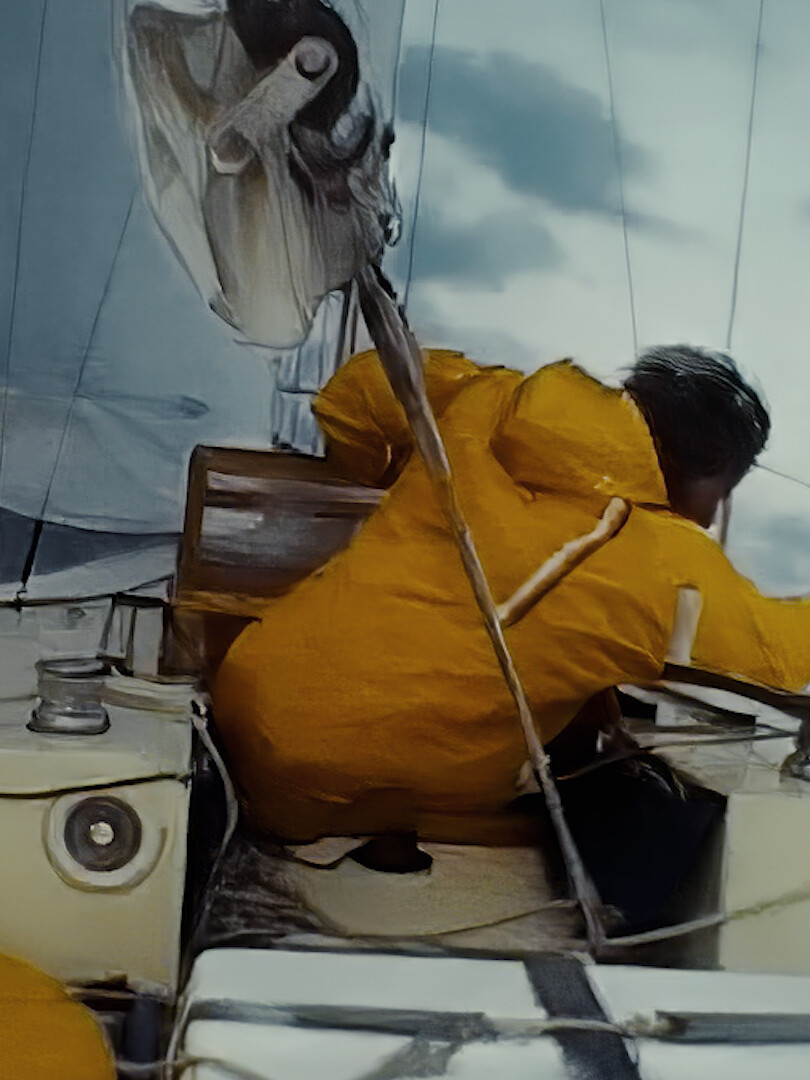
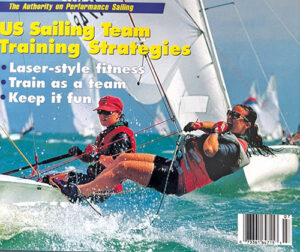
Sailing World during her Olympic 470 campaign.
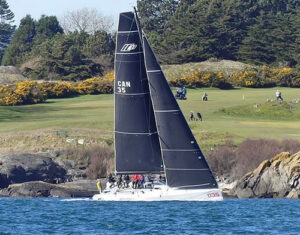
It’s been a busy start to the summer racing season for Cascadia Sailing. While the countdown to September’s NYYC Women’s International Championship is well underway, training aboard the IC37 Westerly has continued to intensify, both on and off the water.
When the team isn’t training aboard Westerly, many of the women on the Cascadia team are competing locally and nationally and internationally, representing their yacht clubs and countries across a wide range of classes. These events provide valuable opportunities to continue developing skills, gaining experience, and bringing new ideas back to the team.
One of Cascadia Sailing’s greatest strengths is the diversity of sailing backgrounds within the crew. While we’re united by a common goal on the IC37, each sailor brings a unique perspective that continues to shape the ways we learn, race, and perform together. From seasoned offshore sailors and experienced keelboat racers to those of us who grew up racing dinghies, our different backgrounds have become one of our biggest assets.
As we’ve spent more time training aboard Westerly, one thing has become clear: the skills developed in dinghy sailing carry over remarkably well to the IC37. While the jump from a two-person dinghy to a 37-foot one-design keelboat might seem significant, the IC37 is a sporty, high-performance boat, and many of the same fundamentals apply.
In a dinghy, every movement matters. Balance, timing, and communication are just as important as sail trim, and those instincts remain just as valuable on the IC37.
To learn more about how those skills translate to Westerly, we asked some of Cascadia’s dinghy sailors how their small-boat experience has shaped their approach to racing a high-performance keelboat.
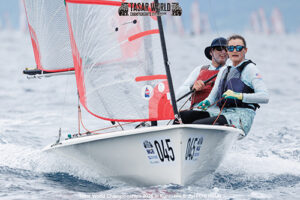
Lindsay Bergan and her husband, Dalton, won the 2026 Tasar World Championship in Japan this spring.
What skills from sailing the Tasar have translated most to the IC37?
Lindsay: The boats are very different, but being able to get plenty of reps sailing in dense, competitive fleets in both the Tasar and J/70 over the last few months has been invaluable. It’s helped shake off the rust and rebuild that instinct for how situations develop at key moments like the start and the windward mark. My goal on the IC37 is to give our tactician, Jen Glass, the most relevant information so she can make good decisions about positioning the boat under pressure.
It’s a lot easier to throw in last-minute maneuvers in a dinghy like the Tasar, but in the IC37 with 11 crew on the rail, we need to think further ahead. That makes it especially important to anticipate what our situation will look like 30 seconds, or even a few minutes, from now. Off the starting line, if we wait too long, will we lose the ability to tack and duck? If we’re not sure we’ll lay the weather mark, are there port tack boats that could duck us and pin us out from tacking? Sailing the Tasar has helped me get back to recognizing those situations earlier, so by the time we’re on the IC37, they feel familiar rather than rushed.
Tara Golonka has campaigned in the 49erFX and recently competed at the 470 US Nationals, where she and her teammate finished as the top Canadian team.
Jen Morgan Glass campaigned the 470 and has raced competitively in the 505, 29er, and 49erFX. She was also instrumental in helping establish the 49erFX as an Olympic class ahead of the Rio Games.
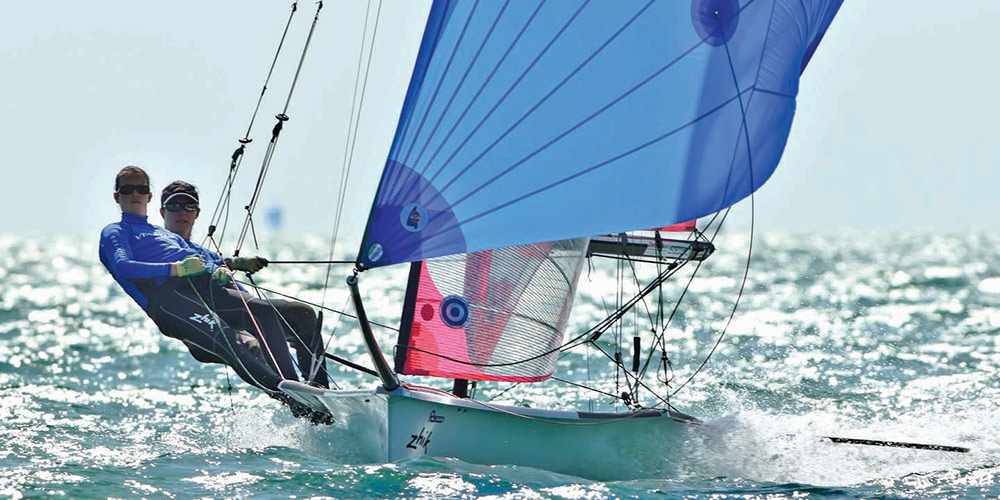
Jen and Tara, you’ve both spent years sailing skiffs. What similarities—and differences—do you see between sailing a 49erFX and the IC37?
Jen/Tara: There are definitely a few things that feel familiar from skiff sailing. The IC37 is also really responsive to active sail trim and weight movement, and when you nail a jibe, you still get that same fast, satisfying exit. The biggest difference is that, because it’s a keelboat, everything happens slower, which means you have to think further ahead and be much more deliberate with your maneuvers. As a result, it doesn’t accelerate like a 49erFX, so it’s less lively and you can’t power up quickly when you crack off upwind. Learning to adapt to those differences with a team of 11 has been a really fun challenge.
Kate Sargent is a former 29er/49erFX sailor and coach who has spent years developing sailors in high-performance dinghy classes.
How has your coaching background helped your transition to the IC37? What advice would you give a young dinghy sailor stepping onto an IC for the first time?
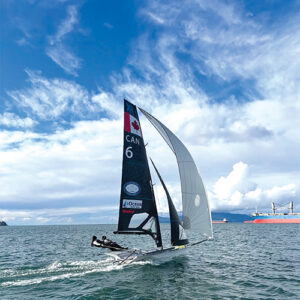
Kate: There are many skills to developing doublehanded athletes that are transferable to large teams such as on the IC37. My time working with athletes in doublehanded skiffs has many of the same focuses: role delegation, kinetics, and communication. The 29er gives athletes a sensitive platform that demonstrates cause and effect quickly. My challenge is to help athletes create processes and routines that help them find consistency in an otherwise finicky boat. These focuses apply well to training on the IC37, and have helped me develop processes for my specific role on the bow that work seamlessly with the delegated jobs of my teammates.
The advice that I would give to a dinghy sailor stepping onto a larger keelboating team would be to trust their skillset and be open-minded to new perspectives. I always say to my athletes, “A boat is a boat is a boat.” This means that if you focus on the fundamentals you can make it work on any team, the specific quirks and technicalities of the boat will naturally follow with some hard work.
Jaime Mack has primarily raced singlehanded dinghies and is currently competing at the RS Aero European Championship in Travemünde, Germany.
What lessons from racing large RS Aero fleets translate to the IC37 starting line?
Jamie: I created the following mnemonic that is handy for big fleet, one-design starts in the Aero and J/70, and directly applies to the IC37 class— the four “‘M’s”:
Mindset: You deserve the best start in the fleet, because you are that good. Period.
Minutes: Work to your target starting position against the clock; always know the time, be a metronome!
Management: Starting in big, one-design fleets requires managing fleet density much earlier in the starting sequence; as time runs down, narrow your focus to managing just the 2-3 boats closest to you.
Motion: Always keep flow over your foils to maintain steerage; use crew weight aggressively in down-speed maneuvers and to accelerate at the start.
Like many of the sailors who shared their perspectives above, my own sailing background has been primarily in dinghies. After campaigning the 470, I went on to race a variety of boats, most of them under 24 feet. Stepping aboard a 37-foot boat with a crew of 11 was a completely different experience, and I quickly understood why the team needed a playbook.
As my teammates have highlighted, there are obvious differences in the feel and responsiveness of the IC37 compared to a dinghy, but despite the larger platform and bigger crew, the same fundamentals still apply. The IC37 is a true one-design, so success comes down to teamwork, boat handling, and smart tactical decisions rather than equipment. It’s an exciting, responsive boat and, once it gets up and going, it’s (almost!) as much fun as any dinghy I’ve raced.
Next on the calendar for Cascadia Sailing are two back-to-back training weekends where our focus will be on bringing all of those experiences together as a team. In early August, we’ll head to New York for the Safe Harbor Regatta, our first opportunity to line up against many of the other IC37 teams before the NYYC Women’s International Championship. It’s a chance to see how we stack up, continue learning, and build momentum heading into September. We can’t wait to get to the start line!
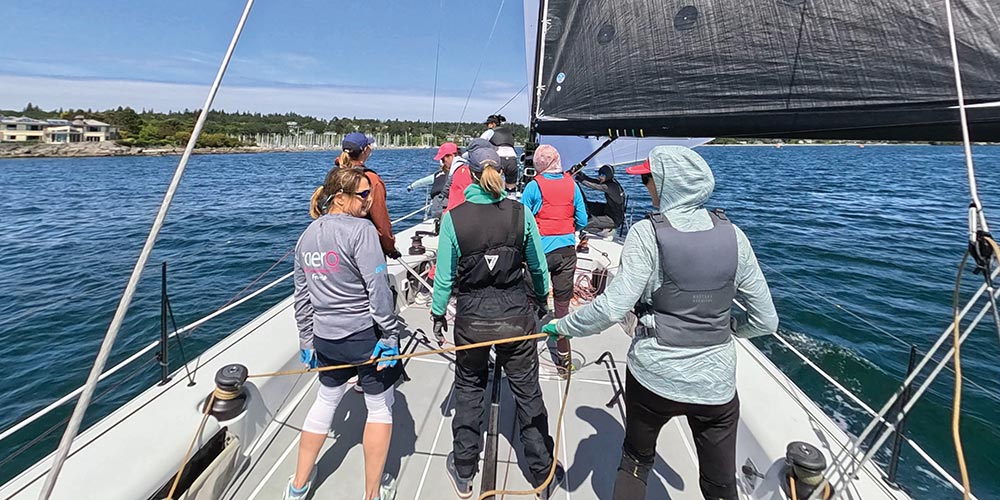
With a traveling regatta this month, Cascadia Sailing continues their fundraising effort with an ultimate goal of $120,000. Donations fund top-level coaching before and at the Championship, team travel, and the chartered IC37 they’ll use for the Safe Harbor Regatta. Learn more and contribute to the team’s exciting endeavor at: www.cascadiasailing.org