 By and large, I’m deeply grateful for my childhood. I was afforded a wealth of opportunities and experiences that shaped me into a relatively happy, functional adult. Until recently, I hadn’t been able to point to anything that distinctly might have made those years better. That is, until I stepped foot aboard the Schooner Zodiac as a part of a four-day session of Northwest Maritime’s Salish Sea Expeditions (SSE).
I grew up a landlubber––my parents, both Air Force veterans, were far-removed from the maritime world. Sailing was an enigma to them (still is) and, by extension, to me. That is, until I boarded a sailboat for the first time only a handful of years ago. Now, after hundreds of days and thousands of ocean miles in my wake, it’s fair to say that my understanding of sailing has deepened substantially. Still, the idea of a floating classroom, a school onboard a century-old schooner, was something I couldn’t possibly wrap my head around.
Prior to my participation in an SSE trip, my lack of familiarity with this kind of experiential education led me to some misaligned expectations: I assumed sailing would be the central curriculum—physics in how the boat moves, biology in the megafauna we’d see from the deck, basically a boat ride with some bonus learning. Little did I know, we’d be covering those bases, as well as conducting full-blown experiments, delving into chemistry, microbiology, geology, and underwater ROV exploration. Added to this, of course, was a whole lot of accompanying fun.
A Living Laboratory Under Sail
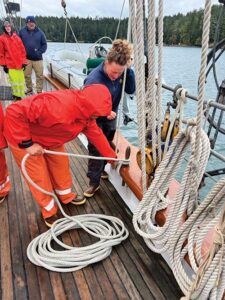
Founded in 1994, SSE has brought more than 12,000 students, thousands of teachers, and hundreds of schools into its “science-under-sail” programs; immersive, inquiry-based experiences that transform the Salish Sea into both classroom and catalyst. That’s the org-proffered description of SSE on the Northwest Maritime website—and it framed my preparation for the trip.
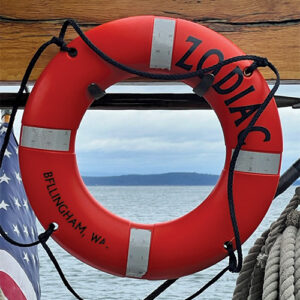
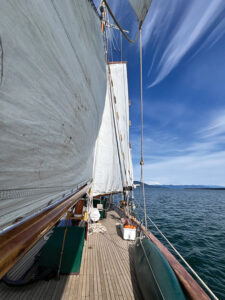
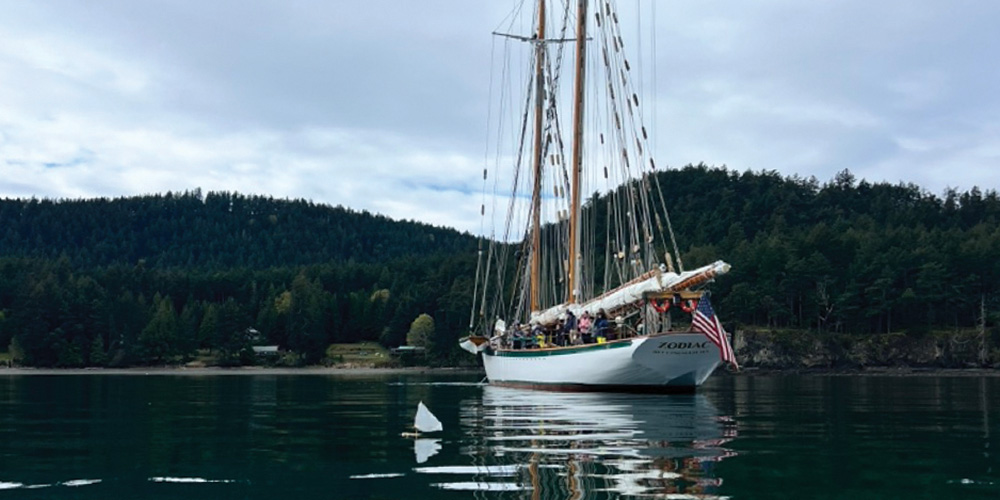
I arrived and more of the tangible details rose to the surface, both about SSE and about Zodiac herself: a 160-foot two-masted gaff topsail schooner launched in 1924. I was rapidly enveloped in shared experience with ten of Eton Middle School’s students who, like me, were well outside of their own ho-hum normal and poised to engage in all sorts of discovery. Lucky for me, the setting was a natural intersection of two things I love: sailing, and working with middle schoolers, an age group that is equal parts chaos and curiosity. I was immediately enamored with all facets: the vessel, the kids, and the concept.
Leading this group from Eton were teachers Kirsten Zender and Logan Hays, the first two people I met at the Bellingham Cruise and Ferry Terminal. Kirsten is statuesque and undaunted, with a present German accent befitting her cogent and convivial communication and wry humor. It was quite clear that she had the trust and admiration of her pupils. Where Kirsten is arcadian and distinguished, Logan is merrily genial, with a fantastic mustache to boot. The children? Clever, collaborative, and considerate. I was going to love this group.
First Lessons: Load the Boat, Find Your Place
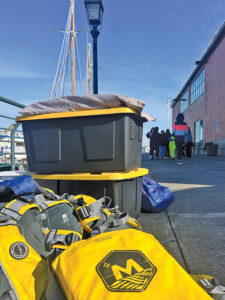
As the students unloaded their bags from the bus that brought them from Seattle’s eastern suburbs to Bellingham, the rest of the trip’s Northwest Maritime staff arrived, consisting of Madison Maxwell, Ted Moskal, and Rhagen Olinde. Amidst the soft, anticipatory calm before departure, the Zodiac’s crew prepared their ship while, dockside, we helped the group ease into the rhythm of the trip with icebreakers and introductions. Soon enough, it was time to load.
Dock carts piloted by teenagers rattled down a steep, low-tide ramp, piled high with duffels and gear. What could have been a logistical headache became, instead, a moment of efficacious triumph. The kids were organized into a seamless chain, passing bags hand-to-hand, working with focus and pride. Watching them lean into the process, without hesitation, was almost as impressive as anything that followed. By the time the last bag disappeared into the hold, something subtle had already shifted. This was no longer just a group of students, it was a crew in the making.
Canvas, Muscle, and Memory
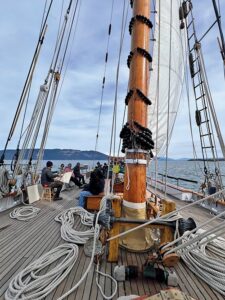
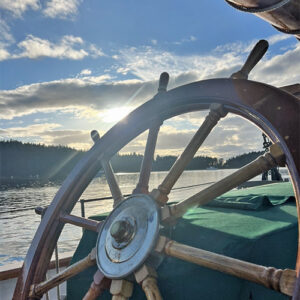
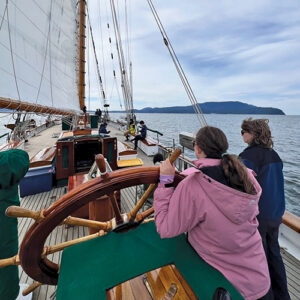
After a safety briefing and egress drill, we slipped away from the dock. Right away, the learning began. Four students were immediately put into a watch rotation, with one student on the bow to look for detritus and vessel traffic, another at the helm to steer Zodiac (with crew guidance), a student in the chart room to navigate, and a fourth to serve as a messenger, relaying messages among the former three. Every time we were underway, the students moved through this rotation––a 160-foot boat driven by 13-year-olds. How insanely cool.
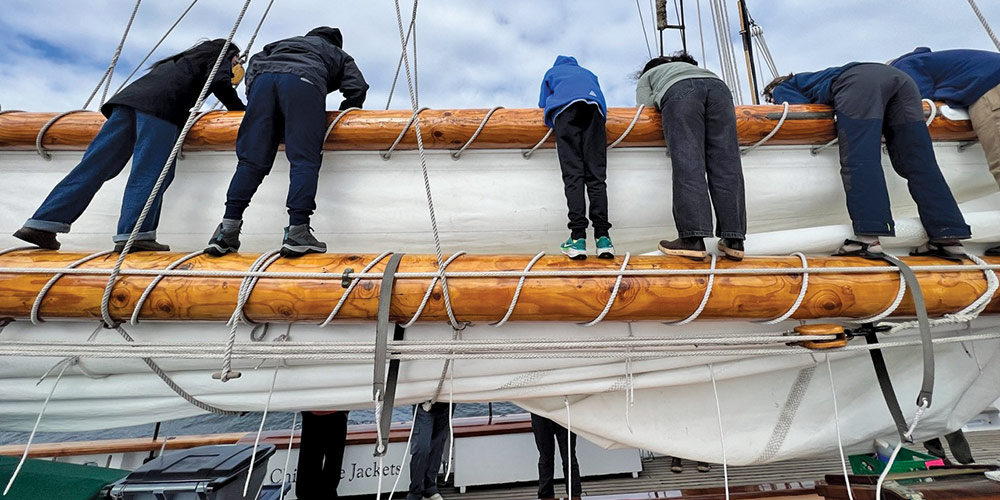
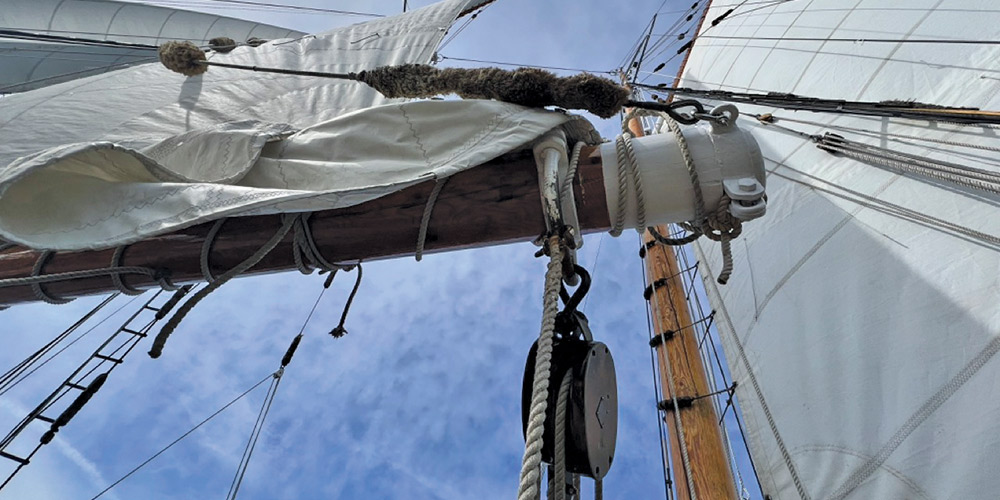
We motored out of Bellingham Bay, heading west, while the morning’s northerly wind faded into an indecisive southerly, hesitant at first, then steady enough to get to work. Sailing stations were assigned to students and chaperones alike; lines were explained, and movements were demonstrated and then practiced––and then practiced again, and again, until they began to stick. Then, it was time to raise some canvas. The mainsail went up first––throat and peak, port and starboard, a coordinated heave that demanded both strength and timing from everyone onboard. The foresail followed, also a team effort, then the staysail, each hoist layering new understanding onto the last.
I found my place on the bow with the jib crew, alongside Zodiac crew member Olivia and three fearless students. Together, we ran sheets, managed lines, and sent the sail aloft. Twice the size of my young team members, I found myself on the halyard for the first hoist––much of my sailing background comes from modern race boats, where everything is engineered for efficiency. Aboard Zodiac, however, the experience felt entirely different: heavier, more tactile, steeped in history. The three-strand line resisted just enough to demand attention, and every movement required intention. Nothing happened by accident, nor came easily. And, because of that, every successfully-completed duty or well-executed maneuver felt more meaningful.
Looking around between my own pulls, I observed the quick learning progression happening aboard. What began as deliberate, sometimes awkward effort amongst students and chaperons quickly became instinct, giving way to confidence as we all settled into Zodiac’s rhythm.
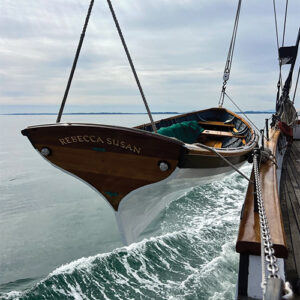
Over the course of four days, that rhythmic confidence transformed into something more impactful: ownership. The students didn’t just learn how to sail Zodiac––they started to get visibly excited every time they were called on deck for a watch rotation; they took pride in how well they were hoisting and dousing sails; they tended to the quieter work of the vessel each morning by bailing tenders, swabbing decks, and polishing brass; and they became little sponges, devouring every word that came out of the mouths of Zodiac’s crew. “How old do you have to be to volunteer?!” was the most emphatically-asked question of the trip.
Science, Seen and Felt
By the end of the trip, the mechanics of sailing and caring for Zodiac had become second nature, maneuvers executed with aplomb that, just days earlier, would have seemed out of reach. But while sailing and tending to the vessel provided the structure of the week, it was the science that gave it real depth.
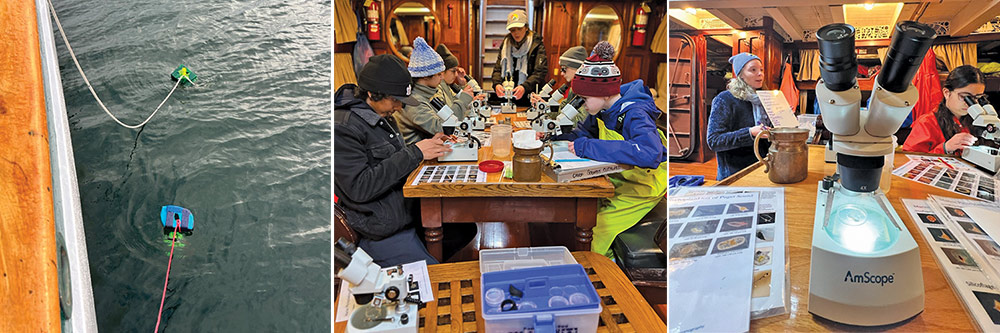
At each anchorage––Parks Bay on Shaw Island, Prevost Harbor on Stuart Island, and Echo Bay on Sucia Island––the students deployed plankton nets of their own design and creation. One of the most amusing moments of the trip was, during the first evening, watching Ted hand zip ties, a length of line, an empty milk jug, a flashlight, duct tape, a block of foam, and a piece of PVC pipe to the kids, and then saying, “Make something.” No further instructions, just improvisation and creativity. At the end of the construction exercise, the students lowered their creations over the side of Zodiac, then retrieved them the following morning. Turns out, the PVC pipe was internally wrapped in fine mesh, and the contraptions––some more successfully than others––had collected water samples.
Under Madison’s guidance, the students concocted hypotheses about what the pH levels of these water samples would be, how many different types of plankton species they would contain, the correlation between the two, and how it might differ from one anchorage to another. The first round of samples onboard, the students did exactly that: they tested the samples’ pH level, then utilized pipettes to deposit water droplets onto microscopes we’d brought for just this purpose. The students then utilized reference sheets to identify plankton species, logged how many they found, and then took an aggregate average number across all of their findings. It was hands-on science in the truest sense: immediate, tangible, and very much relevant.
Beyond the Textbook
happens on expeditions like this.
The learning didn’t stop there. During the second evening aboard, we were handed hull-shaped pieces of wood, bits of dowel, pieces of translucent plastic, and little skeg-shaped pieces of metal, and then divided into pairs for a boatbuilding competition. I teamed up with Rhagen, and we wound up creating something that somewhat resembled an Aussie 18, nicknaming it “Sir Lancelot.” The next morning, I hopped into one of Zodiac’s skiffs with representatives from each boatbuilding team, and we launched our miniature models into Prevost Harbor with the goal of racing them from Zodiac’s bow to stern. The only caveat? There wasn’t any wind.
Our little boats bobbed and searched for breeze, and it quickly became apparent that Sir Lancelot was, well, a little bow-heavy. But, no fear, due to the lack of breeze in Prevost, it was announced that we would have a second attempt in Echo Bay. A fortunate happenstance, too, since we got to make any necessary adjustments to our boat designs between the becalmed maiden voyage and the actual contest. So, Sir Lancelot became Sir Lancelotless––and wound up winning the miniature boat race. (The winning prize was a high-speed boat ride in one of the Zodiac’s tenders. For the record, Rhagen and I forfeited our prize, letting the runner-up students go in our places.)
In addition to model sailboat building, we had other practical learning opportunities, particularly with Captain Calen Mehrer’s expertise. Over the course of our trip, he captivated us all with sailing theory lessons and, in Echo Bay, he launched Zodiac’s underwater ROV and projected the little robot’s camera feed onto a prominent monitor in the salon. With everyone gathered round, Calen guided us along the seafloor of Echo Bay, dungeness crabs navigating the sand, sea pens swaying in the current, gunnels darting past the camera lens. It was a fascinating glimpse into a world just beneath us.
Shore excursions added yet another educational layer. On Stuart and Sucia, we hiked through forests and along shorelines, learning, with Kirsten’s guidance, about the geology of the San Juan Islands and the ecosystems that define them. Madison and Ted further facilitated tidepooling, rock skipping, birdwatching, and nature journaling, replete with sketches, paintings, and notes.
During our Stuart shore excursion, we paused to watercolor. A soft rain had been falling, and instead of shielding our paper from the precipitation, we kept going, watching as droplets transformed our paintings in real time, pigment bleeding and blending across the page. It felt like a fitting reflection of the week itself: education shaped as much by environment as by intention.
“The salt air and the shared responsibility, the quiet focus over a microscope and the laughter echoing across the deck, the steady care of a well-cooked meal and the awe of a whale surfacing beside you—once you’ve been a part of it, you don’t leave it behind.”
The Sound of Learning
When the sails were stowed and the lessons complete, we played. Without electronics (which no one seemed to miss), the students filled the ship with laughter, song, and dance. They performed musical numbers, played cards, and invented games as they went. One evening, I found myself shoulder-to-shoulder with them on the deck, all of us lying on our bellies in a tight circle, playing Tapple and laughing to the point of breathlessness.
The only thing that could pull us away from our self-facilitated entertainment? Dinnertime. Caz, the ship’s cook, somehow managed to turn a constantly-moving galley into a place of comfort and delight, producing meals that felt nothing short of miraculous, especially because she never repeats a dish. Which is to say, there’s something so deeply grounding about being well-fed at sea, about gathering around a table after a full day of working and learning, salty, wind-flushed, with appetites fully earned. Caz’s meals became their own kind of lesson: in care, in nourishment, and in the simple-but-profound impact of being looked after.
Those moments––warm food, full bellies, and the steady hum of conversation––were as much a part of the experience as anything we learned topside or under a microscope, but it was the laughter that lingered most, immersive, communal, and alive.
A Classroom With Lapstrakes, Not Walls
Amidst the merry mirth, though, there was a quiet awareness settling in as the trip progressed: this wouldn’t last forever. On our last morning, we tidied the ship the way we’d learned to––coils neat and capsized, decks clean, gear stowed with care––and began our return toward Bellingham Bay. A subtle shift came over the vessel as the routines we’d so quickly grown into were already beginning to feel like something we’d dearly miss.
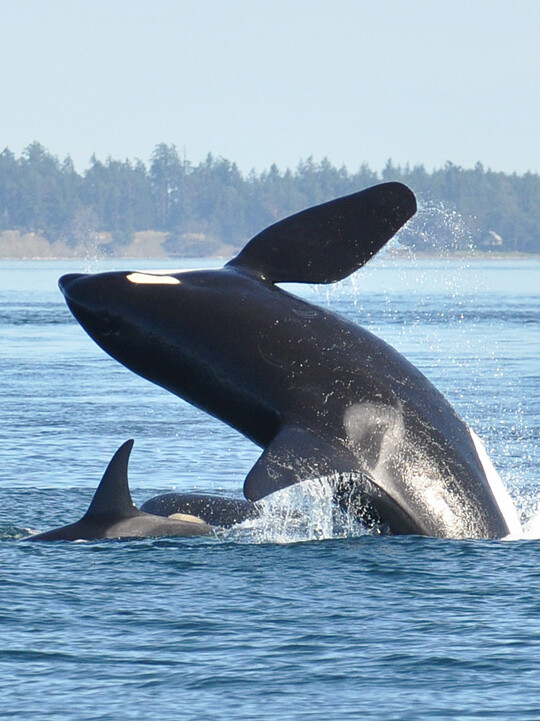
And then, as if on cue, the Salish Sea offered us one last, parting lesson. Nearing Fairhaven, a humpback whale surfaced off our beam, its spout rising in a soft, unmistakable plume before it slipped beneath the surface. We watched in collective awe as it surfaced again––massive, effortless, entirely at home in the waters we had spent the week trying to better understand. For a moment, everything else fell away. It was the kind of encounter that no textbook could replicate, no classroom could contain. The culmination of everything the week had been building toward: not just knowledge, but connection. Not just observation, but presence.
As we continued on toward the dock, I found myself ruminating on one simple phrase a student had uttered: “This is the coolest classroom I’ve ever had.” It’s hard to argue otherwise. Partaking in an experience like the ones offered by Salish Sea Expeditions, an opportunity that I didn’t have in my youth, turned out to be just as profoundly rewarding as an adult. I stepped away from Zodiac feeling like I’d undergone a life-changing experience.
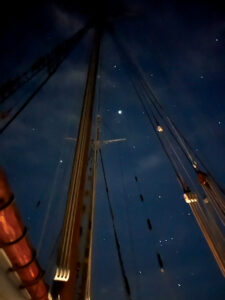
Looking at the trip through the eyes of the students I was chaperoning, I know that this expedition will fundamentally change their lives as well. The salt air and the shared responsibility, the quiet focus over a microscope and the laughter echoing across the deck, the steady care of a well-cooked meal and the awe of a whale surfacing beside you—once you’ve been a part of it, you don’t leave it behind. These are the transformational experiences so many of us strive for, and they take shape in motion; in the work, in the wonder, and in the connections forged between people, place, and purpose.
When asked about their favorite parts of the experience, some students spoke first of the sailing and others of the quiet immersion in nature––but most returned to the people: the rare opportunity to learn and grow alongside one another in an unfiltered, unfettered environment. Whether the voyage sparks a lifelong love of sailing, a path into STEM, a deeper attentiveness to the natural world, or simply a willingness to step more boldly beyond the familiar, each student carries something meaningful ashore. Their horizons are just a bit broader than they were before they stepped aboard Zodiac, the world’s coolest classroom.
Massive thanks and a heartfelt standing ovation to Kirsten Zender and Logan Hays from Eton Middle School; Captain Calen, First Mate Ron, Chef Caz, and Crew Members Olivia, Marc, Laurent, Dave, Carolyn, Matt, and Milo from Schooner Zodiac; and Madison Maxwell, Ted Moskal, and Rhagen Olinde from Salish Sea Expeditions and Northwest Maritime.
After several years serving as 48° North’s advertising sales pro, crossing oceans, and racing both locally and internationally, Ryan Samantha Carson is pursuing a new career course with Washington State Ferries.