I’ve spent more time in Canada than any foreign country, nearly all of it coming and going by boat. Last summer, I attended a family reunion in Vancouver, but this time, boating wasn’t in the cards. My wife, two adult children, and granny piled into our modest family car and headed north to the international border. Between the five of us, our luggage, and a cargo box atop the roof, there was no space for even our smallest hand-carry boat.
The route to British Columbia from Portland by car is a tease of waterways. It starts by crossing a mile-wide section of the Columbia River, then passes the river in a more scenic section adjacent to Kalama. Next comes a glimpse of the bottom of Puget Sound near Olympia, then a sweeping view of Commencement Bay above Tacoma, and a flyover of Lake Union in Seattle. Eventually, we found ourselves looking out at Semiahmoo Bay near Blaine, waiting in a long queue of cars to cross the border. By boat this would be a much anticipated element of the trip; in the car, I felt a tinge of frustration as we inched along on the hot tarmac, waiting our turn to clear customs. A seagull soared overhead and alighted on a car ahead of us, as if mocking my relative freedom.
Navigating in any new place takes observation and skill. By boat, I might be worried about running afoul of commercial traffic or striking a rock I hadn’t noticed on the chart. Finally past the border in the family car, racing forward at 80km/h (how fast was that?) I was more worried about keeping pace or getting lost. Once in the city, I encountered flashing green traffic lights (which made no sense to my American eyes) and found myself longing for more familiar navigation markers where I knew what red and green actually meant. Paused at a stop sign, I realized that I’d sailed more miles in British Columbia than I’d driven in a car. No wonder I was so confused.
We stayed in the Hastings neighborhood, where the water was clearly visible, but a busy road, train tracks, and an industrial port made access seemingly impossible, especially to a guy who hadn’t brought a boat.
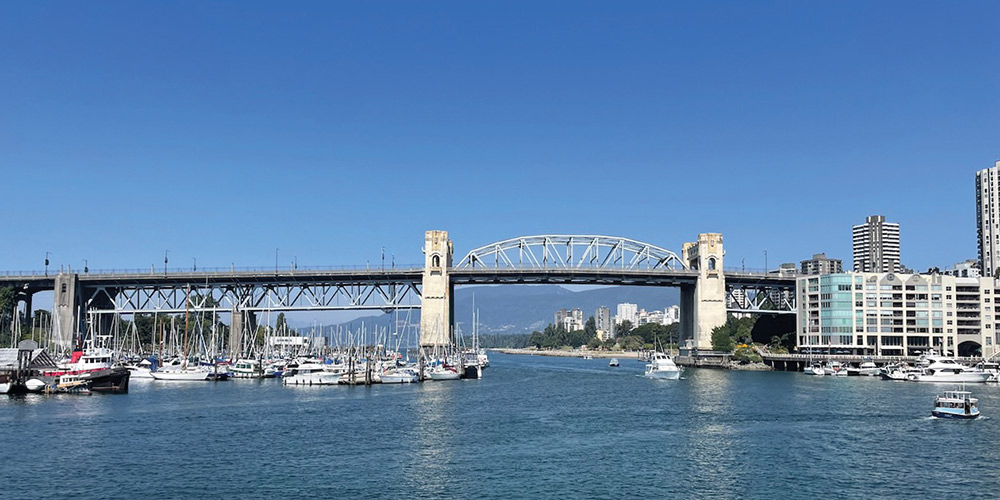
We did the tourist thing, visiting botanical gardens, museums, and parks, eventually hopping on water taxis, wandering the shore, and looking at marinas from afar. This minor connection to the water relaxed me a bit, but the boats were all big ones, distancing me from the sailing I love. I was beginning to feel like the embodiment of the Norse phrase, “bound is the boatless man.”
On one family jaunt, surrounded by the glassy, multi-story towers downtown, I noticed a tiny yellow Victorian house, its bay windows and fish scale shingles radically incongruous here compared to its vertical neighbors. Like the little house, I felt out of place.
A few days into our visit, my wife and I found ourselves free of the stress of family affairs, walking along the waterfront of Granville Island toward tiny Heritage Harbour, an annex of the Vancouver Maritime Museum.
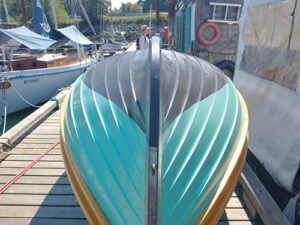
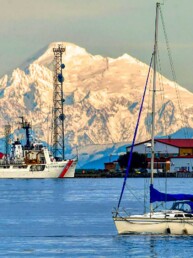
The harbour (part marina, part exhibit) is open daily for visitors to its fleet of well-cared-for wooden boats with local roots. Everything here was built on a human scale, and mostly constructed of wood, from the boats to the funky little shingled workshop. The entire place had a cheerful, welcoming vibe. Ahead of me was Ern, an elegant wooden cutter used in the making of the Charlie’s Charts guidebooks. Around the corner was Anja, a charming, pint-sized cruiser that I’d spotted on the cover of a recent Woodenboat Magazine. A handful of well-used motor cruisers and small craft rounded out an intimate, yet striking scene, perched on the edge of town with container ships and mountains in the distance.
The workshop, a floating structure, belonged to the Oarlock & Sail Wooden Boat Club. I peered through its window, inhaling the scent of wood shavings. Inside was a new rowing craft mid-way through being planked. Via a friend, I’d made e-mail contact with Daniel, a member of the club, but I wouldn’t be meeting him for a few days. Until then, I was happy just knowing that in this bustling maritime city, there was a spot that felt welcoming.
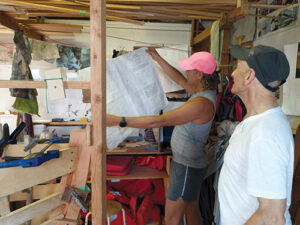
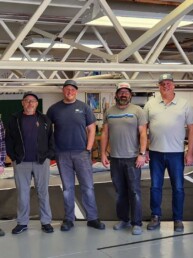
On the appointed day, I was so excited that I showed up too early, then hung around the maritime museum grounds before sheepishly wandering down to the club. After recent political comments by our president, I worried that interacting with Canadians as an American might be awkward. Almost as soon as I arrived at the workshop however, a few members invited me in. As we exchanged pleasantries, no one batted an eye when I disclosed my American identity. With relief, I sat back to learn the backstory and intricacies of building the Bus Bailey rowboat before me.
When Daniel arrived, we hopped into a wooden sailing dinghy built by the club. As we sculled away from the dock, everything felt completely normal, unlike my slight disquiet while driving. Port and starboard were in their normal places. We worked well as a team; I was the jib keeper, while Daniel handled the tiller and mainsail. With a light wind and glassy sea, we lounged in T-shirts and shorts, our bare feet soaking in the summer air. Talk came easily. As sailors and builders, we had endless things in common: tales to tell, boats we wanted to build or sail, and wish lists of trips we’d like to take. National identity didn’t matter on the sea.
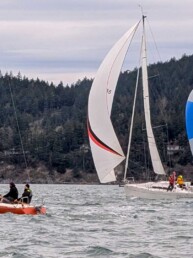
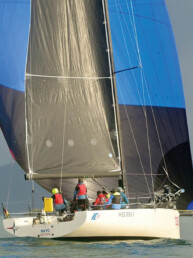
We made our way into the broad expanse of English Bay on an outgoing tide. Keelboat racers bobbed and drifted on zephyrs. Kayakers paddled past and waved. A few party boats zoomed by, sending a wake towards us, but we didn’t mind. There wasn’t enough wind to properly sail for long, but our conversation was engaging and variable, the weather as good as the stories.
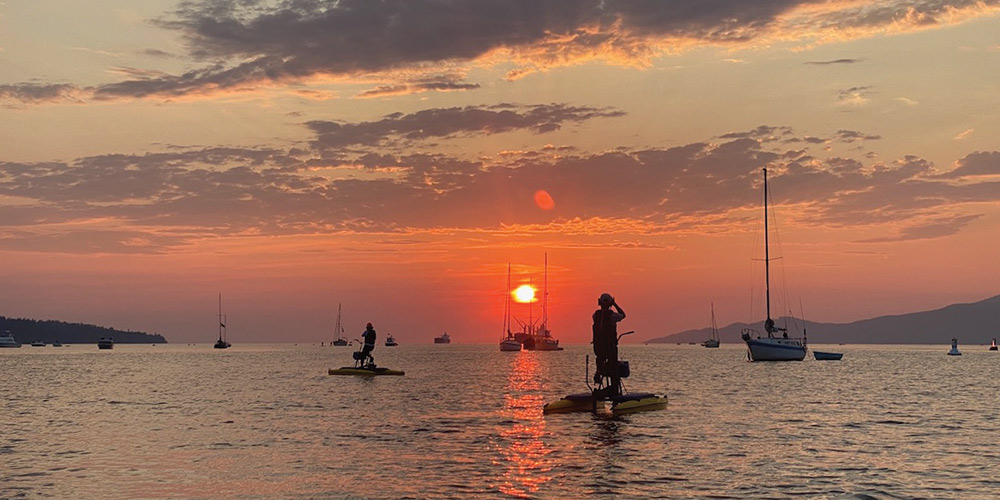
By the end of my time there, a crimson sun was slowly sinking in the west, its light turning the water a dozen shades of orange, red, silver, and blue. It was getting dark, but I didn’t care to hurry home. I’d found my place.
Bruce Bateau sails and rows traditional boats with a modern twist in Portland, Oregon. His stories and adventures can be found at www.terrapintales.wordpress.com. To learn more about the Oarlock Sail and Wooden Boat Club, visit: www.oarlockandsail.com