Every boater knows the moment when a piece of gear doesn’t quite work as expected—the engine that dies, the sail that rips, the light that goes out, the block that blows up, or the line that parts. There may be some rolling of eyes or sleeves as you take a deep breath and accept that you’re going to have to dig into the fix. If you’re like me, there’s a portion of your brain that celebrates having a new puzzle to solve, and an even bigger part that sets about reconciling the inconvenience because I never seem to plan for this kind of thing. All the while, I’m hoping things don’t go so poorly that I have to drain my amygdala that controls fear and anxiety, or my wallet and pride by calling for a tow.
I’ve been lucky in this way. While professional boat technicians would surely side-eye any of my jury-rigs, I’ve usually managed to effect an adequately functional repair; or at least have been able to make it back to the dock to reassess without much trouble.
In the last few months I’ve been aboard a couple boats with some cutting edge technology, a bunch of stuff I don’t begin to really understand. What I do understand is that a bit of that cool tech simply didn’t seem to work, and nobody on board knew what to do about it. The lack of functionality did not dominate or ruin either experience, but it was an aspect of my time on the water. Moreover, it highlighted the broad catch-22 with technology—it’s only as good as it is useful for the intended audience.
I’ll spare you any conspiratorial tinfoil-hat musings, but the platitudes and jokes about computer systems and connectivity in everything from your automobile to your microwave are becoming increasingly relevant to boats. As this happens, it’s fair for an average person to feel a little less agency. Do I know how to fix a car that’s as old as I am? Certainly not. I do, however, believe that my path to understanding how to do so would be more direct than learning to repair one manufactured in 2025. It’s always been easier to call for professional backup for complex repairs but, with the prevalence of integrated computer systems, it now seems like less of a choice and more of a requirement.
Cruisers who spend time offshore or in very remote waters are well practiced at carefully selecting what kinds of systems they will rely on. Redundancy, simplicity, and repairability have always been prized attributes. This mindset hasn’t been a central part of my boating experience—I’ve been happy leaning into new technology in areas like sails, composites, and weather modeling; and relying (probably too unquestioningly) on the now-ubiquitous technology of combustion engines, 12-volt systems, and electronic navigation software. But these next-level technological systems I encountered recently might change my calculus.
My boat dreams now involve my young family. While it’s entirely sensible to hope that our future family boat may allow certain modern conveniences, my main focus will be that it works—reliably and simply. And if it doesn’t, the right boat for me needs to have puzzles I think I can solve, or at least work around, on my own.
This realization called to mind my days managing a sailing club and its 25 boats. Do you know which boats were always in service? The simplest ones. There’s a case for the intrinsic value of simplicity, of going without, of rejecting technological modernity on principle. I love a good back-to-basics adventure, but that’s not quite it for me.
My recent experiences of boat-tech’s little foibles (or my errors in their employment) reinforce my status as a luddite for essential systems. My focus on simplicity is about reliable functionality in the best case scenario, and about my ability to address an issue—given my own technological limitations—when function inevitably falters. On the other hand, will a 12-volt ice maker fit in my stocking, Santa?
Wishing you and yours a safe, happy holiday season,
~ Joe

Joe Cline
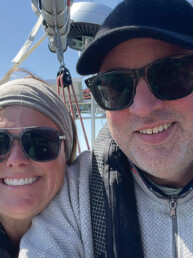
Joe Cline has been the Managing Editor of 48° North since 2014. From his career to his volunteer leadership in the marine industry, from racing sailboats large and small to his discovery of Pacific Northwest cruising —Joe is as sail-smitten as they come. Joe and his wife, Kaylin, have welcomed a couple of beautiful kiddos in the last few years, and he is enjoying fatherhood while still finding time to make a little music and even occasionally go sailing.