Ask any Pacific Northwest angler to explain the appeal of sport fishing and you will likely hear about the thrill of the catch, the splendor of our region’s waters, the chance for self-discovery, and the camaraderie with others. Sometimes the fish is beside the point. Most sport fishers I know focus on the pursuit, which in the Salish Sea often involves trolling a lure or bait behind a slow-moving boat. Much of the human population lives along the shoreline here, and Pacific salmon (Oncorhynchus) have been the catch of choice in this marine environment for more than a century. As most anglers will tell you, a salmon is not just a fish.
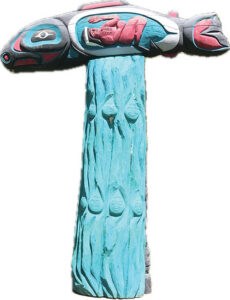
Salmon are central to our region’s sense of place. For thousands of years, the Coast Salish peoples have held a sacred relationship with these fish, and they continue to affirm their spiritual significance in creation stories and ceremonies. Salmon embody the abundance, renewal, resilience, and vitality of the Salish Sea—the foundation of life here. Their migratory behavior—hatching in freshwater, migrating to saltwater, and returning to the streams of their birth to spawn and die—makes them a keystone species affecting extensive food webs, connecting ocean and land environments.

During the late nineteenth century, their large size (some were called “hogs”) and the magnitude of the runs (observers claimed a person could cross a stream walking on their backs) added to their mystique. As fishing for sport gained popularity at this time, anglers particularly prized three species of salmon: chinook, also called kings; coho, also called silvers; and pinks, also called humpbacks. These fish tended to jump out of the water and “give chase,” adding to the excitement of angling. Chinook have retained their iconic status among modern sport fishers. “They are the trophy fish of the Pacific Northwest,” Brian Wilson, an avid local angler, recently explained. “They are the gold standard” [personal communication with the author].
Sport fishing in the Salish Sea developed alongside the commercial fishing industry during the late nineteenth and early twentieth centuries. It spurred the growth of small boat building and equipment design, while tackle shops, resorts, and boat houses that rented fishing vessels added to local economies. As more people moved to the cities along the Salish Sea, recreational fishing offered a link to an earlier life centered around the water. It encouraged new social networks, including angling clubs and sporting organizations, which have persisted into the twenty-first century.
Selling Salmon

Railroads, seeking to expand their markets to tourist passengers, recognized the appeal of salmon angling. “Fishermen and yachtsmen may set their own courses in rented boats,” promised one advertisement for the Milwaukee Railroad in 1948, hoping to entice visitors to its terminus in Puget Sound.
Ads in the early twentieth century were not limited to wealthy passengers who could afford guides and extended journeys. Companies like Johnson and Evinrude highlighted opportunities for sport fishing in small boats, often emphasizing family bonding or group outings fueled by their outboard engines. These ads appeared in a variety of print publications, including outdoor magazines, newspapers, and promotional pamphlets. They often showcased advancements in boat equipment and fishing gear, such as rods, reels, and lures, while using rustic, idyllic imagery that evoked an earlier era.
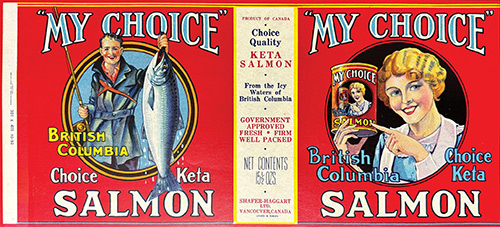
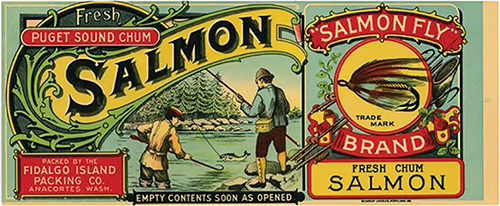
So appealing was the subject of recreational fishing that it was used to illustrate and advertise commercially caught salmon. Canned salmon labels, which often depicted fanciful scenes, featured pastoral views of anglers and their catch—a far cry from the realities of the mechanized equipment and bloody floors of actual cannery operations along the Salish Sea.
Salmon Tales
The publishing industry also benefited from extolling the value of angling. “When you can’t go fishing, console yourself by reading about it,” suggested Harry W. Howard in 1954 [Sport Fishing for Pacific Salmon]. To be sure, writers had explored the merits of fishing as early as 1653, when Izaak Walton published The Compleat Angler, a classic British book celebrating the activity as a contemplative, reflective pastime rather than a source for food or profit. Over the centuries, this cerebral approach to angling resulted in a fair amount of navel-gazing, promoting fishing as a route to self-discovery. “Many men go fishing all their lives without knowing that it is not fish they are after,” Henry David Thoreau mused in Walden (1854), sparking debate among scholars and anglers who ponder whether Thoreau used those exact words and what he meant by them.
Early twentieth-century publishers tapped into a more down-to-earth market for adventurous as well as practical stories about fishing. Book-length guides and pamphlets advised anglers on how, where, and when to troll for salmon in Puget Sound. Innovations in printing and lower postage costs made magazines accessible to a wide readership, while a growing middle class had more time for outdoor pursuits like fishing. Magazines such as Field and Stream, Hunting and Fishing, and Western Sportsman, published in Seattle by the Washington State Sportsmen’s Association, offered vicarious experiences and useful information about salmon angling in an era before YouTube, TikTok, podcasts, and online forums.
General publications focusing on Pacific Northwest culture joined the trend. In 1903, for instance, The Pacific Monthly, a precursor of Sunset Magazine, regaled readers with a tale of a lighthouse keeper who caught a salmon while trolling near Cape Disappointment. First, he “came on board to examine my tackle,” wrote author Captain Cleveland Rockwell. To his astonishment, Rockwell saw the keeper the next day “with the most extraordinary tackle which was ever presented to a salmon.” His gear included a redwood strip dressed “down to the thickness of an inch,” with pieces of wire serving as guides or rings. “For a reel,” Rockwell marveled, “the iron wheels of a child’s toy cart were rigged with a crank and securely lashed to the pole.” According to Rockwell, this unconventional angler “succeeded in catching many a lusty salmon” with his “remarkable outfit.” News of the makeshift tackle and the large haul spread quickly. Within a week, “every rooster on the military post presented a most forlorn appearance,” as “necks and tails had both been plucked to make salmon flies” [Oct. 1903].

Competition, Camaraderie, and Continuity

When the Great Depression hit in the 1930s, sport-fishing contests called “salmon derbies” offered desperate residents in cities around the Salish Sea the chance to earn a year’s wages in prize money. Ben Paris, a Seattle restaurateur hoping to boost interest in his business, started an annual derby in 1931 in association with the Seattle Star newspaper. Later, the Seattle Times and Seattle Post-Intelligencer sponsored their own salmon derbies, centered on catching chinook and coho. Sporting organizations like the Everett Steelhead and Salmon Club also sponsored derbies, as did yacht clubs. By the mid-twentieth century, these contests had become “so popular they were a regular occurrence on Puget Sound” [Russell R. Christianson, A History of Puget Sound Salmon Sport Fishing, 1998]. Derbies typically started at daybreak, lasting until around noon. Some included women anglers. Drawing large crowds of participants and spectators, they promoted salmon fishing by engaging the public while bringing anglers together.
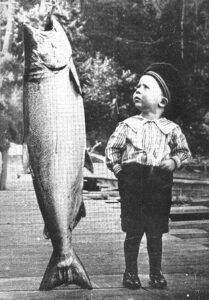
Kids also participated in derbies, which encouraged a lifelong interest in angling. Erik Werner, a local angler who currently helps organize youth derbies, recently described the excitement of children catching their first salmon. “The joy on their face is a sight to behold,” he commented. “And it’s infectious.”

My friend Alan Newell agrees, noting that his passion for angling started when he was a kid riding bikes with his friend to a local boat house, where they rented leaky vessels for an afternoon of fishing. “We probably spent as much time bailing as we did fishing,” he recently mused. “But how can you beat an afternoon on a boat with your friends?” Now an avid fly fisherman in Montana, Alan periodically ventures to the Salish Sea to troll for salmon. Salmon fishing historian Russell Christianson recalled a similar childhood. “When I was 13 years old I had my own boat and motor,” he wrote. To pay the cost to keep them in a boat house, he mowed lawns and worked odd jobs. “I rode my bicycle two miles down there every chance I got to go fishing” [A History of Puget Sound Salmon Sport Fishing].
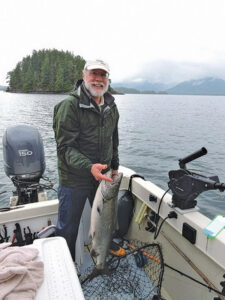
Werner, who trolls for chinook, coho, and pinks from his Sea Ray, recognizes the continuity among generations that salmon angling offers. Fishing in the Salish Sea has been a big part of his life since third grade. “You’re part of something that’s been here from the beginning,” he marvels. “And we still get to do it.”
Even so, changes are on the horizon. The human population along the Salish Sea doubled in the last three decades, increasing the pressure among various groups that harvest salmon, while improved gear and fish-finding technology allow for more efficient catches. Although anglers and sporting organizations have long supported conservation efforts, including bag limits, closed seasons, and other regulations to protect fish, it is unclear how these measures can offset major issues such as climate change or the decline of Southern Resident killer whales dependent on chinook salmon for their food supply. For now, salmon remain an enduring symbol of what makes life in the Salish Sea special.
Lisa Mighetto is a historian and sailor residing in Seattle. She is grateful to the Seattle Public Library and Tacoma Public Library for documents and information, and recommends checking out the 2026 Seattle Boat Show schedule, which offers many sport fishing seminars on gear, regulations, best spots, and more.