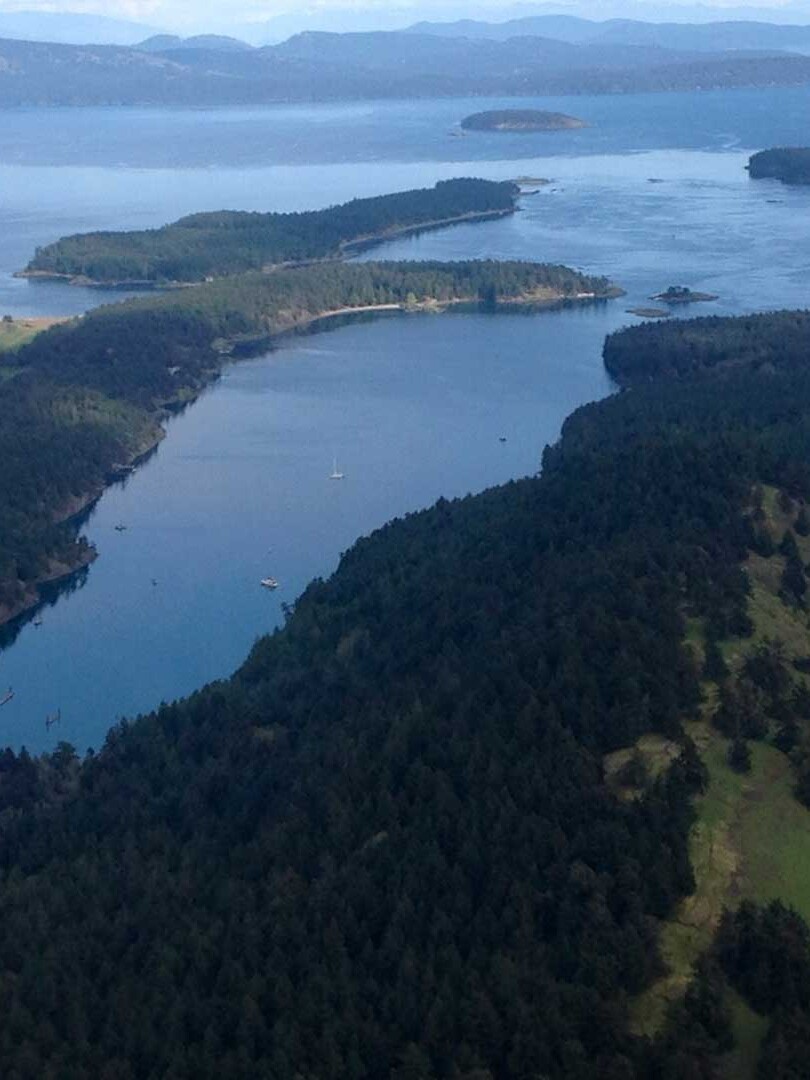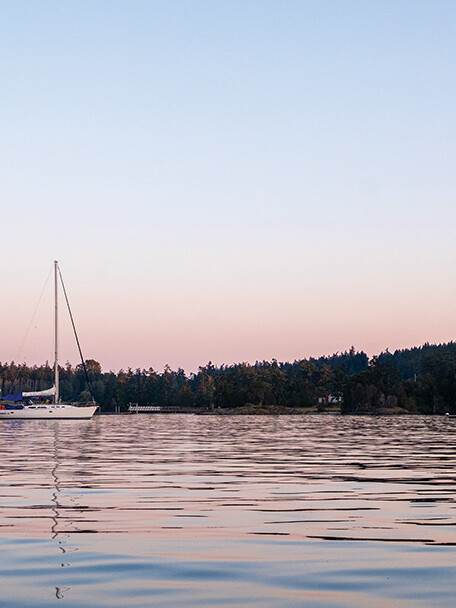
Huge congratulations goes out to the intrepid crew of One Ocean, who recently returned to Anacortes after a 27,000-mile journey around North America and south to Cape Horn, carrying out research along the way.
After more than a year at sea and over 27,000 nautical miles sailing through some of the world’s most remote and challenging waters, from the Arctic to Cape Horn and across the Pacific, the crew of the sailing vessel One Ocean completed the Around the Americas Expedition with their arrival at Cap Sante Marina in Anacortes on August 11, 2026. (Listen to an interview with the crew HERE.)
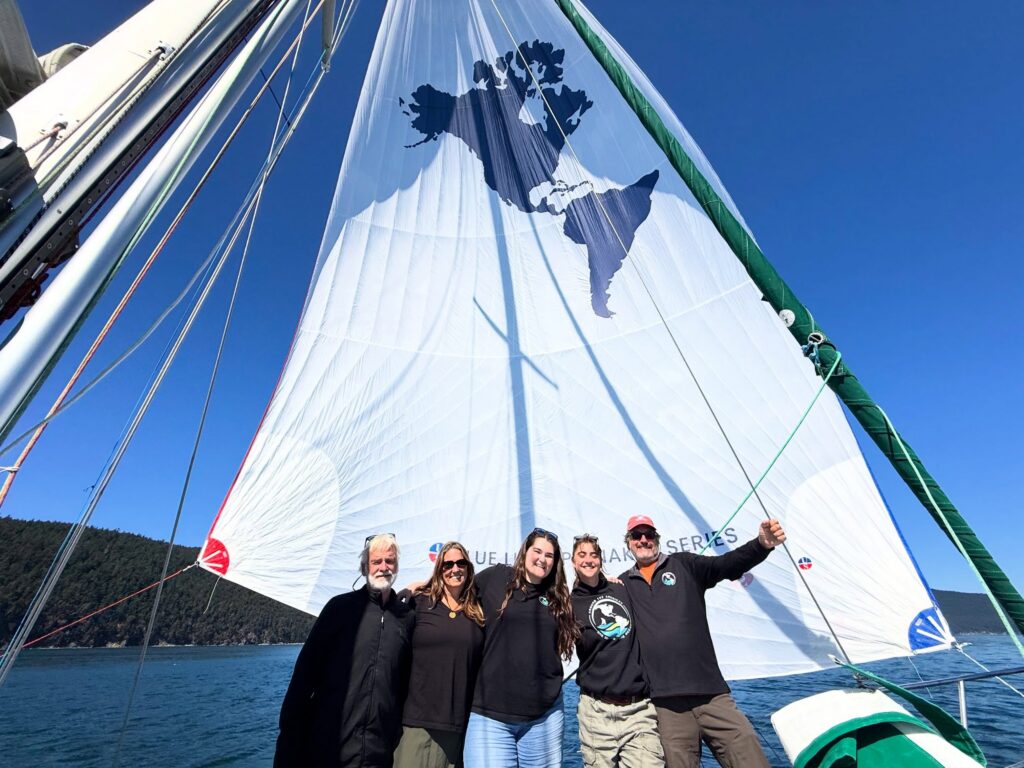 The expedition returns with far more than scientific data and miles sailed. It returns with new research, strengthened partnerships, thousands of inspired students, and countless stories shared by coastal communities, scientists, educators, volunteers, and Indigenous knowledge holders across the Americas. Together, these experiences revealed a powerful truth: the waters surrounding the Americas are not separate—they are one interconnected ocean. Protecting the future of our coasts, marine life, and communities begins with recognizing that every action has a ripple effect across our shared waters. We are One Island, One Ocean.
Departing Anacortes in May 2025, the expedition traced the coastlines of North and South America, navigating the Northwest Passage, the Arctic Ocean, the Atlantic, the Caribbean, the Southern Ocean, Cape Horn, the Pacific, the Galápagos Islands, Hawaii, and finally home to the Pacific Northwest. Along the way, the crew experienced towering Arctic icebergs, powerful Southern Ocean storms, tropical heat, trade winds, and some of the most biologically rich marine ecosystems on the planet.
But this voyage was never simply about sailing around two continents. It was about retracing the historic 2009–2010 Around the Americas Expedition led by Captain Mark Schrader, where the guiding principle “One Island, One Ocean” was born. More than a decade later, this second expedition honored that legacy while expanding the mission through modern ocean research, education, and global collaboration. By following the same route more than 15 years later, the team collected valuable comparative scientific data, helping researchers better understand how our oceans are changing over time.
The expedition was also shaped by a remarkable team from Skagit Valley. Captain Mark Schrader, the first American to single-handedly circumnavigate the globe via the five great capes of the Southern Ocean, brought decades of experience to the journey, including four roundings of Cape Horn and two transits of the Northwest Passage. Co-Captain and Project Director Jennifer Dalton sailed alongside her daughter, Grace Dalton, Lead Marine Biologist and a graduate of Burlington-Edison High School, and Tess Schornack, Education Outreach and Social Media Coordinator. Grace and Tess both attended La Conner Elementary School, highlighting how local students can grow into leaders advancing ocean science, education, and conservation on a global scale.
The expedition served as a floating platform for scientific research, environmental education, and community engagement, proving that meaningful conservation begins by connecting people to the ocean.
Throughout the journey, the crew partnered with scientists and research institutions, including the University of Washington’s Applied Physics Laboratory, to collect oceanographic data, deploy drifting research buoys, document kelp forests, monitor marine wildlife, and study sea surface temperatures, ocean currents, and changing marine ecosystems. Every mile sailed contributed to a growing body of research that will help scientists better understand our changing ocean.
At the same time, One Ocean became a classroom without walls.
Using live satellite connections whenever possible, the crew connected with thousands of students across Canada, the United States, South America, Ukraine, and South Africa through interactive virtual classrooms. Students followed the expedition in real time, learned about marine science directly from the ocean, asked questions from their classrooms, and discovered how their own communities are connected to the health of the world’s oceans.
“Whether we were surrounded by Arctic sea ice, sailing beneath the cliffs of Cape Horn, or crossing nearly 4,000 nautical miles of open Pacific between the Galápagos and Hawaii, one lesson became clearer every day,” said Captain Mark Schrader. “The ocean connects us all. There are no separate oceans. There is only One Ocean, and islands that we all call home.”
The expedition also demonstrated the power of collaboration. Scientists, educators, volunteers, students, sponsors—including Seattle Yachts—Indigenous communities such as the Samish Indian Nation, and coastal residents all became part of the journey, sharing knowledge, stories, and expertise that extended the expedition’s impact far beyond the wake of the vessel. Many of these partnerships grew through Skagit Valley College’s Marine Technology program.
Throughout the expedition, the crew shared daily updates, photos, videos, and educational content from some of the world’s most remote waters. Their storytelling built an engaged online community that grew to almost 25,000 followers in less than 14 months, extending the expedition’s reach well beyond the sailing community and inspiring people around the world to become better stewards of our shared ocean.
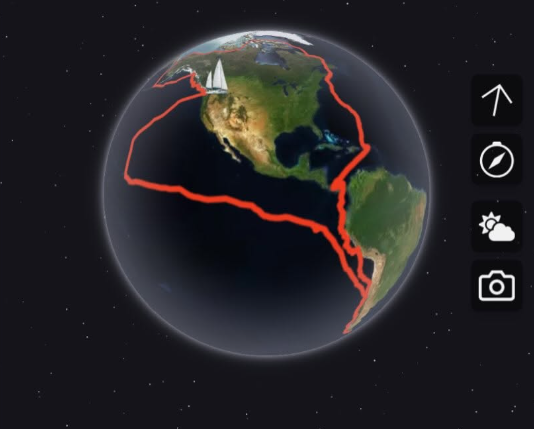 Among the expedition’s accomplishments:
-
Sailed more than 27,000 nautical miles around North and South America.
-
Successfully navigated the legendary Northwest Passage and rounded Cape Horn.
-
Conducted collaborative ocean research with scientists and research institutions.
-
Deployed oceanographic research buoys to improve understanding of waves and ocean conditions.
-
Documented kelp forests, marine mammals, seabirds, and coastal ecosystems.
-
Connected with thousands of students through live virtual education programs.
-
Shared stories from remote communities, highlighting environmental challenges and local stewardship efforts.
-
Inspired communities to recognize that every watershed ultimately flows to the same ocean.
While the voyage is ending, the mission is only beginning.
Over the coming months, the Around the Americas team will share expedition findings through public presentations, educational programs, podcasts, documentary filmmaking, classroom resources, and scientific collaborations. The data collected during the expedition will continue supporting ongoing research, while the stories gathered along the way will encourage new generations of ocean stewards.
“Our goal was never simply to sail around the Americas,” said expedition Co-Founder and Project Director Jennifer Dalton. “It was to help people realize that what happens in one community eventually affects another. Pollution, climate change, fisheries, biodiversity, and conservation don’t recognize political borders. We truly are One Island sharing One Ocean.”
The Around the Americas Expedition demonstrates that exploration remains one of the most powerful tools for education, science, and inspiring action. As the crew returns home, they invite everyone to become part of the next chapter by supporting ocean literacy, protecting local waterways, and recognizing that every river, every coastline, and every community is connected.