48° North has been privileged to share stories from the incredibly talented group of sailors from British Columbia and Washington who make up the Cascadia Sailing Team as they prepared for New York Yacht Club’s (NYYC) inaugural Women’s International Championship held in Newport, Rhode Island on September 12-19, 2026. Though a fuller reflection on their experience will be coming in the November issue, 48° North was able to catch-up with Tactician Jen Morgan Glass and Skipper Chris Wolfe just a few hours after each of them had returned home from racing in Newport. Here’s a bit of that conversation.
48° North: Let’s start with some early impressions as the team got into Newport. What was your mindset for this campaign culminating event?
Jen: In early August we went to the Safe Harbor Regatta, which was our first opportunity to line up with other people and see how the stuff that we’d be doing in a vacuum by ourselves was going to play out. We came out of that event with a couple of goals. When the fleet was organized, we did well. And when the fleet was disorganized, we struggled to respond to that in the right way. We also had a little bit of height challenge upwind, so we knew we needed to work on that. We also found that our boat handling was really good, and that was a focus of our training and a big positive. We worked on these goals in the month between the regattas.
We came into the championship event ready to test our upwind height and our chaotic starts. We got to work on the upwind height a little bit in the first few days of practice by grabbing a couple of tuning partners.
The ocean is bumpy, and it was bumpier during the championship than it was in some of the practices. It’s bumpy in a way that we don’t ever see in the Pacific Northwest. We knew that was going to be a little bit of an Achilles’ heel, and it just happened with the timing of the race schedule that the current-against-wind got worse over time. We got better and better, and found that we had good speed and we had improved our height. We felt good about those things.
What were you doing to address the height issue, and what did you feel was most effective?
Some of it was just awareness, the challenge is on Chris as the driver when she’s really focused on speed. When she would want to lean on it and sail a little bit lower, I would be mean and say, “No lower, can’t do it, maybe you can have a degree down, but you can’t have four.”
When did she have nice power, figuring out the conversation between her and our main trimmer Joy of when can I squeeze this high? It was a lot of practice on feel. In a competitive one design fleet, you don’t have the time to wait for the instruments to catch up, you have to do it based on relatives. That’s another thing about practicing by yourself is that you’re looking at numbers on an instrument because you have nothing else. We have targets, but the reality is, when you’re on the race course in a one design fleet, it’s just the relatives.
Did the boat you competed on feel different than the boat that you trained on?
It was mainly the environment and the relatives, but also the urgency, and that’s one of the things that’s hardest to put into practice when you’re by yourself. We would time things—how long did it take us to get up to speed out of a tack; hit a bad set of waves, how long are we down speed? It’s still hard to train the urgency you feel when the boats next to you are eking forward and you’re like.. aghhh! But we made a lot of improvements.
If I fast forward a little bit to answer the question you haven’t asked… We made huge improvements, but if I think about how we could get to a place where we could win that regatta, it would be by going to race a bunch of events in IC37s against the fleet and really honing in on that. Okay, I had a good start, and then I hit a wave. How do I get back up to speed quickly? For the teams that race these boats all the time, it takes them 10 or 15 seconds less, and that was the difference between the ability to tack and cross, or not. Then, if we can’t, we have our second-class choice of lanes, the next decision we’re making is impacted. At this level, those little things matter.
We had a couple of great coaches. We worked with Ben Glass a lot in the Pacific Northwest—looking at video, with him on the boat with us, and driving some of that urgency and helping fine tune. Then we had Steve Erickson at the regatta; Steve’s a multiple America’s Cup sailor, Star World Champion, Olympic gold medalist. He used photography to say, “Okay, here are your bookends—this is the tightest you can be, and this is the loosest you can be.” He took photos off the boat and also on the boat; so if I’m trimming the main and looking up, I know more about what I’m looking at and can correlate. We continued to get better and better, and it was awesome to see the progress.
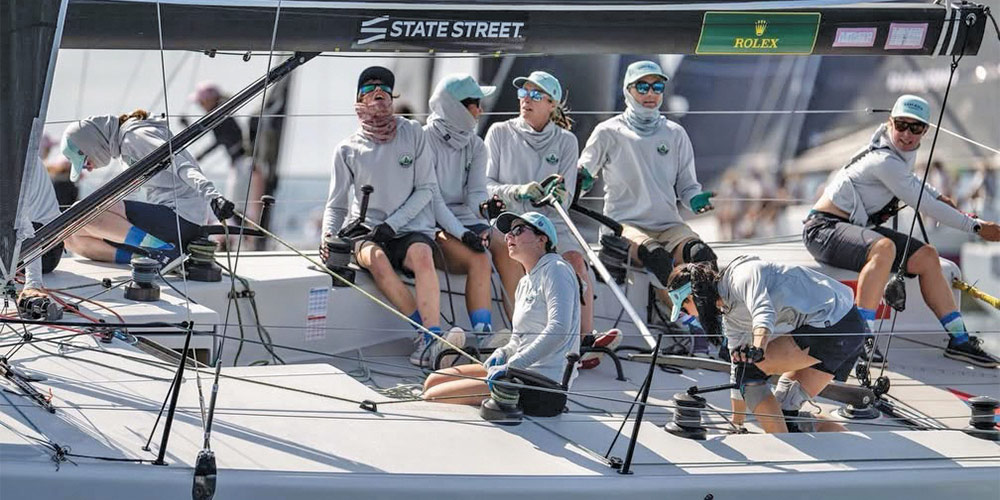
Very cool. Anything else from the coaching that felt was really useful to the whole team?
So many things. Both Ben and Steve were really good at focusing on one or two things that we could do better every day. Not trying to boil the ocean—everyone of us, even the winners, could pick 100 things that we’d all love to be better at. Not because we’re bad, that’s just life. Focusing on one or two things is not overwhelming, and it’s important to have that sense of progress and positivity.
Can you give us a specific example?
One way we drove some consistency into our starts, even when there was chaos happening around us, was by having a rhythm—getting to the committee boat first at the nine minute or the seven minute mark, but not at five or three. We’d get the cadence of our loops back. We wouldn’t sail too far away. We’re going to be at the boat end, not the pin end. We’re going to put our jib up at 13 minutes and do our final upwind.
(Chris joins the call)
In the bumpier water, one of the other things that we worked on was consistent load downwind, deciding when we were sailing to apparent wind angle—not with instruments but with feel—and when we were turning a little bit more and trimming sails. Chris and Tara worked really hard on locking in and finding that spot.
Were there any big surprises within the fleet dynamic or racing?
Chris: I don’t know that there were big surprises. The starts were super chaotic, and it was fantastic to do a few more iterations towards the end of the regatta. It was feeling better and better, but you can’t get enough of the intensity and excitement at the starts.
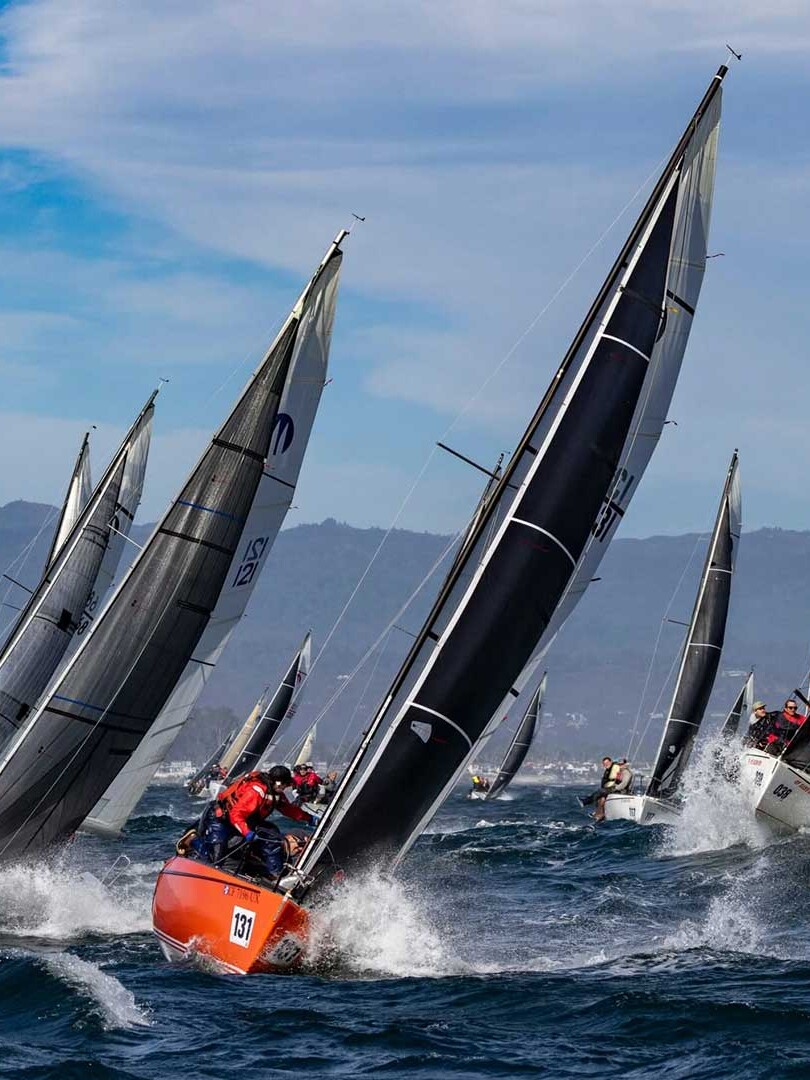
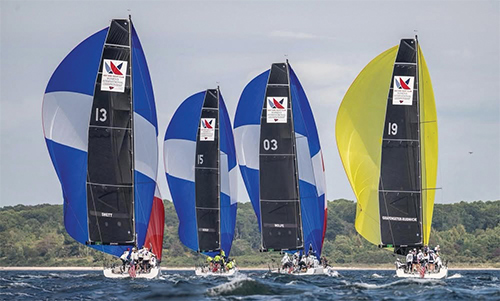
Jen: I’d say the level of competition at the event. We just did a two-lap windward leeward, pretty classic race course. The first beat was normally about 1.5 miles and, barring some sort of crazy thing, all 20 boats rounded the weather mark within a minute of each other, and most were overlapped. So that’s the level of competition, and I just think it’s super cool and I love it. We thought maybe there’d be a couple boats that were kind of a disaster or just couldn’t get the boat handling down; and there was just none of that, it was all rock stars. An Olympic gold medalist was driving the boat next to you in second-to-last—like all right, here we go.
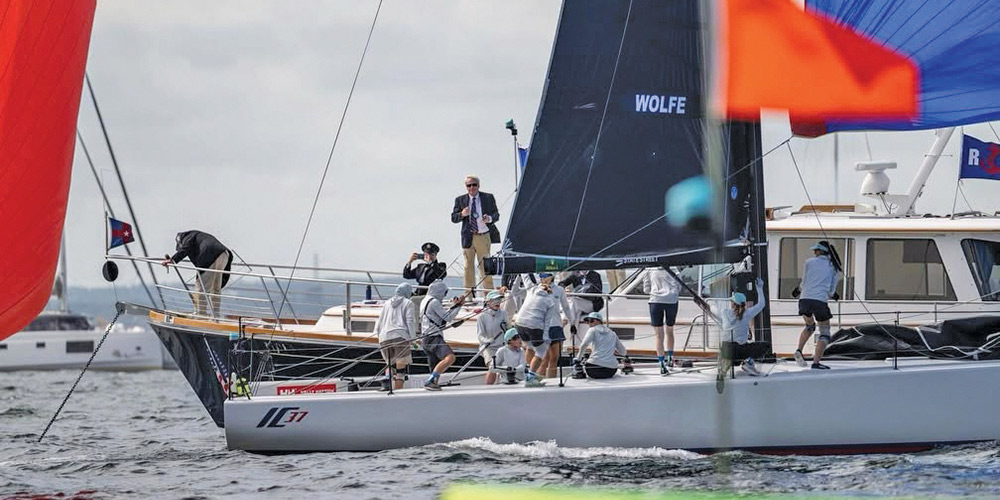
So given that context, tell us about the race that you won!
Chris: Oh man, that was such an incredible win. Driving the boat, I’m just completely focused on telltales, speed, and what everybody else is telling me is going on around me. At the front of the pack, you’re really able to sail more of your own race and I think the boat was a little bit quieter. It was a great groove to be in.
It was unique, because we kept picking off boats. It wasn’t like we got super lucky. Jen made an amazing layline call from a little bit out, and I think we picked off two boats there. The bow team was incredible, always with the hoists and the takedowns, but at that hoist being able to get into a mode where we had Katie Spithill, this amazing match racer, and then crossed [regatta winner] Megan on port. It was pretty special for us.
Jen: Yeah, it makes us really proud that, as Chris said, we didn’t bang a corner and get a lucky shift. We had a good start, and it was a little bit lighter and flatter. The team just did a great job of going fast up the first beat, and we got around the first weather mark in fifth or sixth. We went down the first run, did the thing, and then there was a geographic righty on the top we had seen in the first lap, and we knew we wanted to go that direction. I tacked in a place where I knew we might get a big righty, and we might have some positive current. We rounded the second weather mark in second, and Katie Spithill was just in front of us, and there were four boats right on our tail. They fanned out. We had come up with our term for the no-look jibe—we were calling it “snack time”—and so I was like, “Guys, I’m getting real hungry. It’s snack time.” We rolled into it. We were kind of going back and forth—we make it, we couldn’t make it. The team executed this awesome jibe and we jumped the first place boat and made it across the four boats that were trying to eat us up. Then we’re on port, pointed more or less at the finish line and we had to cross the lead team. We just made that cross.
We were slightly high and had to work with Katie down low to get to the finish line. And Chris and Tara did a great job with the driving and the kite trimming. It was awesome. The media came to us at the end and said we had the most cheering of anyone that won a single race.
Wow! What else? Lasting impressions or other big takeaways?
Chris: NYYC took the step to work with an organization that is really important to me, Sailors for the Sea. This is a non-profit that four of the women who competed had volunteered with for years, including the winner Megan, two sailors on the Aurora team, and me. Being able to spend some time in real life with some of the people I’d worked with remotely was special; and it was a real testament that NYYC was willing to certify the event as a Platinum Clean Regatta.
The opportunity to connect with other women who are doing amazing things in our sport—it’s not something you get every day. And I really think that Cory Sertl and NYYC put something together that we all get to look back on and say, “I was part of that.”
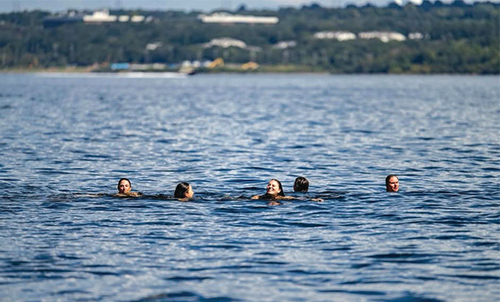
Jen: It is different with all women. There was one day where there was no wind. There was a lot of swimming in underwear. That certainly wouldn’t happen at a co-ed event. That was pretty funny.
For anyone looking at the event, you should do it. The level of competition was as high as anything else I’ve been to. There were over 30 women there who had raced in the Olympics, 14 or 15 who had raced in the America’s Cup, and about 10 that had raced around the world. To have that caliber of humans at any event, forget the gender, is really impressive. We got to see the Mighty Mary movie in the lead-up in Newport. A number of the women who sailed on the Mighty Mary team were there in person, racing in the regatta or coaching. You feel that part of the glass ceiling breaking. It was pretty magical.
Results at: nyyc.org/2026-womenschamp