The early-season North Sound classic stayed true to its name, and provided all the wild winter racing fun you’d expect, and then some!
“Did we just do Girts… or did Girts do us?” I’m not sure who asked the question first, but it quickly became the unofficial theme of the 2026 Girts Rekevics Memorial Foulweather Race. Hosted by the Anacortes Yacht Club—with the traditional post-race celebration at the San Juan Island Yacht Club put on by their awesome volunteers—this year’s race fell on February 21. From the moment racers stepped onto the docks at Cap Sante Marina that morning, it was clear that, once again, the name “Foulweather Race” wouldn’t be merely ceremonial. It was going to be wet and windy.
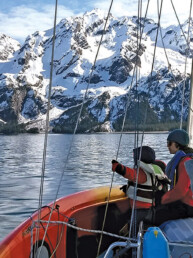
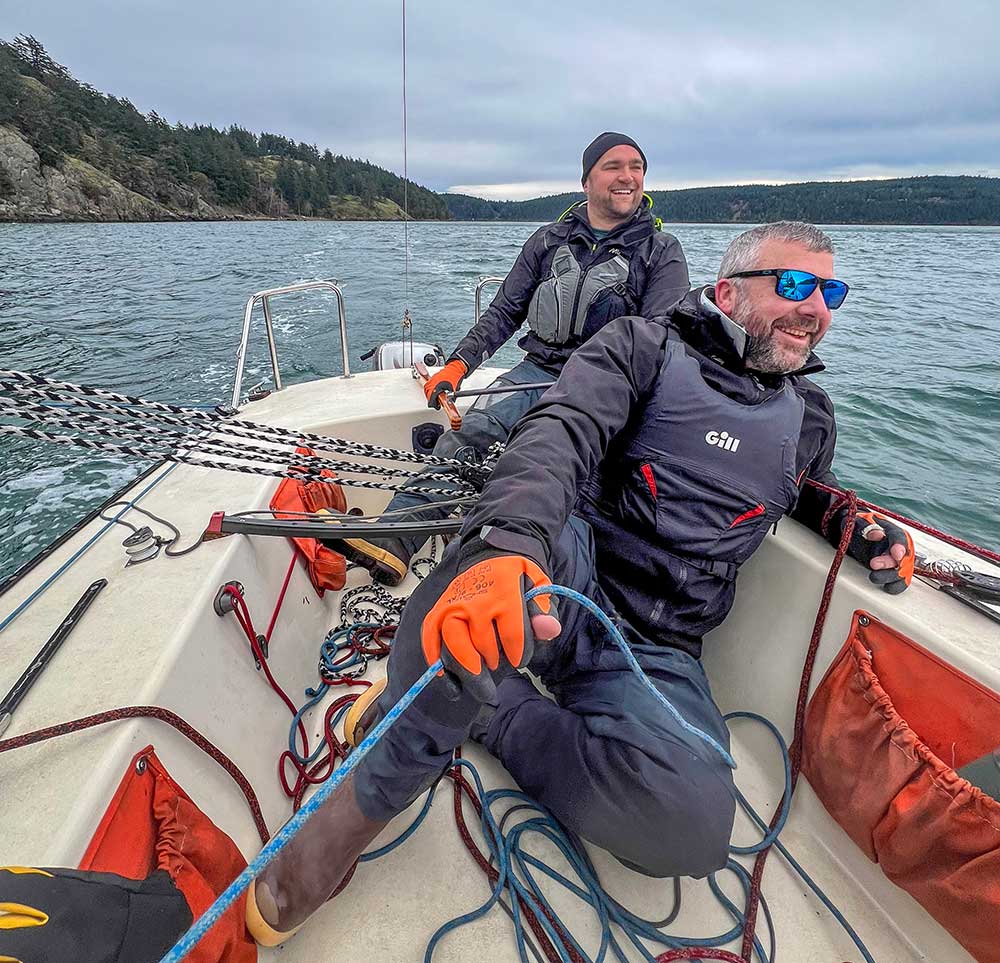
That was certainly the case aboard Hummingbird, the mighty Moore 24 I’d be racing on, skippered by Jon Anderson, with Conor Harkins and Charlie Lawrence rounding out the crew.
The signs were all there early: Forecast models had been calling for a big breeze, and the telltale plumes from the Anacortes refinery were bent at right angles while the surrounding water flashed white with breaking caps… But something about the wind direction gave us pause. Easterly?
I’ve been told to never trust an easterly in the San Juans. This year’s Girts would go on to reinforce that wisdom and provide us all with a hearty helping of white-knuckle sailing fun.
A Classic Foulweather Start
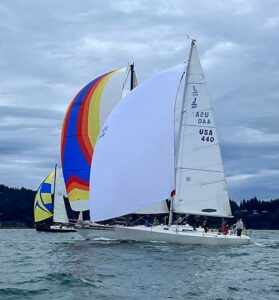
One of my favorite quirks of the Foulweather Race is the refreshingly simple start procedure: Everyone starts together at 9:30 a.m. sharp on a line set between the refinery dock and a nearby channel marker. There’s no race committee, no flags, no recalls; will the line be square? Nobody knows!
Fortunately, just before the start, the breeze clocked slightly toward the south and calmed down a bit, making the call easy—hoist the kite immediately! In colorful synchronicity, the fleet surged toward Cap Sante and rounded into Guemes Channel under spinnakers. There was a sizable ebb for most of the morning, so most boats happily positioned themselves mid-channel to ride as much of the tidal current as possible.
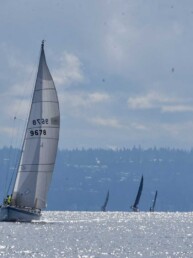
Before long, we waved farewell to some of the competitors with a heftier waterline advantage or the favorable combination of more hulls with less weight, like Mike Powell’s F-25C Makika, Nick Estvold’s Baltic 39 PANGAEA, and Bob Brunius’s J/120 Time Bandit––boats that all hold special places in my heart. As their transoms shrank in the distance, us smaller boats began sorting ourselves out while crossing Rosario Strait.
Small Boat Company
For a while, we held decent pace with Jennifer and Ben Braden’s Moore 24, More Uff Da, along with the Bradens’ former UN-30, 6 Feet Moore, sailing under Elsa Balton and Miles Johannessen’s new ownership.
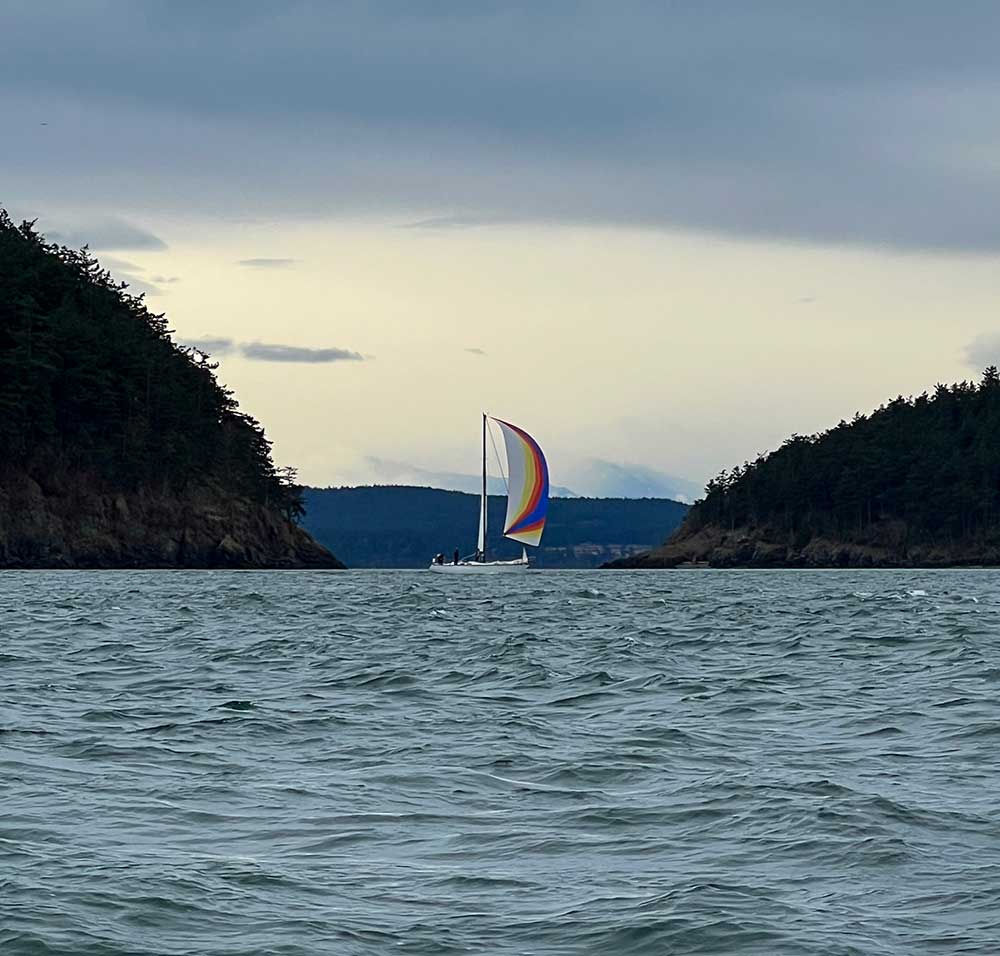
All things considered, it was a pretty tame crossing into the islands; but then we arrived at Thatcher Pass. Watching a handful of the larger coalmine canaries make impressive gains hugging the Decatur Island shoreline, we decided it might be time to try something different, something that might separate us from our fellow small boats. Needless to say, we did; and on this occasion it worked!
Winner Winner Chicken Dinner
If you’ve never rounded down (down, not up), especially on a keelboat with no lifelines, it’s quite the interesting experience.
As we entered Thatcher Pass, the breeze began to build. The wind funneled through the gap in punchy, swirly puffs that seemed to arrive from every possible direction over the transom. With the fresh, albeit chaotic breeze filling our spinnaker, and with Decatur Island rapidly growing larger, we knew a jibe was in our future. The trick was finding the right moment.
When we thought we had a window––or perhaps when we realized we were out of runway––we went for it. Somehow, during the maneuver, the spinnaker wrapped itself tightly around the forestay. On the bow, Charlie had already managed to get the new sheet into the pole’s jaw, but the wrap meant he couldn’t bring the other end to the mast. What happened next plays back in my memory like a series of snapshots.
First, I saw Charlie slipping off the bow. I grabbed what I could of his lifejacket and held him to the boat until he could regain his footing. Then, I looked up to see the spinnaker pole flying wildly, about fifteen feet in the air, suspended from the kite like a fencer’s épée… and we were its targets. “That’s not good,” Conor calmly mused. Finally, I turned aft, and saw water pouring over the gunwale and into the cockpit, so I slammed the hatch closed to prevent any from going down below.
Conor and I were able to get a hold of one of the spinnaker sheets while Charlie managed to uncleat the halyard––inconveniently located on the side of the mast closest to the water. With the halyard blown and the kite shoved unceremoniously into the companionway, Hummingbird righted herself. We immediately hoisted the #2 and turned away from Decatur to regroup. A bit wetter, a tad colder, and only moderately shaken, we continued undeterred.
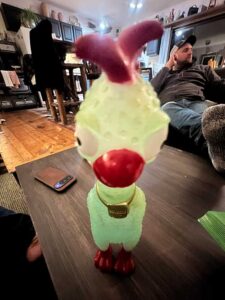
Later, over our lasagna dinner in Friday Harbor, the maneuver would earn us the unofficial award of “Earliest Broach in the Race,” along with a very prestigious—and loud—rubber chicken trophy. Winner winner, chicken dinner.
French Finish
Once we’d collected ourselves and confirmed everyone was still having fun, we decided to give the spinnaker another go. Our second kite run was also quite memorable, but for entirely different reasons.
Approaching Lopez Sound, the course effectively squeezed us into the narrow gap between Willow Island and Blakely Island, making for a particularly exciting challenge. With the ebb still pushing and the breeze building behind us, Hummingbird charged through the slot under the kite.
Sailing into Upright Channel, we’d almost caught up to the fleet, but the sailing gods had other plans. The aforementioned spinnaker halyard cleat chose this moment to play a prank on us, with the halyard working itself free and sending the kite down in spectacular fashion. We quickly scooped the kite into the companionway and took that as a suggestion from the universe that, perhaps, we’d pushed our kite luck far enough for the day.
Taking the hint, we committed to sailing the rest of the race under the #2, which, as it turned out, was probably the right call. As we worked our way through San Juan Channel, the breeze continued to build. Without the kite to worry about, the sailing actually became refreshingly straightforward––fast reaching and running, with the occasional puff and surf-able wave to remind us that the race still had plenty of bite left in it.
The fleet, however, had pulled well ahead of us. Boats that had once been nearby were now specks on the horizon… but, even from the back of the fleet, we could still make out the finish.
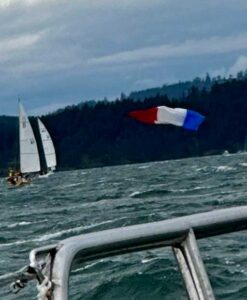
Or, rather, we could make out Stephanie Campbell’s Wild Rumpus marking it. From miles away, what stood out most was the boat’s bright red, white, and blue spinnaker flying proudly a boat-length or two ahead of the boat itself, horizontal to the water at roughly mast-height—looking remarkably like a French flag waving above the water. Intentional or not (pretty sure not), it made a perfect finish line marker for us stragglers. Oui Oui!
Smooth Sailing for Some
Despite the lively conditions, several boats managed impressively clean races. Time Bandit took top honors in PHRF 1, followed by Steve Orsini’s Beneteau First 35 Black Arrow and Jim Bottles’s First 36.7 Heron. In PHRF 2, More Uff Da secured the class win, with 6 Feet Moore and Wayne Lytle’s S2 7.9 Arturo rounding out the podium. John Gunn’s Beneteau 265 Little Annie and Scott Soes’s Catalina 34 RANGER topped out PHRF3, and Makika claimed the multihull trophy.
Meanwhile, John and Anne Bailey once again demonstrated their trademark calm and efficiency aboard the stately Burns Schooner Sir Isaac, sailing the entire course doublehanded and without incident in the shorthanded division. Some boats had clean runs, others proudly collected rubber chickens.
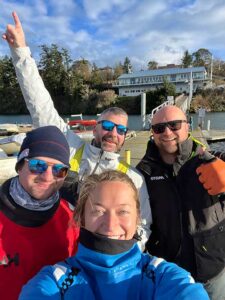
Did We Do Girts?
By the time we reached Friday Harbor, soggy and slightly humbled, the fleet was already swapping stories ashore; that’s the real magic of races like Foulweather.
While the course and the winter conditions that keep sailors honest are certainly part of the draw, it’s the shared experience of a fleet willing to show up in February, push their boats hard, and laugh about the chaos afterward that makes this event so special.
Later that evening at the San Juan Island Yacht Club, with drinks in hand and stories growing taller by the minute, one question kept resurfacing: “Did we do Girts? Or did Girts do us?” The answer, as usual, was probably a little bit of both.
Title background photo by Jennifer Braden.