If you’ve been following along on social media or through our monthly updates published in print and online by 48° North, the latest article by our skipper, Chris Wolfe, took you on a deep dive into the IC37 that we will be racing in the Women’s Invitational Championship this September hosted by New York Yacht Club. Recent articles and interviews have shared some of the team-building work that’s brought us closer together, as well as perspectives from our tactician, and updates about our training sessions.
Now, we’re taking you forward on the boat to share what life is like from the pit to the bow on the IC37—the good, the bad, and everything in between.
The front end of the boat—or as we like to call it “Adventure Land”—has some quirks that bow teams on other boats might not experience. The IC37 was designed with efficiency in mind for course racing, with each crew member on the boat playing an integral role in the execution of each maneuver. The bow team is broken up into specific jobs that must be completed at the right moment and in the right order. Our bow team consists of four regular players: pit, me (Zoe); mast, Becky Kelly; bow, Kate Sargent; and floater, Sarah Turpie. Each is responsible for specific aspects of any maneuver, but all work in concert towards the same outcome.
The pit manages halyards and the bow sprit, controlling timing during hoists and douses, while the mast person focuses on physically hoisting sails. The bow handles the jib and spinnaker forward, with the floater supporting the bow and filling in where needed. While these roles are defined, many of their jobs are small portions of the same goal and overlap constantly. For example, during a hoist, the bow might guide the spinnaker tack forward to the pole while the floater guides the head of the spinnaker into a position to avoid a snag, working together to complete the step efficiently. The bow team is required to be very process-oriented, trusting each other—and being trusted by the rest of the crew—to complete their portion of the job before moving on to the next. If that order breaks down, the result is immediate, with the team getting out of sync, maneuvers slowing down, or the spinnaker ending up in the water.
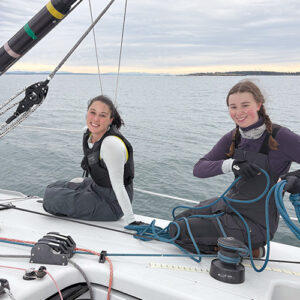
and mast crew Becky Kelly organize halyards in the pit.
The addition of the drop line, a line attached to the “belly button” of the spinnaker that runs through the hatch to the back of the boat, then back to the base of the companionway, adds another feature to be managed that other boats often don’t have. The drop line is a highly effective tool, when used properly, and a risky one if things go awry. Certain conditions need to be met for the drop line to succeed in its job: good timing, preparation, and communication. If those conditions are not met—including the synchronous release of the three corners (halyard, tack, sheet), while speed and strength is employed to haul-in the drop line, bringing the spinnaker into the boat through the hatch belly-first—then the efficacy of the drop line can revert into more of a hindrance for a douse. The drop line is normally the culprit of both “good” maneuvers, and also for those ranging from “bad” to “ugly.”
Though the influences on racing outcomes from the course environment and competitors are infinite, the actual mechanics of sailing any boat involves a limited set of controllable variables. As such, the bow team must be able to adapt and problem-solve with the available tools when issues arise. The spinnaker on the IC37 is large, meaning mistakes during jibes and sets can be catastrophic to a race. As the wind increases, the margin for error decreases, as the load on the spinnaker can become too much to manage in the case of a mistake. Rapid-fire adaptations require both accuracy and concurrent execution. A bow team that knows each other well can work at maximum efficiency and solve any adversity that might occur at the front of the boat. This is where the previously mentioned trust comes into play. The bow team has to know each other’s strengths and weaknesses so that contingency plans can be developed on the fly. Team Cascadia’s bow team has been spending a lot of their training time and regattas ironing out how to problem-solve together, a focus that will surely be a strength throughout this campaign.
In order to put all our training to the test, we delivered our IC37, Westerly, down to Seattle the weekend of April 18-19 to compete in the Puget Sound Spring Regatta (PSSR), hosted by the Corinthian Yacht Club. This regatta gave us a chance to apply what we had been working on in a race environment against other boats.
The weekend delivered exactly what we needed at this stage in our journey: a mix of valuable race experience, lots of opportunity for team building and, as always, a steep and rewarding learning curve.
On Saturday, we were treated to some beautiful, spring-like conditions, but unfortunately the wind was light and shifty, so after drifting around for a few hours with no steady breeze in the forecast, racing was canceled for the day. Still, it wasn’t time wasted. A few brief wisps of wind rolled through in the morning, giving us just enough opportunity to work on our light-air maneuvers. With Carl Buchan onboard sharing insight and guidance, we were able to take full advantage of our time on the water, and we focused on weight movement, communication, and techniques for building and maintaining speed in light conditions.
Saturday afternoon, we swapped sailing gear for T-shirts and runners and headed out for a five-mile hike through Discovery Park. It was a perfect reset, time to connect as a team off the water and recharge ahead of what we hoped would be a more promising day two.
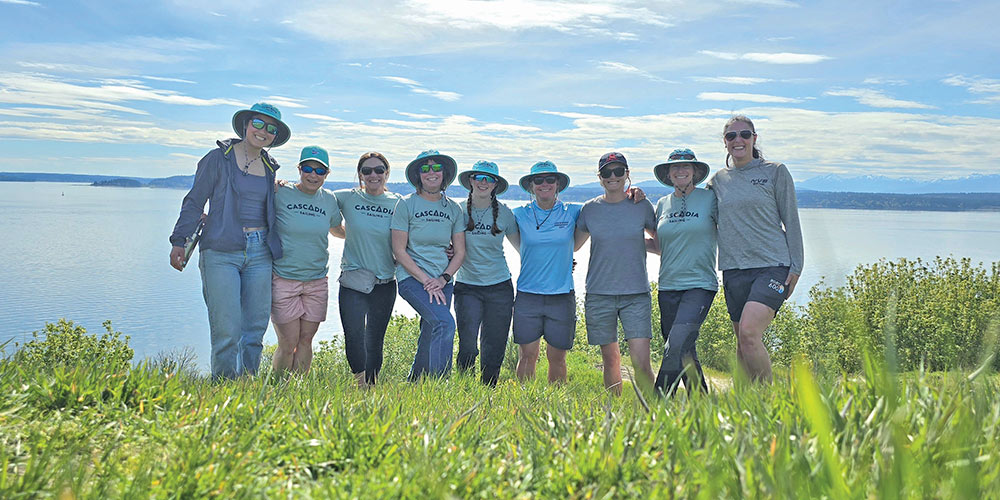
Sunday did not disappoint. We arrived at the dock to find a steady breeze already filling in across the bay. What followed was a spectacular day of racing: five races in classic champagne sailing conditions, with sunshine and a steady 12 to 15 knots, providing the perfect platform to push our performance. It would prove to be an all-hands-on-deck day in Adventure Land!
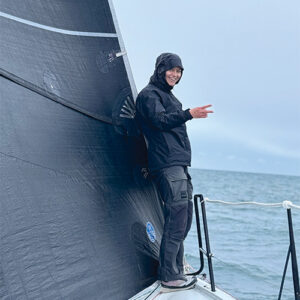
The conditions allowed us to focus on refining our bow teamwork and build confidence in more dynamic maneuvers. As previously mentioned, the success of each maneuver relies on each team member completing their specific job at the right moment. One mistake and the whole maneuver can be compromised. From jumping halyards at the mast, to managing the drop line, to pulling the kite through during jibes (or “tractoring”), every position demands a high level of athleticism, coordination, and precision.
The pit position also includes the role of “crew boss,” tying it all together and relaying key information from the back of the boat, and vice versa, as well as calling weight movement to always ensure the boat is at its optimal heeling angle. Whether it’s the call to move to windward out of a tack to flatten the boat, or quick adjustments mid-leg, that coordination is what keeps everything running smoothly. The pit also helps control the timing of hoists and douses, managing the halyard, tack, and bow sprit while adjusting the speed of the drop to keep the sail under control.
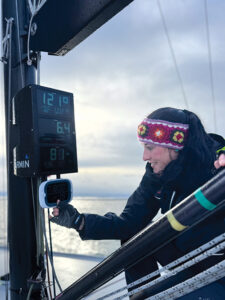
Our tactician, Jen Glass, kept us sharp throughout the day, calling for several jibe-sets at the windward mark. The repetition over five races helped solidify our teamwork on the bow and gave us a chance to work through challenges, particularly managing the drop line below and keeping it clear of the “spinnaker-eating” mast step. We definitely had a few ugly maneuvers along the way, but it gave us the reps we needed to smooth things out.
Those challenges showed up in real time. At one point, after a douse, we found the drop line on the wrong side of the kite. With no time to reset before the next maneuver, we had to fix it on the fly, using a boat hook to reroute the line and get everything back in sequence. It was not clean, but it worked, and it reinforced how quickly small setup errors can escalate, and how important it is to recover just as quickly.
On the other end of that spectrum, we also had a more controlled moment with a mid-race kite swap as the “spinnaker-eating” mast step had its day. This was not a simple three-corner swap from a bag and the entire sequence had to be completed during the upwind leg, with limited awareness of time. It meant going into the boat, derigging the old kite, rigging the new one, and rerunning the drop line, all while managing large sails and ensuring every line was led correctly. The drop line, as a fourth control line, made the setup less forgiving, with little margin for error.
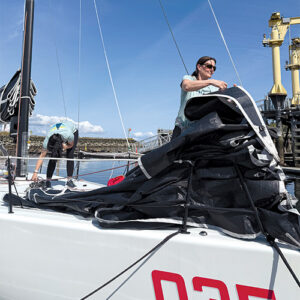
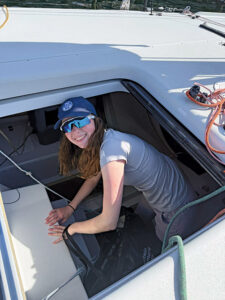
Rigging it demands a certain level of agility, as the cleat sits in the very aft, narrowest part of the port hull, turning the task into a contortionist’s exercise at the best of times, let alone in the middle of a race. While the situation came out of a messy moment, the swap was fast, controlled, and executed cleanly under pressure.
That experience carried into some of the adjustments we made throughout the day. One key adjustment was putting a crew member in charge of managing the excess drop line during the hoist, which made the whole sequence smoother with less tangles. Another refinement was assigning one person to “tractor” the spinnaker through the jibes. With one person dedicated to pulling the kite around, the rest of the bow team could stay focused on timing and weight movement. The result was a noticeably smoother, more controlled transition through each maneuver.
On Sunday, we were joined by Jonathan McKee, whose input helped us further refine both our maneuvers and our onboard communication. His approach was simple: less is best. We focused on keeping the boat quiet, with clear, concise calls focused only on the information needed to execute each maneuver. It was a subtle shift, but one that made an immediate difference in our timing and overall flow.
PSSR allowed us to take a strong step forward. We were happy to come away with the win in our division, but the more important outcome was how much we improved as a team over the course of the day. By the final races, maneuvers were more controlled, communication was clearer, and the team was working in sync.
The regatta reinforced that success on the bow is less about any one role and more about how well the team functions together. It’s a collective effort. As we continue toward the Championship, the focus will be on building consistency and continuing to refine how we move and communicate as a unit.
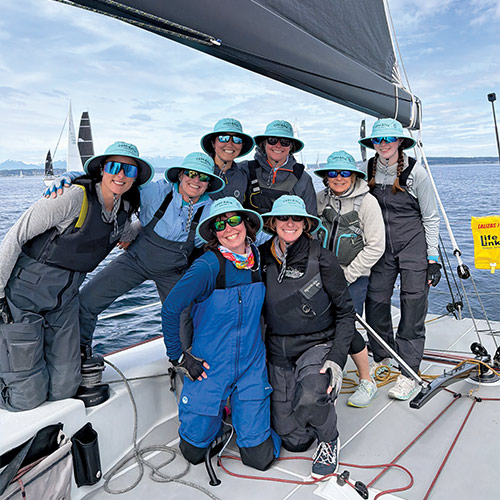
Cascadia Sailing continues their fundraising effort with an ultimate goal of $120,000, helping fund top-level coaching before and at the event, team travel, and participation in a lead-up NYYC regatta on a chartered IC37 in July. Learn more and contribute to the team’s exciting endeavor at: www.cascadiasailing.org