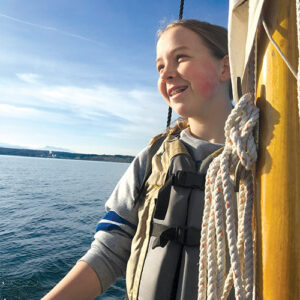
 Emilia Ramsey is the 21-year-old steward of the 26-foot 1905 clinker-built double-ender, Dorjun. Her arc with the boat began nearly a decade ago and the two weave a remarkable story of connection, learning, and care—the launching of a maritime career and relaunching of a vessel that is as storied as it is beloved.
One fine spring morning, much like the one today, as I weaved in and out of the soft melodies I had gone to sleep with the night before, and while no blasts of breakfast bugles had yet blown their brassy horns across the scented lawn outside my bedroom window, and while breakfast was just beginning its sinuous path across the sun-bathed kitchen floor and down the hall to my room, I woke up to a dream. In it, there was a boat, and she was waiting for me, floating oh so tenderly in her slip. Her gaff rigging freshly tallowed, her decking newly painted Seattle Grey, with varnished rope-stropped blocks, and rigging lines freshly served and parceled. The hull was perfectly planked lapstrake in Alaskan Yellow Cedar and painted white with a touch of forest green, and she had a wide raised deck forward with a cuddy cabin ample for sleeping two and feeding six, and a vast cockpit that could sleep another four. Every line, every sweep of her sweet contours were so exquisitely balanced they seemed to be singing to me, telling me like a seabird that can’t contain its utter joy except to say exultantly in chords ascending, “Come aboard, and be quick about it!”
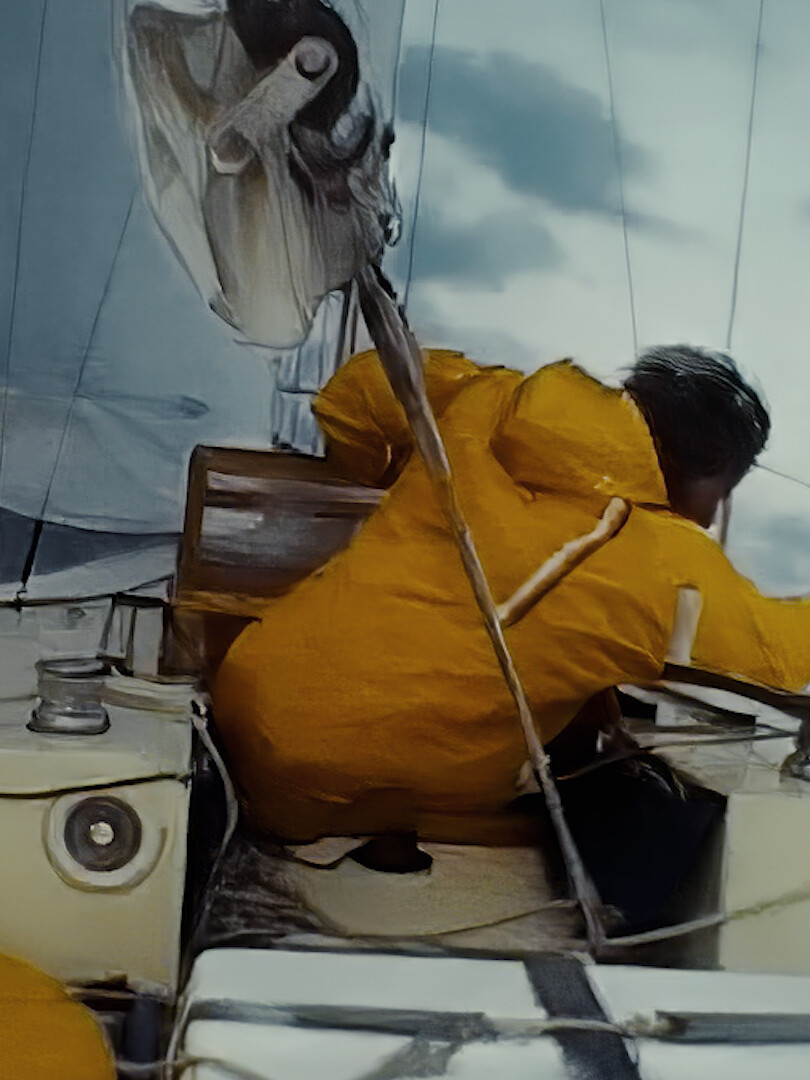
I had seen her months before, at the start of my senior year in high school, hauled out at Port Townsend’s Northwest Maritime Center, up on a trailer. Dorjun, a 1905 wooden surfboat-turned-gaff rig sloop, who gained her steady confidence from rounding Cape Horn in 1933 with legendary explorer Amos Burg; a voyage documented in National Geographic a few years later. Dorjun put that confidence to good use in her decades of service as an educational vessel, instilling a love for adventure in young hearts.
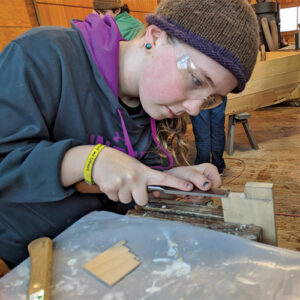
There on the trailer, she showed the honest wear of her years, the kind that needed steady hands, and many of them. Still, she sat there, ever-regal; her quiet resilience shining through. She carries the accumulated memory of every builder, sailor, restorer, and dreamer who ever touched her. Seeing her stirred within me childhood memories of being aboard her with my peers in Northwest Maritime’s Girls Boat Project.
I stood there and remembered the warm glow of her cabin, the light pouring through her foc’sle hatch, my friend Chloe sounding an old bugle as we exited Point Hudson and began what had been my first sailing adventure.
A few days after seeing her there, I asked my teacher and dear mentor Chrissy McLean what was going on with Dorjun. She gave a warm smile and said, “Yeah… she’s going to need some serious love and care.” While I didn’t say anything out loud, I had the thought, “Maybe I could do it…I would learn so much.” It felt like a wild idea at the time, yet it tucked itself somewhere in the back of my mind.
When I read that Dorjun was for sale in late February, I thought of all the reasons I couldn’t take her on. The restorative work, the regular maintenance, the sheer level of responsibility… it was a compelling list! But my years in various maritime programs had instilled in me an understanding of how capable I was and, also, a desire to view challenges not as things to avoid, but as things that could shape me. Although I was preparing to go to university, I’d been wrestling with feelings that I was leaving my maritime community too soon. There were still so many things I wanted to learn and people that I wanted to learn from and alongside.
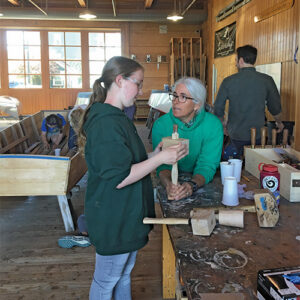
Something was shifting in me and a vision was coming into focus. I wanted to help Dorjun continue her work as a boat who teaches, inspires, and connects people. Dorjun had been an educational vessel; a place where young people learned who they were and what they could do.
I wanted to restore Dorjun to her former, sparkling glory with the help of young people. It felt like a way for us to give something back to her. I felt this deep pull, almost like a responsibility but also a privilege: the sense that we could help carry her forward into her next chapter.
The vision included my peers, particularly those at the OCEAN K-12 School. We had worked together so fluidly in maritime programs that it felt like we could take on almost anything when we were united. I saw this as an exciting opportunity for us to work together, to learn together.
On a personal level, I wanted to advance my skills working on wooden boats, to move from being a student in maritime programs to someone who could take responsibility for a vessel. I wanted to learn how to shape a project with my own hands and judgment, and to understand the craft at a deeper level. I wanted to deepen my connections to the community. And I wanted to sharpen my communication skills, my ability to organize people, my executive function, and resourcefulness.
And then there was Dorjun herself. My vision was, and is, to have her in my life indefinitely. Her soul feels like home.
All of these pieces came together in this one vision. It felt like the universe was offering me an opportunity that would shape me and expand my world in ways I’d dreamed of. To decline it, to pack up and head to university right away, would be to limit myself.
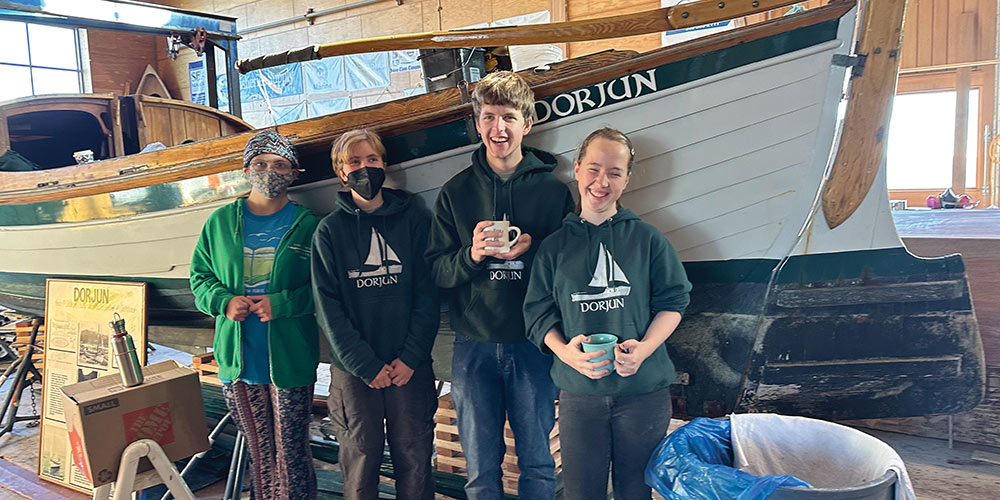
So I met with boatshop manager Joel Arrington and we looked through Dorjun—her frames, planks, varnish; every place where time had left its mark. My next step was to draft a project plan where I documented all of Dorjun’s needs, and what a commitment to her would look like. And that’s when I fully realized—this was a commitment I was ready to keep.
It was two weeks before my high school graduation when I officially adopted Dorjun, and I spent that summer connecting with her history, consulting with those who knew her best, gathering supplies, and planning the work ahead. Before I knew it, September had arrived, and the student volunteers and I experienced our first Wooden Boat Festival as Dorjun’s crew.
I met so many people who had known Dorjun over the years. Some had sailed her decades ago. Some had repaired her. Some had even known Amos Burg or had stories passed down from those who did. Each conversation felt like being handed a glowing fragment of her history. I knew when I adopted Dorjun that I would not just be preserving a boat, but also her legacy. I knew that I was stepping into a lineage of care. But I didn’t know just how large her extended family was. Connecting with them has been one of the most meaningful experiences of my life.
Soon after the festival, it was time for her haulout to the beloved boatshop where I had made my first bevel gauge years before.
A boatshop is a working place. Its purpose is to get you to want to work. How could one possibly behold its scaffolds and furniture and assortments of pungent glues and mastics, thickeners and thinners, adhesives and sealants, as well as the latest in machine cutting and shaping tools, all standing in delirious profusion at your fingertips, and somehow resist working? The first thing you notice is your hands stop twitching, and come out of their pockets.
When you’re in a boatshop everything becomes the boatshop. The world outside starts to become evanescent. What remains is the work before you, and the sounds from the others in the shop around you. There is a sense of camaraderie, of sister and brotherhood, that is very peaceful and satisfying. It’s like everybody in the shop is engaged in the small art, not of model boatbuilding, but of model worldbuilding; and there is a quiet undercurrent of excitement that all present, all working separately—yet, significantly, interdependently—on their own private cosmos, can feel. The act of creation is palpable, and you can see it for what it is in the calm faces of the craftspeople as they take their journey of discovery inward.
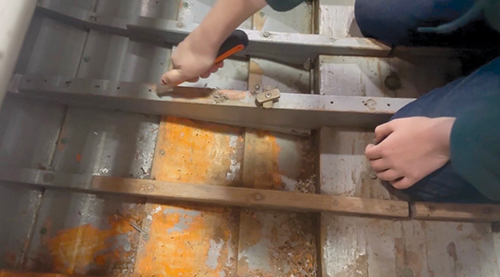
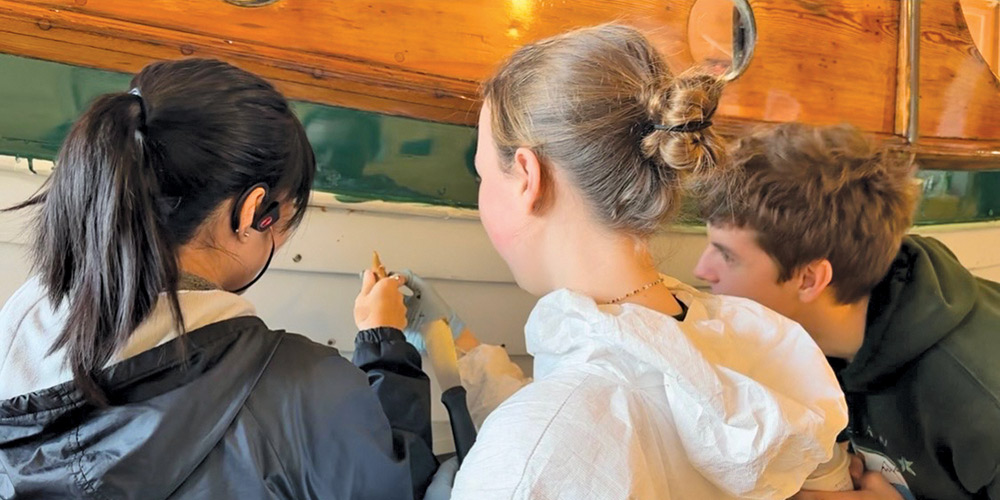
Our first task was to take out Dorjun’s aft seating, so we could access the full belly of the cockpit, removing a seemingly infinite number of stripped fasteners along the way. Darn those bronze squareheads! Victory against them was sweet. Our next task was also a test in patience and resolve—scraping and sanding the bilge down to bare wood. Later, we put 74 new rivets into her hull to reduce the water she took on. We painted, oiled, and varnished the entire boat, removing years of sun damage. Every task was a lesson. Every lesson was a step forward. The hardest part wasn’t the physical work—it was the project management. Timing everything out. Sequencing tasks. Tracking supplies. Knowing how many hands each job required. Understanding options and choosing the best methods. I was learning at every moment. I was learning how to lead, how to listen, how to make decisions that mattered.
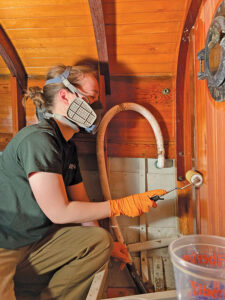
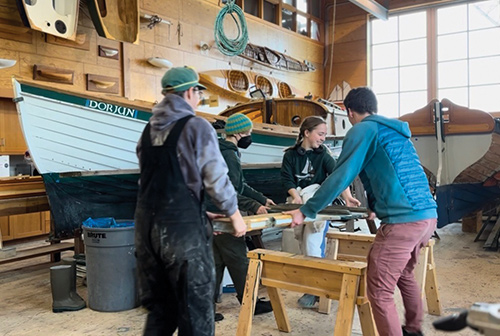
To work with such phenomenal young people is a joy like no other. Crewmembers Willow and Gabe were right there next to me on many late nights in the boatshop. Violet always brought her effervescence, her sense of humor, and even showed up with a sea shanty she’d written for our crew, performing it for us in the shop. Eva’s quiet confidence was a grounding force for us all. There were so many other young people, adult volunteers, and a few living legends who gave their time and lent their skills and knowledge.
After months inside, we finished our work by oiling her handrails, re-installing her nubby bowsprit, and carefully painting her canvas decking. With the help of mentors, a new bilge pump system was installed and a new tabernacle and forestay were created.
Dorjun’s long awaited splash day finally arrived, and I was hopeful that with her new rivets, she wouldn’t take on as much water as she had in the past, but I wore my wellies just in case. Friends, family, and many others from the maritime community joined us in the wet, windy weather for her launch. After being lowered into the water, she was held there for a time so that I could monitor her water levels. Much to my excitement, the rivets helped immensely; she took on very little water, so we battled the wind and got her to her slip. As a crew, we were eager to begin journeying under sail, but it would have to wait.
Until…
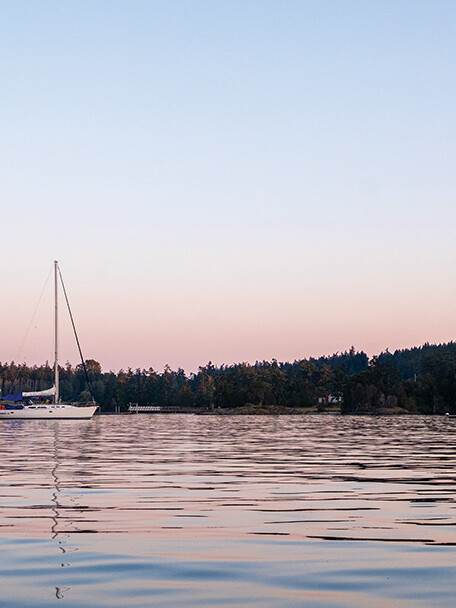
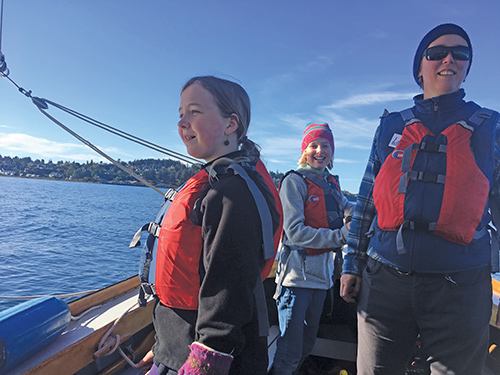
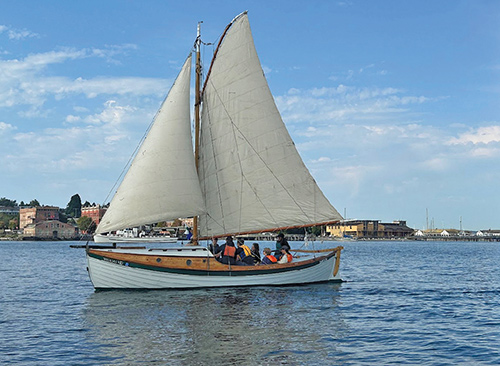
One fine spring morning, much like the one today, with sun splashing over the bay, a few clouds drifting, and just the right wind, my crew and I took Dorjun out for our first sail together. I was at the tiller, the crew was gathered in the cockpit. The mainsail filled slowly, like breath returning after a long sleep. Her centerboard tracked straight and true, slicing silently through the water like the nose cone of a narwhal diving for halibut. She floated on her lines, and she carried her way with the humble composure of a great queen. Dorjun heeled gently, coming alive beneath my hands—I eased the tiller, held her steady, looked at my crew, then up at the sunlit canvas glowing above us. Awe, joy, pride, and belonging washed through me all at once.
Looking back, it’s jarring to think of what I would’ve missed out on if I had said no to Dorjun. As that high school senior, I was worried about being swept into a new direction without knowing what I wanted to carry forward. Dorjun gave me the opportunity to keep learning, and to put this part of my life into focus. She inspired me to go to the Northwest School of Wooden Boatbuilding to strengthen my ability to meet her needs long-term, and also to grow further into who I was becoming. I’ve come to the realization that wooden boats and maritime education aren’t just things I love—they’re part of the life I want to build. Dorjun helped me see the shape of my own future.
Amos Burg cared deeply about exploring the natural world, connecting with people, and following and sharing his passions—and Dorjun has similarly inspired confidence, a sense of peace and oneness with the natural world, and a love for adventure in so many young people. As Dorjun and I voyage toward our shared horizons, she will continue this work and legacy for many years to come.
Emilia Ramsey is a resident of Port Townsend, where Dorjun is moored. She is a graduate of the OCEAN K-12 School and the Northwest School of Wooden Boatbuilding. Currently, she works as a paraeducator at the Port Townsend Maritime Academy. Look for Emilia and Dorjun at the 2026 Wooden Boat Festival.