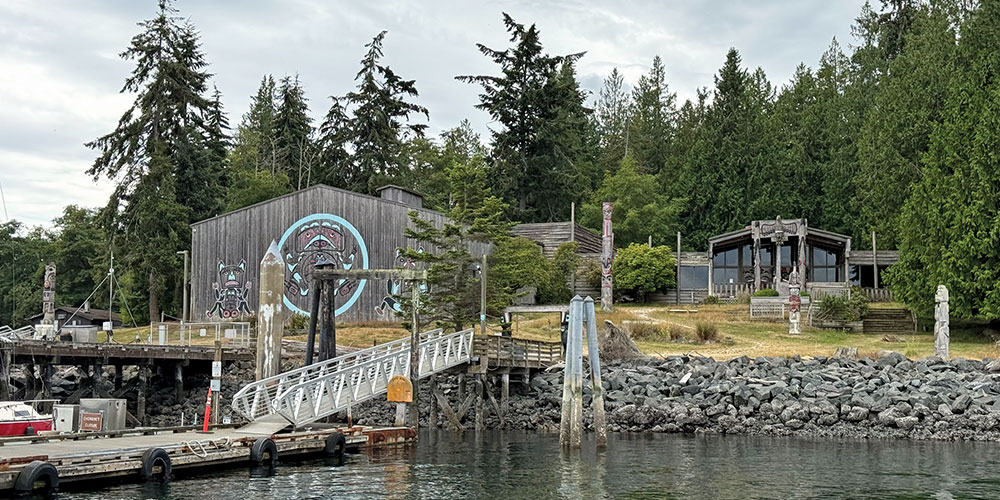
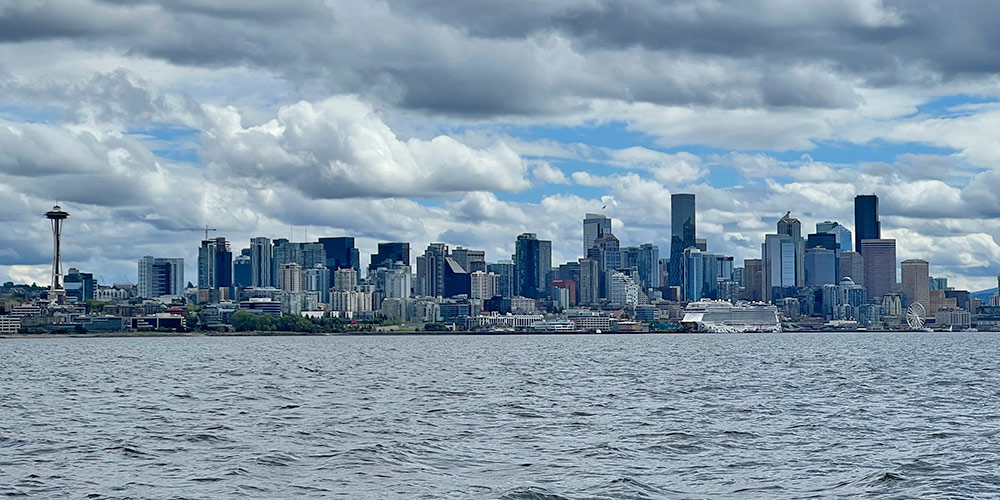
Like many visitors, I first came to Blake Island on a commercial boat. A short run from the Seattle waterfront brought the vessel to a landing, where hundreds of passengers were greeted with clam appetizers. We then filed into a longhouse for an alder-fire salmon bake and Indigenous cultural show featuring masked dancers and storytelling. Afterward, passengers could walk the trail that circled the island before boarding the boat for the trip home.
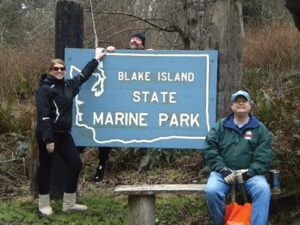
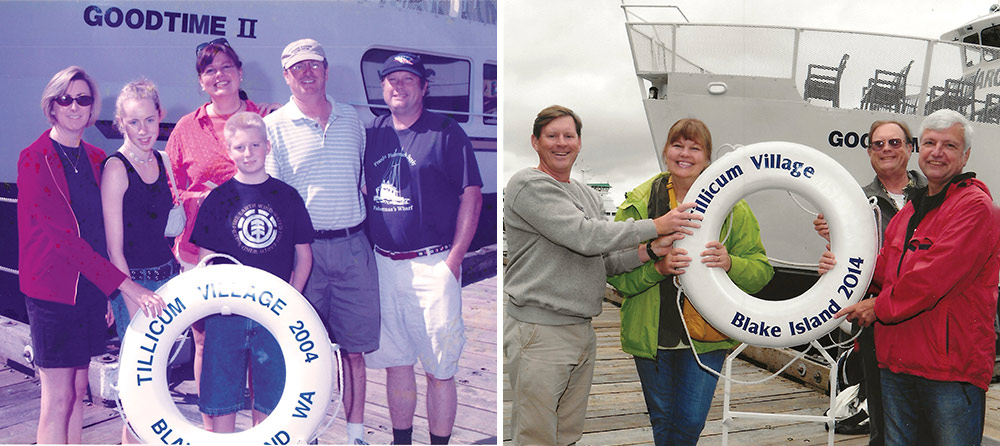
Over the years, my husband Frank and I brought many groups of relatives and friends unfamiliar with Seattle on this trip, giving them a taste of local cuisine and a chance to see the gleaming city skyline from the water. To this day, a line of photographs in my office documents our various voyages, operated first by Seattle Harbor Tours, then Argosy, each one stamped with a date. Looking at them now brings back memories of people and different times in my life, viewed from the same setting and identical poses. “It was a rite of passage,” one of my friends commented, remembering how he introduced his kids and grandkids to Blake Island over the years.
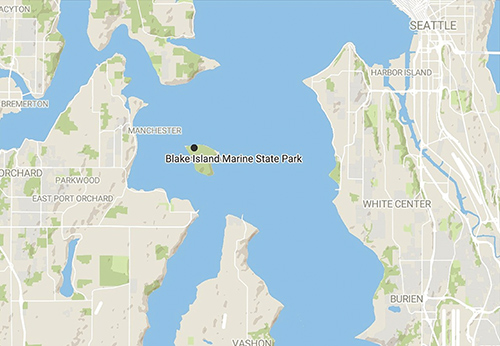
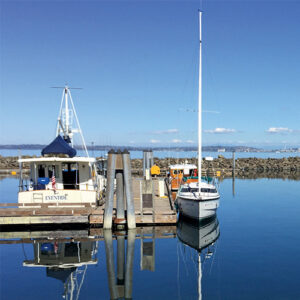
Frank and I understood that this was an experience created for tourists. Even so, there was something magical about being so close to a densely urban development—downtown Seattle is easily visible from a northeastern beach—yet immersed in a world of trees, water, and wildlife. While Blake Island lies only six nautical miles from Seattle, it feels like a different world. And on one of our trips, we noticed a set of docks with various private vessels. We both had the same thought: we could bring our MacGregor 26x, Murrelet, here.
Time Passages
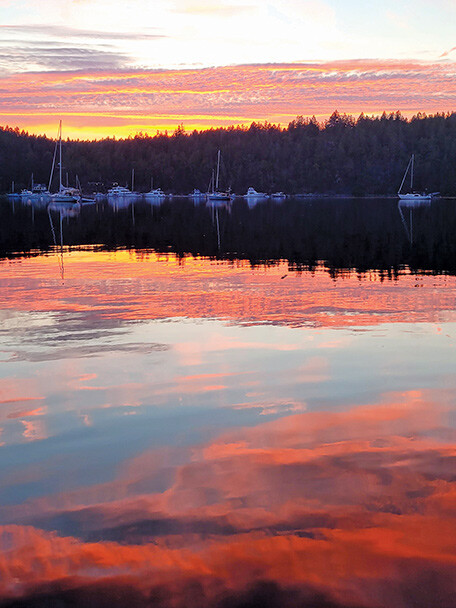
Through the decades, Frank and I sailed Murrelet to Blake Island more times than I can count, sometimes tying up at the docks and other times taking a buoy. Yet I recall our first overnight stay vividly, especially how we reveled in the stillness and space when the bustling crowds left for the evening. The quiet chatter of boaters and nearby campers did not detract from the sounds of birds and wind rustling through the trees. Deer trod softly around the buildings near the landing, while raccoons foraged through the grass and shrubs in an era long before Jimothy. I saw my first Pileated woodpecker as I walked the trail alone around the island, surrounded by forests of Douglas firs, cedars, and madronas, their orange-red bark still visible in the twilight. For several minutes, he flew ahead of me, stopping until I caught up, as though leading the way. I could not believe my good fortune.
Years later, Frank and I took another memorable trip to Blake Island in his sister’s boat: a brand-new Outbound 46. Our overnight stay was the vessel’s maiden voyage, and we devoted much of our time exploring the unfamiliar navigation systems and interior features while planning future trips. For us, it was a time of excitement and possibilities, made even more special by the setting. The boat was so new the name Ahelani had not yet been applied to the hull, and we experimented with different fonts and name positioning at the Blake Island dock. On our way back to Seattle the next day, we were boarded by the US Coast Guard (for the first and only time in all my years boating in the Salish Sea). Incredibly, they tied up alongside us while we were under sail, and I remember struggling to help Frank lower the massive, heavy canvas quickly while his sister and her husband explained why this fancy new boat was flying across Puget Sound without a name or identification.
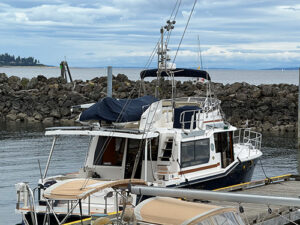
Frank and I took our most recent trip to Blake Island a few weeks ago, with friends from our yacht club. Their Ranger Tug 43CB Andiamo, which we boarded at Elliott Bay Marina, made this our most comfortable voyage.
Blake Island can be reached only by boat, and the trip from Seattle, however short, reminds us how everything in the Salish Sea is connected by water through an intertwining system of marine highways. It’s more than scenery that makes this voyage appealing; it’s the transition from a metropolis to a natural place that evokes an earlier time in our region’s collective memory as well as in our personal lives.
As I looked back at the receding skyscrapers, the lyrics of the old Al Stewart song called “Time Passages” came to me. “Well I’m not the kind to live in the past, the years run too short and the days too fast,” the song explains. “It’s just now and then my line gets cast into these time passages,” because “there’s something back there that you left behind.” Once you “hear the echoes” you’ll feel yourself “starting to turn,” while “years go falling in the fading light.”
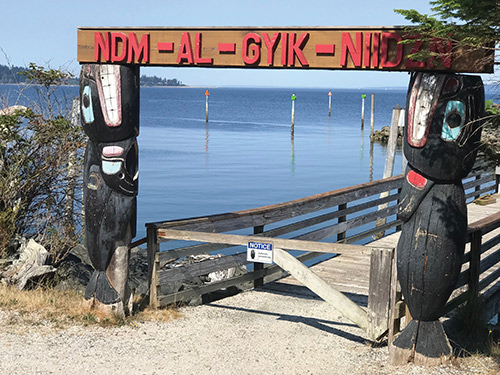
A marina host helped us dock when we reached the island and within minutes a state park ranger greeted our crew, confirming that we could tie up briefly and explore the island without paying an overnight fee. Everywhere I looked suggested something from the region’s past or my own personal history. That’s where the salmon bakes were held, I thought as I walked along a path, and where President Clinton presided over a historic summit. And that’s the tree my sister propped herself against with a book one afternoon, declining to hike with the group. How I envied her! There is the grove where I followed the Pileated woodpecker, and here is the cove where Frank’s father and niece went swimming, both hardy souls from California, becoming family legends for braving the cold water. While all places have a history and many are potential sources of nostalgia, Blake Island must inspire a wellspring of reminiscence, given the large number of visitors over the years.
Island Tales and Forest Trails
Blake Island (Ta’tcu) lies within the traditional territory of the Suquamish Nation, which used it as a summer camp. For thousands of years, Indigenous peoples harvested ling cod and crab in the island’s waters and dug clams on its beaches. According to Suquamish oral tradition, Blake Island was the birthplace of Chief Seattle (Si’ahl), a Suquamish and Duwamish leader for whom the city was named. Born around 1786, he was still alive when the American explorer Charles Wilkes sailed past the island in 1841, naming it for George Smith Blake, the officer in charge of the US Coast Survey.
During the nineteenth and early twentieth centuries, locals called it “Smuggler’s Island.” Located just southwest of Seattle, its hidden beaches and secluded coves enticed bootleggers needing a stopover during their hauls of illegal booze from Canada during Prohibition. [See “Rum Running in the San Juan Islands,” from the August 2024 edition of 48° North for a description of smuggling operations in the Salish Sea: 48north.com/lifestyle/rum-running-in-the-san-juan-islands]
During the early twentieth century, Blake Island attracted the attention of William Pitt Trimble, a wealthy real estate developer with a knack for promoting and selling shoreline properties. He and his wife Cassandra (“Cannie”) Ford Trimble, yachters who enjoyed exploring potential properties by boat, fell under Blake Island’s spell, purchasing acreage in 1905. They constructed an estate that included a large two-story house, tennis court, dock, and caretakers’ quarters. While William commuted by boat to downtown Seattle to attend to his business interests, Cannie raised their five children and planted a formal garden of vegetables and flowers. Together, the couple hosted elegant parties at the island, inviting dignitaries from the city. Cannie drowned in 1929 when her car plunged into the water at the Seattle waterfront, and the family left the Blake Island property soon after. The house burned in the late 1940s. To this day, remnants of foundations are visible near the waterfront on the east side of the island.
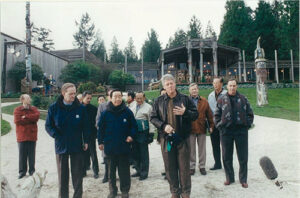
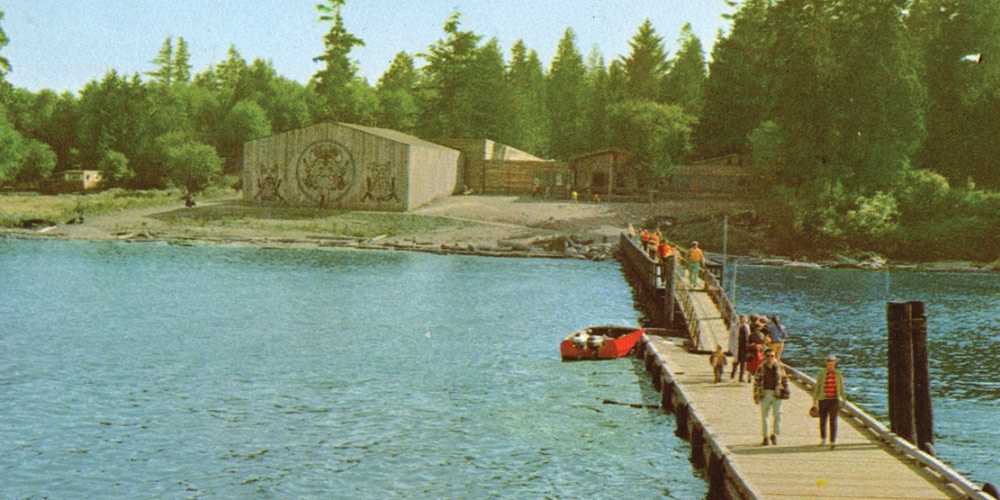
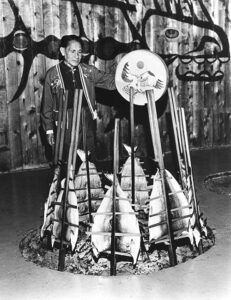
The entire island became a state park in 1959. Inspired by the Seattle World’s Fair in 1962, William S. “Bill” Hewitt, under a concession lease with the state, developed Tillicum Village, meaning “friendly people” in Chinook Jargon. An experience as well as a place, Tillicum Village featured a replica cedar longhouse, traditional salmon cooked on cedar stakes over open alder wood fires, and Indigenous storytelling and dances. Starting in 1962, passengers to the island arrived by commercial ferries. Notable visitors included King Olaf V of Norway and President Bill Clinton, who assembled leaders from 13 Pacific Rim nations for the Asia-Pacific Economic Cooperation (APEC) conference to meet in the longhouse in 1993. The following year, Argosy Cruises took over the operations for Tillicum Village.
During peak years, Tillicum Village welcomed 80,000–100,000 visitors annually. Don Holmes, whose family served as caretakers on Blake Island during the early twentieth century, fondly recalled boating, swimming, and beachcombing on the island as a youth. “Remember when you are visiting Tillicum Village,” he said, “you will be walking in the same area on the island where I spent a lot of time when I was your age.” [Don Holmes, “Boyhood Memories of Blake Island,” Yukon Harbor Historical Society, n.d.] His words suggest the layers of stories and memories found around every corner of Blake Island.
What Comes Next?
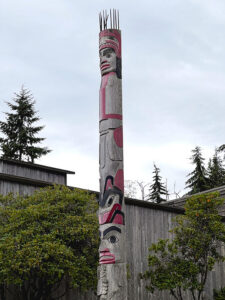
It was the end of an era when Argosy closed Tillicum Village in 2021, citing loss of revenue during the Covid-19 pandemic. Critics suggested that the show had run its course anyway, noting that it combined elements of Indigenous heritage in a misleading, inauthentic manner. Rather than focusing on Blake Island, the show featured several distinct Northwest Coast cultures, including the Kwakwaka’wakw and Haida of British Columbia and the Tlingit of Southeast Alaska. Perhaps the sensitivity and sophistication of the audience had changed in recent years, reducing the appeal of packaged storytelling and dances.
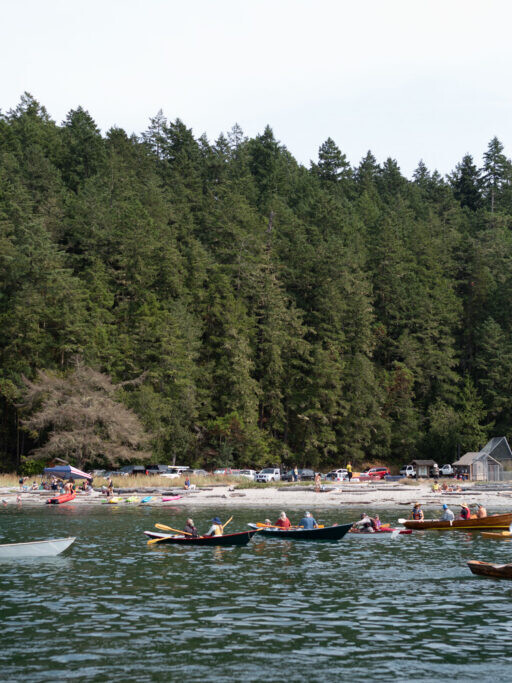
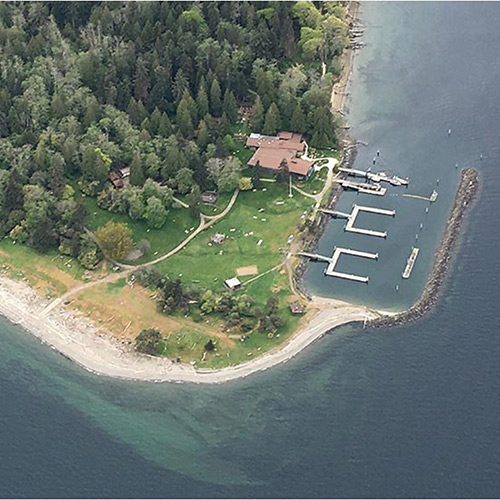
Today, Blake Island Marine State Park remains open to private boats, offering dock space, buoys, campsites, and showers. The forested trails are still there, along with five miles of undeveloped shoreline. As my friend’s boat Andiamo circled the island a few weeks ago, we noticed several vessels on the west side of the island. Kids splashed in the water while a flotilla of paddleboards and kayaks launched from the beach. Clearly memories continue to be made here.
State park officials are currently considering four options for Blake Island’s future, including “back to nature” and “rustic retreat” choices as well as a potential expansion of infrastructure to maximize recreational opportunities. By July 2026 around 5,000 people had weighed in. “I think it’s very clear that this park is a very important place to a lot of people,” Washington State Parks Planner Alexandra Sullivan observed. [Tom Banse, “Storied WA State Park in Central Puget Sound at a Crossroads,” My Edmonds News, July 11, 2026]
Whatever direction is decided for the future of Blake Island, this author hopes it will retain its natural as well as spiritual character, ensuring that visitors can continue to connect with the land, water, and stories of this beloved place.
Lisa Mighetto is a historian and sailor residing in Seattle.
For more information on Blake Island, see: https://parks.wa.gov/find-parks/state-parks/blake-island-marine-state-park
For information on the planning process for the marine state park, see: https://parks.wa.gov/about/strategic-planning-projects-public-input/projects/blake-island-marine-state-park-master-planning-0