Ask any experienced cruiser what they carry for self-sufficiency and they’ll talk about impellers, belts, zincs, and hose clamps. That kind of mechanical preparedness is drilled into us from day one, and for good reason. But so much of what keeps a modern boat running isn’t mechanical anymore, and the failures that cut cruises short have quietly shifted in the same direction. A lot of what I troubleshoot for customers these days is systems or is data-related and, in many cases, it comes down to not having the right parts or tools aboard to fix it on the spot. Here’s what I’d put in a digital spares kit before heading out for the season.
The Diagnostic Duo
Every boat should have a multimeter and, if you’re reading this column, you probably do. But most cruisers I talk to don’t own a DC clamp meter, and that’s the tool that actually helps you trace down more complex issues. A clamp meter measures current by clamping around a wire without breaking the circuit. That means you can go hunting for a parasitic draw while the boat is still powered up, check whether your alternator is actually putting out what it should, or verify the real load on a circuit without pulling anything apart. A good Fluke or Klein model runs around $150 and is one of the most useful tools I carry aboard my steel trawler, Aruna.
NMEA 2000 First Aid
NMEA 2000 networks are great until they’re not, and when they go down they tend to affect your ability to navigate safely. In most cases, the culprit is a single device that’s gone bad and is dragging down the whole backbone. The fix involves isolating the failed element, but you need the right parts on hand to do that at anchor.
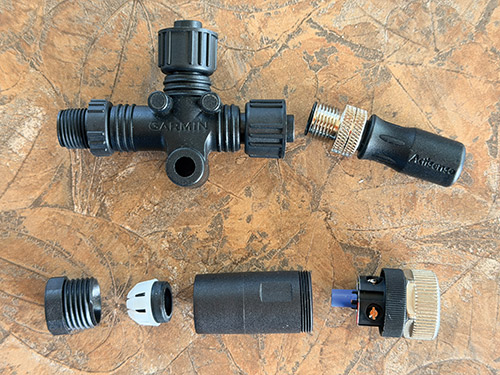
A small bag with a spare drop cable, field-attachable connector, two spare terminators (one for each end) and a T-connector will handle most of what can go wrong with an N2K backbone. Those few parts let you fix a flakey connection, restore the bus, and get back underway. Without them, a single bad transducer or display can leave you running blind for the rest of the trip. These parts are cheap and weigh almost nothing. There’s no good reason not to have them.
Physical Connections Done Right
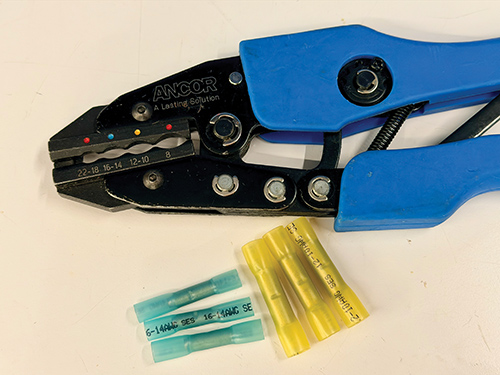
If you’re still reaching for electrical tape when something needs fixing aboard, it’s time to upgrade your repair kit. Heat-shrink butt connectors and a good ratcheting crimper give you a waterproof, mechanically solid connection that will actually hold up in a marine environment. They’re not hard to use and they make a real difference in the longevity of any repair you do underway. Make sure your crimpers are appropriate for heat shrink—many standard double crimp sets will damage the heat shrink. You’ll also want a heat gun so you can finish the connection by melting that heat shrink correctly around the wire.
For fuses, carry the ones you can’t buy at a marina. Blade fuses are everywhere. MEGA, ANL, and Class-T fuses—the ones protecting your high-current DC runs, inverter output, and alternator circuits—are a different story. I’ve had clients stuck because a high-current fuse blew in a remote anchorage and there was simply no replacement to be found. A handful of spares in the right sizes costs less than the stress from being hobbled.
Digital Manuals and Logging
This is the one people skip because it feels less tangible, but it’s saved me on more than one occasion. Put a ruggedized USB drive aboard with offline copies of every manual for every system on your boat. Then add the exported configuration files for your critical equipment like inverters, router, etc. Having these files on a computer or cloud drive is great for every day use, but if you have a significant failure, having them on a USB stick could be a huge time saver.
I also keep a series of documents on that drive with non-obvious settings, configuration notes, and the kind of hard-won details I’d otherwise have to dig through old emails or forum posts to find. Serial numbers, warranty info, the setting that took three hours to figure out the first time. The goal is that if something fails in a remote anchorage, I can fix it without needing to remember anything or have an internet connection to look it up.
Backup Connectivity
Starlink has become the go-to for connectivity afloat, and for good reason, but it’s a single point of failure in a way that’s easy to overlook. The service has outages like any other but, more importantly, if the hardware itself fails you have nothing. A cellular router with an appropriate data plan solves both problems. Routers like those in the Peplink lineup are what I run on Aruna, and they give you cellular as a true independent backup, plus the ability to pull in marina WiFi as another source when it’s available.
If you plan on cruising the coast of British Columbia this summer, Canadian eSIMs are worth setting up before you leave. Services like Airalo or PhoneBox give you a Canadian data plan without roaming charges, and they work on both phones and cellular routers. The catch is they need to be downloaded and activated while you still have a reliable connection. Do it at the dock, not after you’ve crossed the border and your US plan stops working.
The Overlooked Handful
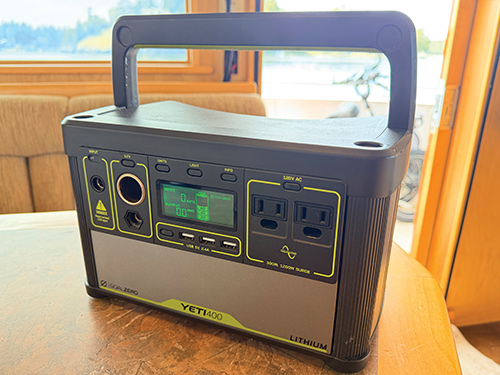
A few smaller things worth having. A couple of short CAT6 patch cables take up almost no space and are useful any time WiFi isn’t working and you want a direct wired connection to your router or chartplotter. A quality, sizable power bank with an inverter is something I think of as a necessary spare too. If your inverter dies, or you have a complete electrical failure, this power bank can allow you to power up a Starlink to call for help or look up troubleshooting, as well as continue to charge things like tablets for temporary navigation use.
And finally: electrical contact cleaner and dielectric grease should be aboard too. These might sound like maintenance items rather than emergency supplies, but I can’t tell you how many intermittent electrical problems I’ve traced back to a corroded or poorly seated connector rather than a failed component. A shot of contact cleaner and fresh dielectric grease on a suspect connection has fixed more “electrical gremlins” than any replacement part I’ve carried.
Prepared, Not Lucky
The boats that turn around early aren’t always the ones with the worst luck. Too often, they’re the ones that didn’t have what they needed to fix what broke. None of this kit takes up much space, and none of it costs much. Most of it you’ll never touch on any given cruise, and when that’s the case—hurrah! But when something fails in a remote location, the difference between a problem that can be solved at anchor and a premature end to the trip is usually whether you stocked your boat with the right things before you left the slip at your home marina.
Steve Mitchell is a year-round Pacific Northwest cruiser aboard his 54-foot steel trawler Aruna and a lifelong boater with experience in both sail and power. With decades in the technology industry and over 20 years of hands-on experience designing and installing marine electronics, electrical systems, he blends technical expertise with real-world cruising insight. As founder of SeaBits, he tests, reviews, and consults on the latest marine technology, and contributes to numerous boating publications.