On a Monday morning last fall, I realized that I was a bit more exhausted than anticipated from my weekend sail. Still, I couldn’t complain: I had just successfully organized my first official “Messabout” with the Traditional Small Craft Association; a group dedicated to the use and construction of small boats. During the event one guy drifted downstream, another lost his wallet in the river, and it rained biblically on our campout, but the weekend still felt like an achievement to me.
Taking its name from a classic line in The Wind in the Willows, “There is nothing–absolutely nothing–half so much worth doing as simply messing about in boats,” a messabout is a loosely organized gathering of small boats.
Although I’ve been sailing the tidal Columbia River for at least ten years, the idea of inviting strangers to join me was somewhat daunting. Would they slip downstream? Who might stray into the ship channel? Would someone get pinned against a wing dam?
These were valid concerns. My home turf is the Portland section of the Columbia, some one hundred miles upstream of the Pacific. Here, the river is nearly a mile wide, with a tidal range of about 2.5 feet. Given that the entire river is 1,240 miles long and drains 258,000 square miles, there’s typically current going downstream here. Known as the Lower Columbia, this portion of the river also has rows of wooden pilings (aka wing dams) on its banks. These structures capture sediment and keep the current directed into the main channel. If the tide isn’t pushing inland and slowing the current, boaters have to row and play the eddies to stay put—or hope there’s enough wind to move upriver.
Despite its challenges, the river is quite sailable once you understand these variables. So the mild conditions of early September felt like an ideal window for bringing out some old salts, along with newer sailors who wanted to learn the basics of what can be an intimidating river. Besides increasing people’s comfort with the Columbia itself, I also wanted to find new companions for overnight cruises; so in addition to an afternoon messabout, I added the option to spend the evening at the dock, or anchored in a sandy cove at Government Island State Park, just a few miles from the ramp.
Event day dawned warm and sunny. The wind forecast was light, but I hoped that as the sun rose, a breeze would follow. When I arrived at the boat ramp at 11 a.m., the parking lot was deserted. But soon, where aluminum fishing boats usually dominate, wind- and human-powered craft began arriving: two squat SCAMPs, an elegant paddle-and-sail boat with an outrigger, a regional rowing design known as a Lake Oswego boat, and many more.
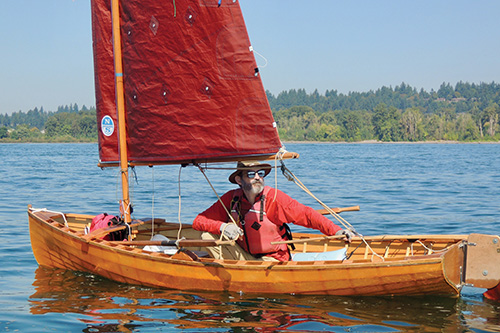
The messabout began with a show and tell tour, the skipper of each boat introducing themselves and the backstory of their craft. Caught up in getting to know each other, attendees almost missed the sight of a nearby flag coming to life. It was time to wrap up the shore talk and get out on the river.
A prudent sailor always starts a journey on the Columbia by going upriver, since on the return trip, the current will surely take you home. But with no guarantee of a breeze to push us up, I wanted to get everyone on the water and moving together while I could.
A few hands went up when I asked who’d sailed this section of the river before. That was a promising start, as it meant I wouldn’t have to shepherd everyone. I gave a crash course in river navigation, currents, and our plan for the day. Slowly, but surely, everyone got afloat.
We agreed to hang out together near the launch ramp for a while; then, those who were overnighting would continue upriver. As is common, several of us swapped boats, noting differences, preferences, and (silently) minor grievances. Mike, in his well-canvassed Thistle, zoomed about. I rowed and sailed as zephyrs arrived, stopping to chat with people I didn’t know, and encouraging others not to get too far behind. Eventually, the overnight group started heading upriver.
All went well for the first half hour or so, but as the breeze trailed off, some of the craft with smaller sail plans started drifting downstream. A few went back to the beach or the ramp, but one went downstream far enough that I almost lost sight of him, which made me anxious. I couldn’t raise him on a VHF, so I asked Mark, now sailing a Sea Pearl with an outboard, to see if a tow was needed (it was). Crisis averted.
The overnighters got a bit of breeze that had eluded the day sailors, and we slowly drifted away. I had a higher confidence level in this group, and I knew them better. When I saw the day sailors had made it safely ashore, my earlier anxiety about shepherding newbies through the first part of the day dissipated.
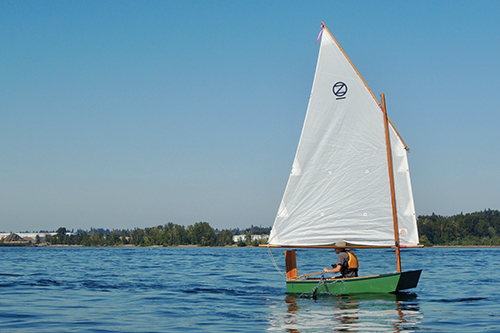
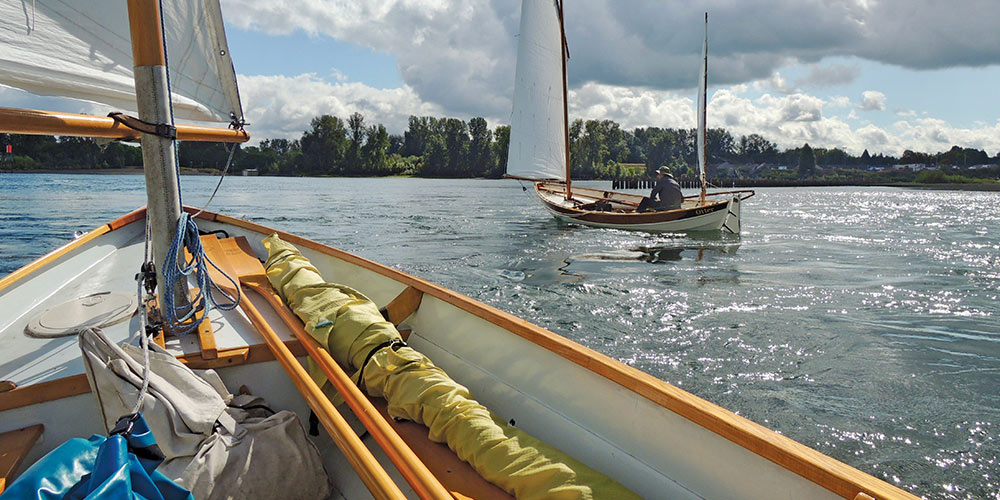
Our crew was now down to six boats. Four sailors worked their way up through the more trafficked main channel, while Dan and I, both in sail and oar boats, opted for the quieter, but riskier, path of shallow water between several islands. A gentle breeze allowed for a downwind run, which was good because my centerboard began to plow a furrow in the sandy bottom. Moments after raising it, I had to retract my rudder and steer primarily by leaning, since I was now in less than a foot of water. Dan followed, getting stuck here and there himself, shifting to oars, and eventually finding his way to deeper channels and returning to sail power.
The crew reconvened a few hours later at the state park dock. After answering the usual questions from keelboat sailors and motor cruisers there (How did you get here? Where are you going? Are you going to sleep on those things?), we traded stories of the day as clouds gathered above. It was drizzling at sunset when we retreated to our cockpit tents, and by bedtime, a deluge pelted us. I fell asleep to the soothing patter. At dawn, many of us woke to find that the hard rain had infiltrated our boats. But it was nothing a sponge and sunlight couldn’t clean up.
By daybreak, a breeze was building and the clouds began to part. For some that was a call to head directly home, but for three of us, it was an invitation to sail another 10 miles to complete a circumnavigation of the island. We had steady winds, mostly on the nose, but once we rounded the far end of the island, the current was with us, which allowed long tacks and lots of windward sailing—so long as we didn’t get too close to the many sand bars on this lesser traveled side of the island. Running aground is a Columbia River tradition (at least for small boats) and part of the fun of cruising here. Shoving off with an oar or retracting a centerboard is all that’s required to get going again.
Managing the messabout was tiring, and it took us the better part of Sunday to get back to the ramp. But despite my Monday morning fatigue, I was happy to have introduced boaters to a waterway I enjoy so much. As a sailor in a small, motorless boat, I’ve sometimes felt alone on the lower Columbia. Maybe, I thought, some of these folks would be out there now too.
Bruce Bateau sails and rows traditional boats with a modern twist in Portland, Oregon. His stories and adventures can be found at www.terrapintales.wordpress.com