Why would I buy a boat so far away?
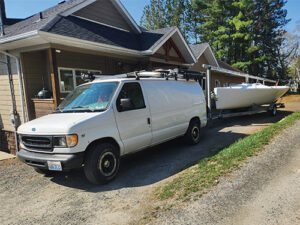
In the early morning darkness, I left the campground in East Grand Forks, Minnesota and drove my camper van—“The Flying Brick”—on the bridge over the Red River into Grand Forks, North Dakota, looking for a McDonalds to grab breakfast and some coffee. I came across one and, since I was pulling a trailer and not able to use the drive thru, I parked in an open area along the side of the restaurant. As I was walking across the parking lot, a young lady leaned out of the drive thru window and yelled, “What are you towing?” I answered, “A sailboat!” I had finally reached an area far enough from a large body of water that a sailboat wasn’t all that recognizable.
Why was I towing a sailboat in North Dakota? The answer is a project that started in early 2025, but had been on my mind for several years. In March of that year, I was approached by someone who was interested in buying my J/35, Great White, a boat I have owned for 26 years. I had been thinking of downsizing to a smaller, trailerable boat with ideas of exploring and racing on big inland lakes. That potential buyer dropped out, but it got me thinking again about a smaller boat. When I started researching trailable boats, I really gravitated towards the Rocket 22.
The Rocket 22 is a light sport boat built in British Columbia starting in 2007. It checked all the boxes for what I thought would fit my needs: small, light, easily trailable, ramp launchable, and fast. Only 16 were built, so they are not readily available, but I found a Facebook page for Rocket 22 owners. I joined the group and my first post was to ask if anyone knew of a Rocket 22 for sale. Within a week, I got an answer from a guy that lives in Kenora, Ontario, Canada, on the shores of Lake of the Woods. He actually owned hull number 16, the last to be built. We negotiated by phone and text and soon agreed on terms, and I committed to buy the boat.
With the commitment made, I started to plan how I would actually get the boat. I decided that I could drive to Ontario with my camper van and tow the boat home to Bremerton while camping along the way. It was about 1,800 miles to Kenora, which I figured would be doable in about three or four days. And it could be a great adventure!
I prepared the van for the trip: maintenance, installed a hitch, loaded tools and spares, and got provisions. I investigated what I needed for importing the boat, motor, and trailer into the United States and I was able to transfer a down payment to the seller.
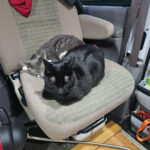
My departure date was May 5 with an itinerary to arrive in Ontario on May 8; that is, until a problem with the transfer service delayed the plan. I found out my transaction was declined on May 5 just as I was getting ready to start my drive. With help from a friend, I found another service to transfer the funds. Even though I had no guarantee that the money would be transferred on time, my two cats Larry and Moe (The Boys) and I left home around noon heading for our first stop in Idaho.
It was good to be on our way. The Boys sang about their displeasure for a while before settling down. I drove east on Interstate 90, the traffic was light and the weather nice. Just past Moses Lake, though, the van started acting up. After looking for an open parts store and trying to go back to Moses Lake, I rolled into a rest stop with an overheating engine and a dead battery. That evening, I wound up talking with a guy from Moses Lake at the rest stop and it turned out we had some friends in common. He offered to help me the following morning.
The next morning—after my first night ever camping in a rest stop—I started working on the van. I found out that the alternator was seized, which broke the serpentine belt. I called my “road angel” and asked him to pick up the parts I needed. He arrived a few hours later and I installed the alternator. Unfortunately, the serpentine belt was too long and it took two more trips to Moses Lake before we found one that fit.
With the van fixed I was finally underway again at around 6:30 p.m. and I drove to my intended first destination, a campground east of Coeur d’ Alene, Idaho. The campground had a closed sign saying it would not be open until mid-May, which became a theme of the trip with numerous campground closures. No problem, I camped in a small parking area outside the gate.
The next day I drove across Montana on I-90 and I-94. It was tough driving with strong winds, but the mountain views were impressive and the plains more interesting than you might think. That evening at a National Forest Service campground just across the border in North Dakota, I got some good news—the boat seller had received the money transfer. So now I was the owner of a Rocket 22, sight unseen.
I set out driving east across North Dakota on I-94 and then north on I-29 to the Canadian border at Emerson. The border crossing into Canada included a few strange questions from the customs agent. She asked, “What is the purpose of your visit?” To which I responded, “To buy a boat.” She then wondered, “Why drive so far for a boat?” I explained that it was the only one for sale in North America and she seemed ok with that answer.
Once I passed muster at the border, it was another 150 miles to the seller’s home in Kenora. I was greeted with a nice dinner, a hot shower, and a level parking place for the van. There, I got my first look at my Rocket 22.
The next morning, the work began. I had planned ahead and bought mounted tires and wheels before I left home; which I installed to replace the badly cracked and dry-rotted old set. The seller and I wrapped the mast with plastic. I loaded all the parts and sails in the boat, and lashed everything securely. It all went smoothly and by noon, I was on the road headed home.
I was pleased that the van could easily pull the boat and trailer, but I could always tell it was behind me. By the time I reached the US Border I was getting more comfortable driving with it in tow. The border crossing was pretty easy. I presented all the forms and the bill of sale for the boat, motor, and trailer to the agent who told me, “I have never cleared a boat into the country before.” I was instructed to pull ahead and another agent came out, looked at the boat, asked a few questions, stamped my papers, and sent me on my way. No tariffs or duties. I continued south on I-29 to East Grand Forks, Minnesota where my story began.
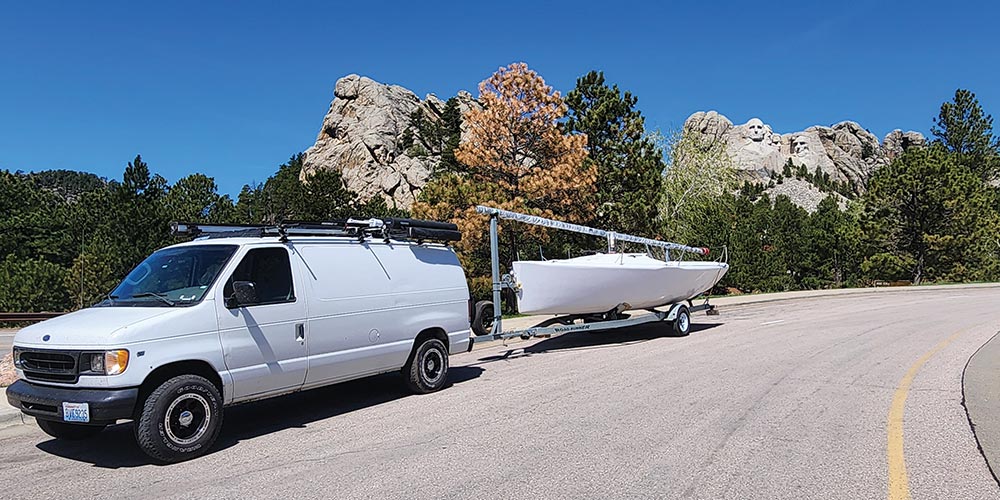
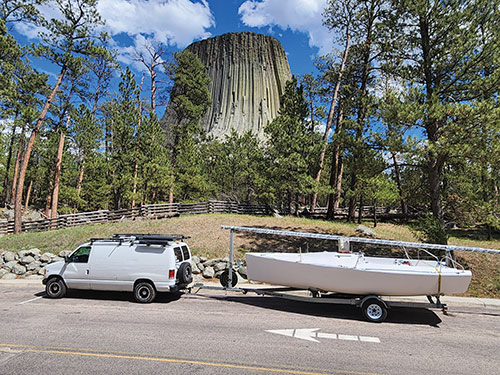
The next day and for the rest of the trip, I became a tourist. I drove south to where I-29 intersected I-90 and headed west across South Dakota. I made a lot of stops at various attractions. Some prominent ones were the Badlands, the town of Wall where I got breakfast at the famous Wall Drug, Mount Rushmore, Sturgis, and Devils Tower in Wyoming, camping near the Badlands and at Devils Tower. Everywhere I went, my new Rocket 22 brought lots of questions.
From Devils Tower, I drove north to Montana on two lane roads and then west on I-90. Driving on the backroads that wound through the prairies and fields was nice. I had to stop three times in Montana for boat inspections checking for invasive species like zebra mussels. This happened again once each in Idaho and Washington. With many mountain campgrounds still closed, I decided to stop at the same rest stop east of Moses Lake, but it was closed too! So, I found an alternative near George. It was late when I arrived and I parked with the big rigs. After this long day, I was tired, as were The Boys. Sleep came easily.
The final day was driving home on familiar roads over Snoqualmie Pass. The closer I got to Puget Sound, the stronger the van seemed to run. Or maybe the boat was pushing us along when it could smell the water!
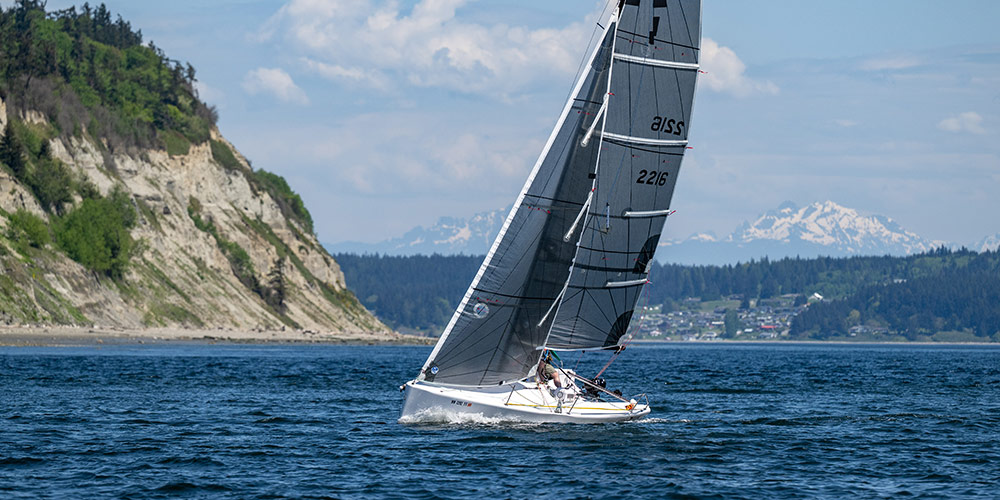
I parked the boat in front of my house for a couple weeks. After sorting things out and doing some rerigging, I splashed it in late May for the first time ever in seawater. I found the Rocket 22 is easy to rig, fun to sail, and that it accelerates quickly. It was a good start! I named the boat Cookie Cutter.
In the year that followed, I’ve been enjoying and learning a lot with Cookie Cutter. The boat is definitely a lot different than Great White, a boat I still really love. It hasn’t all been sailing—after being dismasted late in the season (a story for another day), I had to scramble to get the boat ready for this year’s Race to the Straits. I have sailed Great White in all but four editions of this race since 2002, and was always proud to do well in the singlehanded division.
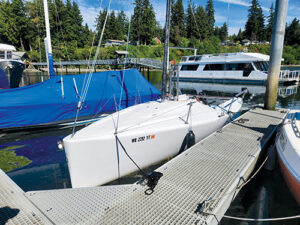
This year with Cookie Cutter was different, as I was one of the smaller boats in the entire fleet. After a hectic week of preparation, I started racing toward Port Townsend in northerly wind and short, steep wind waves. Cookie Cutter was not happy pounding into waves and burying the bow. I reefed and it seemed to do better.
As the wind lightened later, I started passing a few boats, but my performance was dismal—a couple hours off the pace of other boats. After drying things out, I spent the night aboard Cookie Cutter, which was surprisingly comfortable for such a small boat.
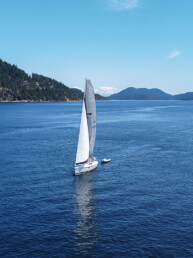
I was looking forward to Sunday’s return to Seattle. The wind was still blowing from the north and it would be a nice downwind run. I had been told that this was the Rocket 22’s forte and it was fun! With the spinnaker flying, I was hitting impressive speeds, often planing in the gusts and on the larger waves. Cookie Cutter was a pleasure to sail like this—light on the helm and responsive to inputs. Only a couple times did I let the boat start to get overpowered, then I was warned by the “stick shaker” that the rudder was going to stall. A little bit of easing the sheet and things returned to normal. The sense of speed is greater in a small boat than it is in a larger boat.
Sailing a small boat is a thrill, possibly even more fun among big boats. And that’s where my boat’s name comes from. The cookiecutter shark is a small, tropical shark that preys on much larger mammals, whales, and other sharks.
Getting to sail Cookie Cutter, a boat with its origin in this region, in Race to the Straits felt like an inflection point. It was a great adventure to bring the boat from Canada and across much of this country; but taking it sailing in one of my favorite races on Puget Sound was the purpose and inspiration for that big journey and truly began this new sailing chapter for me. I’m looking forward to many more adventures with Cookie Cutter.
Dan Wierman is a retired Mechanical Engineering Technician who resides in Bremerton, WA. In addition to being an avid shorthanded sailor, he’s also a self-proclaimed bicycle junkie.