Getting Someone Back Aboard The Boat
My column “Understand Your Safety Gear” in the May issue of 48° North was the first in a series focused on safety equipment—in that case, specifically the equipment designed to keep you aboard. While overboard recovery technique deserves lots of its own discussion, this month, I’ll delve into the topic of the gear designed to get a crew member back on the boat should they go overboard.
When someone goes overboard, there are two ways that it usually goes: first, the crew overboard (COB) is still attached to the boat; and second, the person is not attached to the boat and their distance is increasing rapidly. Each situation has its own solutions.
If the COB is being dragged next to or behind the boat, the good news is that we can go to work retrieving them quickly. The bad news is that being dragged is, itself, dangerous. The first step in response is to stop the boat’s forward momentum.
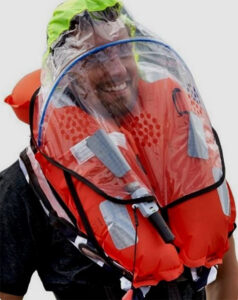
This is when some gear planning in advance could come into play. There are a couple of alternatives for harnesses or PFDs that can increase the COB’s chances, such as a back-towing attachment harness or a hood attachment on the PFD. The back-towing attachment can release the front tether point and move the attachment point higher on your back—reducing the likelihood of being dragged with your face in the water. Relatedly, when deployed, the hood on the PFD can help shield your face from the waves and onrushing water. (Figure 1)
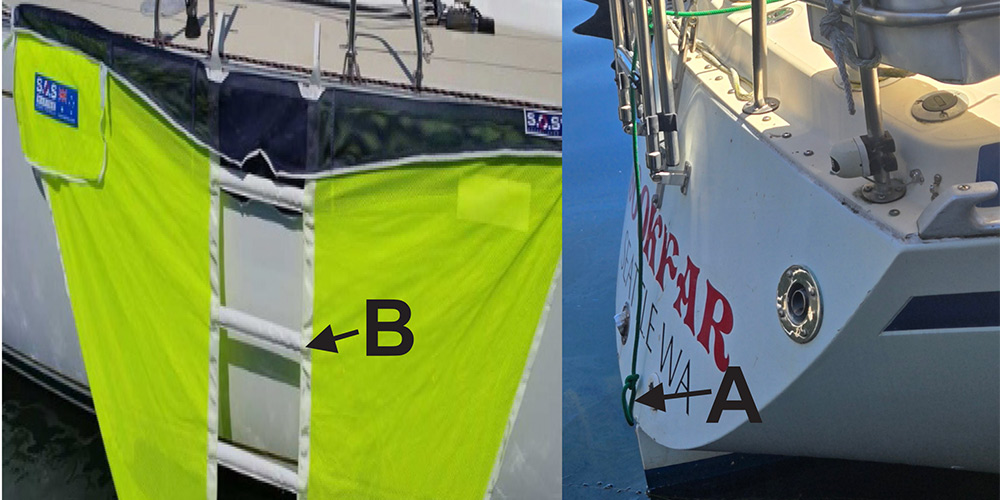
Once the boat’s momentum is stopped and the acute risks of dragging reduced, the next priority is getting the COB back on board. For quick recoveries, a ladder may be enough; keeping it within reach of the person in the water is always important. While some boats might have a swim ladder that could function in a pinch, there’s good reason to consider a dedicated rescue ladder. Such a ladder might be a permanent metal ladder with a lanyard or an emergency ladder with webbing and stiff rungs. (Figure 2) Having this gear aboard is advantageous, having it stored in a place that allows quick and easy deployment in an emergency is even better.
In the case that, for whatever reason, the COB is in the water and not attached to the boat, the most traditional response sailors will have been taught involves a crew member pointing at the person in the water immediately and constantly. It’s an excellent protocol in the right situation, but in many overboard scenarios, you may not be close enough to keep your eyes (and finger) on them, at least not eventually if the distance between boat and swimmer is increasing in a heavy sea state. This is when having a piece of equipment that you can launch to aid in pinpointing the COB’s location becomes beneficial.
Launching a Dan Buoy, a Man Overboard Module (MOM), or the now more antiquated rigid man overboard pole is best. The modern versions are most commonly inflatable with CO2 when they hit the water, but are also available as a rigid pole or float. Stowing this gear at the ready is crucial. Like inflatable PFDs, these need to be serviced regularly. These markers’ essential elements are visibility (including a strobe), stability, and flotation for the overboard crew, and often include a few other useful characteristics including a sea anchor to slow the pace at which the device is blown downwind from the COB and sometimes dedicated flotation or components to assist the crew in pulling the person in the water back aboard. There are many stories of people being rescued because they were located thanks to the visibility the Dan Buoy and its strobe provided, including the well-publicized overboard situation during one of Seattle’s springtime Center Sound Series races in 2025.
The next items on the checklist are electronic aids: AIS (Automatic Information System), DSC (Digital Selective Calling), and PLB SAT (Personal Locator Beacon via satellite). All of these must have MMSI (Maritime Mobile Service Identity) numbers. If your boat can receive AIS and display it on your navigation system, then a personal AIS will provide instant position information for your crew member. A waterproof, portable VHF with DSC and GPS will, when activated, send exact position information to a connected navigation system.
A PLB communicates directly with SAR (Search and Rescue) services, such as the USCG. A PLB does not send GPS info to your boat. There is also RLS (Return Link Service), a specific feature on some modern PLBs, which sends a signal to the global satellite networks; when they receive it, they send a signal to your personal device to alert you that the SAR services have been notified. These electronic beacons are crucial gear that delivers safety and security, but should be seen as complementary—not as replacements—to a physical marker in the water.
There is another class of COB devices that sound an alarm when any crew member leaves the area monitored by the base station on your boat. They can also shut down the engine; unfortunately, they won’t stop the boat under sail, but the alarm will alert those onboard. Personal AIS beacons will sound an alarm on the boat and guide those onboard to your position, assuming the plotter and AIS receiver are on. The downside of AIS is that it depends on line-of-sight reception, though it should be sufficient for a vessel you just fell off—in the cold waters of the Pacific Northwest, a rapid recovery is essential. A combination satellite and AIS PLB gives you the broadest coverage. The vessel from which a COB fell off is always the best option for a rescue boat—as long as this vessel isn’t incapacitated in some way—and its ability to get to the COB quickly is most likely if properly equipped. USCG response times will be longer by their nature.
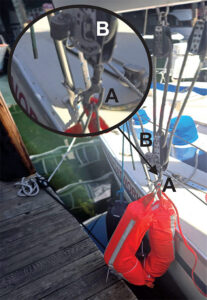
When you have your crew member close and your vessel under control, the search phase has ended; now it’s time for the rescue. First, assuming the rescuee is conscious and has the use of at least their arms, get a Lifesling or the equivalent to them. When they have the sling around them and under their arms, you can hoist them aboard using a halyard or a prepared tackle, such as a main sheet with a snap shackle. (Figure 3)
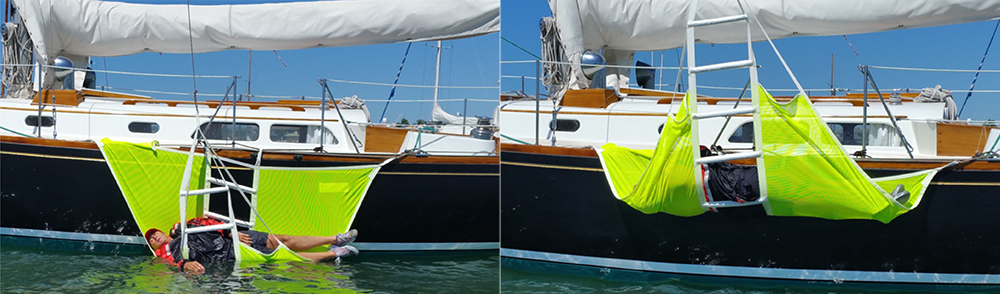
If your crew person is unconscious or immobile in the water, we go to plan B. When the ladder, harness, and sling are all ineffective, then the person will need to be hoisted aboard. A parbuckle is an effective piece of gear for getting an incapacitated crew member aboard. It is also possible to use the mainsail by slipping it off the mast track and over the side with the halyard attached. Bring the crew person alongside with a parbuckle or the mainsail used as a parbuckle in place so that it can cradle the person as you winch them aboard. (Figure 4)
Until now, the focus has been on the personal survival of a crew member in the water, but there are a couple of other pieces of gear I want to mention that are particularly relevant if your primary vessel becomes unsafe. One is an electronic locator for vessels in distress called EPIRB (Emergency Position Indicating Radio Beacons). An EPIRB is registered to a vessel, whereas PLBs are registered to a person. The other is a life raft, and specifically a coastal life raft—these are appropriate for Puget Sound, can be half the price of offshore rafts, and are typically more compact, especially if you are a cruising couple, as they come in two-person configurations. When it comes to getting back aboard a boat, if that boat is not your boat, these are two critical aids to a serious problem.
It won’t be news to anyone reading this magazine, but a person accidentally in the waters of Pacific Northwest, even in the summer, is a life threatening situation, with water temps typically ranging from 45° to 55° Fahrenheit. Going over the side exposes you to the 1-10-1 principle: 1 minute to control your breathing, 10 minutes to make purposeful movement for self-rescue, and 1 hour (or less) to become hypothermic. Should you find yourself falling overboard, close your hand over your mouth and nose. This may sound strange, but the most dangerous minute of one of these accidents starts when you hit the water. The shock of Puget Sound’s water temperature will trigger a gasp reflex. If your mouth and nose are in the water, then there’s a very real risk of drowning long before a rescue could play out.
Learning, reviewing, and practicing COB techniques and drills is vitally important. And part of this crucial preparation involves keeping the right rescue gear functional and ready to deploy. Of course, the best solution of all is to stay on the boat.
Jack Wilken wrote the How-To column in 48° North for more than a decade. He spent his career as a USCG-licensed Captain and shipwright, and he founded Seattle Boat Works in 2008. Though now mostly retired, he continues to write and consult with the family business. He’s still a happy and avid cruiser as well.