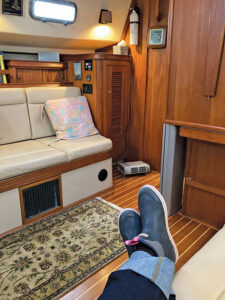
Before deciding to buy Sea Fox, our Malö 39, we were fortunate enough to join her previous owners for a sea trial in the Sea of Cortez. The time to sail in Mexico is winter; whereas the summer’s sweltering heat and hurricanes make for less than ideal cruising conditions. The previous owners agreed to let us sail with them from La Paz to Cabo San Lucas, giving us about 160 nautical miles to test and inspect her systems and see how she handled all points of sail. They had completed an impressive refit over the past three years, starting by tearing out all of the old equipment from the bilge spaces and applying a fresh coat of paint throughout. By the end of our sea trial, one week and infinity tacos later, there were plenty of things that impressed us about Sea Fox. The nearly-new Yanmar diesel engine with exceptionally low hours, the solid new electronics package, and the way she handled sloppy sea states. But what sealed the deal was the heater.
Slipping out of the clear emerald water after a morning of spearfishing, I climbed aboard the sugar scoop transom, shivering in my frigid wetsuit. We fired up the hydronic diesel heater and ten minutes later I was standing on the transom peeling off my wetsuit under a gloriously steamy hot shower, with the added bonus of a toasty warm salon waiting for me down below. A hot shower after a cold dive may not sound like a compelling reason to buy a sailboat, let alone a heater. But spend enough time cruising in cold, wet places and you begin to understand that reliable heat isn’t just a luxury. It’s one of the systems that can fundamentally change your cruising experience.
If your boat stays on the dock all winter, electric heating options are endless and very affordable. A handful of Lasko space heaters from Costco will keep you cozy all winter long and installation only takes a minute. But we are cruisers who value the adventures and solitude that can only be earned far from the comforts of a shore power pedestal. So, when it gets chilly, we must explore more sustainable solutions. Let’s start with buying the right boat for your cruising goals, which should include giving serious consideration to the geographic region you intend to do most of your cruising.
We often see new boat owners experience some level of buyer’s remorse after purchasing a boat that has lived its whole life in a warm climate and shipping it to the Salish Sea. A boat used in lower latitudes may be set up differently than one whose planned use is in the Pacific Northwest. These boats frequently come equipped with reverse cycle air conditioners, otherwise known as heat pumps. A heat pump that is expected to keep a boat warm in the Pacific Northwest is really going to struggle to do the job. And it is going to use a ton of energy to do its job poorly because, essentially, this relies on pulling heat from the seawater to put into your cabin. With an average sea temperature of 50 degrees in the Salish Sea, there is not a big margin for excess BTUs (British Thermal Units) when heating large open spaces.

If you’re planning to enjoy your boat in the Pacific Northwest during either of our shoulder seasons, the question will not be if you need heat, but rather which solution for staying warm will be best based on your cruising plans, budget, and boat. Like all decisions about how best to engineer your boat’s systems, there is a healthy helping of “it depends.” We are huge proponents of simplicity because we find that keeping it simple keeps you out cruising the longest and with the fewest glitches. The easiest option? Invest in some snow bibs and a down parka and get ready for winter camping on your boat. If your intent is a brief and gingerly dip into higher latitudes before sailing south to warmer waters, this might actually make sense for you. However, if waking up to seeing your breath in the V-berth with ice crystals on the port light frames does not sound like your idea of comfortable cruising, we can relate!
There are still plenty of boats here in the Salish Sea with solid fuel stoves installed aboard. If you are keen to keep warm with one of these inefficient gems, you’ll need to save your extra cabin and lazarette space for your chainsaw, chain sharpening tools, bar oil, and your pre-mixed fuel cans. For the purposes of this discussion, we will assume that our heating fuel will be diesel; since diesel is already the fuel source most of us have on hand, it is not volatile, and does not leave your boat full of sawdust and other uninvited lumber guests brought in with firewood.
There are three types of diesel heaters that are practical to install on most cruising boats, hence practical to discuss. These options include bulkhead mount, forced air, and hydronic. Each option has its own inherent benefits and drawbacks.
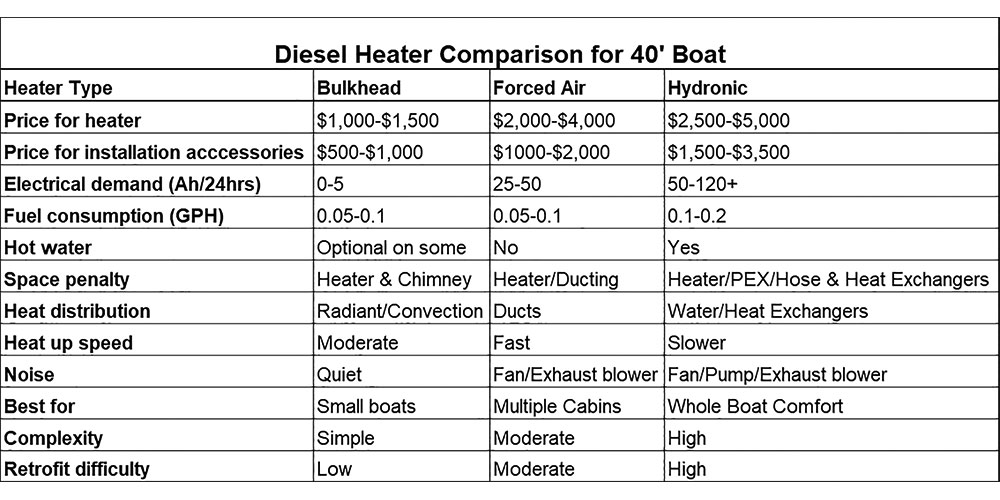
The simplest type of diesel heater is a bulkhead mount style heater. Bulkhead mount diesel heaters can be an effective and attractive option to keep it cozy down below. They are simple. There is little to no electrical consumption. There is no duct work to install, they are extremely quiet, offer a nice dry heat down below, and there is something reassuring about the little diesel heater glowing in the salon.
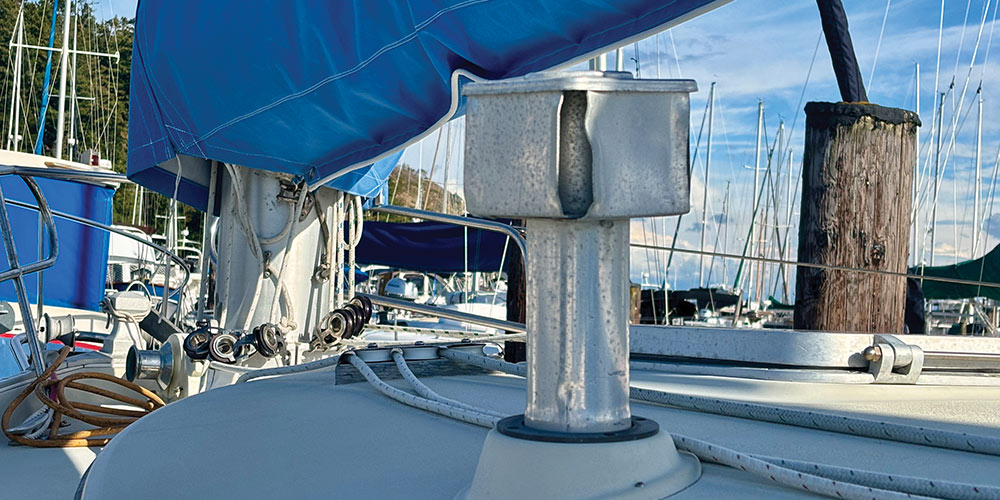
This style mounts directly to a boat’s interior bulkhead and passively radiates heat created by burning diesel fuel. They rely on fuel metering valves that work almost like a carburetor to keep a steady slow flow of fuel going to an internal combustion chamber. Installation of a bulkhead mount diesel heater does not simply involve bolting the thing to a bulkhead and plumbing in some diesel fuel. These heaters must be installed according to the manufacturer’s recommendations to ensure they run properly and do not pose a fire hazard. The surfaces of the mounting wall directly adjacent to the heater and the chimney must be covered with a stainless-steel wall liner plus the addition of spacers that create an air gap between the wall liner and high heat insulation on the bulkhead itself. If you’re planning to install an auxiliary diesel fuel tank mounted high enough to gravity feed the bulkhead heater at all points of heel, no fuel pump is required. Alternatively, if you intend to draw fuel from your boat’s primary fuel tank, the installation will require a dedicated fuel pickup, as well as a low-pressure fuel pump installed in the fuel line feeding the diesel heater.
Since the heater is burning diesel, it must have a way to exhaust the fumes. This is done through a chimney or a flue. The flue is a rather unattractive installation requirement that involves taking a minimum 3-inch hole saw and cutting into the top of your coach roof for the flue stack. For those of us who place a high value on hot water, some models feature a hot water heating coil, making your bulkhead-mount diesel heater perform double duty as a passive water heater.
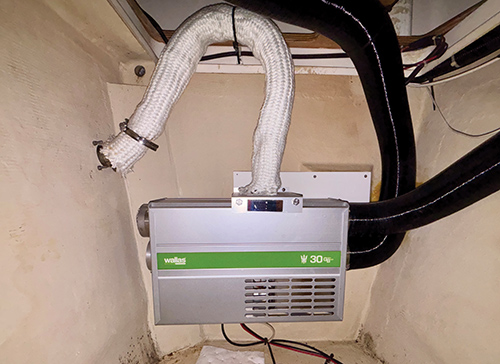
Increasing slightly in complexity, cost, and installation effort is the forced air diesel heater. A forced air diesel heater can be a highly effective way to heat your boat’s interior. The heating unit is relatively compact and can usually be installed out of the way in a lazarette. They’re thermostatically controlled, can be turned on with the push of a button, and are capable of heating multiple cabins. An electric fan pulls cabin air across a heat exchanger that is heated by a small internal diesel burner. The burner requires a supply of clean, fresh combustion air, separate from the cabin air being heated.
The biggest tradeoff when installing a forced air diesel heater is the amount of cabinet or storage space that can be taken up by the duct work. The hot air produced by the heater is distributed to the cabins you’re intending to heat via ducting, and also requires installation of a register style outlet. But planning an extensive ducting system can burn into your budget in a hurry. Typical ducting measures 3.5-inch in diameter, requiring a formidable hole saw bit be taken to each cabinet and bulkhead through which your ducting passes. The duct tubing typically costs over $10 per linear foot and is relatively fragile, so you must be careful not to install the ducting where it could potentially be crushed. The ducting runs must also be as straight as possible to minimize efficiency loss by friction. Don’t forget to account for cutting a hole in a vertically accessible location for the heater control/thermostat panel. Luckily, you won’t need to cut a hole in your coach roof for the installation but you will need to plan the route for the hot exhaust pipe and installation of an exhaust outlet through-hull somewhere near the rear of the boat. The installation instructions mandate a fiberglass insulation jacket on the heater’s exhaust pipe.
Maintenance is relatively minimal but running the unit occasionally during the offseason is required to keep mechanical parts from seizing. On some units, per manufacturer’s safety guidelines, the core heat exchanger must be replaced with a genuine original spare part every 10 years from the original date of service. There is also a really cool forced air diesel heater worth mentioning if you want to heat a small boat that might also benefit from replacing the cooktop. Wallas makes a diesel heater/cooktop combo; a dual-purpose appliance that runs on diesel to provide both flameless cooking and blows cabin heat. Two for one!
Next, we have the Cadillac of diesel heaters: the hydronic heater. Hydronic heaters provide a unique solution for distributing heat throughout the entire boat without having to run large amounts of ducting through your cabinets and bilge spaces. Hydronic heaters use the same closed-chamber diesel burner technology as forced-air heaters, which means they still have the same combustion-air intake and exhaust requirements. The difference is that the heat exchanger transfers the heat from the burner to a liquid, typically a propylene glycol solution. An electric pump then circulates that hot liquid throughout the boat in a closed loop. Along the loop, the heated fluid passes through local heat exchangers equipped with blower fans that move air across heated fins and into the cabin.
The most time and labor-intensive part of these installations is the plumbing. High-temperature coolant hose or PEX can be used to build the closed loop that circulates the hydronic fluid. The loop must be routed to every part of the boat where you want heat, as well as to any other components you want to integrate into the system. This means planning a logical route throughout the boat for the fluid lines, which will undoubtedly result in plenty of penetrations, hopefully requiring only a small spade bit. Along this route, 12V-powered heat exchangers about the size of a car battery must be installed. Each unit averaging about $250. As you may have gathered, this is not a small-scale installation. Before you know it, you’ll have every floorboard removed, every cabinet disassembled, most lazarette spaces emptied out, and a dozen new wire runs to retrofit a hydronic heating system.
The complexity of the installation increases further if you want to independently control multiple zones or operate the hydronic fluid pump independently of the heater. Because the hydronic fluid expands and contracts as its temperature changes, the system also requires an expansion tank. This adds both cost and another piece of equipment that must find a home in an already crowded lazarette.
The fact that a hydronic heater distributes heated fluid makes it a remarkably versatile system. Properly plumbed, a fluid-to-fluid heat exchanger can transfer heat from your engine’s fresh-water cooling system to the circulating propylene glycol, essentially using your engine’s excess heat to warm your cabin spaces. Take that a step further by running the hydronic fluid through your boat’s hot-water heater, and you can use either excess engine heat or your diesel heater to make hot water. Pretty impressive!
All of this versatility comes at a steeper energy cost. The hydronic heater is the most power hungry of our heating options. The circulating fluid has to be pushed throughout the entire heating loop, and each heat exchanger along the way has its own electrical demand to power the blower moving air through its thermostatically controlled zone. Sea Fox draws upwards of 25 amps at 12V when the heater is spooling up and maintains 8-10 amps while running. For long-distance cruisers without robust power generation capacity onboard, this may not be a suitable option.
If you’re weighing your options for a diesel heater on your boat, the best place to start is with the boat itself, not the heater. Instead of asking which heater is best, start by asking yourself what space you need the heater to fit in and how much power you have to run the heater. Then work backwards. If there is clearly not space behind cabinetry to install necessary ducting, this could quickly narrow down your options. If your house battery bank consists of a single 100 Ah lead acid battery, a hydronic heater won’t be a strong choice for your boat.
Always keep in mind that a diesel heater is a combustion appliance inside a small fiberglass, wood, or aluminum structure (aka your boat). Manufacturer installation requirements and maintenance schedules aren’t optional details. They are a matter of safety. Dickinson, for example, explicitly calls for a carbon monoxide alarm with the installation of its diesel appliances, and it’s a brilliant idea to install a carbon monoxide alarm when adding any internal combustion heating appliance to your boat.
So, is a diesel heater a necessity or just nice to have? We’d argue that the farther north you intend to sail, the closer it gets to being a necessity. For liveaboards who won’t be spending the winter tied to a dock with shore power, we’d definitely call it a necessity. The heater itself may be a luxury, but the ability to dry out the interior of your boat is not. We create an enormous amount of moisture simply by breathing while we sleep, and without a reliable source of dry heat to remove that moisture, mold and mildew will eventually find their way into the fine cracks of your boat’s joinery, the fabrics of your upholstery, and your expensive foul-weather gear. In the cold, wet cruising grounds of the Pacific Northwest a diesel heater is just as important for keeping the boat and everything in it dry, as well as keeping you warm and cozy.
Gio and Julie of Pelagic Blue lead offshore sail training expeditions and teach cruising skills classes focused on preparing aspiring cruisers for safe, self-sufficient world cruising on their own boats. Details and sailing schedule at www.pelagicbluecruising.com