I sometimes think I should be working for the Wahkaikum County Tourist Bureau’s Boating Division. For the past five years I’ve regularly offered to bring fellow boaters to some of my favorite small craft destinations in this rural county along the lower Columbia River.
The pitch starts something like this: “I’m looking for a few good sail and oar boaters to join me on a summer cruise on the Estuary. There are thousands of acres of marsh, gazillions of gallons of water (mostly fresh), virtually no mosquitoes, and a fascinating variety of places to anchor, from wild, to city, to historic. This isn’t like a Carnival cruise, where someone tells you the activities for the day. It’s a ton of fun, but everyone needs to be self-sufficient, comfortable running aground (welcome to the club), content to shift plans with the weather, and adept at telling tall tales around the campfire, or wherever we end up.”
I usually get a few takers. Thus, as an employee of the Wahkaikum County Tourist Bureau Boating Division, I’d be a flop.
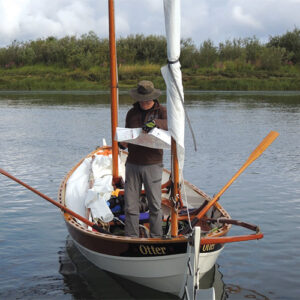
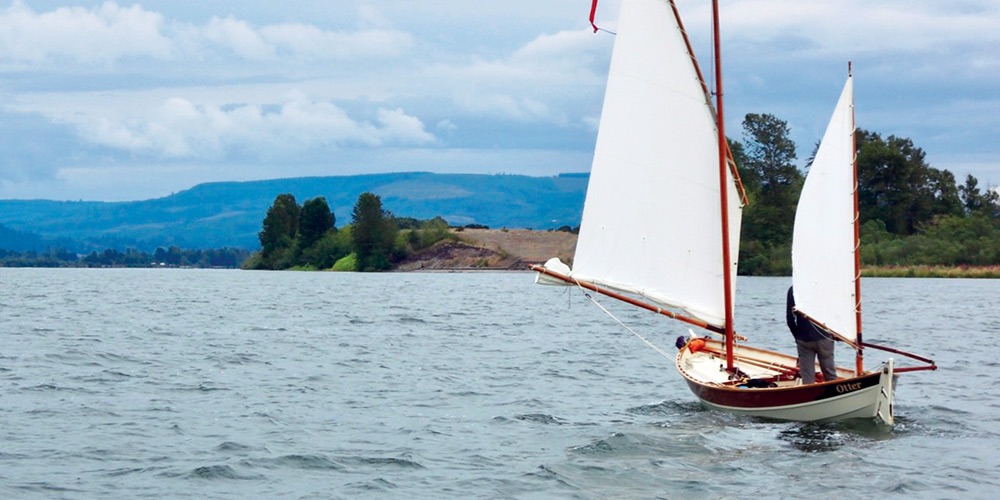
Perhaps some people are intimidated by the vastness of the waterway, or the lack of a fixed plan. But after years of putting me off, my old friend Dan finally gave in to my pitch and signed on for a late summer cruise in his 19-foot Ness yawl.
Launching from Elochoman Slough Marina in Cathlamet, the weather was perfect. Well, perfectly normal for this section of the river: deeply overcast with a marine layer threatening to unleash moisture. The friendly and caring staff at the tidy marina always make it easy to visit. With decent docks, nice restrooms, a covered picnic area, views out to the slough, and a beer joint adjacent, it can be hard to depart. Still, a water view gives the clearest sense of Cathlamet’s history as a settlement since the 1850s, so we made a sweep upriver to gander at commercial structures perched on pilings, a small fleet of moored tugs, and a variety of residential buildings creeping up the hillside that make up the town.
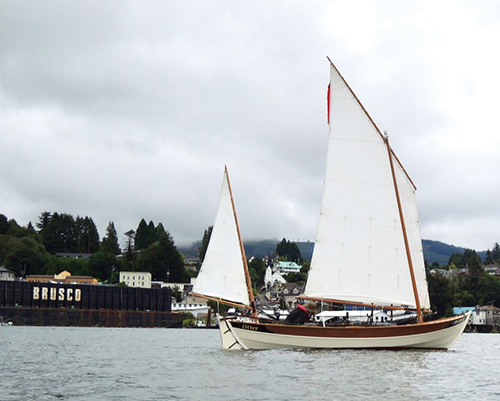
Downstream in the Cathlamet Channel, the town comes to an abrupt halt at the edge of the Julia Butler Hanson National Wildlife Refuge, with its myriad back channels and tidewater islands. A thousand feet across the channel are the charming hideaways, residences, and farms of Puget Island, all protected by levees. Upon reaching the end of the island and the mainstem of the Columbia, Dan was surprised when I asked him to pause.
“Look out for ships,” I yelled, waving my arms.
It was Dan’s first time on the Columbia, and at first, he may have thought I was kidding. Realizing I was serious, he scanned a ship-tracking app on his phone to double check my visual approach.
“All clear,” he called, and we scooted to the next channel heading west. For small craft, a voyage on the Columbia affords a variety of route choices, each with joys and perils, one of which I realized I hadn’t explained.
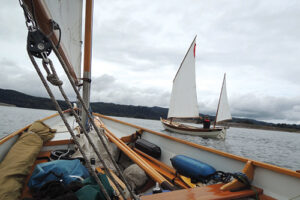
“Dan, keep well clear of the wing dams,” I called, motioning towards the edge of the channel. “You can get pinned on those long rows of pilings—the water can move really fast as it funnels through there.”
Once beyond the dams, we tacked our way against a sea breeze pushing up the river against the tide and turned down a side channel, hoping for relief. Finding none, we pulled to the side, tied off to some old pilings and took in the view. Lush conifers clung to a cliff on the Oregon side of the river, while shrubby willows and leafy cottonwoods crowded the high spots along the islands and sandy shores. Miles from the nearest car, we soaked in a deep silence.
As conditions allowed, we rowed or sailed loosely downstream. For Dan, a Puget Sound sailor who is more used to rocks, cold water, and crowds, our leisurely approach was a novelty, as was our lack of a particular destination each day; and with no other boats around, we faced zero competition for space at a dock or anchorage. As sunset neared, we arrived at the intersection of three channels. The wind was calm, so we dropped anchor and watched the sun paint the clouds a peachy shade before the light fizzled into gray as the clouds closed in.
Come morning, the sky had dropped lower, like a misty false ceiling, and dew coated our cockpit tents. We donned raincoats and continued moving west, now in silky smooth waters. A mysterious sound punctuated the quiet and, as we came past a headland, a herd of cows trotted along a levee on the mainland shore. We soon left them behind and headed deeper into the refuge’s maze of islands. Periodically we stopped to check our charts and confirm our location. The islands possess a sameness that makes it hard to differentiate one from another; and it’s easy to get lost. Since we were riding a dropping tide towards the coast, a wrong turn could strand us in a dead-end slough until the next tide cycle. Although with mud bottoms everywhere, it would only hurt our pride.
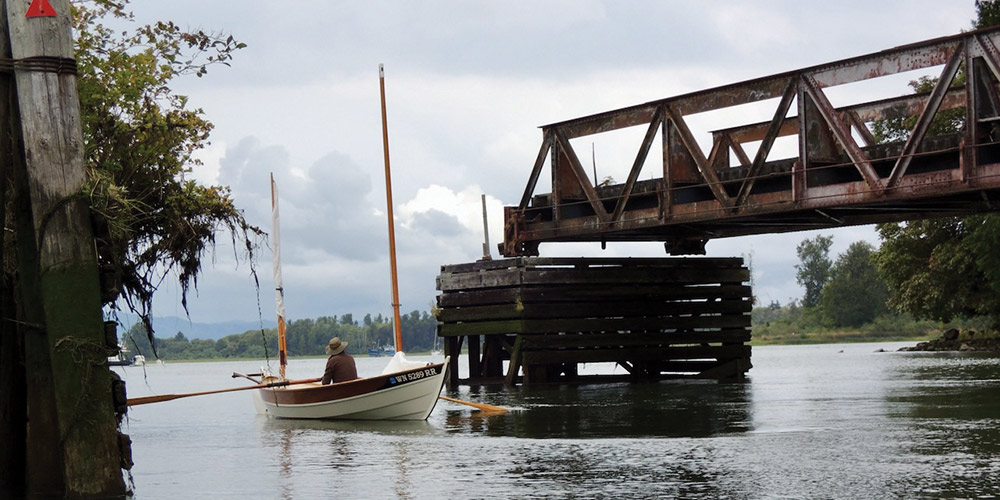
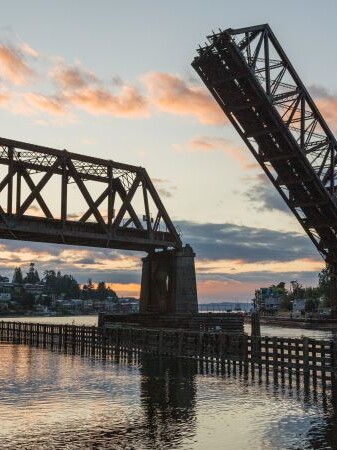
After traveling for two days, we encountered other boaters for the first time a few miles from Astoria—a raft of hefty motor cruisers. Yet even when the channel is empty of sailors, remnants of human activity abound here and, as we rounded the next bend, we were greeted by a swinging railroad bridge over a tidal river. Although intact, the rust and overgrown shrubs on its approaches indicated that the bridge hadn’t moved in decades. Passing it and heading up river gave us views of a broad mudflat where shorebirds scurried about and an eagle alighted in a tree. This would be a fine place to spend the night.
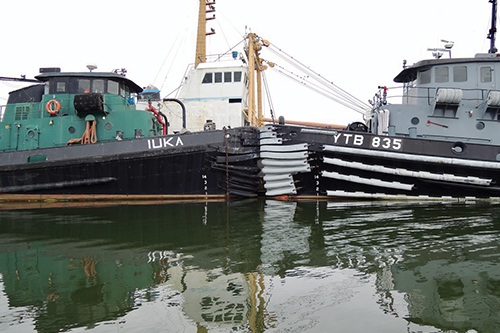
The rambling nature of our cruise made time seem to stretch on endlessly, yet I knew from checking the tide tables that tidal currents exist regardless of my perception, and the opportunity for us to turn back upriver would arrive early the next morning. Heading for the mainstem and ship’s channel, we passed a few moored tugs and a salvage ship that drew me in for a closer look. Dan sped ahead, focused on catching the flood. I soon rowed after him, finding a quiet surge of water pushing me upriver. When the sea breeze filled in, we skated along the outside edge of the ship channel, passing sand islands, then through shallows that looked almost tropical, with their reflective golden bottom.
I had reached hull speed just as my rudder struck a sandbar, causing a line to part and resulting in a loss of steerage. Unlike Puget Sound, the water in the Lower Columbia is quite swimmable in August, so I waded ashore in my shorts and bare feet, beached my boat, fixed the rudder and continued on—this time more carefully.
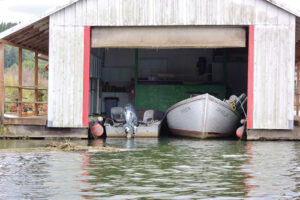
With steady winds from astern, it began to feel as if an unseen rope was pulling us upriver, making sail adjustments unnecessary. We grinned as the wind propelled us onward for hours. In fact, we got back to Cathlamet so early that we were reluctant to go ashore. Instead, we decided to anchor for the night in a shallow slough where no larger boat could go. Heading home could wait until tomorrow.
Come morning, the prospect of a hot breakfast at The Cottage, a local bakery and restaurant, finally lured us from the river. We sipped coffee and lingered over huge stacks of blueberry pancakes.
Over another cup of coffee, Dan reviewed the highlights of our expedition. “I wasn’t sure about this place,” he said. “But it was exactly as advertised. And I’ll be back next year, for sure.”
Maybe there’s a position for me at the Tourist Bureau, after all.
Bruce Bateau sails and rows traditional boats with a modern twist in Portland, Oregon. His stories and adventures can be found at www.terrapintales.wordpress.com