A Trip to Blake Island Sets the Stage for Future Adventures
From the very beginning, I had a plan for sailing to become a way to adventure with my partner, Bianca. When I casually floated the idea of taking US Sailing’s Basic Keelboat course together in 2021, it was in my mind that cruising could become something bigger in our life if she enjoyed it. Five years on, it’s striking both how far we’ve come, and how resonant those early experiences remain.
In My Genes
My appetite for exploring the Pacific Northwest has always felt insatiable. And while Bianca has experienced some of the region’s most challenging and rugged backpacking trails, with and without me, being immersed in nature is not something she pines for the way that I do. One or two nights is usually plenty for her, before the bugs, the poor sleep, and the trowel in place of a flush toilet lose their novelty.
Modern sailboats, however, have creature comforts: kitchen appliances, mattresses, hot water, etc. With these tools as part of the experience, longer adventures seemed possible, and I started to dream. We’d fall into a new daily rhythm. We could follow the tides and sunny weather to beaches and small coastal communities. When the rain and wind blew over, we could be tucked into tranquil coves or harbors and draped in nature until the foul weather exhausted itself. We would swoon for the wildlife—the eagles, orcas, otters—and slowly, fall in love with the Salish Sea’s hidden places.
My grand plan was ambitious, since neither of us knew anything about sailing. In fact, I had never been aboard a sailboat, even though my dad had sailed in his youth and owned boats with friends. He and his buddies had competed in local races like Swiftsure and partied their way through 1970s summers around the southern Gulf Islands. The location of our family home on Active Pass was a result of those years, and a promise my dad had made and nurtured to someday own land there.
Growing up, we spent more time watching the traffic transiting Active Pass than on the water ourselves; but once or twice a summer, often when we had guests and wanted to roll out the red carpet, my dad would day-charter an older 20-foot speed boat from a friend’s rental shop at Montague Harbour. We would visit the Saturday crafts market at Ganges—the largest among those islands—or have wood fire pizza at Fernwood Point.
From my dad, I learned to find navigational aids and to plot them onto our charts to be sure we knew where we were. He explained how I should exaggerate motions to signal to attentive skippers how we intended to pass them. I experienced the thrill each of us knows, of taking the wheel for the very first time, with him on one of those boats. And I’m sure he had had similar moments with his dad.
My grandfather—who was always “Papa” to me—was never a sailor, but a mariner who lived his entire life on our coast. He was a Royal Navy Reservist and an avid fisherman who earned his professional chops as a refrigeration engineer in the canning industry—a lifeblood of the northern British Columbia port town where he’d grown up. He and my Nana owned many boats, and phrases from my father’s childhood became part of my family’s lexicon: “It’s just like living on a boat,” which translated to, “Tidy up and put your things away.”
Boating remained an important hobby for both my father and Papa for a number of years—albeit one that brings significant costs of time and money. They had enjoyed their proverbial “second best day” of boat ownership long before my older siblings and I were born.

Time to Learn
Reflecting on my family’s history and its divergence from my own experience to date, I couldn’t help but wonder how far this new beginning might take us. Bianca and I enrolled in our sailing course.
Our first day will sound familiar to those with deeper experience in sailing and sailing instruction. We had less than 10 knots of wind, but it was steady. John, our instructor, led us through attaching the halyard shackle to the head of the mainsail, hoisting and filling the sail, and turning off the motor. Almost without realizing it, the serenity of sailing began to captivate Bianca and me. We learned to tack and to jibe—intentionally and not. We were taught figure-eight maneuvers to collect fenders that had “fallen overboard” and required prompt rescue from the dangerously cold waters. In the classroom, we discussed tides, currents, sailing vernacular, and emergency procedures. Eventually, we passed our exams and became certified by our sailing club to sail one of the six Catalina 22s in its livery on our own. So we did, in April 2021.
A Memorable Maiden Voyage
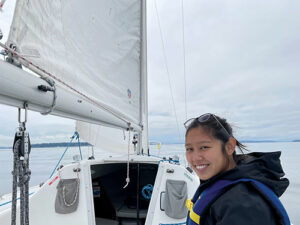
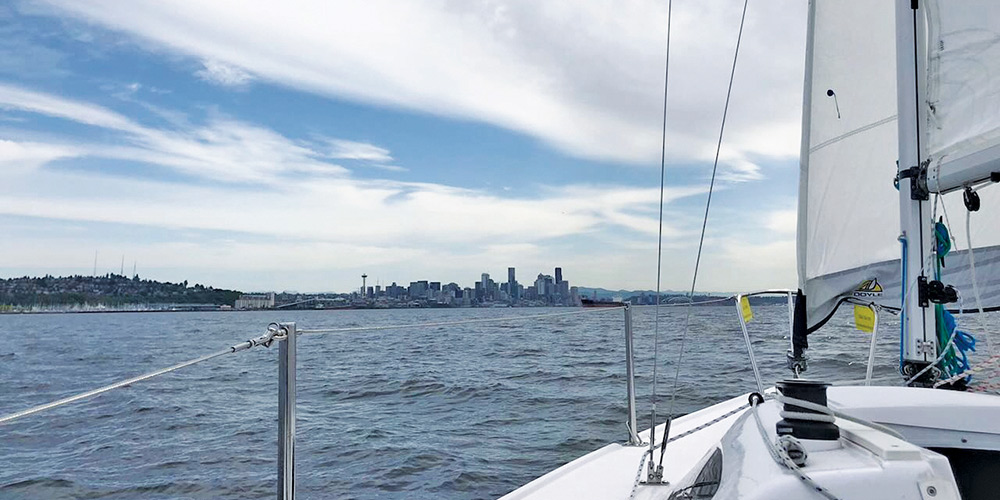
Under a brooding sky, Munchkin II—and her crew of two—made for Blake Island Marine State Park. Bianca and I wore wool sweaters under our foul weather gear. It wasn’t raining but it was cold and, with no cockpit protection, we were prepared for the wind, rain, and spray. Springtime weather in the Pacific Northwest can feel like a coin toss between winter and summer, and that day’s coin turned winter-side up.
The modest northerly breeze coming down the Sound filled our main and jib and helped us along on a deep broad reach—that calm, confidence-inspiring point of sail. The sea state was mild as we slid southwest in concert with both the surface winds and the flooding tide: trillions of gallons of sea water rushing into Puget Sound from the Pacific Ocean. Approaching Blake Island, we watched its silhouette grow on the horizon, and the abstract lines and numbers on the chart became real.
We stowed our sails, slipped into the marina, tied up somewhat triumphantly, and enjoyed a beautiful day in each other’s company. The park was virtually empty of visitors. The residents of the island—yellow goslings, fallow deer, and other fauna—were recruited as apprehensive photography subjects.
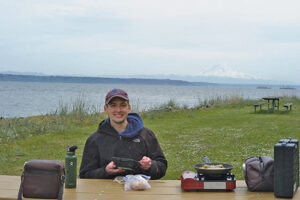
The rain picked up along with our appetites, and we shared steaming hot peppers and sausages before strolling down the island’s lone service road in a light rain. We walked among old growth groves of Douglas fir mixed with redwood Cedar and Arbutus along the waterfront edges. I marveled at how this timbered gem, in such close proximity to ever-growing Seattle, was spared from development, while her neighbors boast ostentatious homes and almost always a bridge for vehicle traffic.
When it was time to leave the island, the most vivid part of that day was our departure from the marina. Boating is often loudly punctuated by lessons and, after casting off the lines from the dock, we got one. I lost control of Munchkin II—steering, shifting, and throttling my way towards learning that sufficient water needs to flow over a rudder in order to have steerage. We were slipping ever closer to the marina’s breakwater. While I was entirely focused on stopping our drift towards the rocks, people who were near but previously out of sight had begun to emerge. Some unseen signal of slow-speed vessel distress was broadcast to nearby skippers and they began to congregate on the docks or the decks of their boats.
My futile shifting between forward and reverse continued and Bianca’s confusion evolved into a moderate panic. I finally had a ‘go for broke’ moment and revved hard in forward and kept the throttle wide open for long enough to finally gain some steerage. As we puttered off toward the exit with more control but a little less dignity, we left some soft clapping and shaking heads in our wake. Onboard Munchkin II, the crew was silent, reflective.
Bianca and I think back on that day a lot. We reminisce about that warm feeling of accomplishment: slipping out of Shilshole Bay Marina on our own for the first time, landing at a wonderful park so close to home but previously inaccessible to us, and returning back safely some hours and nautical miles later. Our very first outing confirmed my hope that sailing could open up a world of exploration for me and Bianca around the PNW’s vast coastlines.
We were also shown unequivocally that the marine environment is challenging, something that has rung true ever since. There is always something to learn, some component of the vessel to break down, or a mistake to be made and toll exacted. Our logs of days underway in the years since include less time overcoming problems of our own making. Still, the parade of challenges marches on, particularly as we continue to push the boundary on how far we cruise and for how long. Thankfully in most instances, the fees are paid primarily in stress and time, and any struggles pale in comparison to the joys and rewards we find in adventuring on the water together.
For me, the daily cycle of seamanship and boat maintenance remains an addictive intoxicant: observing, diagnosing, problem solving, and hopefully improving. Bianca accepts the challenges of cruising with a slightly more utilitarian spirit, but my plan did work. She is not immune to the absolute magic of cruising these waters. We enjoy spending the day outside and working with our hands, together.
As of April, we now sail doublehanded on Wind Song, a capable Hunter Passage 42 we proudly call our own. This past summer, we spent over a month out cruising, sailing between Seattle and the northern reaches of the Discovery Islands. Next year, perhaps Alaska?
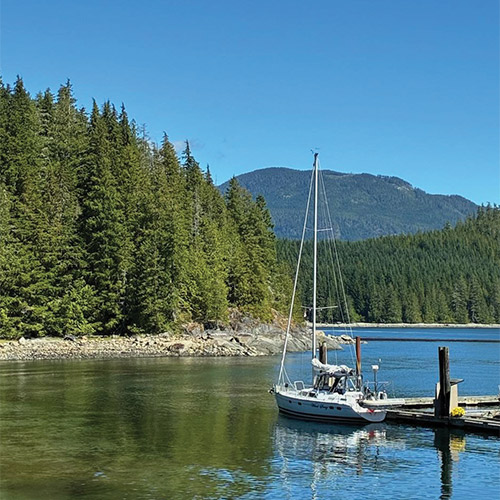
Charlie and Bianca Boddie were born and raised in the Pacific Northwest. They are prepping their Hunter Passage 42 Wind Song for more ambitious cruising this coming season.