The subject of safety gear has always been at the top of my list. This seems like a good place for me to return to 48° North. Safe boating affects us all, and safety at sea is inherently situational. My time in the U.S. Coast Guard (USCG) gives me a view from both inside and outside of these dynamics. In this article, I’ll set-up the series, and then focus on some of the essential personal gear that might be attached to a sailor’s body.
The topic of safety gear could easily be focused on sectors or lifestyles within boating—from the simplest and most foundational basics to highly refined systems for offshore passagemakers. As I dive into this subject, I will focus on the waters most frequently enjoyed by this community of readers: the Salish Sea and the Inside Passage to Alaska. Of course, experienced cruisers know that most any patch of water therein could potentially offer you and your boat a placid bath tub or an epic storm. In both situations and anywhere in between, we act based on our history, preparation, and how we have equipped our boats and ourselves.
Wherever we sail, we encounter a series of events that can lead to the extremes of pleasurable satisfaction or hair-raising disaster. The safety gear on our boats and bodies can help us obviate the latter and turn it into the former.
CFRs and the Six Essentials
The building blocks of our on-board safety gear come from the USCG. As a law enforcement agency responsible for boating safety, the laws the USCG enforces come from the Code of Federal Regulations (CFRs). The CFRs are compiled by the interested federal agencies: USCG, Corp of Army Engineers, Maritime Administration, and others. Congress gives the appropriate federal agencies authority to create the CFRs. Many of these regulations apply lessons learned from past accidents and deaths to make sure they don’t happen again. Personal Flotation Devices (PFDs)—which are still acceptably and interchangeably also referred to as life jackets—provide an example. The life jackets of Titanic era vessels used cork blocks that were so stiff and buoyant that when passengers jumped from the upper decks, the jackets were forced up when they hit the water, often resulting in broken jaws or necks. In time, new regulations for PFDs were implemented seeking to avoid this known design flaw.
As a sailor, it’s good to keep in mind that Coast Guard safety standards are minimum requirements. Recreational boats must carry certain USCG-approved serviceable and accessible safety gear, including wearable PFDs for each person, plus one throwable Type IV, fire extinguishers, sound-producing devices, visual distress signals for night and day, and navigation lights. Some specific requirements depend on the size of the vessel. Many readers know what it’s like to be boarded by the USCG, and regardless of any other inquiry, it’s common for officers to check for compliance regarding these core pieces of safety gear.
Details About PFDs
The most important thing about any life jacket is that it’s most effective when it’s being worn. Adapting the adage about reefing sails: the right time to put your life jacket on is 20 minutes before you think, “I should have put my life jacket on.” The safest time to do so is before you leave the dock. Beyond that sage wisdom, there’s quite a lot to know about PFDs, and here are some of the less obvious details.
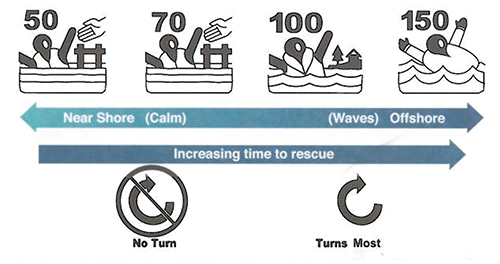
The Coast Guard has traditionally used a numbered “Type” system for PFDs (Type I to Type V); with each Type corresponding to the intended use. This number system is being replaced by an international-friendly one that is based on buoyancy force in Newtons (N) and turning—the ability to get a person’s head out of the water, which is mandated for the more buoyant levels. One Newton is a little less than four pounds of buoyant force, 1 N = .225 lbs. (Figure 1)
Lower Newton levels, including 50N and 70N, are intended for sheltered and near-shore waters where rescue should be quick, whereas 100N is suitable for coastal and offshore recreational use, and high-buoyancy life jackets (150-190 Newtons and above) are recommended in rough offshore conditions and should turn an unconscious person face-up even while wearing heavy clothing.
This system is used by the International Organization for Standardization (ISO) and Safety of Life at Sea (SOLAS) organizations. And, importantly for Pacific Northwest sailors, adopting the Newton-based system means that American and Canadian standards are now “harmonized.” It is wise to ensure that your existing PFD meets the new requirements, but many previously USCG-approved life jackets are expected to be in compliance. All PFDs must have readable USCG approval stickers in order to be counted as part of the ship’s inventory. There are quality PFDs on the market with good attributes—higher buoyancy, comfort, more secure harnesses—that have ISO or SOLAS approval, but no USCG approval. It is not against the law to wear a PFD that lacks USCG approval, but you still need to fulfill the approved inventory requirement on-board.
The storage of PFDs must be clearly marked, easily accessible, and in dry locations, ensuring they can be retrieved instantly without being unlocked, obstructed, or unwrapped. This means that storage in a bag with a closed zipper is not compliant, though it is fairly common.
Washington law says 12-year-olds and under on vessels under 19 feet are required to wear a PFD in open spaces. A PFD must match each person aboard for physical size and swimming ability.
Inflatable PFDs
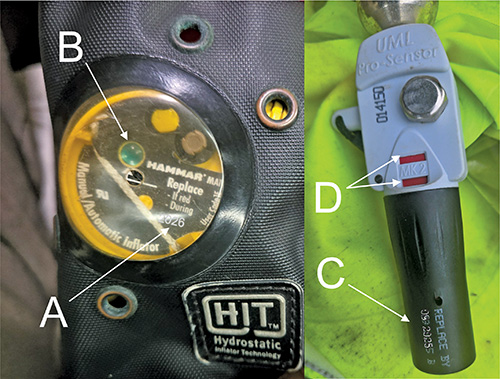
Inflatable PFDs can have interesting appeal, but also some stipulations. Beyond USCG approval, they are designed for users of ages 16 years and above, and some must be worn to count towards the requirements. They also require specialized maintenance. Keeping these in working order involves checking the bladder for air retention; as well as inspecting the firing mechanism and expiry date, making sure that the arming indicators function; then replacing parts as needed. (Figure 2)
It is important to read both the product details at the time of purchase, and the USCG approval label and look for restrictions pertaining to that PFD.
The available inflation mechanisms may be manual or automatic (dissolving pill, bobbin, or paper; or hydrostatic, which senses a change in pressure when submerged about 4 inches). Each type is designed for different water conditions. The hydrostatic model promises no accidental inflations while you are still out of the water, but the inflation timing of the dissolving paper-style is about 2 seconds faster. The water-soluble paper element, UML, is more reliable than the dissolving pill or bobbin, which are potentially susceptible to wave splashes, rain, or excess humidity or condensation. Newer models are less prone to accidental inflations. Hydrostatic models are generally more expensive, both to purchase and to re-arm.
One accessory to take into account on inflatable PFDs is a crotch strap(s), especially if it has an integrated harness. Imagine yourself being hoisted aboard by the rings on your harness. It could get pretty uncomfortable without double crotch straps. If you were in the water, the crotch strap(s) keep more of your body afloat without additional physical effort.
Considering an inflatable life jacket raises a handful of additional questions. Generally, an inflatable option should increase comfort and mobility thanks to reduced bulk compared to a standard (inherently buoyant) life jacket, but usually has some amount of delay before flotation is available to the user. Reduced mobility, on the other hand, creates its own risk.
One related concern is Cold Water Shock, which comes from sudden immersion in water below 59°F and leads to involuntary inhalation, which can cause drowning if your head is underwater when such inhalation takes place. Puget Sound is around 56°F, even in the summer. An inflatable’s delay, even slight, could increase the likelihood that you are submerged during Cold Water Shock inhalation. Standard PFDs boast guaranteed reliability without maintenance; while inflatables provide valuable attributes like the potential for greater buoyancy as well as integrated lights and a spray hood. Your choice of a PFD should reflect your particular sailing style and circumstances.
Stay on the Boat
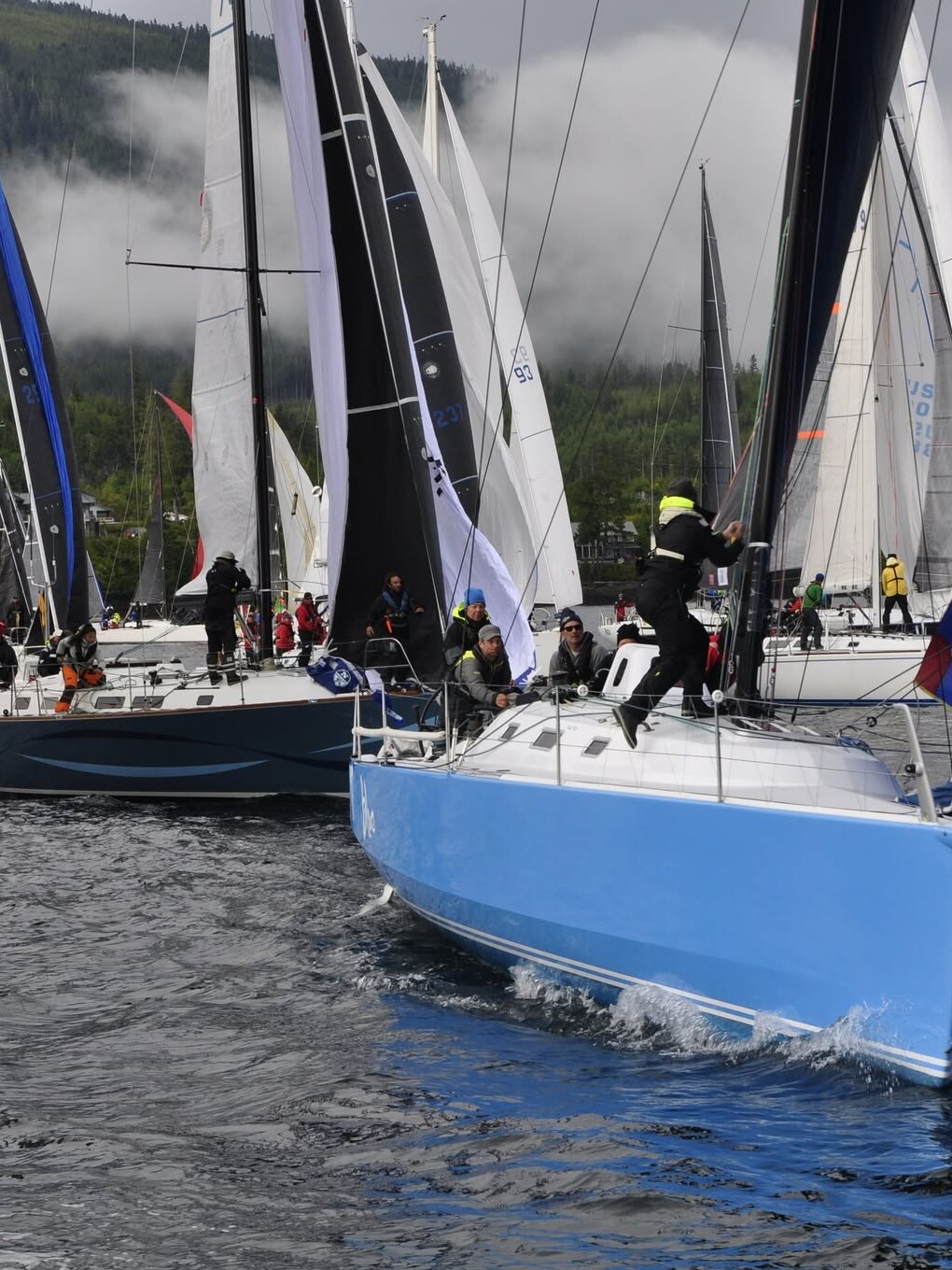
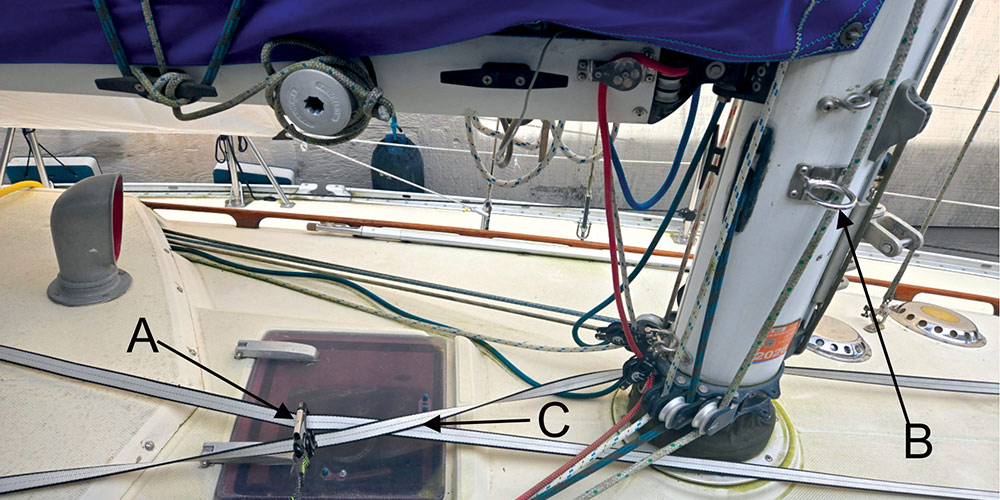
Harnesses, tethers, and jacklines are another part of the safety gear equation—all working together to prevent you from using your PFD by keeping you on the boat. Common practice has been to run jacklines, which should be made of high strength webbing, on each side of the deck so you can remain connected from the cockpit to the bow. The only problem with this is that if you went overboard you would be dragged through the water along the side of the boat—a potentially life-threatening scenario on its own. Instead, by running the jacklines down the centerline of the boat and using the mast as a termination or crossing point for going forward and aft, you increase your chances of remaining onboard. This way, you will fall on the deck instead of over the side. (Figure 3)
Some years ago we were sailing in the Mediterranean during a storm. I went forward to reef the mainsail and the boat was hit by a wave, knocking me down. My trip across the deck was arrested by my harness and tether which were hooked to the mast. It’s hard to say what might have happened with side-deck jacklines, though that boat also had the back-up of lifeline nets since we had two young children aboard. I waved to let my wife know that I was okay. The gravity of what had just happened would hit me later.
It is good practice to terminate jacklines at pad eyes that are bolted through the deck with a proper backing plate. The jacklines can be made from 1-inch to 1.5-inch flat nylon or polyester webbing. A low-stretch option (but not zero-stretch) reduces shock load to your body, and the flat webbing will not roll under your feet as a line could, causing you to lose your footing.
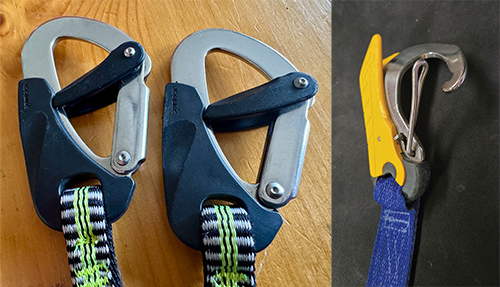
Once we change where the jacklines are run, it is time to look at the Gibb hooks (Figure 4) that have been used on many commercially-available tethers. On a round-the-world ocean race not long ago, a crew member was lost overboard in the Southern Ocean because one of these Gibb hooks was caught under the deck cleat, loaded sideways, and failed by opening before it should have. Newer hooks are tested for sideload pressure, but hard points should be designed to eliminate the possibility of sideloading the harness hooks and sailors should be wary of sideloading hooks in all situations.
A tether should have three hooks: a snap shackle that attaches to your harness that would allow you to release it if necessary; and the others allow you to be connected to the jackline or hard point at all times by clipping the second hook on before removing the first. Always clip to the webbing or designated hard point and not to lifelines or lifelines stanchions, even if that is tempting.
The goal is staying on the boat. There is an array of safety equipment that’s related to overboard response (keep an eye out for Part 2 in this series), but none of it promises as much safety as simply not going overboard.
The colloquial sentiment certainly applies: we create our own luck through preparation. And our gear is only as good as our technique. By keeping our safe seamanship steel sharp and our on-board safety gear in order, we have not only taken steps to mitigate disaster, but have also smoothed the waters ahead for happy adventures afloat in the Pacific Northwest.
Jack Wilken wrote the How-To column in 48° North for more than a decade. He spent his career as a USCG-licensed Captain and shipwright, and he founded Seattle Boat Works in 2008. Though now mostly retired, he continues to write and consult with the family business. He’s still a happy and avid cruiser as well.