 I never expected to have 413,625 pets, but this season at Northwest Maritime (NWM), we did just that. By “pets”, I mean Olympia oysters, and by “we” I mean an enthusiastic team of students, volunteers, staff, and community partners. Jests aside, raising hundreds of thousands of native oysters from free-swimming larvae to spat (baby oysters attached to shells) has been one of the most rewarding projects I’ve ever had the honor of contributing to.
Back in the chilly days of January, our team of hatchery directors, shellfish biologists, and maritime educators from Puget Sound Restoration Fund (PSRF), Jamestown S’Klallam Tribe, and NWM gathered to begin the installation of tanks and pump systems on the NWM campus in Port Townsend. In early February, PSRF brought over the first batch of Olympia oyster larvae, packed delicately in small bags of mesh cradled by damp paper towels and ice packs. Our Workplace Experience high school students helped us carefully release these larvae into our tanks, thus beginning our journey as an Olympia oyster nursery.
Each day, we adjusted the water flow system and fed the oysters pungent slurries of algae paste. Each week, we backflushed the filtration system, did 10% water changes off our pier using hoses and a pump, and rinsed down the oysters so they’d stay clean. Students from various NWM education programs assisted with these tasks.
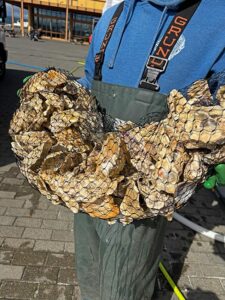
Team Longboat cleaned the bags of oyster shell donated by Washington Department of Fish and Wildlife and loaded them into the tanks for the oyster larvae to attach to. Workplace Experience students did feedings, filtration flushes, water changes, and system cleanings weekly. Port Townsend Maritime Academy students did a population assessment and created infographics showing the life cycle of the Olympia oyster. Maritime Discovery Program students made observations about the spat under the microscopes and played games to learn about the crucial roles our native oyster fill in the ecosystem as habitat builders and water filterers. From February to June, students were hands-on and curious about these critters.
In the 1850s, there were 10,000-20,000 acres of oyster bed habitat in our region. After overharvesting, habitat loss, pollution, and invasive species took their toll, only about 150 acres remain today. With each batch of oysters we outplant, the likelihood that this species will reestablish itself grows.
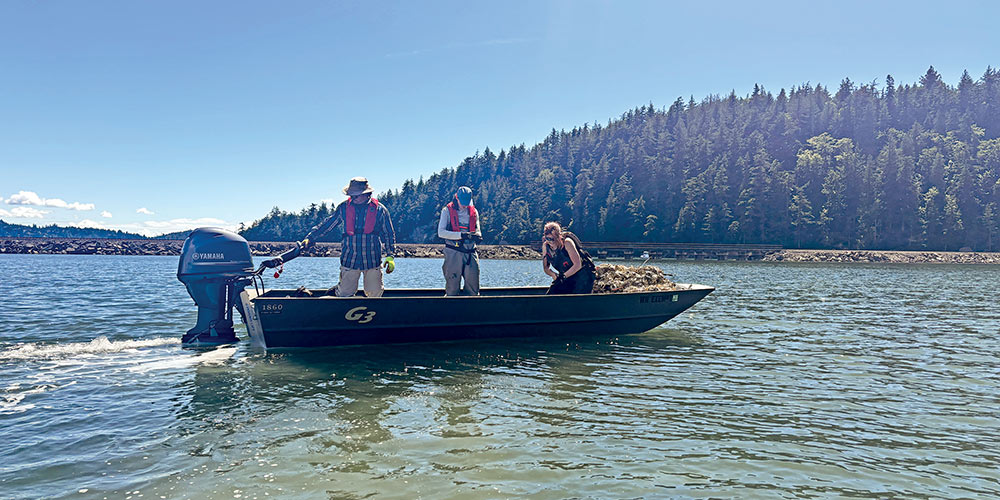
With that hopeful vision in our eyes, on June 10th, we loaded the bags of oyster shells & spat into a truck, drove it across the ferry and up to Chuckanut Bay in Whatcom county. The larvae came from a population in Fidalgo Bay, so to preserve genetic diversity, they went back to a nearby site. Northwest Indian College met us with a boat to assist the process, and the Whatcom County Marine Resources Committee coordinated the outplanting process. With a lot of excitement, smiles, and high fives, 27 community members were on the beach to help load bags, representing 12+ different local organizations. It truly felt like a celebration of resilience and an act of joy being there amongst passionate folks giving back to the Salish Sea.
Olympia oysters are ecosystem engineers: they create and build their communities shell by shell as they grow. But they too connected all of us: building a community of stewards from students, staff, and volunteers across organizations and counties, shell by shell.
By Simona Clausnitzer, NWM School Programs Manager