“Mrrrzzz.” Shaking off a sublime summer Saturday stupor, I pulled out the buzzing phone. Would I be interested and available to join a team for the J/70 National Championship in Santa Barbara in just under two weeks? Um… heck yeah!
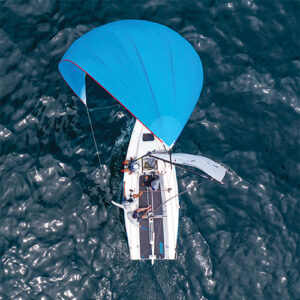
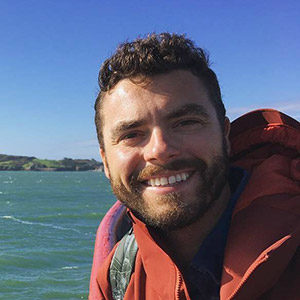
Photo by Hannah Lee Noll.
With a short ramp-up, there wasn’t a lot I could do to prepare. I talked to some knowledgeable folks, watched a few videos, and gratefully accepted an invite to jump on a friend’s J/70 at Leschi in the Lake Washington fleet for a Wednesday night to try to get my mind in the boat. Luckily, several years of background in the J/70 and a few more in the Melges 24 gave me some baseline knowledge, in spite of the couple-year pause I’d taken from regular racing following the addition of our second kiddo. Ready or not, I was soon on my way to the Southern California coast.
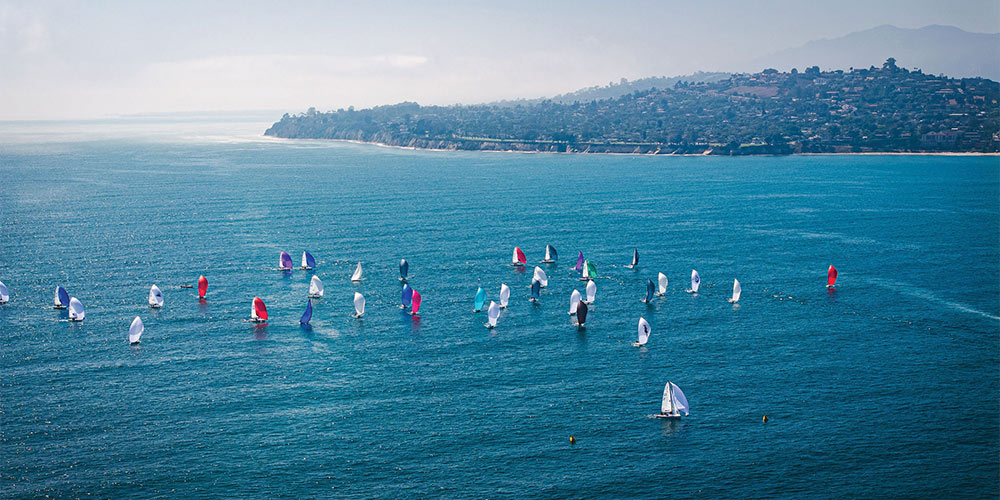
The fleet of 38 boats at Nationals was a good mix of mostly West Coast boats, including quite a few Santa Barbara locals, a good group from around California, a couple from the East Coast, and a strong contingent of 12 boats from the Pacific Northwest.
I was sailing with Andrew Loe’s Dime, which consisted of Andrew, who has more than a decade-long history of very high level J/70 sailing; Lee Sackett from Cleveland, who has his own J/70 and is a skilled and competitive sailor with recent success including as the 2025 J/70 North American Corinthian Champion; and Dan Kaseler from Bainbridge Island, a brilliant sailor who has always been one of my favorite people to race with. Before I stepped foot on the boat, I was just happy to be there with sailors of this quality, and was poised to listen, learn, and try not to ruin a good thing.
Between work, kids, and travel, we got a late start. Andrew pulled Dime into Santa Barbara Yacht Club after 9 p.m. the night before the regatta. We worked into the night, rigging, scrubbing off the road grime, and prepping as much as we could. The first day’s start time had been pushed forward to make the most of what was forecast to be a mercurial breeze over the event’s three days, so we were back early in the morning to hoist the boat into the water and go sailing for the first time as a team on our way out to the course.
We rapidly found our routines, and a short postponement allowed for a little extra practice before the first race of Nationals got off around noon. I’d never been to or sailed out of Santa Barbara before. Other than it being breath-takingly beautiful, the first and clearest observation as a PNW sailor was that this was the ocean. Even the flattest, calmest conditions had swell, and a bit of breeze built the chop more as it generally was running against the current. In spite of the stunning surroundings, I definitely appreciated the fact that the finger-tip control that we PNWers develop when making boats go fast in 8 knots and perfectly flat water wasn’t going to cut it. The ocean lump demanded boat speed.
True to predictions throughout the Nationals, as the northwesterly sea breeze built, it trended course right. That was the case in all but the first race. During that first crack at the very busy starting area, we managed to get pushed over early on the pin end of the line by our fellow Seattle pals on Mossy skippered by Dalton Bergan. We tacked away, ducked the line, tacked back and shot out left. The left shift at the start persisted long enough to save our bacon as we committed to that side following our less-than-ideal start to the event.
The breeze was patchy through the first couple races and, between the waves and oil naturally bubbling up from the seafloor and smoothing areas of the surface, I found the venue uniquely challenging when it came to interpreting what the wind was doing. Glassy spots had breeze, what looked like puffs didn’t materialize, and the swell impeded an easily reliable read. More flat-water sailor’s laments, from this bow guy who was supposed to be calling the breeze. We fought our way back into the first race and secured a sixth-place finish. It did feel like we had some wheels upwind compared to the majority of the boats.
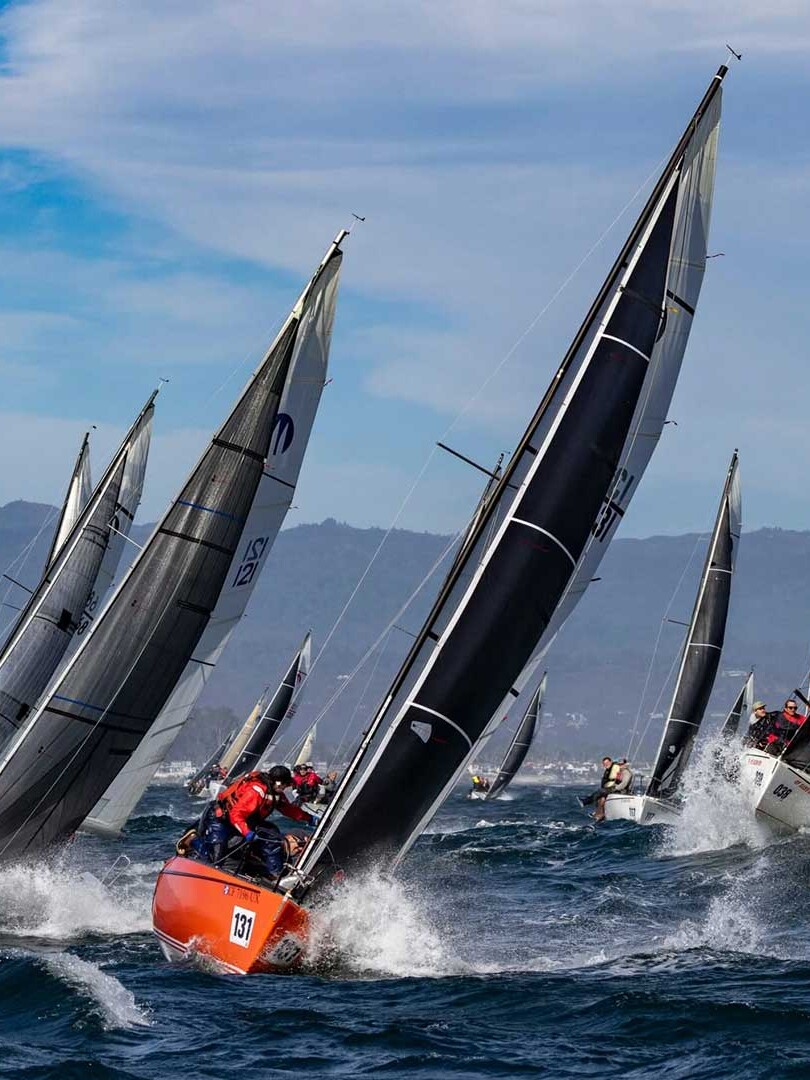
After a postponement, the more predictable breeze settled in and slowly built, and we got into our groove. Given the weekend’s diminishing forecast, the Race Committee was keen to get a lot of racing in while there was wind and, in the end, scored four races on Friday. By the final race that day, the wind was up to 10-13 knots and had created a challengingly confused sea state. The predictions panned out, and the right, especially the top right, was paying dividends. There was enough breeze for some boats to try planing but, alas, not quite. More effective was the mode honed in this class: wing-on-wing, or just “wing” as most J/70 sailors say. On our boat, one of Andrew’s keys to winging success was that the wave angle dictated that there was only one orientation where winging was effective—kite on port, main to starboard—something he shared with the fleet in a debrief the next day. In that configuration, you could catch a little surf ride here and there. Anything else on the wing just got sloppy.
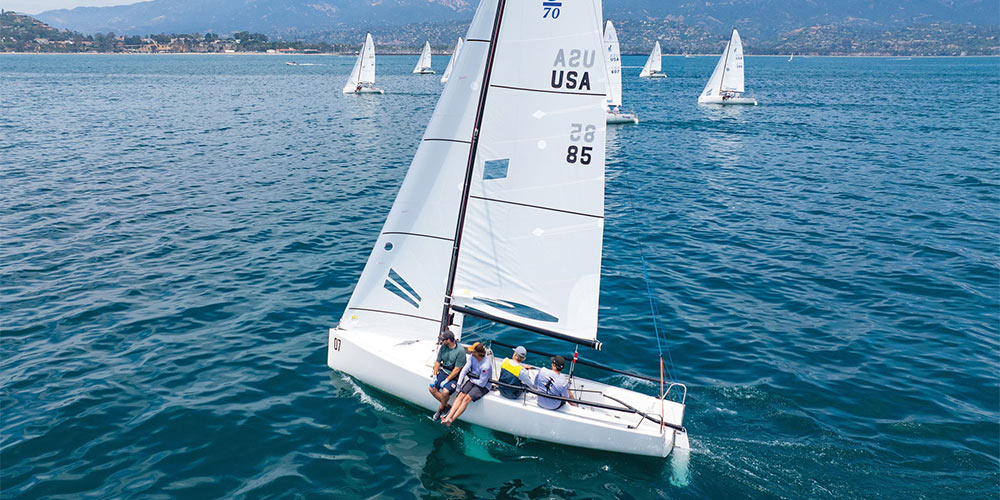
Between solid starts, upwind speed, and effective winging, we had a strong day—winning the third race and finishing with a day-one scoreline of 6-2-1-5—sailing back to the dock in first overall. We knew there was a throw-out coming into play after a fifth race, though, which would shake things up.
Among the day’s takeaways was the observation that there was a group of five or six boats that could almost always manage to escape from the fleet after the start and be toward the front by the weather mark. Lots of others could be right in it with a good start, but that top group was forming a pattern of consistency. This bunch included David Janetti’s Very Odd, with some all-star pros aboard including trimmer Willem Van Waay and tactician Geison Mendes; Ryan Cox’s talented corinthian crew from Ventura on DJ; the Janov family on Crester, two of whom are brothers doing an Olympic 49er campaign; our friends on Mossy including Dalton and Lindsay Bergan, Ben Glass, and Santa Barbara local Jeffrey Grange; and our Dime team.
The second day of the regatta dawned with suspect breeze prospects. A shore postponement was the first order of business, with the silver lining being a chance to catch a bit of the World Cup match between England and Norway. Eventually, we got out on the water and we were able to get one race started just before 5 p.m. Compared to the first day, the swell state was mellow—hardly flat, but gentler in every way. It was a fairly light wind affair with puffs edging into the high single digits, better than I’d worried it would through the day’s calm. The front pack again found its way ahead, and Very Odd took their second consecutive bullet. Our second on Dime was a good finish but, now that a throw-out was applied, Very Odd jumped ahead in the standings. It had been a while since I’d raced a regatta at this level, and I’d never done so in the J/70 class. This was truly top-level competition, but it was definitely fun too!
Waking up on the third and final day of racing, we knew it was all to play for. Well, mostly… At our team house, we talked through a rigorous AI analysis that Dan had run, gaming out scoring scenarios among the top six boats and looking at our opportunities and where we might be vulnerable. Heading out on the water, we had resolved that the top six were tight enough that we just needed to go sail our best, no planned shenanigans.
The breeze was fairly light again, but cooperated enough to get us underway on the event’s sixth race shortly after the scheduled start time of 1 p.m. Not that it had been laid-back on the first couple days, but the Sunday starting area had an intensity that hadn’t been there before—a clear championship vibe. The boat end was particularly jammed up, with everybody trying to tack early to go right.
Over a pair of light-to-moderate races, we locked a third and a fourth, respectively, solidifying our second-place position overall behind Very Odd. We thought that might be it, but there turned out to be another sequence coming down the pike. We did the math… we had enough separation from the group behind that if we could force Very Odd into a score worse than 11th and DJ didn’t win, we could come out on top. Deploy shenanigans! The sequence started, and we executed those efforts. It looked like we had a shot at it until the breeze softened, and the race was called off. Congratulations to Very Odd for a well-deserved National Championship—they were consistently the best boat.
Our Dime team took home second. And Cox’s DJ wound up third overall, and was crowned the Corinthian National Champion.
Looking back on an event and team dynamic I felt truly lucky to be a part of, here are a couple of my lingering thoughts.
Excellence looks ordinary up-close: Sailing with this team of seriously savvy sailors, I was struck by how doing well in a championship regatta doesn’t look snazzy. There wasn’t shift-sniffing savant stuff, no ace up the sleeve. Andrew’s driving is absolutely top-notch, and he is an active part of the tactical decisions too, but what’s his secret? It seemed to me to be an acute focus on getting the rig tension where we wanted it before the race, staying pretty bow-down to keep the speed up as much as possible upwind, and recognizing the best options for downwind modes early in the leg. That stuff all adds up, but there’s no sailing sorcery to it.
We had solid starts, but weren’t immediately punched out ahead in most of them. We did a lot of steering with weight, as all good teams do, especially downwind, but nothing revolutionary. It was a similar tune for Lee pulling strings to make the boat go fast—he seemed to know the settings he wanted, and put the sails there without being too precious or hyperactive about it. Having spent my share of time in the middle and back of one-design fleets, sometimes you want to believe the top boats are doing something different, something you could do and easily jump to their level. Sigh, there’s no get-rich-quick scheme in this game. From my vantage point, it’s all the core principles and things most of us already know, just applied slightly more effectively.
Dan reminded our team after the event of something Andrew said during the weekend, “Picking the first jibe is critical.” That is a great example of this idea. We’re all going to jibe and, in this fleet, everybody will execute the maneuver without issue—it’s just that timing it right and timing it wrong look almost identical. In a small-margin setting, tiny nuances have an outsized impact.
What’s happening with J/70s in the PNW is the envy of everyone outside of our region: I was so proud to be mixing it up with this accomplished fleet while representing the Pacific Northwest. The J/Pod culture was on display when coach Ron Rosenberg called a fleet-wide debrief early in Saturday’s postponement, with tangible advice freely offered from the best performers. Many of our region’s boats might have felt like fish out of water sailing in light-to-moderate breeze and ocean swell, but the PNW boats’ starts show the value of regularly being on the line with 20-30 other boats every Wednesday night.
At least as important, in a fleet as big as the one we have going locally, boats at every level of development have pals to play with that will be approximately at their same level. Are you a top-tier star? You get to sail against the region’s best. Are you a beginner? You will have lots of other boats to spar with while you also get to learn from the region’s best—a recipe for rapid advancement. And everything in between. Our J/70 fleet has been having a moment, and it’s only continuing and growing. Pacific Northwest boats took home 7 of the top 13 spots in this National Championship. That’s something to be really proud of!
I’ll look back on this event so fondly—for the Santa Barbara Yacht Club hospitality, for the friendly social dynamics ashore and the sportsmanlike competitiveness on the water; for the chance to learn from stellar sailors like Andrew, Dan, and Lee, and so many others around the fleet. Color me inspired, and fortunate to have been along for the ride.
Full results at https://yachtscoring.com/emenu/50623