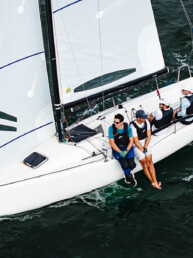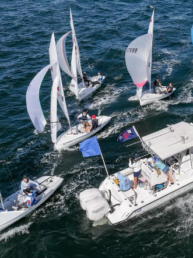
A favorite race to many, this year’s Winter Vashon was another example of how racing this time of year can be challenging yet fun!
Those of us who race sailboats on the Salish Sea know how fickle the weather gods can be. We invest countless hours and dollars hoping for kind enough wind and weather to complete the race course in a reasonable time frame, without unreasonable discomfort. Too frequently, we get a complete absence of wind, too little warmth, and too much rain—luckily most sailors have a selective memory bank to sweep these races under the proverbial carpet. Sometimes, though, you get a day like we had for Tacoma Yacht Club’s (TYC) Winter Vashon 2025, the first installment of this season’s Southern Sound Series, and all the effort and investment makes sense.
We have been racing the Winter Vashon since the late 1980s, first on our S2 9.1 Chinook and now on our Jeanneau SO 519 Equus—we’ve been on the start line north of 30 times. In that history are memories of pea soup fog, playing cards at the TYC dock waiting for the abandonment signal, and drifting slowly north for hours in Colvos Passage. Fortunately, Winter Vashon usually offers a high probability of exciting and challenging conditions. Without a doubt, it has become our favorite race of the season, and 2025 was a great edition.
The early weather predictions did not look too promising, showing calmer conditions between two passing low fronts. By mid-week, however, it had solidified into a promising forecast. So we reconsidered sail selection and loaded up with the heavy weights. Before leaving the dock in Des Moines for the Saturday morning delivery, we were registering sustained winds in the mid-20s with gusts up to 37 knots. One of the roughest locations in the South Sound is the exit of the Des Moines Marina and the crossing over to Point Robinson. Several other boats from Three Tree Point Yacht Club (TTPYC) were turned back. Not a problem for us, though it was slow going.
With the wind from the southwest, it would be a typically challenging start—close to shore and the hills to the south. This produces puffy conditions with wind angles rotating unpredictably. The Race Committee (RC) had problems with the pin end of the line dragging so the race rib was forced to hold position.
We kept monitoring the forecast and conditions, trying to decide which sails to start with. Winds were extremely variable from 12 to 30 knots with angles all over the place. Since it was a reach, we opted for a full main and our J2 with a 120% overlap.
The Non-PHRF and Cruising classes started and departed the area. With full sails, they quickly covered the distance to the entrance of Colvos Passage before hoisting spinnakers. The PHRF and ORC boats started about a half hour later, and the RC sequenced through this fleet of 44 in seven classes.
We aren’t always on top of the signals and flags, however, this year my wife Shelley had binoculars on the RC boat so our timing was spot on… nearly. We would have had a fine start close to the pin, except Equus kept accelerating with a gust and we realized we were probably going to be over early. Traveling at 9+ knots on a port beam reach, I slammed the helm over to almost execute a full tack to starboard, ending up heading southeast along the start line with the jib backwinded. The entire maneuver happened fast, only lasting a few seconds until the start signal, so we had enough momentum to flop back to port. The crew didn’t even have enough time to adjust sails so we pointed back towards Colvos and got back up to speed as quickly as possible. It was definitely not pretty, but we still managed to get the best start of our class. With the strong wind, it was a straight shot across to the southwest corner of Vashon Island. In light winds you have to give it a very wide berth, but that was not necessary this year.
Equus weighs approximately 34,000 pounds, so our downwind strategy was to sail as deep as possible. We can’t play the reaching game that the light boats use effectively because we don’t gain enough speed to make up for the greater distances traveled. Even though our spinnakers are asymmetric, we still use a pole to pull the sail out from behind the main. We also have to use our reaching strut when starting to pull back the pole—if we don’t, we bend the stanchions. Plus maneuvers take time, especially when traveling at 10+ knots and with a ton of load on the lines. Since many of our crew are “highly experienced” (older), we can’t afford to waste the limited stored muscle power.
We entered Colvos Passage as close to Vashon as the wind would allow to minimize those pesky jibes. The goal was to keep the apparent wind angle at 165 to 175 degrees without ever sailing by the lee. The boat was bouncing around, and the wind angle and velocity varied enough to make this a significant challenge. Fortunately by this time, the fleet was spread out so it was easy to keep an eye on the other boats and avoid them. Being on port tack, we didn’t want to get caught up in any conflict. With the wind angle slightly southwest in Colvos, we only had to jibe one time, north of Command Point. We maintained a steady 9.5 to 10.5 knots with winds in the 20-30 knot range. The majority of the fleet flew a spinnaker, and (mostly) kept them under control.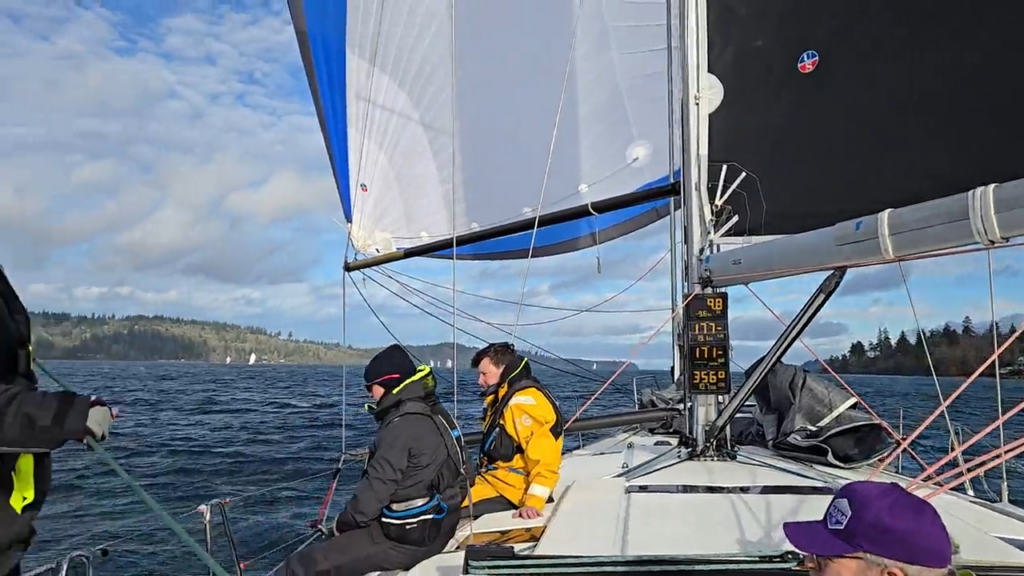
We were mid-channel as we came abreast of Southworth Point and could finally see the ferry boat and noticed that she was just starting to back out of her slip. We know her normal course, so we expected her to keep turning after they started to go forward. We were going 10 knots and were preparing to turn up and away from her to stay clear by going behind. But instead, she obviously decided to go behind us, and kept pointing directly at us as we continued north and she kept turning and following us. No radio calls, no horns. With a friendly wave between the boats, she passed close behind us and then by our starboard side and was gone. All was fine until we got hit with her wake and the big wind hole she created. The sails went into total pandemonium. Once things finally settled down, the boom had crash jibed to starboard and the spinnaker was filling on the port side, by the lee. What a mess. With full wind strength back, it took a little while to get things untangled, cleaned up, and back to full speed.
Once settled, we were late in our preparations to round the north mark. Again, there were no boats nearby, which reduced confusion. We raised the jib just as we got to the mark but we were struggling to drag in the spinnaker and trim in the jib with no respite from the wind. All things considered, the rounding went much better than we had any right to expect. It was somewhere around 12:15, though we were too busy at the time to really notice.
As usual, the wind at the north end was very fluky with both angles and velocities all over the place. Depending on the luck of the draw, you can make big gains or losses relative to the other boats nearby. We ended up better than the boats in front but worse than the boats behind, though no major damage or gain.
During the spinnaker run, we decided to stay with our J2 as the forecast showed the wind decreasing over time. Starting to head south, we saw winds down to 9 knots, which then quickly built to 30-plus knots, back to the mid-teens, and then 20s. Each gust produced a big lift with an equally big header following close on its heels, 30 degree wind angle shifts were the norm. Our track must have looked like a drunken sailor. We were seriously overpowered in the big gusts, but there were only a few of those and they didn’t last long.
Watching the wind patterns on the water to the south, we decided it looked most consistent in the center. We tried to minimize tacks to preserve crew strength, but did keep an eye on the faster boats behind us that were catching up. We did some tacks to cover them but still stayed more in the center then those on either side, along with an extra to clear the shipping lane for a tug and a freighter near Tango Bravo.
The sea state moderated slightly at Point Robinson and the wind settled down to a more consistent range in the mid-20s, which produced only a small amount of weather helm for us. Port tack was close to the finish line so we only had four more tacks to the finish. At this point it had started to rain, which obscured the finish until we were close—but we made it through cleanly. Best of all, no broken crew or boat parts. Repairs not required!
We tied up at the TYC docks to fold sails and shared our traditional chilled Kraken Rum shots with the crew. Then, into the clubhouse we went to have a quick debrief and another refreshment while we complained about our very sore muscles.
We were thrilled that Equus corrected out first overall among this excellent group of sailors. Around the fleet, class topping performances went to C&C 34 Jolly Rumbalow, C&C 38 Atet, Aerodyne 38 Kahuna, Melges 24 Take Off!, Burns 49 Schooner Sir Isaac, Cal 33 Cherokee, Cal 40 White Squall, and Sydney 38 Mako.
A big thank you to the volunteer crew at Tacoma Yacht Club for a well run race.
Winter Vashon 2025 is definitely one of the races that I will remember. It was a clear example of why this is my favorite race and I hope the rest of the fleet feels the same.
Full results at www.ssssclub.com
Please be sure to plan for the Duwamish Head race on January 3rd for (hopefully) another fun and exciting race. Help keep the South Sound Race series healthy!