A Conversation with new J/70 North American Champions Dalton Bergan and Alyosha Strum-Palerm
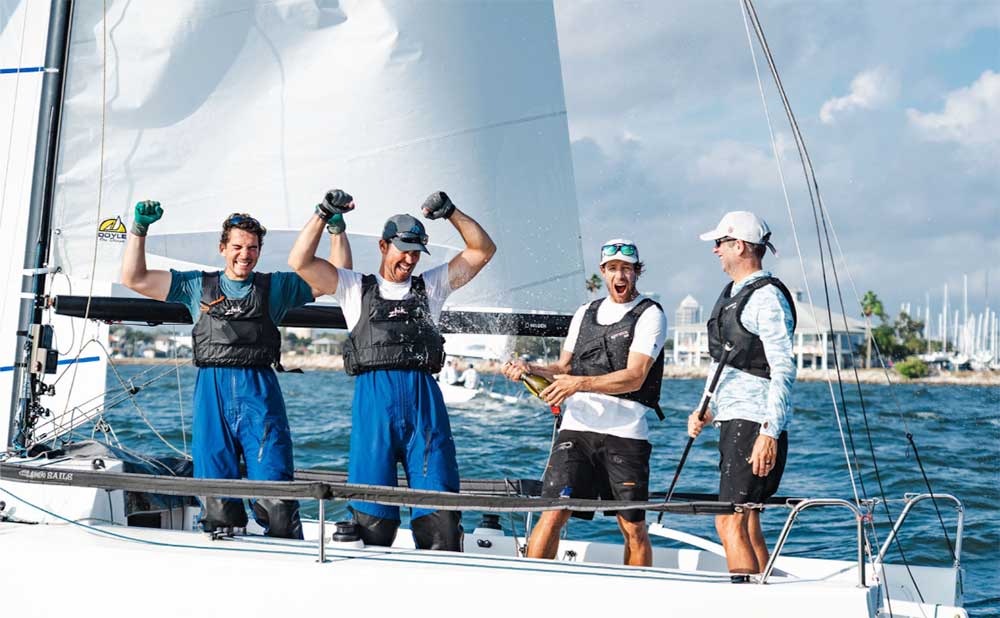
How would a PNW sailor understand the venue at Davis Island Yacht Club in Florida?
Dalton: It’s not that different from Puget Sound—semi-protected water, more protected than Puget Sound, less protected than the lake.
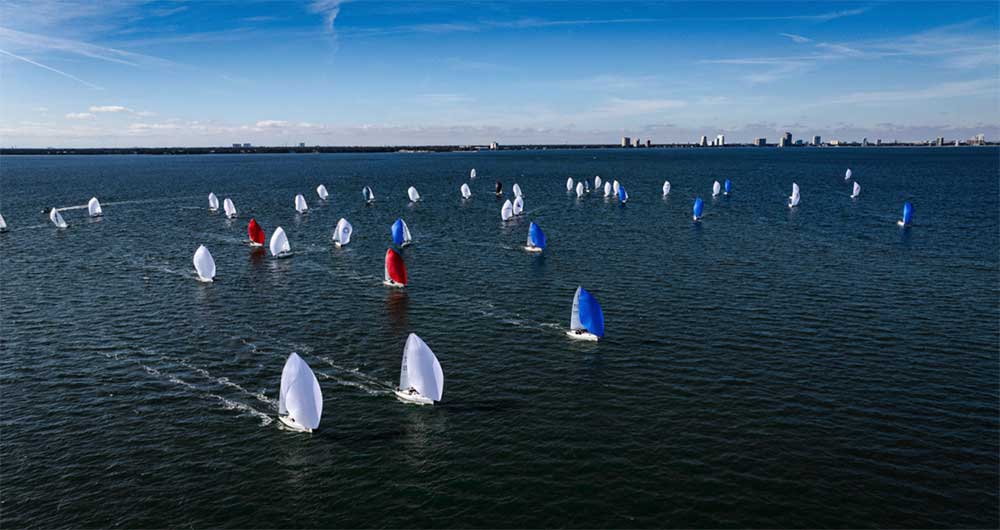
Alyosha: It’s probably more like sailing in the Northwest than a lot of venues. The first day was pretty light air—just under 10 knots. The other days were a little windier, a combination of some winging and some planing, say 10-17 knots.
Dalton: Just the water temperature and air temperature are different.
Alyosha: There’s proximity to land, and all the wind you’re sailing in is coming over land within two or three miles. It’s reasonably shifty, and that influenced the way we thought about the race. It wasn’t just a drag race or pure speed venue. You don’t just start and go straight; although the two races we won that’s what we did, we only did one tack. So maybe that’s not true.
Tell us about how this particular team came together. Have you two sailed together before?
Alyosha: This regatta was going to be me, the boat owner Mike Goldfarb, and two Portuguese pros, Gonçalo and Paulo. Mike ended up dealing with a family emergency, but still insisted that his team should go sailing, and that I find someone to steer. Luckily we found Dalton. This is never something that Dalton and I would have done, if not for Mike.
Dalton and I have sailed together a little bit, but nothing very serious and not very much. I had sailed with Paulo for the European Championships. Gonçalo and Paulo usually sail kind of as a pair; and they got sixth at the Worlds, so they’re definitely at the top of the class right now. We treated it like none of us had sailed together before, but the trimmer and tactician/main-trimmer had sailed together a lot, which made things simpler.
What was it like for you two to join forces? You each have a substantial base of J/70 experience individually, did you learn things from one another?
Dalton: I was super psyched to sail with Alyosha. We were at opposite ends of the boat, so there’s a lot going on between us. Before the race and with the set-up, we have similar thoughts about how to set-up the rig. Each of us has a little different take on some of those things, maybe I would have had a little less rig tension on. We were very aligned about what we could control and what we couldn’t.
Alyosha: We both have similar analytical approaches to sailing. There was never very much friction in the way that we’re discussing races, how they went, or what we were planning to do. We had an open dialogue before and after races. That’s one of the good things about Gonçalo, who was doing tactics—he’s very self-critical and willing to discuss where we think we made mistakes or did well. I definitely feel like we got faster through the event. Our team was lighter than most of the top teams, but even as it got windy we were able to make that work and were one of the faster boats upwind. Maybe there’s a lesson there, not fixating so much on the weight, and just focusing on doing the right things and setting our boat up to match our size.
Normally, to be successful in the J/70 or any top one-design class, teams sail together long enough that they learn each other and how to be the most productive members of their team. That’s something that we did well, considering we only sailed together one practice day before the event—we figured out where we could be most helpful and where to add input.
What techniques were you refining that helped you get faster?
Dalton: There are a lot of different modes downwind—light air soaking/reaching, the next set-up in wind velocity you’re wing-on, next you’re back to regular set-up in a lazy or slow plane, and finally up on a full plane. Trying to get those transitions dialed through the team is a big thing, everyone’s jobs are a little bit different in each situation. Upwind, the biggest thing in the back of the boat is whether the person driving is also trimming the main. And in Seattle, it’s probably 50-50. At the next level up, there’s usually a main trimmer. This was the first time I had not trimmed my own main, so there was some coordination to how much you’re going ease versus how much you’re going to head up.
Did Gonçalo do anything with the main trim that’s different from what you normally do?
Dalton: The combination of traveler, backstay, and mainsheet is always a little different in every condition, but I found him to be dropping the traveler sooner than I would have, and sheeting the main a little tighter. And actually, he trimmed the backstay less than I expected.
Alyosha: Something we did differently than most boats I’ve sailed with in the past is we sailed with more rake. Our mast on that boat is pretty stiff, so we tried to get more prebend. We sailed with as much rake as the jib clew would allow while still being able to inhaul. Since we were sailing in a flat-water venue, but also because we were sailing with less weight, we made the conscious decision to try to sail with a flatter main.
There’s a lot of technique with the jib trimmer. Paulo would set the weather sheet at max-ease and then basically banjo the inhauler constantly, especially when it was windy, from the rail where he was sitting legs out.
Upwind, our set-up reflected the reality that, being lighter, we couldn’t sail fast forward as effectively. We had a good high mode. We sailed with a bit more rig tension than I typically do, but that was so we could have a straighter headstay and sheet the jib tighter, which was our plan knowing that sailing high was our mode.
Gonçalo thinks analytically about the set-up and the sails—why we might be slower, why he thinks we might be faster. He’s not wishy-washy and always looking for a reason—‘if this, then that.’ With the tactics, he’s very numbers-based, so he’s scribbling all over the boat, constantly erasing stuff and making a mess, but he’s keeping track of the minutiae. He also has good intuition and trusts himself.
Tell us about the transitions and decisions downwind.
Alyosha: Gonçalo would ask me a lot about what I’m seeing coming down the course, and he trusted my judgement. He was willing to sail more distance if he thought there was more wind on one side. We didn’t always get those things right. Our mistake a few times was trying to play both edges and wing in the middle, and boats that went to either side just sailed around us.
Dalton: There’s a time when you’re still in reaching mode and trying to maintain a bit of a plane, it might not be the total VMG move, but if it’s getting you to a puff or the breeze is about to come back, you’ll make bigger gains and you don’t have to transition back. So anticipation is a big part of it.
Alyosha: Being able to go onto the wing both ways is pretty powerful (jibe the main onto the wing, or jibe the kite onto the wing). We got better at that as the week went on, and it was a strength of ours. The whole team has to be involved to make those maneuvers go smoothly.
What changes for you when you go from 25 boats to 50 boats?
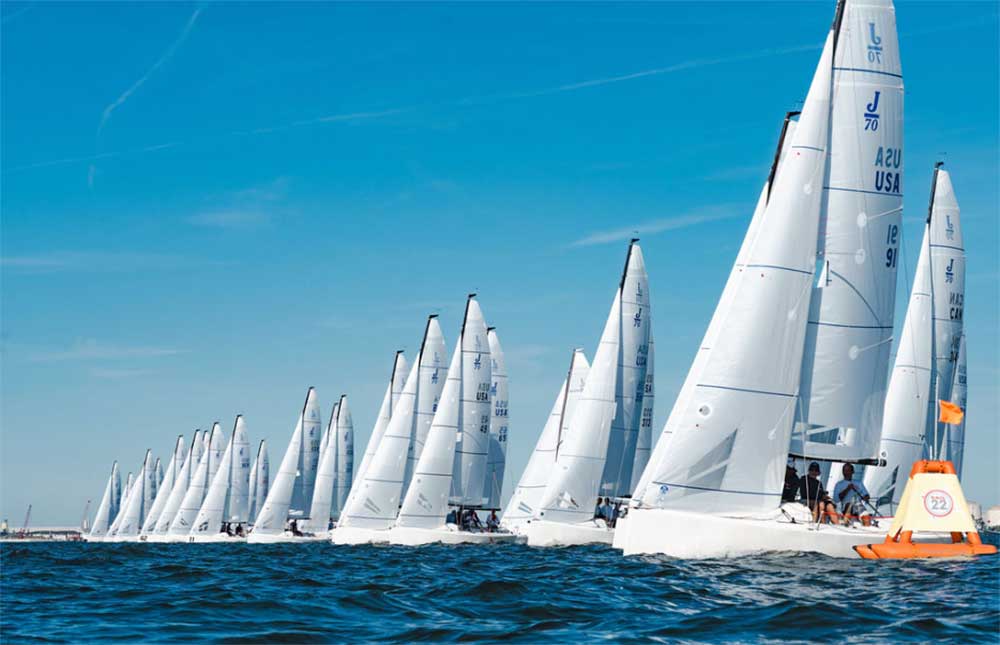
Dalton: We start farther away from the line than on the lake. It’s a timed approach. But, our fleet probably has it as good as anyone in the country when it comes to good starting practice.
Alyosha: On the lake, a lot of our boats are bow-down at go. In this big fleet, that’s not happening. The ideal start is probably over target boat speed three or four meters from the line at go, with a gap. Starting farther back but going full speed is much better than being closer but slower.
You’re each very accomplished sailors, what’s special about this championship?
Dalton: It’s really cool doing this with Alyosha. But it also validates that the racing we’re doing at Leschi is really good and really competitive, and we’re part of a great scene.
Alyosha: I’ve finished second and third at a lot of major regattas, and to win one is pretty nice. That feels good.
Full results at: diyc.org/j70-north-american-championship/
Title Background photo by Hannah Lee Noll.