Navigating Northwest Passage Ice on One Ocean
The Anacortes-based crew of One Ocean has completed the Northwest Passage since the time of this writing—the first major milestone on their 27,000-mile expedition. In fact, they have turned south and are now in Bermuda. That may sound idyllic, but shortly before this issue went to press, their five-day passage from Nova Scotia to Bermuda found them in the midst of an Atlantic storm that was unlike anything they had ever seen. One Ocean endured 50-knot winds for days, a gust as high as 69 knots, and towering waves crashing over the boat and causing damage. The boat and crew are fairly battered, but they are all safe. They will be recovering and making repairs before pushing on. Learn more about their journey at www.oneislandoneocean.com
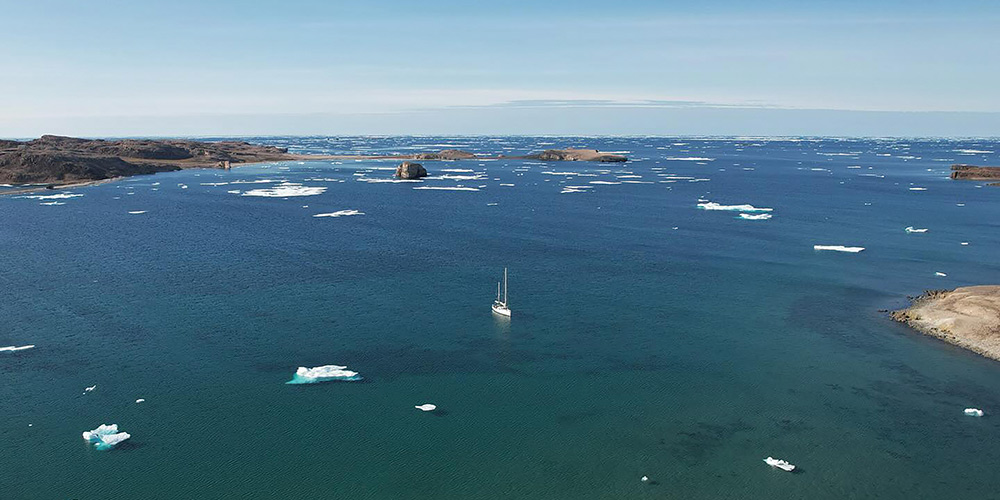
It’s my turn at the helm. I’ve been on watch with Grace and Mark since 10 p.m., and it’s now 12:30 a.m.—an hour-and-a-half left before a crew change. The temperature outside is 32 degrees and there’s no wind, but lots of fog. We’re lucky to be able to steer from inside. Despite the intensity of the situation, the cabin is warm and cozy. Grace is crouched on the couch with binoculars, scanning the port side. Mark paces between her and me. We are all hyper-focused on what’s before us… ice, ice, baby.
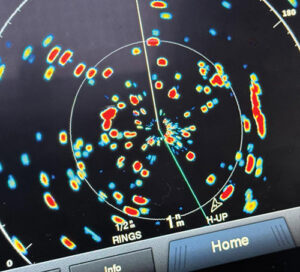
The ice pack ranges from three- to five-tenths (sea ice concentration is represented as a fraction of surface coverage, in tenths). So far, we’ve been able to thread the needle, but it’s tight. Suddenly, a loud scrape on the starboard side—the hull hit a submerged ice chunk. My shoulders clench toward my ears. A bitter, metallic taste floods my mouth. I swallow hard. Stay focused.
The three of us make constant decisions—moment by moment. Grace and I work in sync, calling out leads in the ice: “Leaping dolphin to port! Soaring eagle to starboard!”
“Four minutes left,” Grace announces. We’ve shortened shifts at the helm from 30 to 15 minutes to stay sharp. My hands grip the hydraulic wheel, which isn’t the easiest to steer. I take a deep breath. I can do four more minutes. Slow, steady. We’re deep in it now. I have to get us out—no other choice—but the ice looms taller, darker ahead.
Grace calls for me to steer to port. The ice blocks my view. My time is up and it’s Mark’s turn. He slides in and takes the wheel before I even let go—there’s no room for error. He’s already locked in. Grace shifts to the center position, and I jump on the couch with binoculars, wiping down the steamy windows.
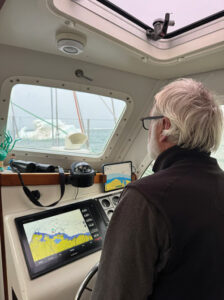
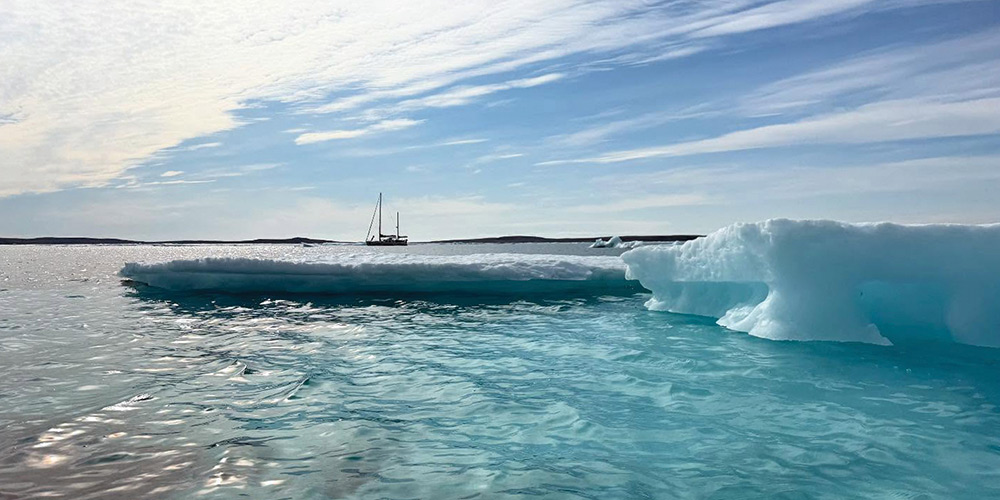
Mark steers us port, then starboard. White ice walls streaked with orange-brown rise as tall as the windows. Suddenly, we’re in a narrow ice channel. At 4 knots, the floe traps us—we no longer have choices. We’re at the mercy of the ice.
The fog lifts, and through my binoculars I see a solid white wall ahead. I lower them and glance at Grace. Her worried look confirms she sees it too.
Mark waits for our calls, but we hesitate. The pause lingers. He asks again, then spots the wall himself. I tell him to hold the course. We stay quiet as Mark shifts One Ocean to neutral. She drifts toward the massive wall. We wait, hoping something will open.
When we’re about a football field away from the dead end, a channel to starboard suddenly opens. Grace calls it, and Mark turns the wheel. The turn is so sharp I worry that One Ocean won’t make it, but she does. Moments later, he swings her hard to port. The chartplotter shows us edging farther out to sea toward thicker ice. The charts predict 5–9 tenths there. Our fiberglass hull can’t handle that, but for now, we have no other choice.
Mark’s fifteen minutes fly by and now Grace is at the helm. We call out leads, working our way to starboard. About forty-five minutes later, we see open water and finally set course toward land.
By the time the next shift of crew wakes, we’re exhausted. We collapse into our bunks, knowing that in just four hours we’ll be back on watch.
Sure enough, four quick hours later I woke to the sharp urgency of directional calls—”port” then “starboard!” We’re back in first-year pancake ice, one to three inches thick. Easier to see over, but endless. I hastily pull on my trusty gear (the Meris line from our supporter, Mustang Survival) and head for the pilothouse.
We’re a mile offshore from Prudhoe Bay, Alaska. Dave is at the helm while Tess and Mike call out leads. But again, there seem to be no options. Their watch is technically over, but for now we need all eyes on deck. Mark and I discuss sending me up the mast when Mike suggests flying the drone.
Dave finds a patch of open water, and we float while Mike and Grace set it up. I scramble onto the cabintop with binoculars. The fog has lifted, the sky is clear, and I can scan in all directions.
Mike and Grace, experienced drone flyers from our kelp studies, set the drone on the stern. It lifts, hovers, and then clips the edge of the dinghy, flipping upside down into the icy sea. Luckily, the floats Mike added keep it on the surface, and they retrieve it quickly.
Meanwhile, Dave holds One Ocean clear of the ice. I stay on the cabin roof, scanning for leads. The cold bites at my cheeks, but the fresh air sharpens me, shaking off my fatigue. Suddenly, I spot open water. A lead opens through the pack. I shout through the window for Dave to steer to port.
That ice is now behind us, but we knew it wasn’t over. We hadn’t yet reached the severe plug between the Beaufort Sea and Amundsen Gulf that had blocked ships from transiting the Northwest Passage all summer. Still, we took our moments of calm where we could: exploring harbors that offered respite and eating well. We emerged unscathed, in good spirits, and still talking to each other—for now, it’s smooth sailing.
Jennifer Dalton is the Project Director and crew for the Around the Americas sailing and research expedition that departed Anacortes, Washington in May 2025. The expedition is conducting the first ever pole-to-pole bull and giant kelp study and sharing findings through an open online education platform. www.oneislandoneocean.com