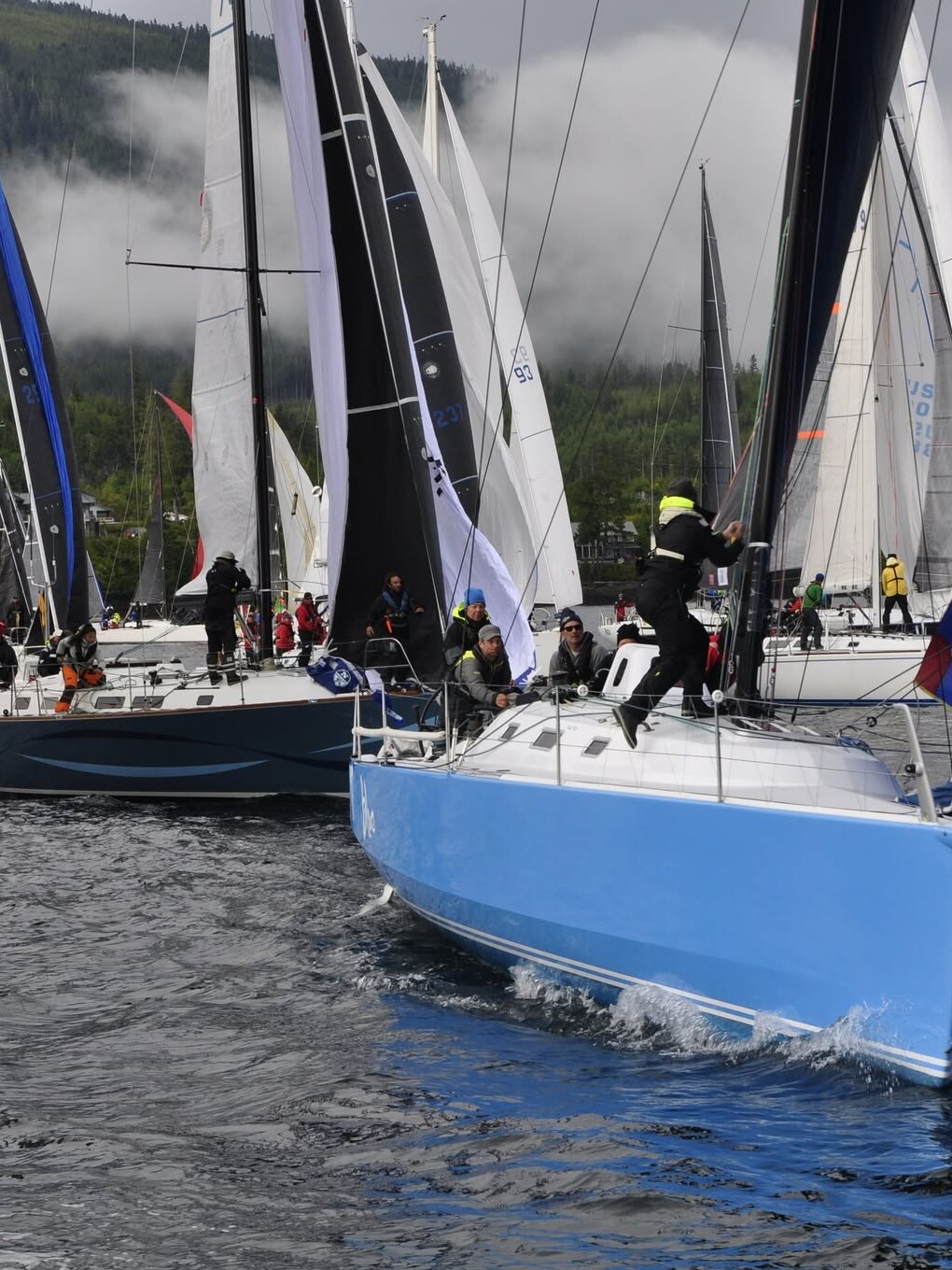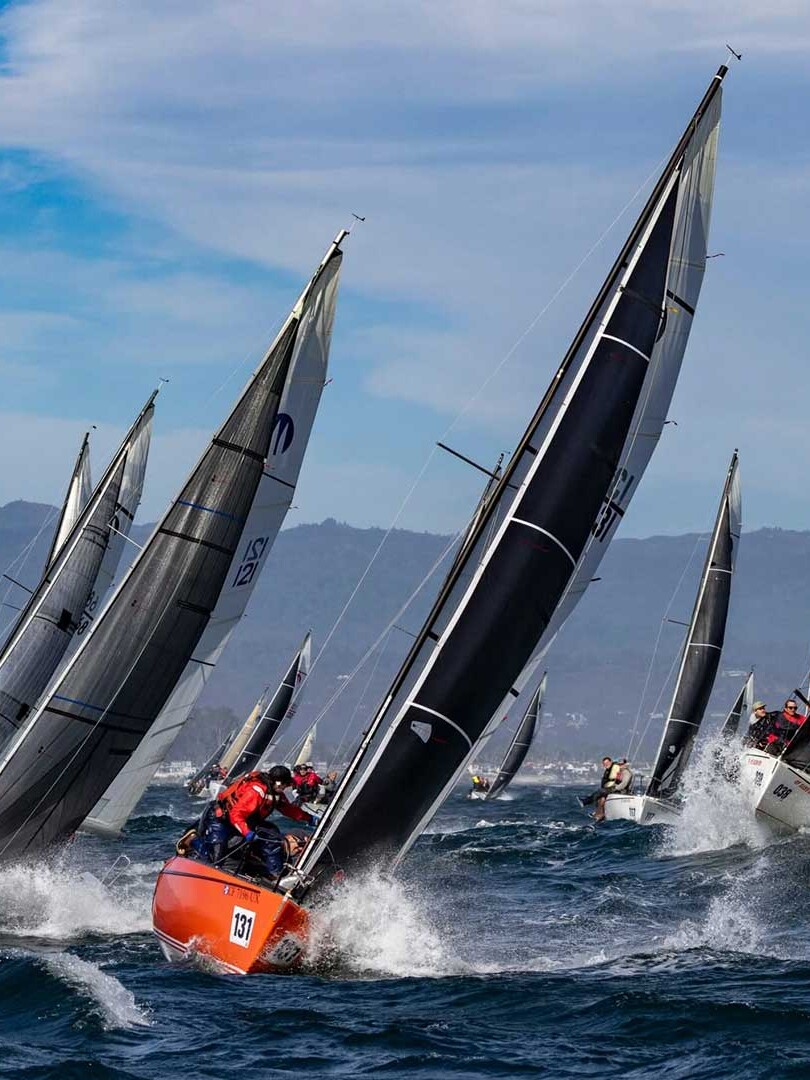
The 50th Anniversary running of the Pacific Northwest Offshore Race was a memorable one, largely for two reasons. First, Race Captain Denny Damore and his energetic volunteer team did an amazing job promoting the event through last fall and winter, getting a lot of first-time entrants to register. This event is not an easy one given the long delivery required to get to Ilwaco, Washington for boats from Seattle, Victoria, and Vancouver, along with the added challenge of the tricky timing required to cross the infamous Columbia River Bar. But Denny’s promotional team never let up and a record-setting group of 43 boats started the race on May 14, 2026.
The ORC fleet consisted of 31 boats with many strong Pacific Northwest teams participating; the Cruising Division consisted of eight boats; and the race also attracted a four boat multihull fleet. The organizer’s ‘northern emissary’ Charlotte Gann worked her magic and persuaded eight Canadian boats to enter, most notably Dan Sinclair’s Andrews 77, Mach II.
The second element of success was the weather—conditions were exceptional for a fast transit. Bruce Hedrick’s pre-race weather briefing promised an off-wind race all the way to Victoria, and what we saw on the water did not disappoint. Most boats reported no upwind sailing at all and the three Paul Bieker designed lightweight flyers—Jonathan McKee’s 44-foot Dark Star, Peter Heppel’s 30-foot Baby Blue, and my 35-foot Longboard—looked like strong contenders by the time the race got underway.
The race started at 1:00 p.m. on Thursday afternoon, so there was enough tide to get from Ilwaco across the bar to the virtual start line at the mouth of the Columbia River. A cold, gray rain greeted us, and we found it really disorienting attempting a virtual start with no land or marks in sight. The fleet set off on a power jib reach in a 15-knot west-southwest wind, which backed to the southwest and then south-southwest range shortly after the start, as winds built into the 20 to 25 knot range, kites were getting hoisted and the downwind fun began.
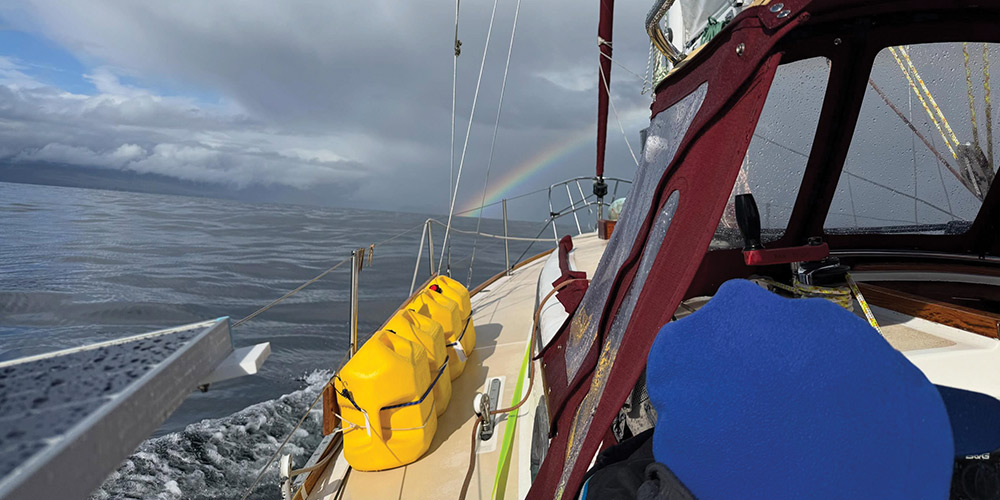
Mach II, the Mark McCuddy and Kent Picknell skippered Wylie 70, Rage, Kim Alfred’s F-45RC, Cheekee Monkee, along with the three Bieker boats quickly separated from the heavier displacement pack. The trick was to avoid sailing too high and stay as close to the rhumb line as possible. Race veteran Jim Calnon and crew on the J/120 Pathfinder schooled us all by diligently sticking to the rhumbline which contributed to winning Division C.
As Bruce Hedrick predicted, after 4 hours of power running, a weak front washed in from the west and the wind veered that direction. Those who changed gears quickly by getting their kites down and getting back to reaching jibs tended to step out a bit on anyone for whom managing the transition took a little more time. That set the stage for a long evening and night of power reaching in 18 to 25 knots combined with a very confused sea state and competing wave trains—all in pitch black darkness. It was a fast and wet night and was a good test of how good your foul weather gear and boots were.
Once the fleet got to Cape Alava, it was possible to crack off 20 degrees for a more comfortable stretch to Duntze Rock with the windspeed moderating somewhere between 15 to 20 knots. Eventually, this allowed spinnakers to make their second appearance of the race before Duntze Rock, which resulted in a fast approach to the Strait of Juan de Fuca. While we all anticipated a nice traditional downwind slide down the Strait, the reality proved to be far from straight forward!
Not long after entering the Strait on the westerly, the wind backed significantly into the southwest and at times south-southwest, which resulted in hard kite reaching down the middle of the Strait.
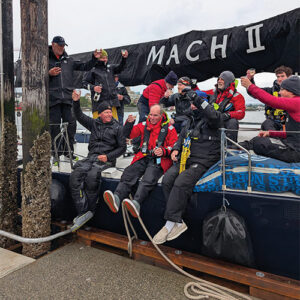
One more pothole awaited—the pre-race weather models showed an emerging and expanding band of light air in the central Strait on Friday morning. The key for the leaders was to press east as fast as possible to avoid being gobbled up by this light air. Mach II, Cheekee Monkee, Dark Star, Rage, and Longboard all avoided the light air and had relatively fast runs to the virtual finish line off Brotchie Ledge. Baby Blue was slowed a bit by the lighter conditions, but the rest of the heavier displacement boats were significantly impacted by the lighter conditions.
After the race, there were reports of mal de mer, foil damage, sprit’s breaking, sail failures, and the occasional snagged crab pot buoy. But all the crews seemed to make it to Victoria safely, if not a little tired, wet, and achy. No one was complaining about the fast pace.
The fast off the wind conditions set up the possibility that the Perry 66 Icon’s 2014 record of 14 hours 56 minutes might be broken by Mach II. Alas, it was not to be as Dan Sinclair reported they lost time backing down in the night to remove some crab pot buoys that got tangled on their keel, which was later followed by a light air patch off Neah Bay that slowed them further. Nonetheless, Mach II completed the course in an impressive 18 hours at 7:07 Friday morning to take the Line Honors win.
Dark Star narrowly crossed the finish line ahead of Rage at 11:30 on Friday morning and corrected ahead of Mach II, winning Division A and ending up third overall.
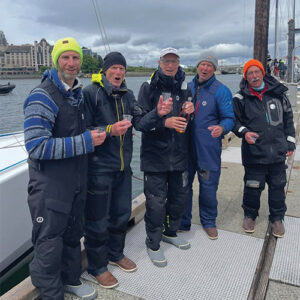
In Division B, Longboard finished at 12:11 on Friday to win Division B and the Overall ORC win. Baby Blue finished 2.5 hours later and was second overall and in Division B. The three Bieker boats enjoyed the conditions, were all sailed well by experienced crews, and took home each of the steps on the overall podium.
In Division C ORC, Pathfinder beat out race veteran Ged McLean’s Wylie 43 Hana Mari to take the win in the 11-boat division. Chad Stenwick’s J/35 The Boss won Division D handily over Ben Emery’s C&C 99 Penelope in a nine boat division.
In the Multihull Division, Joe Grosjean’s Light 55 catamaran Ceres sailed a strong race to win the division by two hours over John Neidig’s Dragonfly 35 Lykke. And in the Cruising Division, Rich Elstrom’s Ericson 35-2 Aja won the very competitive eight boat fleet. Huge kudos to the last boat who hung in there to finish, J. Grant Loomis’ Albin Ballad Highlander with an elapsed time of 63 hours and 5 minutes—admirable determination and resilience!
The Pacific Northwest Offshore Race (formerly known as the Oregon Offshore) has a long and storied history in our part of the world and the success of this year’s 50th anniversary event is a direct result of the dedication, passion, energy, and hard work by the event organizing committee, Portland Yacht Club, Corinthian Yacht Club of Portland, and by the title sponsor Schooner Creek Boat Works. All the participants are grateful for making this year’s edition one for the ages.
Full results at www.pacificnwoffshore.org